Tidio Lyro AI Agent Review 2026: Pricing, Free Tier Limits, and Who It's For

How this review was made
Tidio pays partners to publish about their product, and this post was written under that programme. TheToolsVerse also earns a commission if you start a plan through a link on this page. You should know both of those things before you read a word of it.
The method: every price, allowance and limit below was read directly from Tidio's own pricing pages on 7 August 2026, on both the monthly and the annual billing toggle, and each is quoted against its source. Where a number is Tidio's own reported performance rather than something we measured, it is labelled as theirs at the point it appears. Screenshots and the demo video were supplied by Tidio.
Most AI support tools are easy to price. You pick a plan, you get some seats, you pay monthly.
Tidio is not one of those. It sells two overlapping products on two separate pricing pages and meters three different things independently — AI conversations, billable conversations, and Flows visitors — each with its own allowance.
None of that makes it a bad product. It makes it a product where the pricing page is the thing you have to read carefully, and almost nobody does. So that is what this review is: the pricing decoded on both billing toggles, the free tier measured against its own footnotes, an honest look at Lyro's 67% resolution rate and what has to be true for you to approach it, and a read on who should and should not bother.
The first thing to understand: there are two Tidios
Tidio sells the same AI agent in two shapes, and which pricing page you land on changes what you think it costs.
| Lyro + Tidio Help Desk | Lyro AI Agent only | |
|---|---|---|
| What it is | Full platform — AI, live chat, ticketing, Flows | Just the AI agent |
| Where it goes | Replaces your support stack | Bolts onto Zendesk, Salesforce, or whatever you already run |
| Entry paid tier | Starter, $24.17/mo billed annually | Core, $39/mo |
| What you meter | Billable conversations + Lyro conversations + Flows visitors | AI conversations only |
If you already have a help desk you are happy with, the second one is the relevant page and the first one will just confuse you. If you are starting from nothing, the first is cheaper on entry but meters three things at once.
What the free plan actually gives you
Tidio's free plan is more useful than most, and its structure is worth understanding before you size a rollout around it. The detail that matters sits in a footnote on the comparison table rather than on the plan card.
| Free-plan allowance | What Tidio's footnote says |
|---|---|
| 50 Lyro AI conversations | "Your first 50 conversations are free (lifetime)" |
| 50 billable conversations | "Your first 50 billable conversations are free" |
| 100 Flows visitors reached | "Your first 100 visitors reached via Flows are free" |
| 10 seats | included |
| 1 AI Action, 5 Guidances | included |
The 50 Lyro conversations are a lifetime allowance rather than a monthly one. Tidio states this plainly — the word "lifetime" is in their own table — but it sits in a footnote while the plan card above reads "50 Lyro AI conversations," which is easy to take as a recurring quota.
Read correctly, that makes the free plan a genuine evaluation rather than a countdown. Fifty conversations is enough to see how Lyro handles your real questions, against your real knowledge base, with no clock running — which is more than a time-limited trial gives you. Most vendors hand you seven days and start counting; an allowance you can spend across a month of quiet testing is the better instrument for judging an AI agent.
What it is not is a standing free tier. It does not refill, so size your evaluation to it and budget for a plan on the other side.
Pricing, on both toggles
Tidio's pricing page defaults to the annual toggle, which shows a lower effective monthly rate and the label "2 months free." Flip it to monthly and the real list price appears.
We confirmed both on the Lyro-only page:
| Lyro AI Agent plan | Monthly | Billed annually |
|---|---|---|
| Free | $0 | $0 |
| Core | $39/mo | $32.50/mo |
| Plus | from $300/mo + usage | from $300/mo + usage |
| Premium | contact sales | contact sales |
$39 × 10 ÷ 12 = $32.50 — the annual discount is exactly two months, as advertised. That checks out, which is more than can be said for a lot of "save 20%" annual toggles.
On the full-platform page the advertised rates are $24.17/mo for Starter and from $49.17/mo for Growth, both billed annually. Their monthly rates are higher by the same two-month ratio. Budget from the monthly column unless you are genuinely committing for a year.
Two more line items that are easy to miss:
- Plus is $300/mo plus usage. The "+ monthly usage" wording is not decorative — conversations are billed on top of the platform fee.
- Removing Tidio's branding from the widget is listed as a $16.67/mo add-on, not an included feature on the lower tiers.
Lyro's 67% resolution rate — and the number Tidio will put in a contract
The headline figure Tidio publishes for Lyro is a 67% average resolution rate: roughly two out of three incoming customer questions handled end to end, with no human agent involved. On the product pages this is phrased as "Solve up to 67% of customer problems with Lyro."
We have not measured that ourselves and cannot verify it — it is Tidio's own reported figure across their customer base, and we are reporting it as such. What we can do is explain what it depends on, because that is the part that determines whether you will see anything near it.
Resolution rate is a function of your knowledge base, not of the model. Lyro answers from material you give it — uploaded FAQs, a scraped help centre, imported Zendesk articles. A support desk with thorough, current documentation and a repetitive question mix is what a 67% average looks like. A thin or outdated help centre will deflect far less, and the fix is editorial rather than technical: write the answers, then re-run the scraper.
Here is the part most vendors do not offer at all. Tidio's plan comparison lists "Guaranteed 50% Lyro AI resolution rate" as a feature on the Premium tier, alongside pay-per-resolution billing — you pay for resolutions rather than for capacity.
That is unusually concrete. Most AI support vendors publish a performance number and guarantee nothing behind it; Tidio will commit to half your volume in writing and bill against it. The trade-off is that the guarantee lives on the top tier, so on Free, Core or Plus your resolution rate is whatever your documentation earns.
Practically: use 67% as the ceiling a well-documented desk can reach, and 50% as the floor Tidio will contract to if your volume justifies Premium. Build the business case on the second number and treat the first as the upside.
What Lyro actually does
Lyro is trained on your own material rather than prompted from scratch. Tidio gives it four ingestion routes: FAQ upload, an FAQ scraper, a website scraper, and Zendesk article import. That last one matters — it is the difference between a weekend migration and a two-hour one.
Beyond answering, the feature set splits into two things worth distinguishing:
- Actions — Lyro doing something: checking an order, starting a return, handing off to a human. Free gives you 1, Core gives you 3, Plus up to 10.
- Guidance — rules that shape how it answers. Five on both Free and Core.
Three Actions is a real constraint. Order status, returns, and handoff will consume all three for a typical ecommerce store, leaving nothing for anything else.
There is also a Playground for testing responses before they reach customers, which is the feature I would want most and the one most competitors treat as an afterthought.
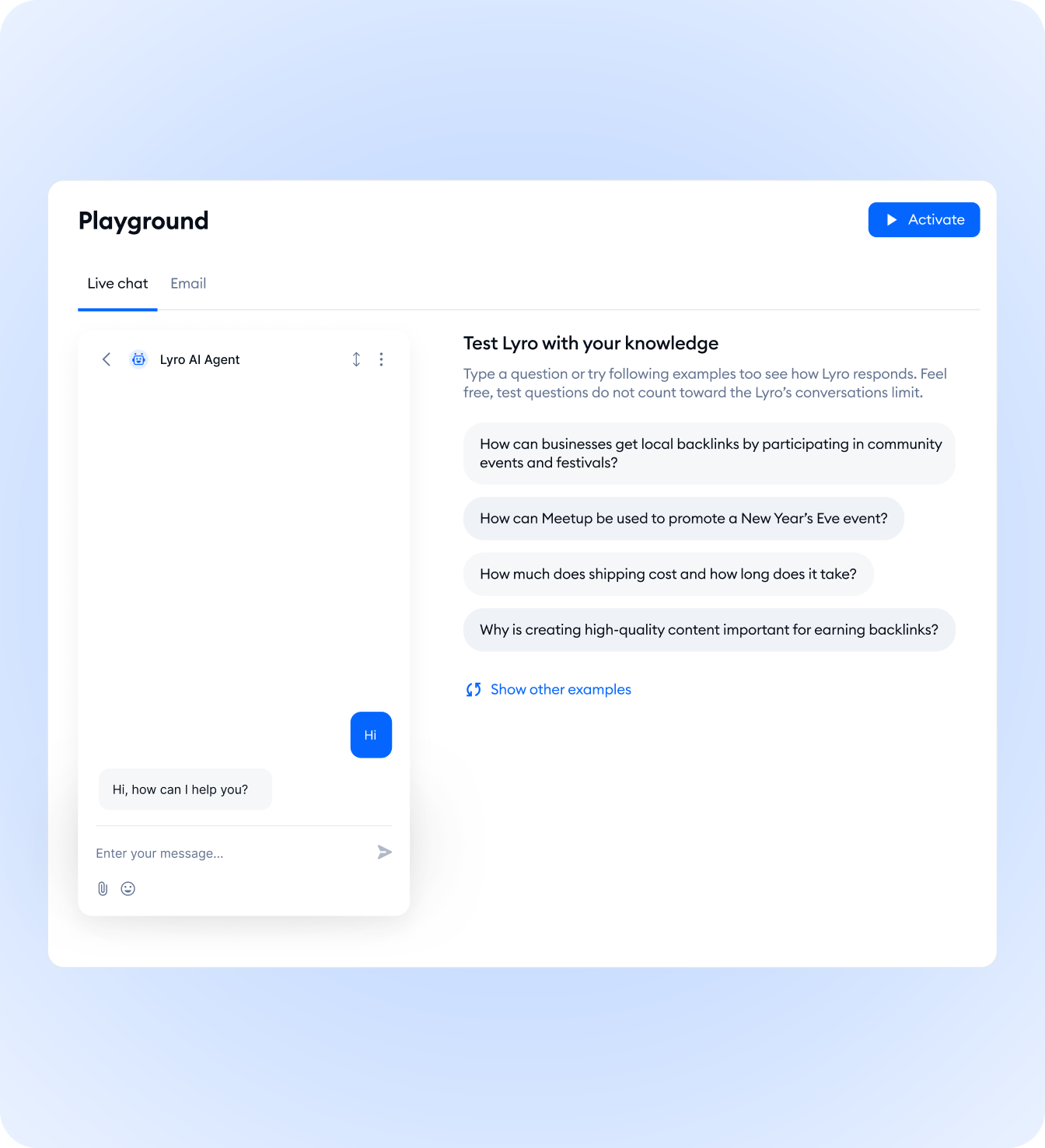
Lyro handles multiple languages without a separate configuration per language — useful if your support inbox is not monolingual, and a genuine differentiator against tools that charge per locale.
On the higher tiers the 2026-era additions show up: real-time knowledge refresh, MCP connections, AI insights, AI CSAT, and AI intents. MCP support on Plus is a forward-looking choice and one of the few places Tidio is ahead of the larger incumbents.
Tidio Lyro — where it is strong, and where to look twice
Pros
- +Publishes a 67% average resolution rate and will guarantee 50% in a contract — most vendors guarantee nothing
- +Pay-per-resolution billing available on Premium
- +Ingests your existing docs four ways, including Zendesk import
- +Free allowance runs on conversations rather than a countdown, so you can evaluate at your own pace
- +Playground lets you test answers before customers see them
- +Multilingual with no per-language setup
- +Runs standalone on top of an existing help desk
- +Annual discount is exactly the two months advertised
- +MCP connections on Plus
Cons
- −The 50 free Lyro conversations are a lifetime allowance and do not refill
- −Three metered dimensions on the full platform make cost harder to forecast
- −Only 3 Actions on Core — an ecommerce store will use all of them
- −The guaranteed 50% resolution rate is Premium-only
- −Plus is $300/mo before usage
- −Removing Tidio branding is a paid add-on
Who this is for
Worth a serious look if: you run ecommerce or SaaS support with a repetitive question set, you already have documentation Lyro can ingest, and your volume is high enough that deflecting even 30–40% pays for the plan. The standalone Core plan at $39/mo is a genuinely low-risk way to put an AI layer on a help desk you are not ready to replace.
Skip it if: your support volume is low. Below a few hundred conversations a month, the maths does not work — you will pay $39/mo to deflect a handful of tickets you could have answered yourself. And if your queries are genuinely complex rather than repetitive, no AI agent at this price point will resolve them; you are buying a routing layer, not a replacement.
Use the free allowance for what it is. Fifty conversations, spendable at your own pace, is a good way to find out whether your knowledge base is ready for an AI agent. Plan the budget for a paid tier on the other side of it.
Try Lyro Free — 50 Conversations to Test Against Your Own FAQs
Tidio's free plan includes 50 Lyro AI conversations you can spend at your own pace, so you can see how it handles your real questions before choosing a tier.
Start Free on TidioVerdict
Lyro is a capable AI support agent with an unusually good ingestion story — four routes into your existing documentation, including direct Zendesk import — and it is one of the few products in this category willing to put a resolution rate in a contract. That is worth more than a headline percentage.
The pricing simply asks more of you than most. Two products, two pages, three metered dimensions and a default annual toggle mean the number you first see is rarely the number you will pay. None of it is concealed; all of it is published. It just rewards ten minutes of reading.
Go in knowing the free allowance is 50 conversations rather than a monthly refill, that the standalone plan is $39 monthly and $32.50 only on an annual commitment, and that the guaranteed 50% rate sits on Premium — and Lyro is a fair deal at the right support volume. Go in on the plan-card headline alone and you will be redoing the maths in month two.
How we check free tiers
Free-plan allowances are the detail tool directories most often get wrong, so we read the published pricing of 137 AI tools and recorded exactly what each free plan gives and where its limit sits. Conversation- and credit-based allowances like Tidio's are among the most common structures, and among the most commonly misread. The full dataset and method are in The State of Free AI 2026.
Frequently Asked Questions
Is Tidio's Lyro AI Agent free?
How much does Tidio Lyro cost per month?
What is Lyro's resolution rate?
Can I use Lyro without switching from Zendesk?
What is an AI Action in Tidio?
Does Tidio put its branding on the chat widget?
Pricing figures in this review were read directly from Tidio's published pricing pages on 7 August 2026, on both the monthly and annual billing toggles. Vendors change pricing without notice — check the current page before budgeting. Screenshots and the demo video were supplied by Tidio. This review is desk research against published documentation, not a hands-on product test.
Some links may be affiliate links. We may earn a small commission at no extra cost to you.
Related Articles
Explore more guides and reviews from our experts.