YouTube Is 39% of What Google's AI Overviews Cite. In ChatGPT, It's 2%.
Disclosure
This article is promotional content produced as part of the Semrush Creator Accelerator programme. It contains affiliate links to Semrush — if you buy through them we may earn a commission at no extra cost to you — and we may also receive a reward from Semrush for publishing it. All measurements in this article are our own. Semrush did not supply, review or approve the data, and the conclusions we draw are ours.
"YouTube is the most-cited source in AI answers" has become a common line in AI visibility advice. It is true in one place and not in another. We asked the same 96 questions of three AI engines and counted every link they cited — and the answer depended almost entirely on whose AI was answering.
Find out where video wins in your market
See which of your keywords trigger AI Overviews and video results with the Keyword Magic Tool, and track your brand across AI platforms with the AI Visibility Toolkit. To get both in one subscription, try Semrush One free for 7 days.
The test: 96 questions people would rather watch
We picked six subjects where video is a natural answer — guitar, video games, home workouts, smartphone tips, woodworking and baking — and wrote 16 questions for each: six how-to questions ("how to change guitar strings", "how to do a plank correctly"), four "best" questions, three comparisons ("dewalt vs milwaukee") and three product reviews ("steam deck oled review").
On 17 October 2026 we asked all 96 of Google (US, desktop, with AI Overviews loaded), Google AI Mode and ChatGPT, and counted the YouTube links in every answer's citations.
The scoreboard
| Engine | Answers citing at least one YouTube video | YouTube's share of all citations |
|---|---|---|
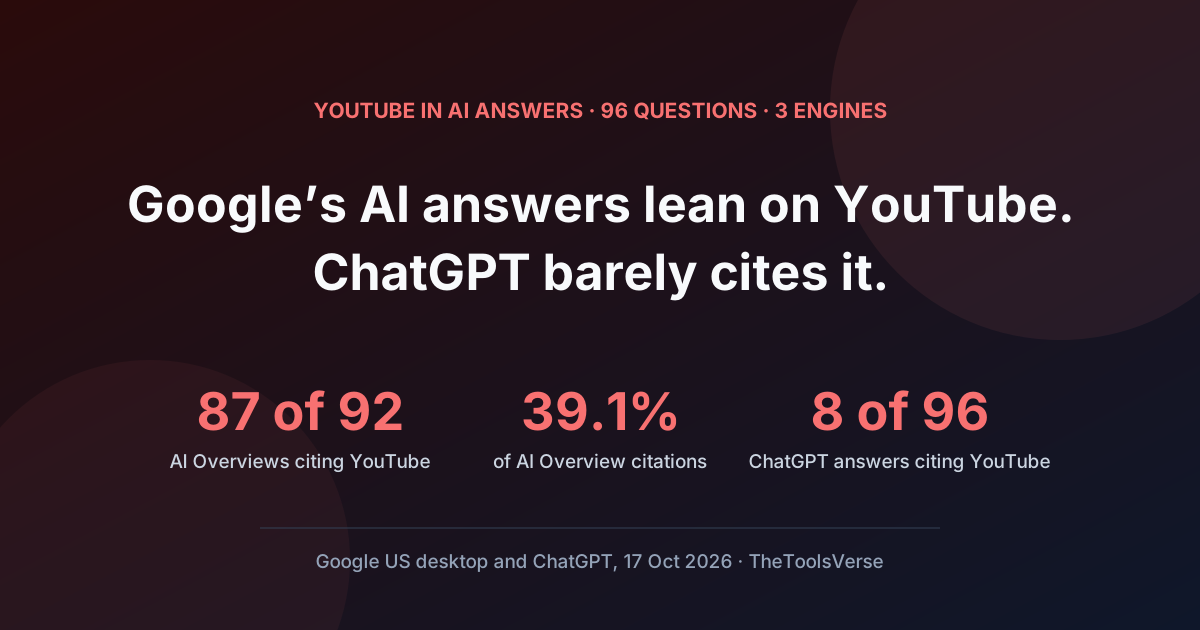
| Google AI Overviews | 87 of 92 (94.6%) | 39.1% (305 of 781) |
| Google AI Mode | 55 of 96 (57.3%) | 35.6% (188 of 528) |
| ChatGPT | 8 of 96 (8.3%) | 2.1% (13 of 633) |
Google showed an AI Overview on 92 of the 96 questions.
In Google's AI Overviews, YouTube was nearly universal: almost every answer cited a video, and close to two in every five citations were videos. AI Mode leaned on YouTube for about a third of its citations. ChatGPT, answering the same questions, cited 633 sources and 13 of them were YouTube.
Google's classic results sat in between: a YouTube video appeared in the organic top 10 for 68 of the 96 questions (113 of 724 results), and a video carousel on 75.
By kind of question
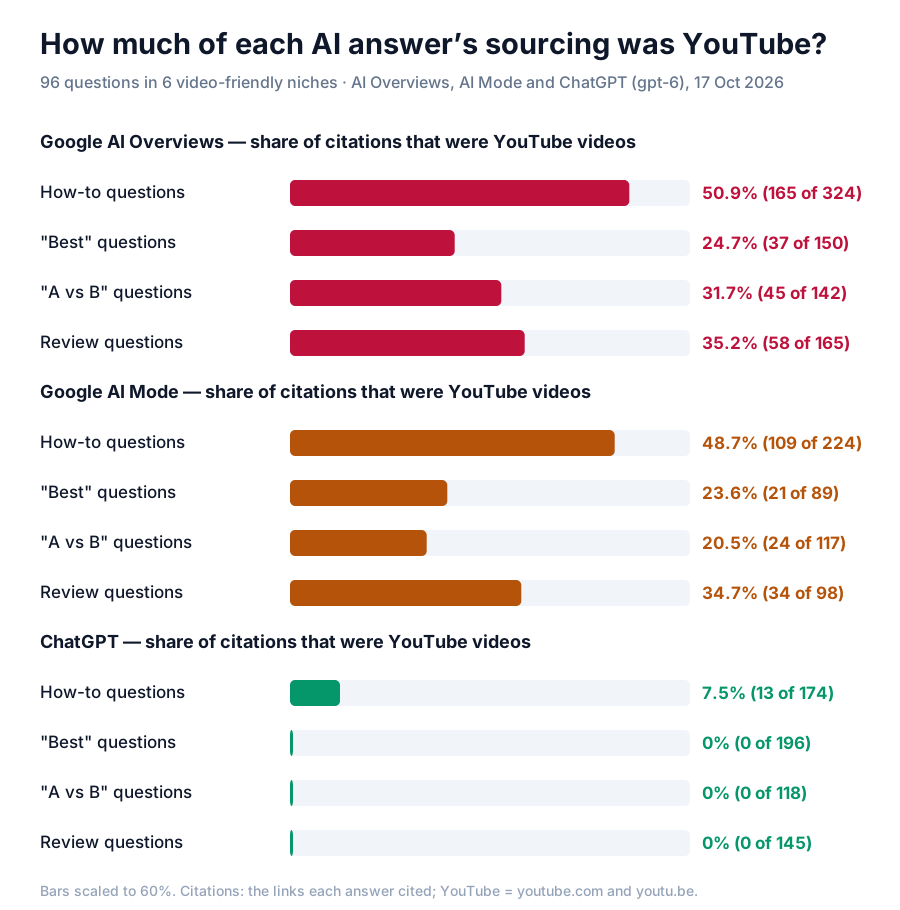
How-to questions were where video dominated: half of all AI Overview citations (50.9%) and nearly half of AI Mode's (48.7%) were YouTube videos. Review questions came next — every one of the 18 review AI Overviews cited YouTube. "Best" lists leaned least on video, at about a quarter.
ChatGPT's 13 YouTube citations all came from how-to questions. For "best", comparison and review questions — 459 citations — it cited no video at all. Instead it went to retailers and review publishers: Guitar Center (27 times), Sweetwater, Tom's Guide and Home Depot (13 each), Guitar World, Best Buy, Walmart, Target, TechRadar, RTINGS and Consumer Reports.
Anatomy of a cited video
We looked up all 412 YouTube videos the three engines cited, from 309 channels.
| All 412 videos | Cited by AI Overviews (305) | Cited by AI Mode (183) | Cited by ChatGPT (11) | |
|---|---|---|---|---|
| Median age | 15.7 months | 17.5 months | 13.4 months | 80.4 months |
| Published in the last 12 months | 172 | 119 | 88 | 0 |
| Three years old or more | 105 | 82 | 32 | 8 |
| Median views | about 43,000 | about 52,000 | about 29,000 | about 141,000 |
| Median channel subscribers | 200,000 | 205,000 | 168,000 | 336,000 |
| Channels under 100,000 subscribers | 174 of 408 | 126 of 302 | 79 of 181 | 0 of 11 |
Three things stand out:
- Google's AI cites small channels. 174 of the 408 cited videos with subscriber data came from channels under 100,000 subscribers. A video does not need a big audience to be the source an AI Overview points to.
- Recent and old both get cited. 172 videos were less than a year old; 105 were three years or older. A how-to video that still answers the question keeps working.
- Creators, not brands, made most of them. The most-cited channels were creators — Lauren Bateman and 731 Woodworks (each cited for four questions), Andy Guitar, intheblues, YourSixStudios — alongside a retailer (Guitar Center) and a hospital (Cleveland Clinic).
The few videos ChatGPT cited were the opposite: old (a median of nearly seven years) and all from channels with more than 100,000 subscribers.
A YouTube plan for AI answers
- Make video for how-to and review questions first. That is where Google's AI cited YouTube most — half the sources on how-to questions.
- Treat it as a Google channel. In our data, video moved Google's AI answers and barely touched ChatGPT's. For ChatGPT, the same questions were answered from retailer pages and review sites.
- Work with creators. Most cited videos came from independent channels, many of them small. Being reviewed or demonstrated on those channels is a way into the answer without making the video yourself.
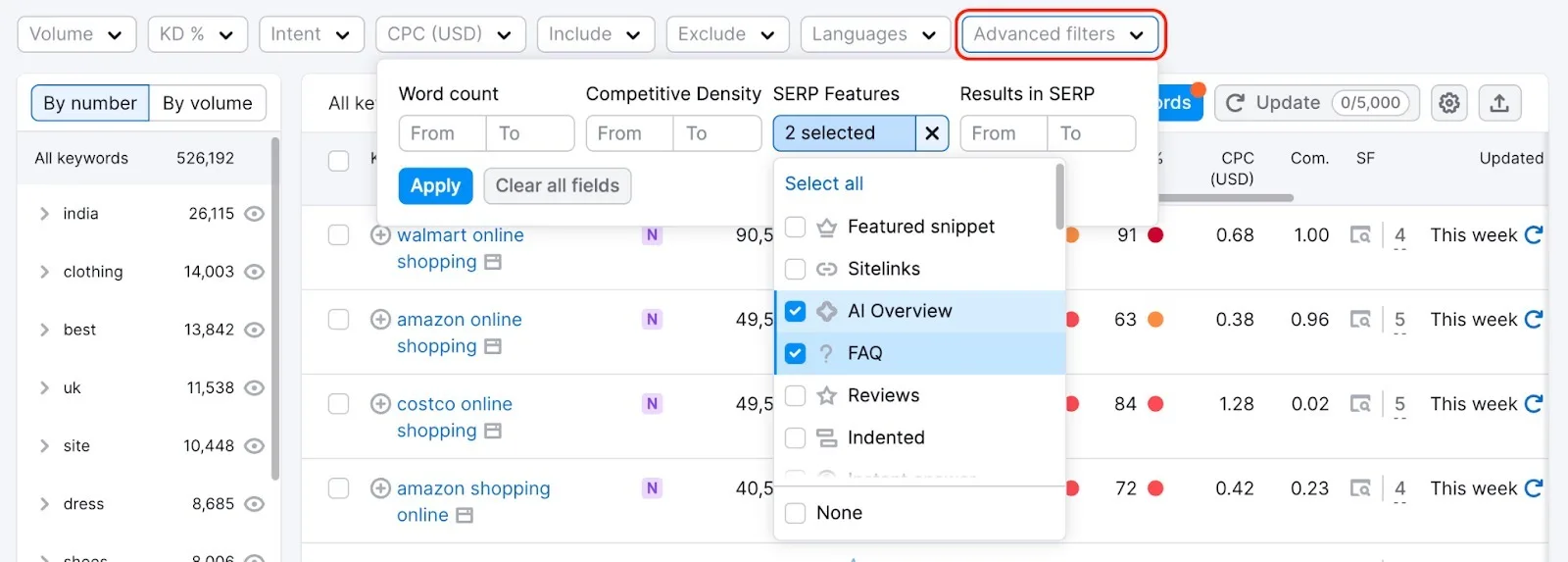
- Find the keywords where video already shows. The Keyword Magic Tool can filter by SERP features — its Knowledge Base suggests you "Find keywords that trigger special search features like AI Overviews, People Also Ask (FAQ) boxes, local packs, or video results."
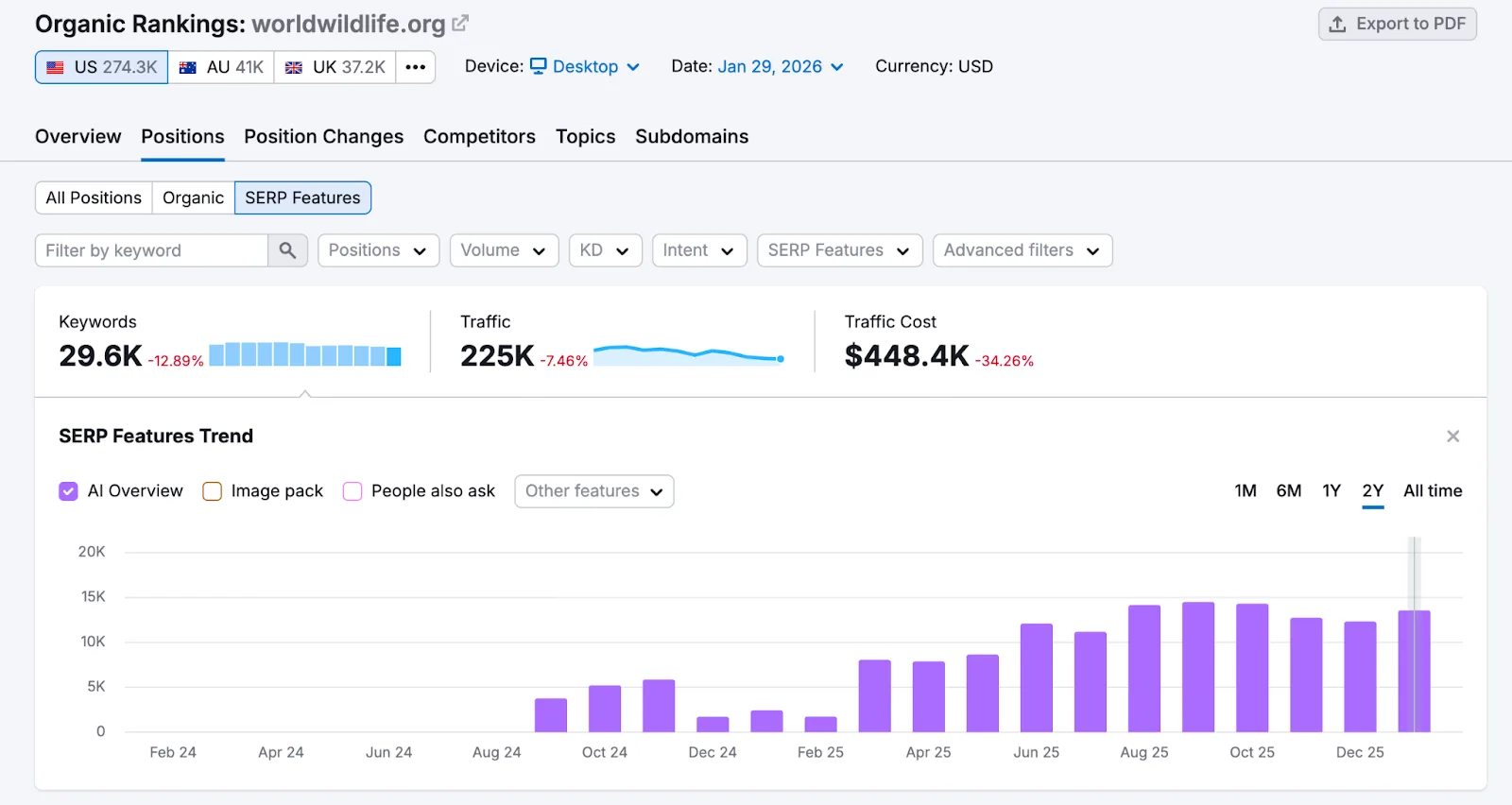
Research the competition, then watch AI Overviews across the rankings. Organic Rankings, in the SEO Toolkit — the report Semrush previously called Organic Research — "will tell you about a website's top organic search competitors, what keywords they get their traffic from". Its SERP Features view "tracks which keywords in a domain's SEO portfolio trigger AI Overviews on Google's search results" — the questions where an AI answer now comes before the classic results, and where a video could be one of its sources.
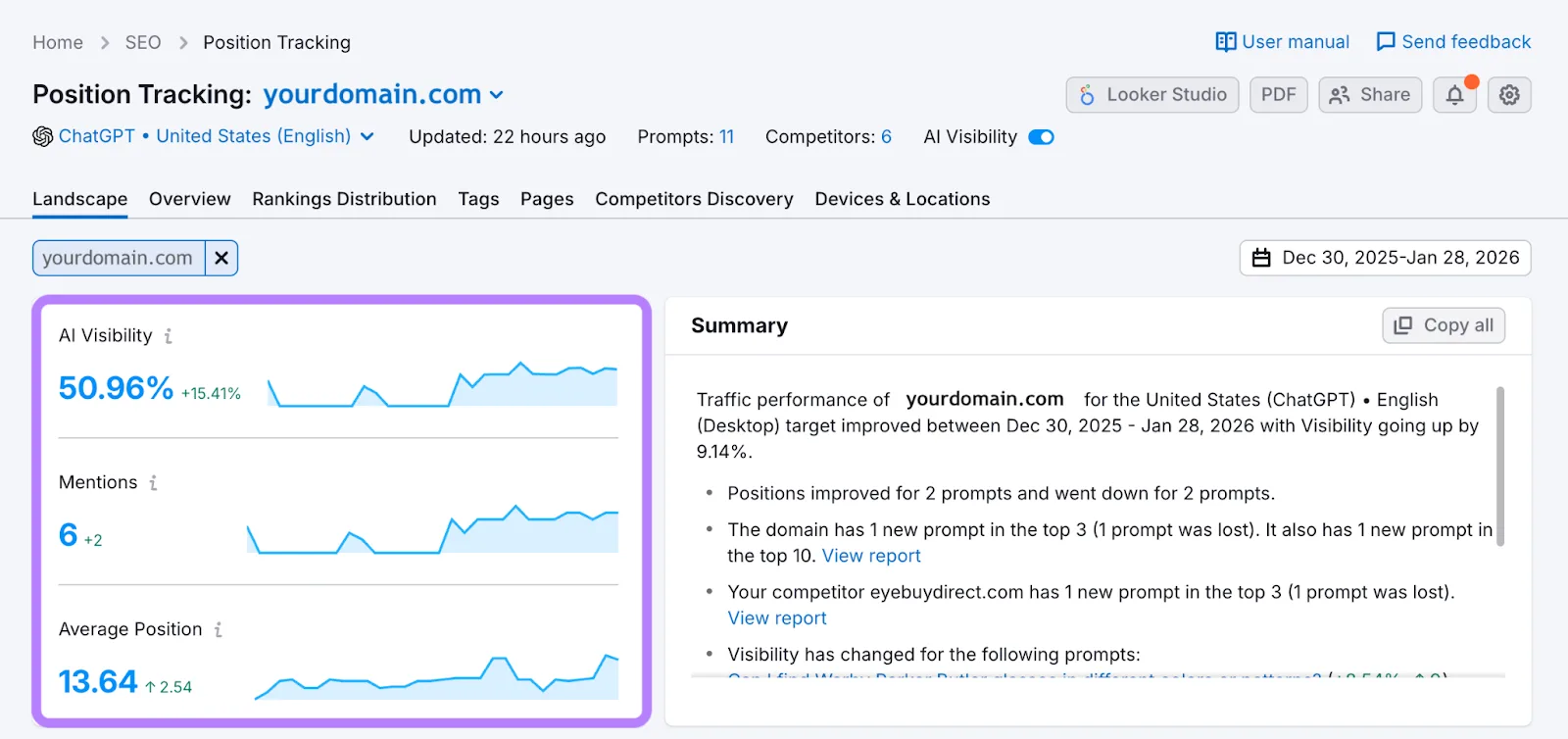
Track the questions you made videos for. Position Tracking lets you "Track your rankings on Google Search, appearances in AI Overviews, and mentions across AI platforms like ChatGPT and AI Mode" for a set of keywords and prompts you choose. Google rankings and AI Overviews come with any Semrush plan; for the AI platforms, its Knowledge Base notes "Tracking on AI platforms: Available with Semrush One or the AI Visibility Toolkit".
See the split by AI platform. Visibility Overview, in the AI Visibility Toolkit, "provides an instant high-level assessment of any brand's AI visibility across LLMs (ChatGPT, Gemini, Google AI Mode) and Google's AI Overviews" — the same engine-by-engine view as our scoreboard, for your brand.
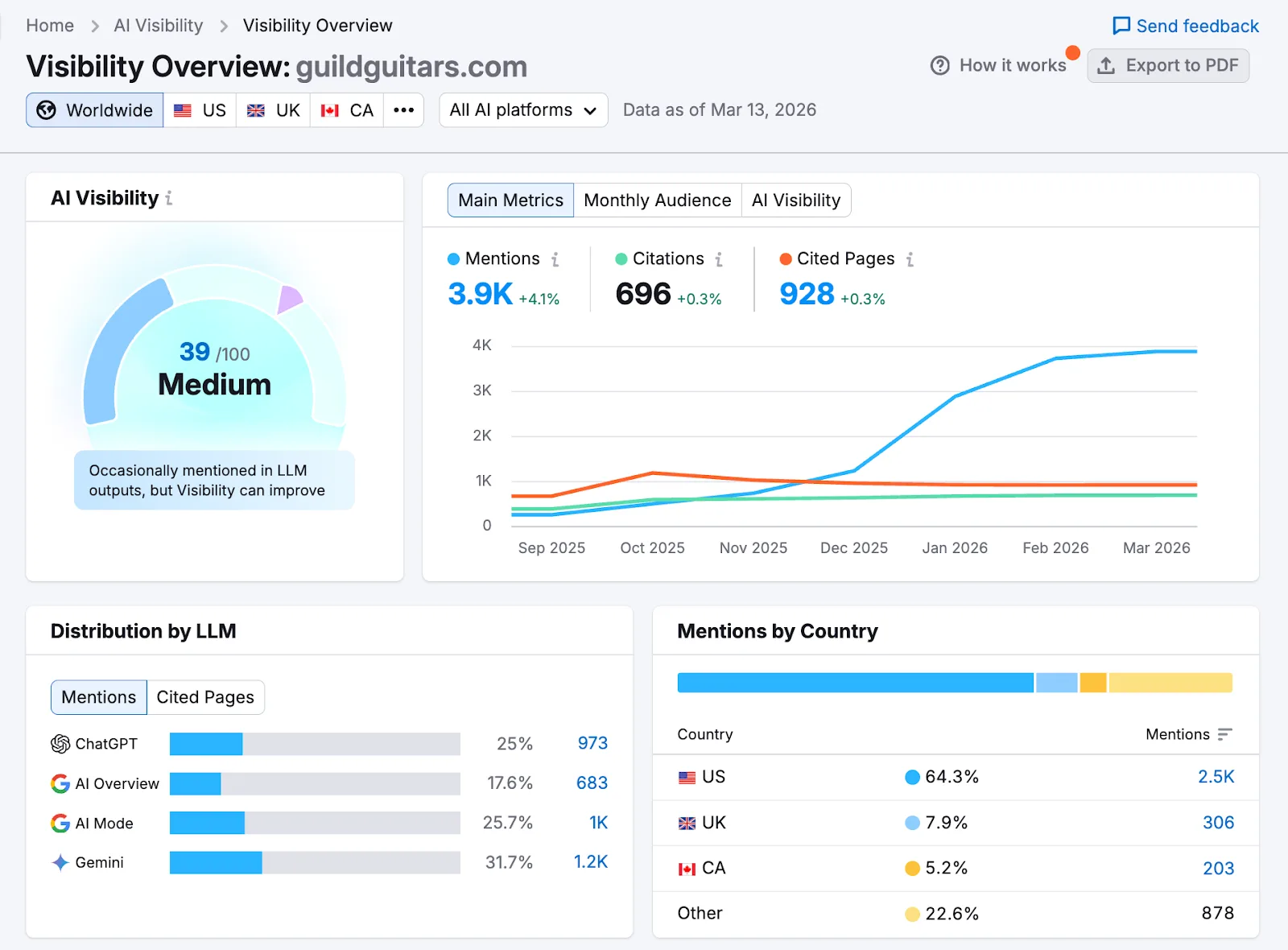
For the written side of a video — the description, the transcript, the article that goes with it — the Content Toolkit applies the same keyword and topic work.
Semrush One bundles the SEO Toolkit (the Keyword Magic Tool, Organic Rankings and Position Tracking) and the AI Visibility Toolkit; the Content Toolkit is sold separately. The 7-day free trial is Semrush One's — the AI Visibility Toolkit has no free trial of its own. To check where video wins in your own market before paying, try Semrush One free for 7 days: its page offers "Unlimited access to all Semrush One tools", "Offer available to new users only", checked on 16 October 2026. Those are Semrush's published terms, not something we tested; none of the data above came from a Semrush account.
Video is a Google-AI channel — for now
On 96 questions where video is a natural answer, Google's AI Overviews cited YouTube on 87 of 92 and AI Mode on 55 of 96; ChatGPT on 8. The videos Google's AI relied on were often recent, often from small creators, and mostly how-to and reviews. If your AI visibility plan includes video, aim it at Google's AI answers and at how-to and review questions — and measure ChatGPT separately, because it is reading something else.
Try Semrush One free for 7 days
The Keyword Magic Tool to find keywords with AI Overviews and video results, Organic Rankings and Position Tracking to watch them, and Visibility Overview to see your brand across ChatGPT, AI Mode, Gemini and AI Overviews — the SEO Toolkit and the AI Visibility Toolkit together in Semrush One. Free for 7 days for new users.
Try Semrush One free for 7 daysAbout the 96 questions
- Questions: six niches × 16 (six how-to, four "best", three comparisons, three reviews), none overlapping another study of ours.
- Engines: Google (US English, desktop, AI Overviews loaded) and Google AI Mode through DataForSEO's SERP and AI Mode APIs; ChatGPT (web search forced, logged out, US English; model reported as
gpt-6) through DataForSEO's LLM scraper. One answer per engine per question, 17 October 2026. - Citations: an AI Overview's references, an AI Mode answer's links and a ChatGPT answer's sources, excluding Google's own pages. A YouTube citation is a youtube.com or youtu.be link.
- Videos: each cited video looked up through DataForSEO's YouTube video info API (publication date, views, channel and subscribers), 17 October 2026. Ages are measured to 17 October 2026.
- What this cannot show: one answer per question, on one day; AI answers change between runs. These are six video-friendly niches by design — the share of YouTube will be lower in subjects people rarely film.
| Figure | Source | Date |
|---|---|---|
96 Google results with AI Overviews; 96 AI Mode answers; 96 ChatGPT answers (gpt-6) | DataForSEO SERP API, AI Mode API and LLM Scraper, US English | 2026-10-17 |
| 412 cited videos: dates, views, channels, subscribers | DataForSEO YouTube video info API | 2026-10-17 |
| Every count, share and median above | Our analysis of the saved answers and video data | 2026-10-17 |
| Keyword Magic Tool, Organic Rankings, Position Tracking and Visibility Overview descriptions; screenshots | Semrush Knowledge Base | 2026-10-17 |
| Semrush One graphic and trial terms | Creator Accelerator affiliate resources; Semrush One page | 2026-09-26 to 2026-10-16 |
Written by Sohail Akhtar. The saved answers, video data and analysis script can be re-run.
Some links may be affiliate links. We may earn a small commission at no extra cost to you.
Related Articles
Explore more guides and reviews from our experts.