We Ranked 9 Signals by How Much They Raised the Odds of an AI Citation. The Four AEO Hacks Came Last.
Disclosure
This article is promotional content produced as part of the Semrush Creator Accelerator programme. It contains affiliate links to Semrush — if you buy through them we may earn a commission at no extra cost to you — and we may also receive a reward from Semrush for publishing it. All measurements in this article are our own. Semrush did not supply, review or approve the data, and the conclusions we draw are ours.
A growing number of SEOs say the "AI optimisation" playbook is mostly old work with a new name. The experts agree on what the old work is: in Zyppy's 2026 Google Ranking Factors Expert Survey, published on 9 September 2026 by Cyrus and Dawn Shepard, 131 practitioners contributed 13,665 data points, and the factors most often named in their top three were relevance (57.1%), backlinks (54.8%) and content quality (47.6%). On links, the authors put it bluntly: "The rumor of the death of backlinks has been greatly exaggerated."
So we put the old work and the new tricks side by side and ranked them.
Start with the fundamentals
Check the links, rankings and crawlability of the pages you want cited with the SEO Toolkit — Site Audit for the technical side, Backlink Gap for the links. To track whether it shows up in AI answers too, try Semrush One free for 7 days.
The test: nine signals, two engines, 60 questions
We asked Google AI Mode and ChatGPT 60 everyday questions on 16 October 2026 — ten each about pets, car care, gardening, home coffee, cycling and photography, half "how to" and half "best" — and collected Google's top 20 for each. Then we fetched every page in Google's top 10 the way a crawler that does not run JavaScript sees it, and checked it for nine signals: five fundamentals and four AEO "hacks".
For each signal, the question is simple: among the pages in Google's top 10, were the ones with the signal cited more often than the ones without? Comparing pages from the same top 10 keeps the test fair — every page had already earned a first-page ranking. We could read 335 of those pages. AI Mode cited 26 of them, ChatGPT 12; AI Mode's larger sample sets the order, and ChatGPT's counts are shown alongside.
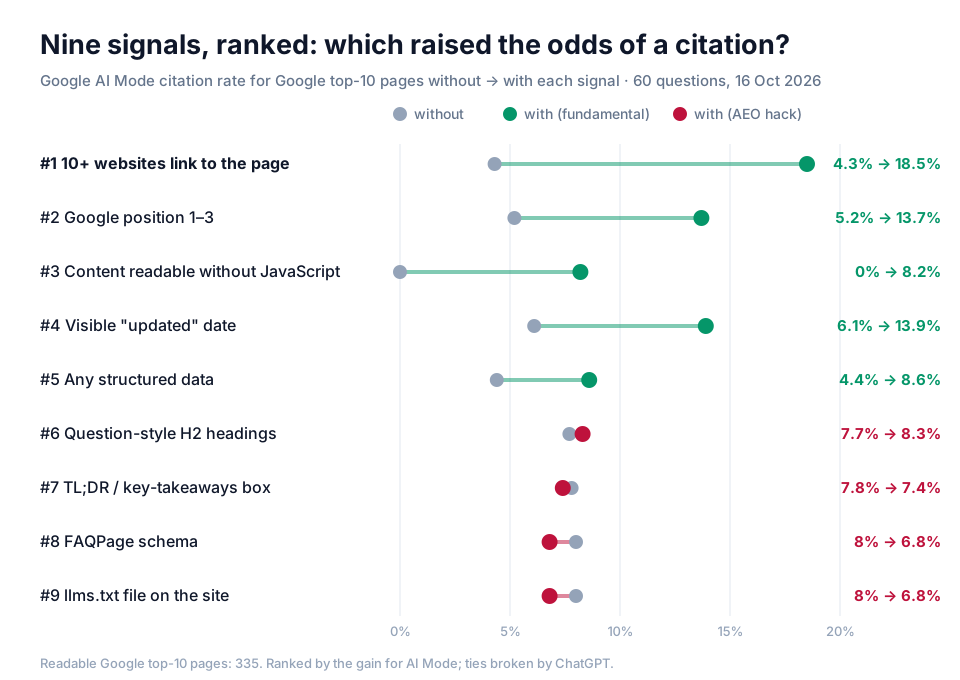
Here is the countdown, from the bottom.
#9 — An llms.txt file
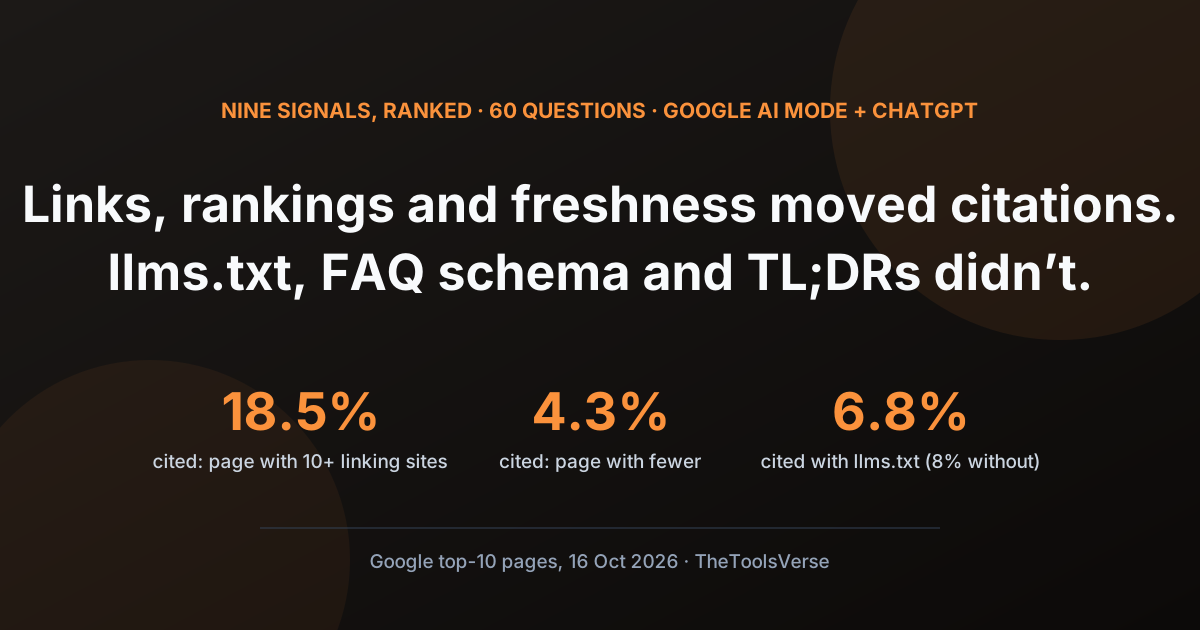
AI Mode cited 6.8% of top-10 pages on sites with an llms.txt (5 of 73), and 8% of those without (21 of 262). ChatGPT cited 1 page from a site with one, and 11 from sites without.
llms.txt is no longer rare: 223 of the 817 websites in our panel serve one, 13 of them generated automatically by a WordPress SEO plugin. It made no difference to which of their pages got cited.
#8 — FAQPage schema
6.8% cited with FAQPage markup (4 of 59 pages), 8% without (22 of 276). ChatGPT: 2 with, 10 without. Marking up a page's questions and answers did not make AI Mode or ChatGPT more likely to cite it.
#7 — A TL;DR or key-takeaways box
7.4% with (2 of 27), 7.8% without (24 of 308). A summary box near the top of the page — "TL;DR", "Key takeaways", "The short answer" — changed nothing for AI Mode. ChatGPT cited 2 of the 27 pages with one and 10 of the 308 without — the only hack ChatGPT leaned toward, on two pages.
#6 — Question-style H2 headings
8.3% with (1 of 12), 7.7% without (25 of 323). Pages whose subheadings were mostly questions were rare in the top 10, and no more likely to be cited. ChatGPT cited none of them.
#5 — Structured data of any kind
8.6% with (23 of 267), 4.4% without (3 of 68). Here the line changes. Pages with any structured data at all — not FAQ schema in particular, just any JSON-LD markup — were cited by AI Mode almost twice as often. ChatGPT did not follow (9 of 267 with, 3 of 68 without). Of the five fundamentals, this is the weakest.
#4 — A visible "updated" date
13.9% with (10 of 72), 6.1% without (16 of 263). Pages that told the reader when they were last updated or reviewed were cited more than twice as often by AI Mode, and ChatGPT cited 8 of the 72 against 4 of the 263. Freshness is an old ranking idea, not an AI one — and a date on the page only helps if the page behind it is actually kept current.
#3 — Content a crawler can read without JavaScript
8.2% (26 of 318) when the page's content was in the HTML itself; 0 of 17 when it was not. Almost every top-10 page passed this check, so it ranks high on a small group: the 17 pages whose text only appears after JavaScript runs were never cited by either engine.
#2 — A top-3 Google position
13.7% cited from positions 1–3 (14 of 102), 5.2% from positions 4–10 (12 of 233). Across all of Google's top 20, AI Mode's citation rate fell with every step down the page:
| Google position | Pages | Cited by AI Mode | Cited by ChatGPT |
|---|---|---|---|
| 1–3 | 177 | 17.5% (31) | 4.5% (8) |
| 4–10 | 379 | 9% (34) | 1.8% (7) |
| 11–20 | 396 | 3% (12) | 1.3% (5) |
Ranking still matters — with a caveat. Most citations did not come from Google's top 20 at all: only 77 of the 352 pages AI Mode cited (21.9%), and 20 of the 334 ChatGPT cited (6%), were in it. Both engines run their own searches, worded their own way. A strong Google ranking raises the odds; it is not the only door.
#1 — Other websites linking to the page
18.5% cited when 10 or more websites linked to the page (15 of 81); 4.3% when fewer did (11 of 254). For ChatGPT the split was total: all 12 top-10 pages it cited had 10 or more linking websites; it cited none of the 254 that had fewer.
The same gap shows across every page either engine cited, not just the top 10 (YouTube videos left out):
| Pages | 10+ linking websites | Median linking websites | Site has llms.txt | FAQPage schema | |
|---|---|---|---|---|---|
| Cited by AI Mode | 312 | 38.8% | 4 | 19.6% | 22.2% |
| Cited by ChatGPT | 331 | 39.9% | 3 | 25.1% | 24.5% |
| In Google's top 20, cited by neither | 825 | 14.8% | 0 | 16.6% | 17.6% |
Cited pages were more than two and a half times as likely to have ten or more linking websites. On llms.txt and FAQ schema the cited pages differed by a few points — and, as #8 and #9 show, that difference disappears when pages at the same Google ranking are compared. It is the old signal, links to the page itself, that separated them.
The boring playbook, step by step
The order of the countdown is the order of the work: links, ranking, crawlability and freshness first; the extras after.
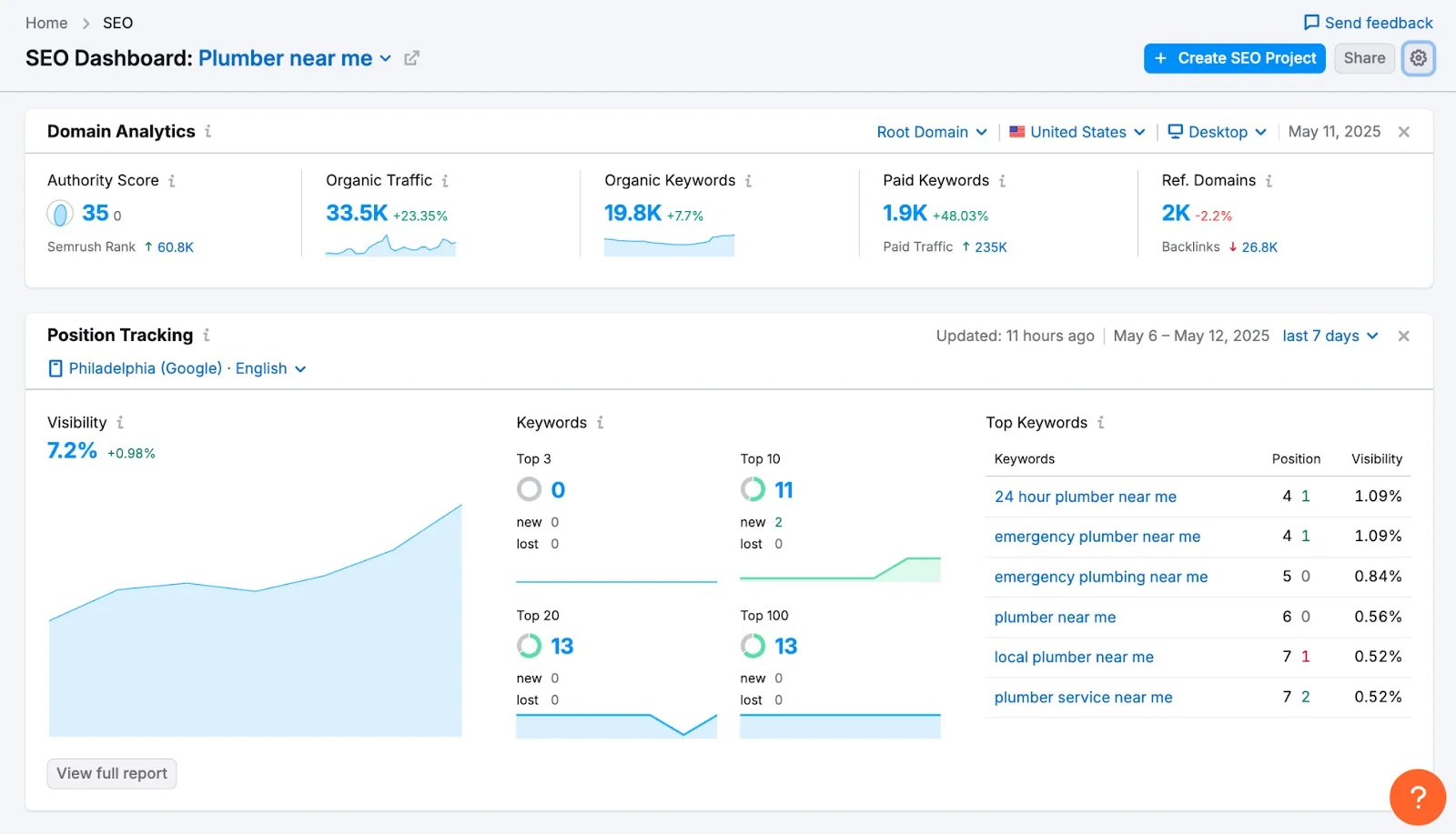
This is the unglamorous foundational work, and it maps onto the SEO Toolkit, whose Knowledge Base describes "backlink management tools, rank tracking, on-page SEO analysis, and a technical SEO audit tool." Its dashboard puts domain metrics next to Position Tracking, so a fix and its effect on rankings sit on one screen.
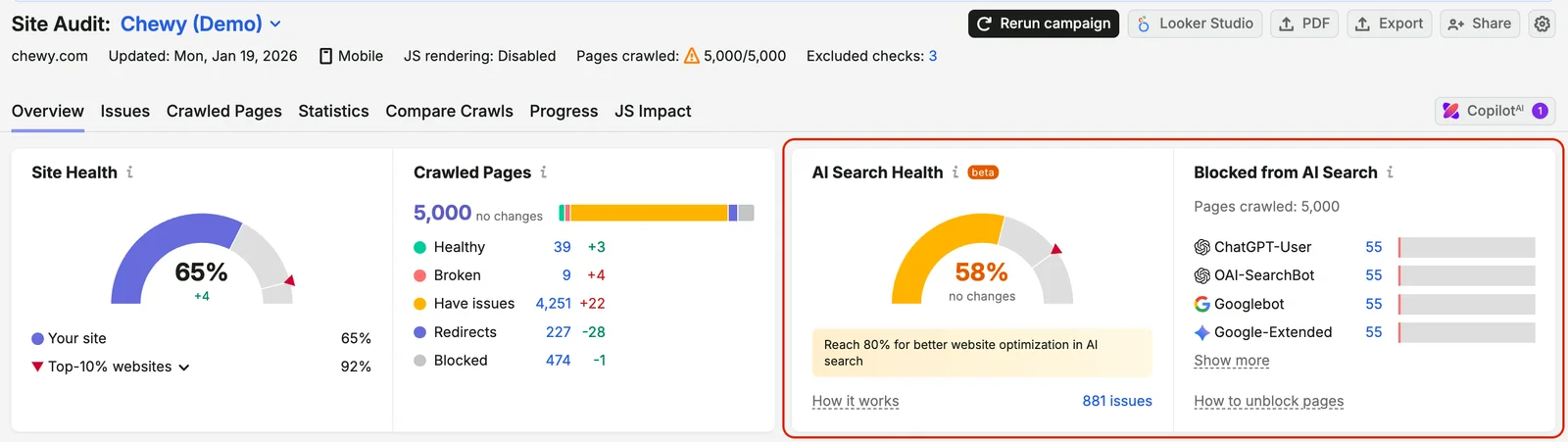
Make every page readable (#3). On-Page & Technical SEO starts with Site Audit, which runs "Over 140 on-page and technical SEO checks". Its AI Search Health score includes what its Knowledge Base calls "Technical readiness: Missing or misconfigured elements that encourage visibility (e.g., schema markup, crawlable navigation, internal links, llms.txt)" — useful hygiene, weighed alongside everything else rather than on its own, which is how our countdown suggests treating it.
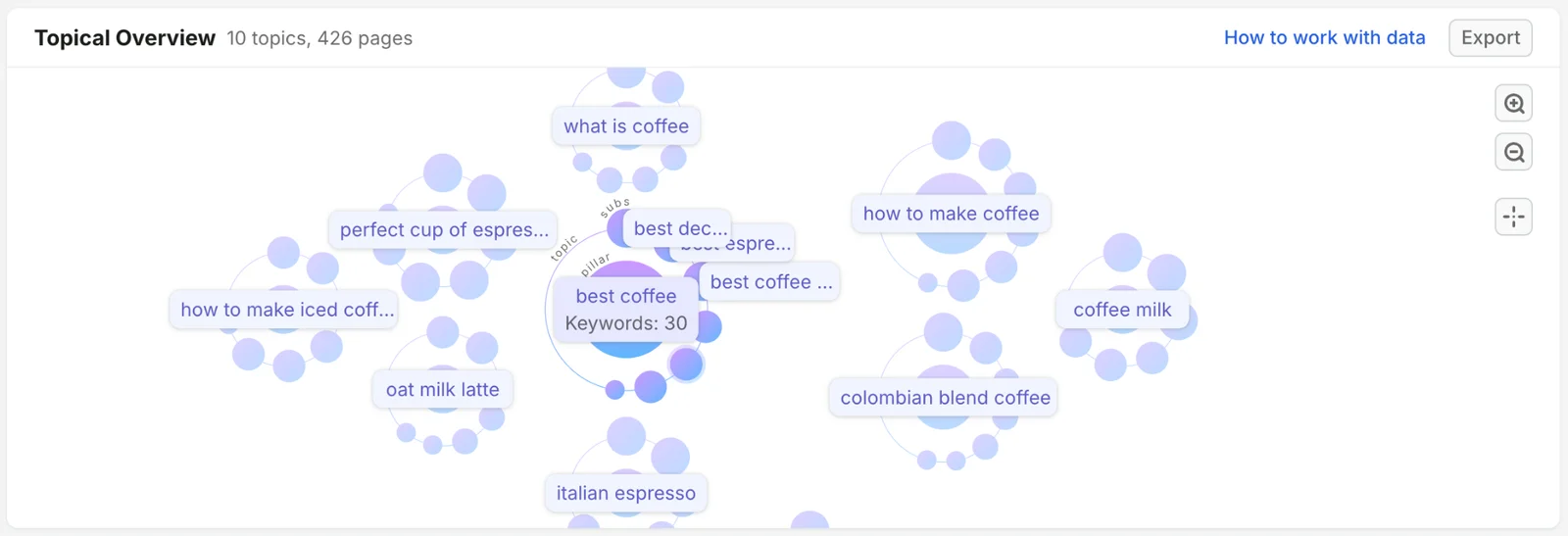
Earn the top-three position (#2). Keyword research and strategy decide which page answers which question. Keyword Strategy Builder "analyzes up to 10,000 keywords and groups them into topics, pillar pages, and subpages" — one clear page per question, the kind of page that reaches the top three.
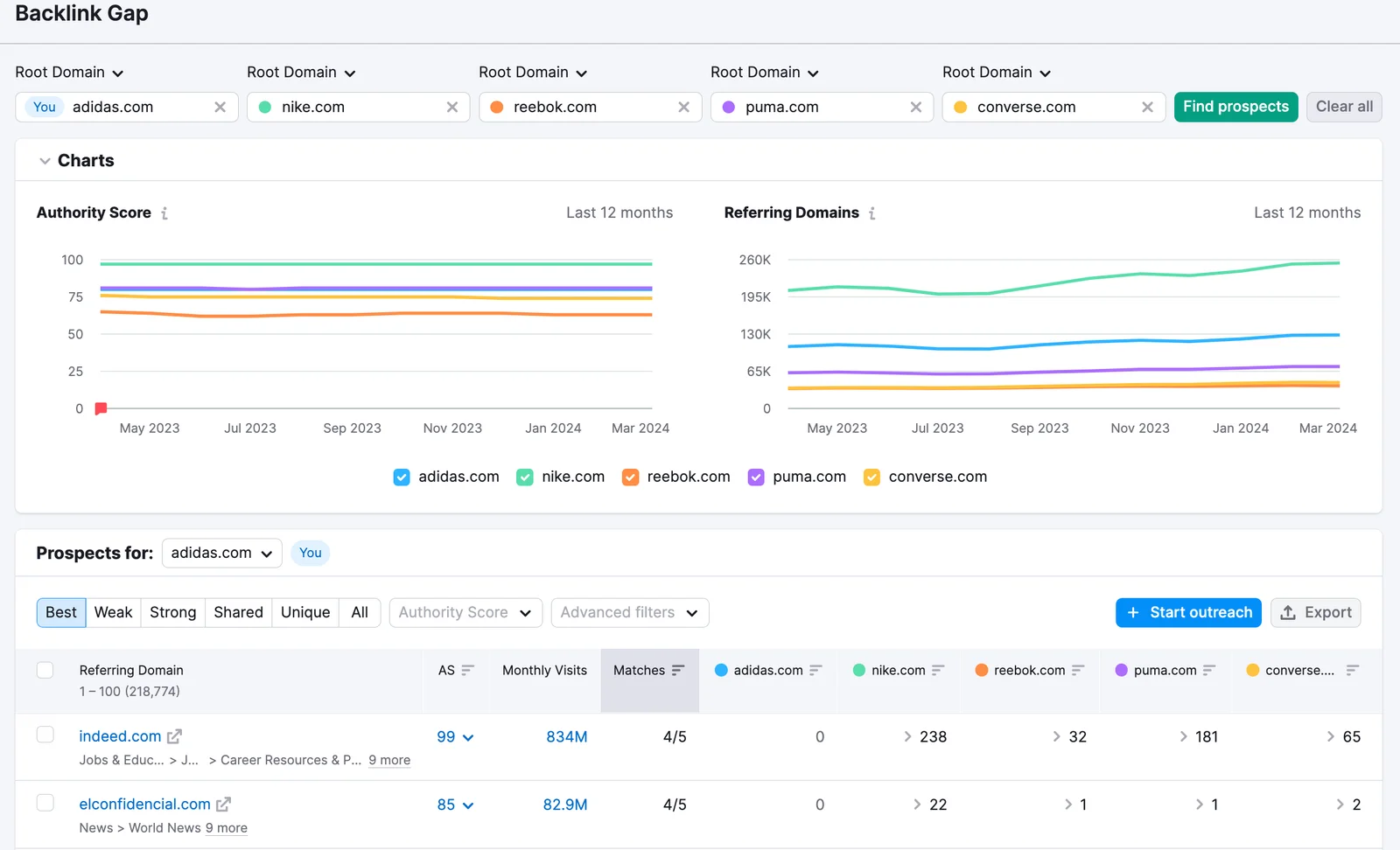
Build links to the page itself (#1). Link building is the lever our data points to. In Backlink Gap "you can compare the backlink profiles of up to five competing websites at once", and it lists the referring domains that link to competitors but not to you.
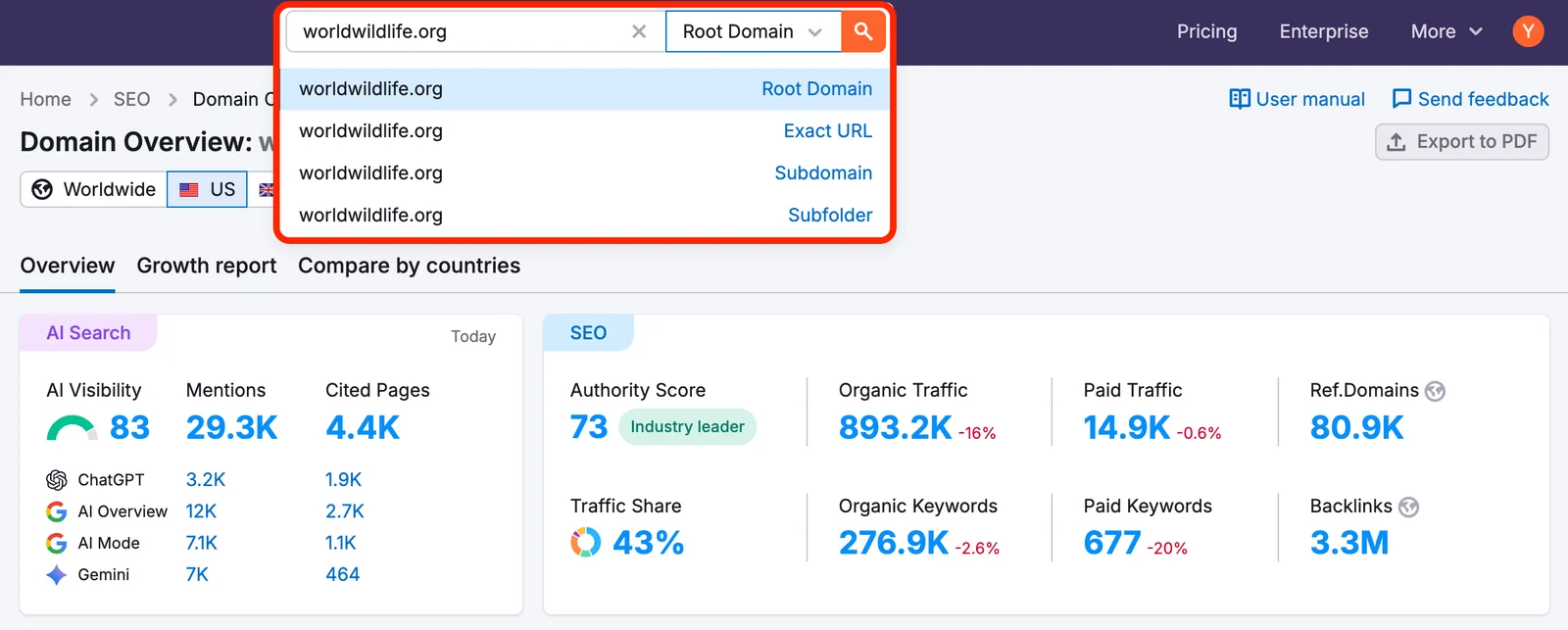
Check the page you want to win, not just the site. For competitive research, Domain Overview "shows a website's organic traffic, paid traffic, backlinks, and comprehensive AI visibility in a single report", and it can be scoped to an exact URL.
Then measure the result in AI answers. The AI Visibility Toolkit "shows you how brands appear in AI-generated answers" — which turns "citations follow good SEO" from a belief into something you can check for your own pages.
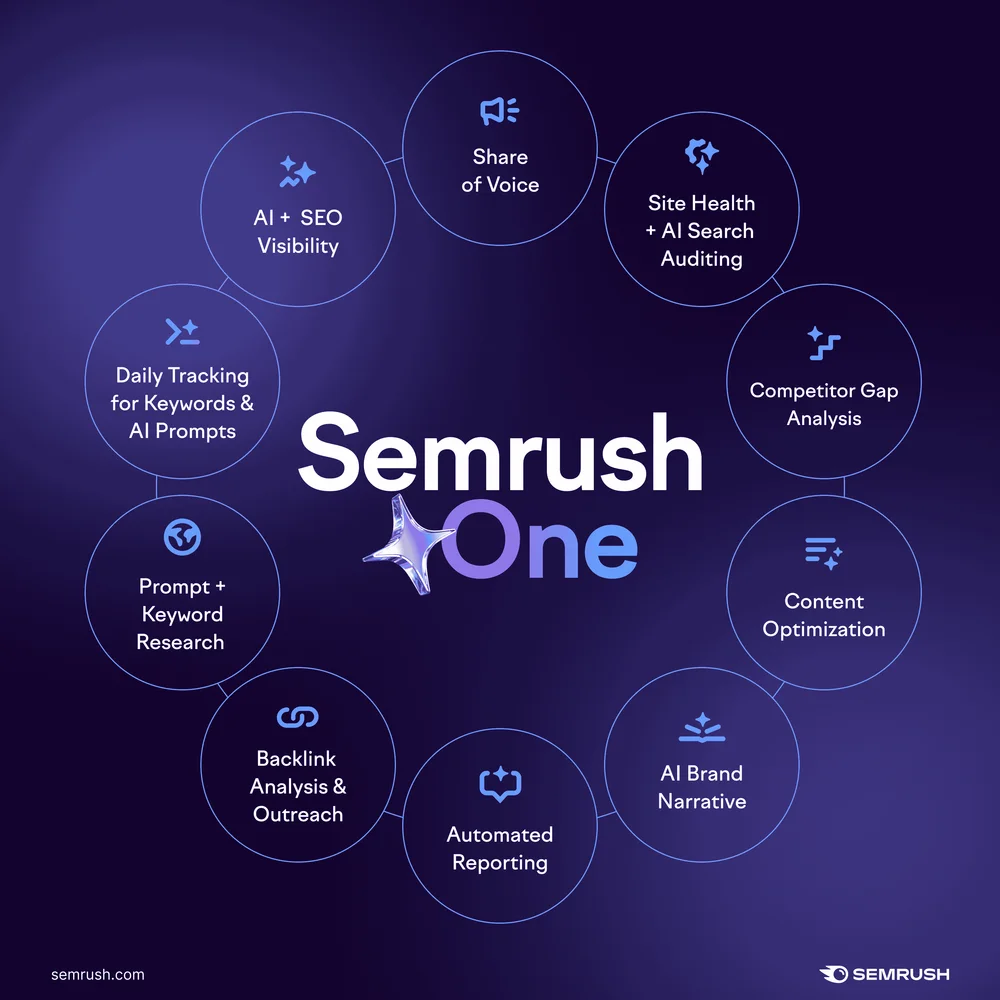
The SEO Toolkit and the AI Visibility Toolkit can be bought separately; Semrush One is the bundle of both, and the 7-day free trial is Semrush One's — the AI Visibility Toolkit has no free trial of its own. To run the playbook before paying, try Semrush One free for 7 days: its page offers "Unlimited access to all Semrush One tools", "Offer available to new users only", checked on 16 October 2026. Those are Semrush's published terms, not something we tested; none of the data above came from a Semrush account.
What to fund first
The five fundamentals took the top five places and the four AEO hacks took the bottom four. Links to the page, a top-three ranking, crawlable content and a current date raised the odds of a citation; llms.txt, FAQ schema, TL;DR boxes and question headings did not. None of the hacks hurt — they just did nothing we could measure. If the budget can fund only one line, it is the oldest one in SEO: earn links to the page you want cited.
Try Semrush One free for 7 days
The SEO Toolkit for the fundamentals — Site Audit, Keyword Strategy Builder, Backlink Gap and Domain Overview — and the AI Visibility Toolkit to see whether it shows up in AI answers, together in Semrush One. Free for 7 days for new users.
Try Semrush One free for 7 daysBehind the countdown
- Questions (60): ten each in six hobby and household niches, half "how to / what is" and half "best …", chosen so that none overlaps another study of ours.
- Answers: Google AI Mode (US English) and ChatGPT (web search forced, logged out, US English; model reported as
gpt-6), one answer each, through DataForSEO, 16 October 2026. A page is cited if it is among the answer's sources or links. - Google: the US top 20 (desktop) for each question, 16 October 2026 — 952 results.
- Pages: fetched once with a plain request and no JavaScript, as a non-rendering crawler would see them (DataForSEO's OnPage crawler, also without JavaScript, for pages that refused us). 335 of the 556 Google top-10 pages could be read. Of the 221 left out of the signal test, 141 were YouTube videos and Reddit, Facebook and Quora threads; the rest were sites that refused automated requests.
- Signals: 10+ linking websites — referring domains to the exact page, from DataForSEO's Backlinks API. Readable without JavaScript — at least 3,000 characters of text in the HTML. Updated date — "updated", "last updated" or "reviewed" followed by a date near the top. Structured data — any JSON-LD; FAQPage schema — JSON-LD of type FAQPage. TL;DR box — "TL;DR", "Key takeaways", "Quick answer", "The short answer", "In a nutshell", "Bottom line" or "At a glance" in the first quarter of the text. Question H2s — at least three H2 headings, half or more ending in a question mark. llms.txt — a plain-text file at /llms.txt on the site, not an HTML error page.
- What this cannot show: association, not cause — a page with many links may also be older, better or better known. The citation counts inside the top 10 are small (26 for AI Mode, 12 for ChatGPT), so read the order of the middle places as a direction, not a precise ranking. One answer per engine per question, on one day.
| Figure | Source | Date |
|---|---|---|
60 AI Mode and 60 ChatGPT answers; model gpt-6 | DataForSEO AI Mode API and LLM Scraper (ChatGPT), US English | 2026-10-16 |
| Google top 20 for 60 questions (952 results) | DataForSEO SERP API, Google organic, US English, desktop | 2026-10-16 |
| Linking websites per page | DataForSEO Backlinks API, bulk referring domains | 2026-10-16 |
| Page signals and llms.txt (817 sites) | Our fetch of each page and of /llms.txt | 2026-10-16 |
| Every count and percentage in the countdown and tables | Our analysis of the saved answers, SERPs, pages and links | 2026-10-16 |
| 131 practitioners, 13,665 data points; 57.1% / 54.8% / 47.6%; "The rumor of the death of backlinks…" | Zyppy, 2026 Google Ranking Factors Expert Survey (Cyrus and Dawn Shepard) | 2026-09-09 |
| SEO Toolkit, Site Audit, AI Search Health, Keyword Strategy Builder, Backlink Gap, Domain Overview and AI Visibility Toolkit descriptions; screenshots | Semrush Knowledge Base | 2026-10-14 to 2026-10-15 |
| Semrush One graphic and trial terms | Creator Accelerator affiliate resources; Semrush One page | 2026-09-26 to 2026-10-16 |
Written by Sohail Akhtar. The saved answers, SERPs, pages, link counts and analysis script can be re-run.
Some links may be affiliate links. We may earn a small commission at no extra cost to you.
Related Articles
Explore more guides and reviews from our experts.