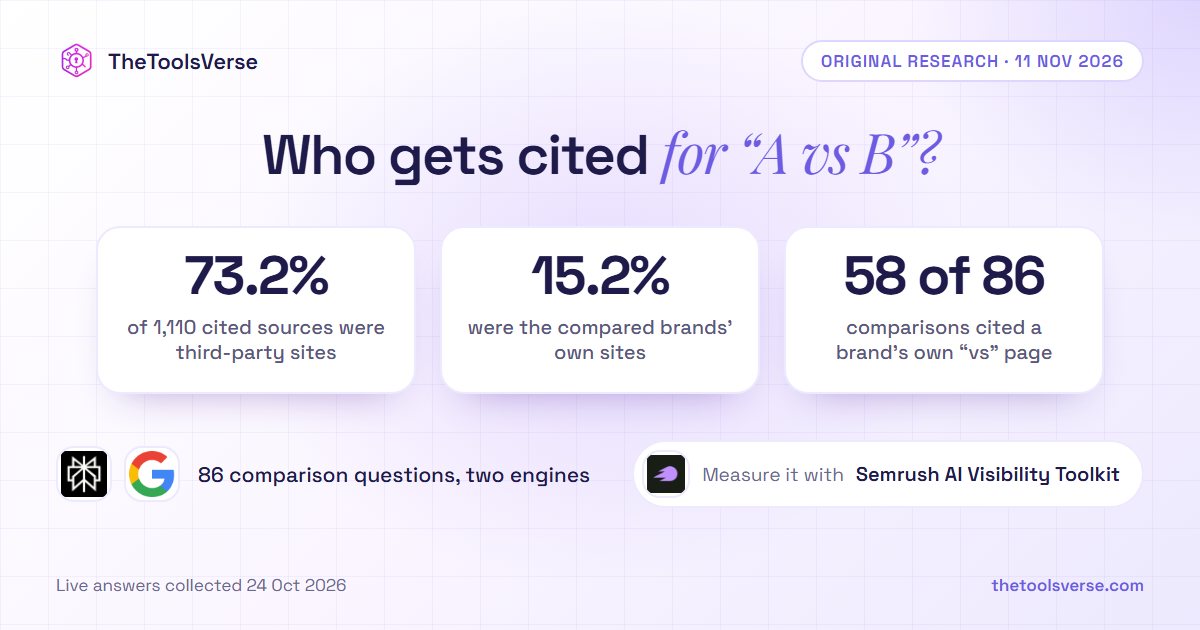
52% of the Web's Busiest Home Pages Carry No JSON-LD. We Read 558 of the Top 1,000 Sites for the Entity Signals AI Is Told to Rely On
Disclosure
This article is promotional content produced as part of the Semrush Creator Accelerator programme. It contains affiliate links to Semrush — if you buy through them we may earn a commission at no extra cost to you — and we may also receive a reward from Semrush for publishing it. All measurements in this article are our own. Semrush did not supply, review or approve the data, and the conclusions we draw are ours.
The advice is everywhere: make your brand an entity, state who you are in structured data, link out to the places that confirm it. The assumption behind it is that the biggest, best-resourced websites have already done this, and the rest of us are catching up.
We tested that assumption by reading the home pages of the 1,000 most popular websites in the Tranco ranking, on 10 November 2026, and looking for the identity signals a machine can read without running a page: JSON-LD, an Organization, sameAs links, and a link to Wikipedia or Wikidata.
See which prompts mention your brand, and which don't
Check how AI answers mention and describe you with Visibility Overview in the AI Visibility Toolkit. To start with it and the SEO Toolkit in one subscription, try Semrush One free for 7 days.
Who answered
Of the 1,000 domains, 558 returned an HTML home page to our crawler. The other 442 did not: 282 gave no response (many appear to be content-delivery and infrastructure domains), 86 refused us with a 403, and 74 returned an error or something that was not a web page. So every percentage below is a share of the 558 readable home pages, not of the top 1,000.
One more limit that matters: we read the raw HTML. A site that adds its structured data with JavaScript after the page loads (for example through a tag manager) shows nothing to us, and nothing to any AI crawler that does not run scripts.
Half say nothing
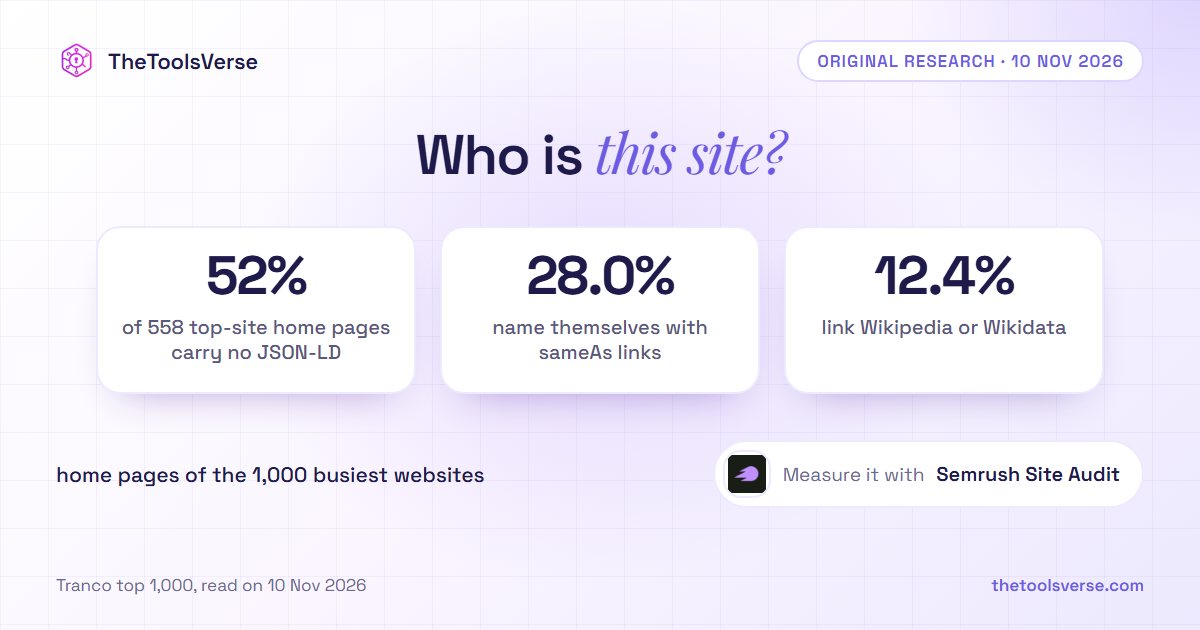
- 268 of 558 (48.0%) carry JSON-LD on the home page, so 52.0% carry none.
- Another 22 (3.9%) use only the older microdata format, and 268 (48.0%) use neither.
- By comparison, 394 (70.6%) carry Open Graph tags. More of the biggest sites tell social networks who they are than tell machines.
| What the home page declares | Sites | Share of 558 |
|---|---|---|
| JSON-LD of any kind | 268 | 48.0% |
A WebSite entry | 170 | 30.5% |
| A site-search action | 110 | 19.7% |
| An Organization (or a subtype) | 190 | 34.1% |
An Organization with sameAs links | 156 | 28.0% |
A sameAs link to Wikipedia or Wikidata | 69 | 12.4% |
The biggest sites bother least
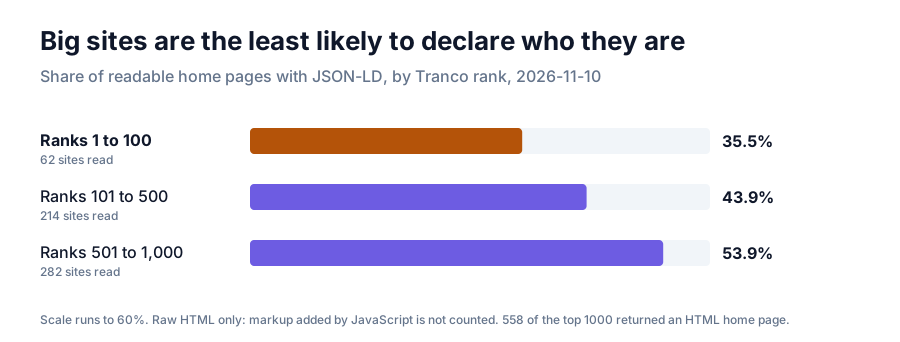
Structured data rises as rank falls. 35.5% of the top 100 carry JSON-LD, against 53.9% of ranks 501 to 1,000. Organization follows: 24.2% in the top 100, 39.0% in the lower band. We cannot say why. It runs against the assumption that the best-resourced sites lead on this.
Naming yourself is the habit of the few
Among sites that declare an Organization, 82.1% (156 of 190) add sameAs links to other places that describe them, nearly all of them (154 of 156) including a social profile. 69 of those (44.2% of the sites that use sameAs) link Wikipedia or Wikidata, the identifiers that a knowledge graph can match against. That is 12.4% of all readable home pages. Apple, Adobe, Yahoo and WordPress.org are among them.
The pattern matters because sameAs is the declaration that ties your own page to an independent record. Without it, a machine has to work out by inference that your site and the entry about you are the same thing. 119 of the 190 Organizations (62.6%) also carry an @id, which lets the pieces of one page refer to the same entity.
What Google actually says
None of this means a site will be cited more often for having it. Google's own guidance on AI features says the opposite about requirements: "You don't need to create new machine readable files, AI text files, or markup to appear in these features. There's also no special schema.org structured data that you need to add" (Google Search Central). What the same page asks for is "Making sure your structured data matches the visible text on the page".
So the right reading of our data is narrow. It says how many popular sites state their identity in a machine-readable way. It does not say that doing so wins a citation, and we did not test that.
What we cannot show
- JSON-LD added by scripts. We saw only the HTML each server returned.
- Inner pages. Product, article and review pages often carry the richest markup. We read only home pages.
- Whether the markup is correct. We parsed it, and one site's markup failed to parse, but we did not validate every property.
- Whether any of it influences an AI answer. We counted declarations, not citations.
- The 442 sites we could not read. They may differ from the 558.
Make your identity easy to check
- Declare an Organization once, on the home page, with a name, logo and
@id. - Add
sameAslinks to records you do not control, such as Wikipedia, Wikidata or an official registry, when those entries exist. - Keep the markup identical to the visible text. A mismatch is worse than none.
- Render it in the HTML, not through a script that a crawler may skip.
- Check what AI answers say about you, not what your markup says about you.
Audit it, then check what AI says back
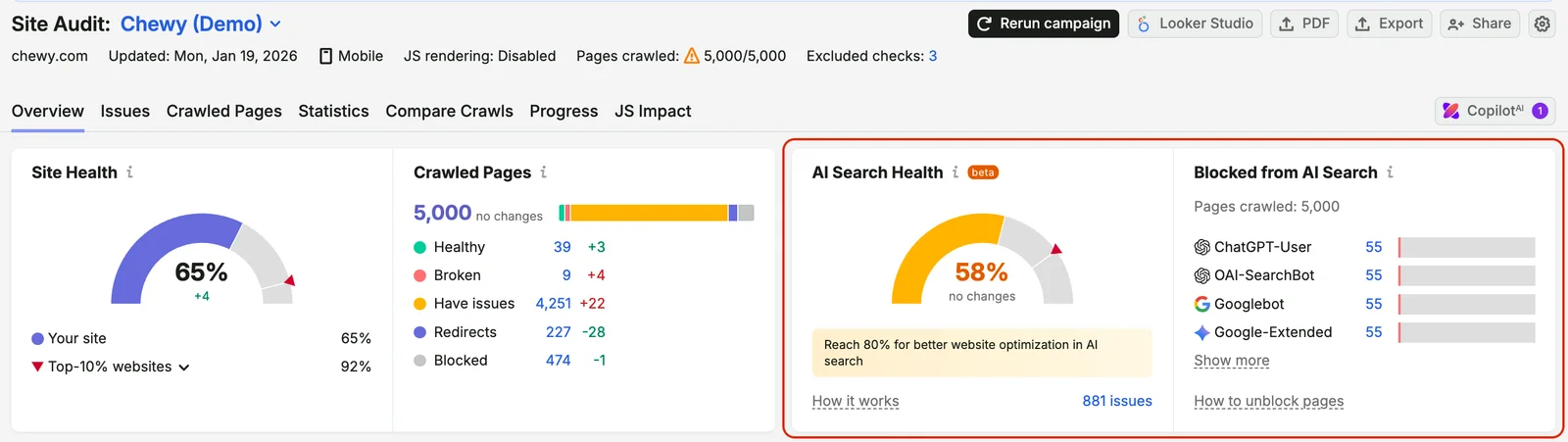
Find the gaps in your own markup. Site Audit in the SEO Toolkit crawls a site the way search engines and AI bots do, and reports JavaScript rendering issues and AI Search Health.
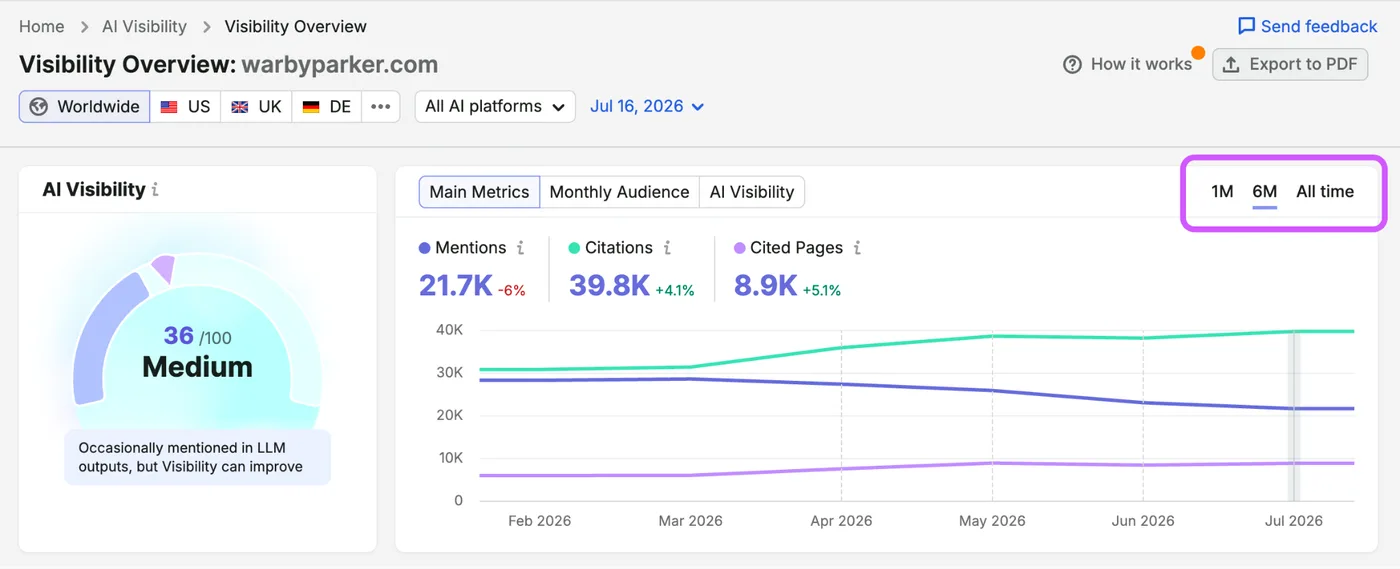
See whether AI answers mention you. Visibility Overview in the AI Visibility Toolkit reports an AI Visibility score with mentions, citations and cited pages over time, and the prompts behind them, for your brand and competitors.
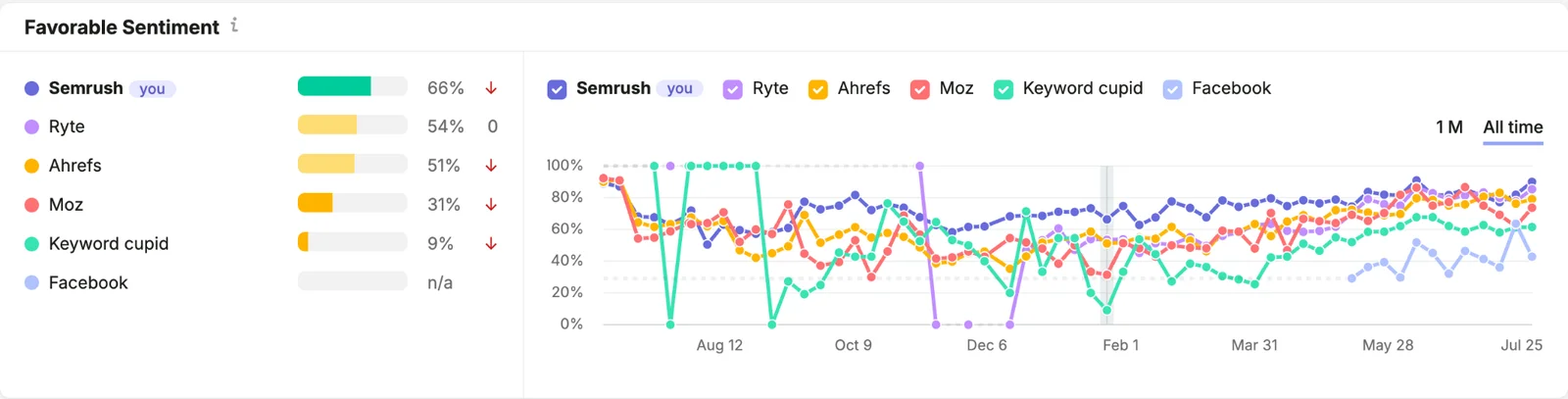
Read how AI describes you. The Perception report in Brand Performance analyses the sentiment of AI answers about your brand, with AI-generated suggestions, so you can see whether the identity you declared is the one that comes back.
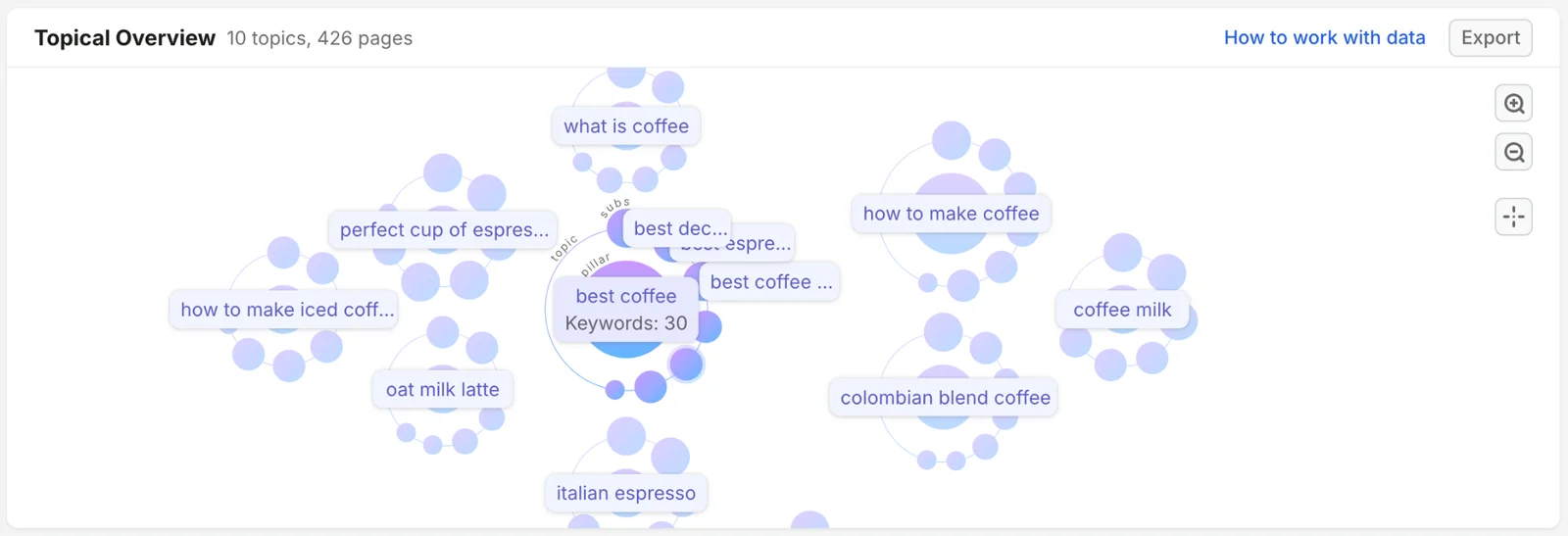
Plan the pages that build the entity. Keyword Strategy Builder groups related terms into topics and pillar pages, so the content around your entity reinforces it.
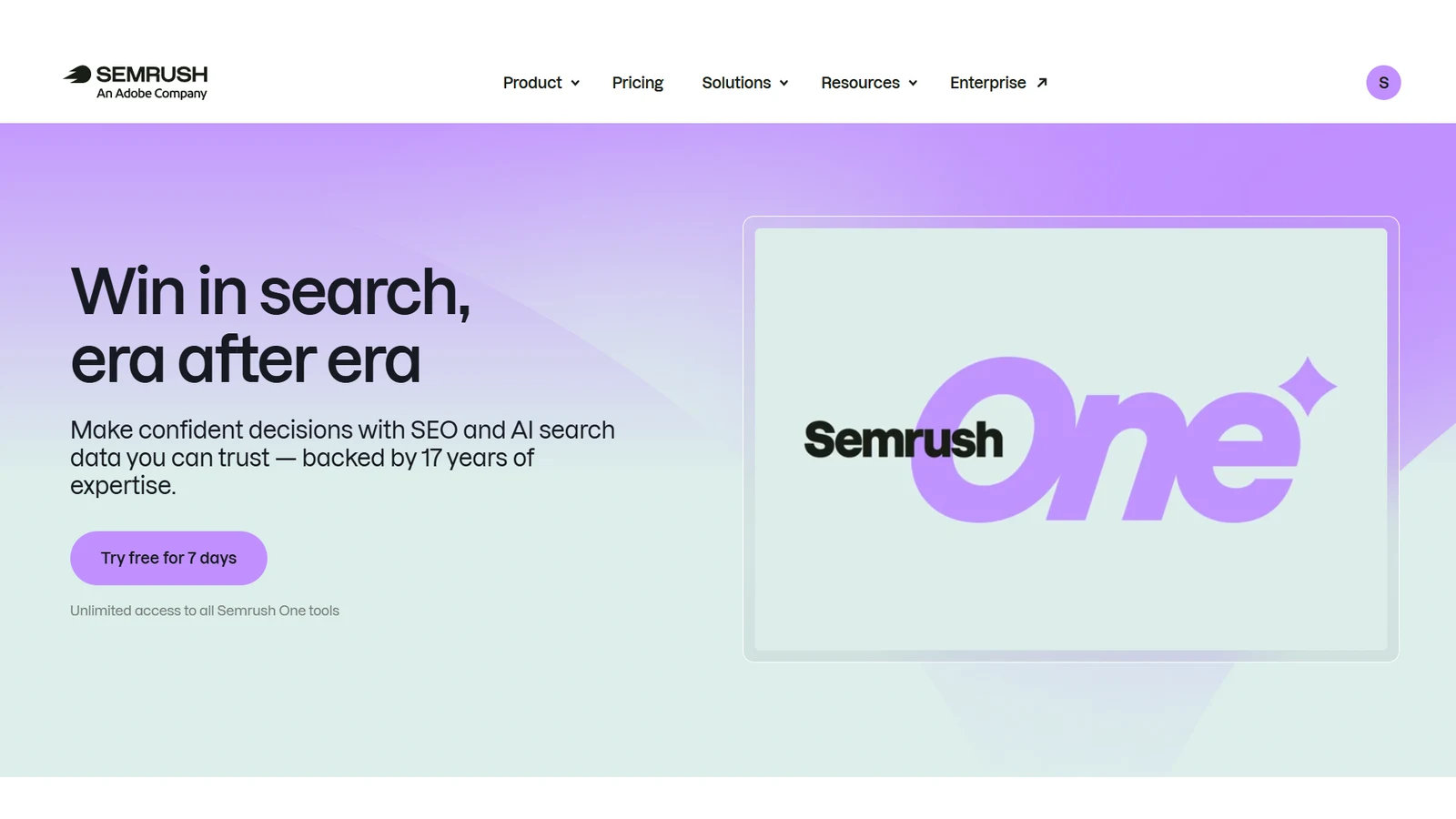
The AI Visibility Toolkit has no free trial of its own; the 7-day free trial is Semrush One's, which includes it alongside the SEO Toolkit. To audit your markup and see your AI visibility in one place before paying, try Semrush One free for 7 days: its page offers "Unlimited access to all Semrush One tools", checked on 16 October 2026. Those are Semrush's published terms, not something we tested; none of the data above came from a Semrush account.
Say who you are, then check who they think you are
Half of the web's busiest home pages say nothing in structured data, and the busiest of them say the least. The opportunity is not that the giants are ahead; it is that identity is still a thing most sites leave to inference. Declare it, then look at what AI says back.
Try Semrush One free for 7 days
Site Audit in the SEO Toolkit to find markup gaps, and Visibility Overview in the AI Visibility Toolkit to see how AI answers describe your brand, together in Semrush One. Free for 7 days for new users.
Try Semrush One free for 7 daysHow we read the sites
- Population: Tranco ranks 1 to 1,000 (the list we downloaded on 5 November 2026), one request to each domain's home page on 10 November 2026, falling back to the
wwwaddress when needed. 558 returned an HTML page with a 200 status. - JSON-LD: every
application/ld+jsonblock in the HTML was parsed, up to 30 per page, including@graphentries. A site counts as declaring an Organization if any entry is typed Organization or a common subtype (Corporation, NewsMediaOrganization, OnlineStore, LocalBusiness and similar). - sameAs: a link inside an Organization entry. A Wikipedia or Wikidata link is any
sameAsURL on those domains. - Open Graph and microdata: a simple pattern match in the HTML.
- Not shown: inner pages, scripted markup, and any claim that these signals cause citations.
- Reproduce it: the crawler and the analysis script are in our research folder (
research/r2-c4-structured-data/); the raw crawl is not published.
Some links may be affiliate links. We may earn a small commission at no extra cost to you.
Related Articles
Explore more guides and reviews from our experts.
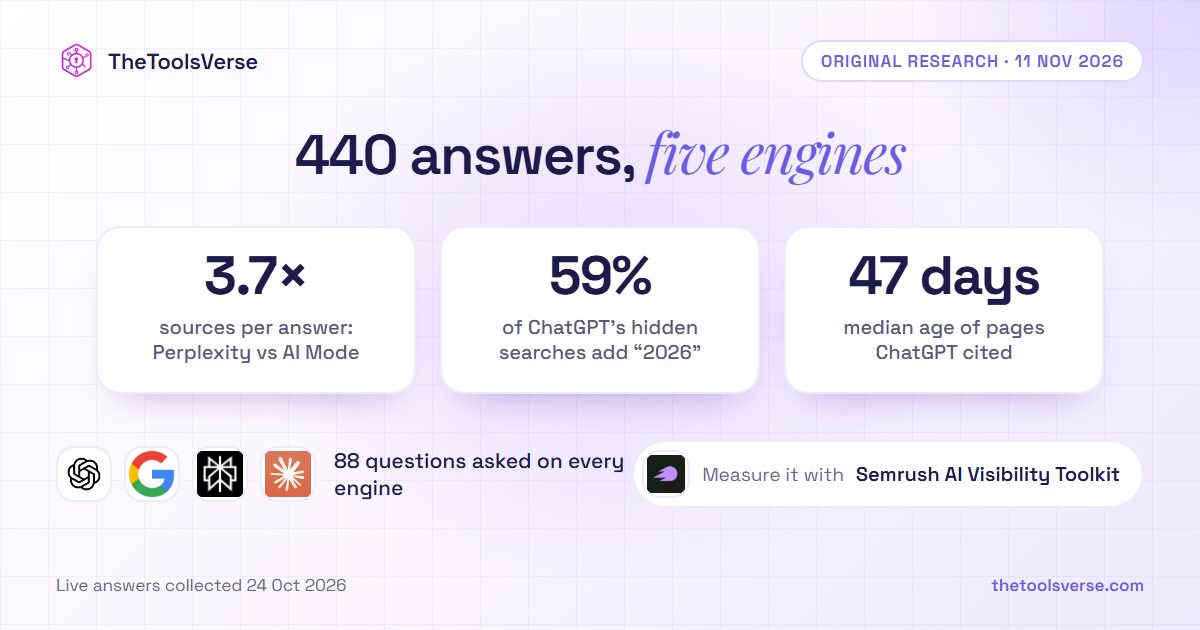
We Asked 88 Questions on 5 AI Engines. Perplexity Cited 3.7 Times as Many Sources as Google AI Mode, and ChatGPT's Hidden Searches Add "2026" to 59% of Queries
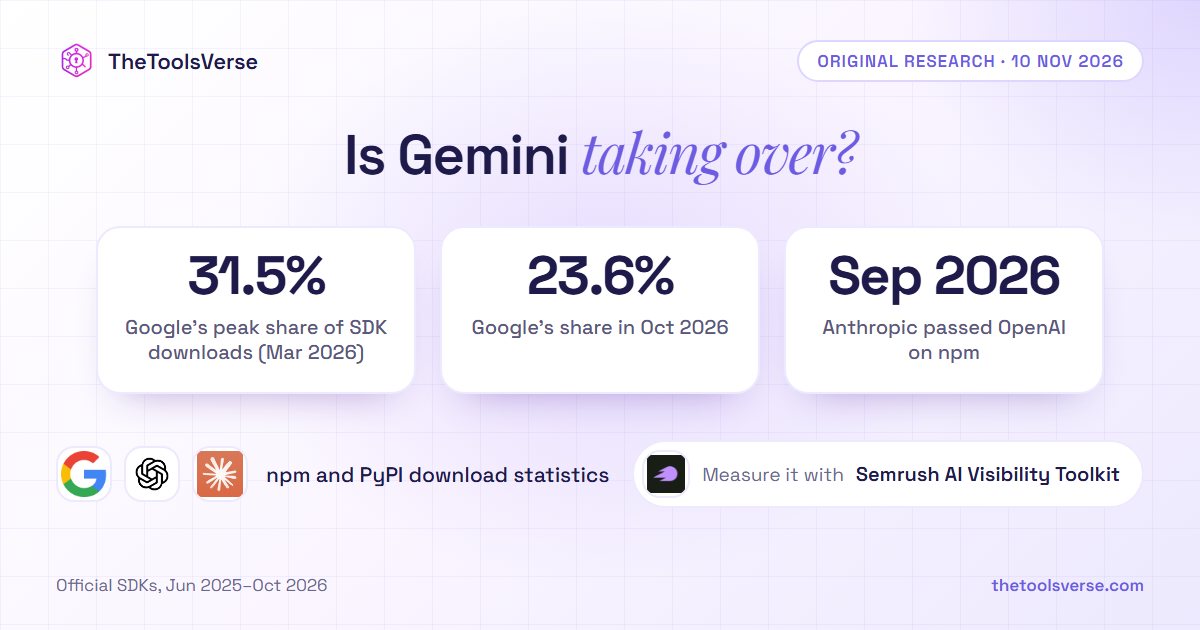
Is Gemini Overtaking ChatGPT? In Developer Downloads, Gemini's Share Peaked in March and Anthropic Passed OpenAI: 17 Months of SDK Data