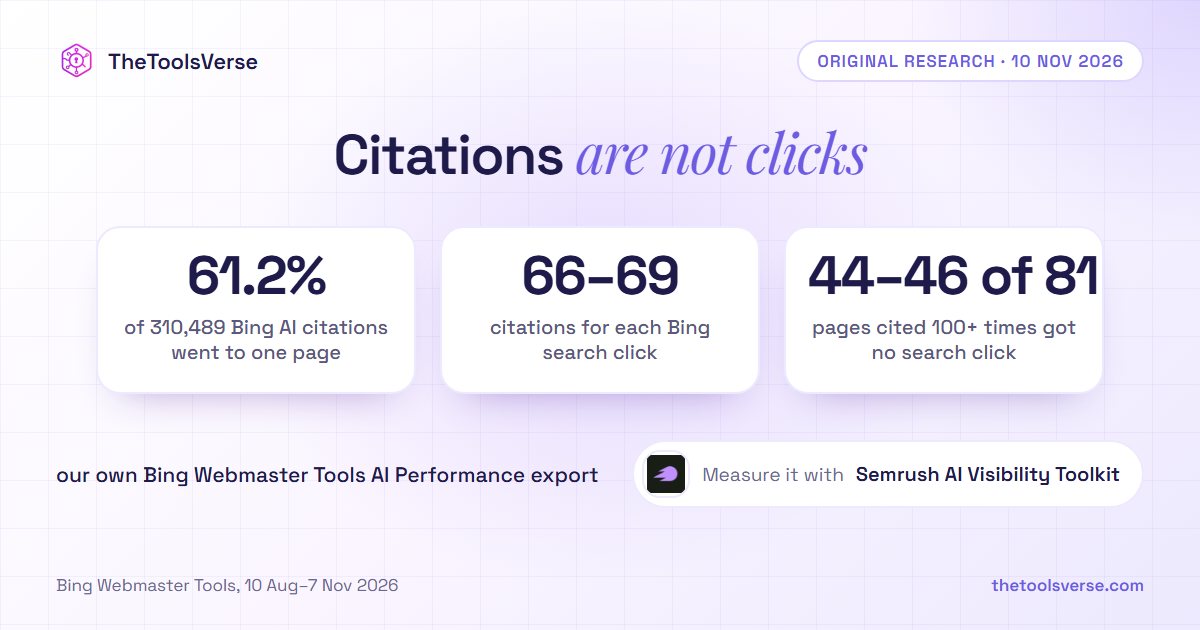
We Asked 88 Questions on 5 AI Engines. Perplexity Cited 3.7 Times as Many Sources as Google AI Mode, and ChatGPT's Hidden Searches Add "2026" to 59% of Queries
Disclosure
This article is promotional content produced as part of the Semrush Creator Accelerator programme. It contains affiliate links to Semrush — if you buy through them we may earn a commission at no extra cost to you — and we may also receive a reward from Semrush for publishing it. All measurements in this article are our own. Semrush did not supply, review or approve the data, and the conclusions we draw are ours.
"Optimise for fan-out queries" is easy to say, and hard to follow without knowing what a fan-out query looks like, how many sources an engine will actually use, or how recent a page has to be to be picked. Advice usually arrives as a rule of thumb for one engine.
So we measured five engines on the same questions. On 24 October 2026 we asked 88 questions about AI tools (where founders list a product, which tool is best for a task, how AI citations work) on ChatGPT, Gemini, Google AI Mode, Perplexity and Claude, using their live web interfaces with search on. That is 440 answers, 2,684 citations and 267 background searches to read.
Measure your own mentions on every engine
See how ChatGPT, Gemini, AI Overviews and AI Mode mention and cite your brand, side by side, with Visibility Overview in the AI Visibility Toolkit. To get it with the SEO Toolkit in one subscription, try Semrush One free for 7 days.
Each engine cites a different number of sources
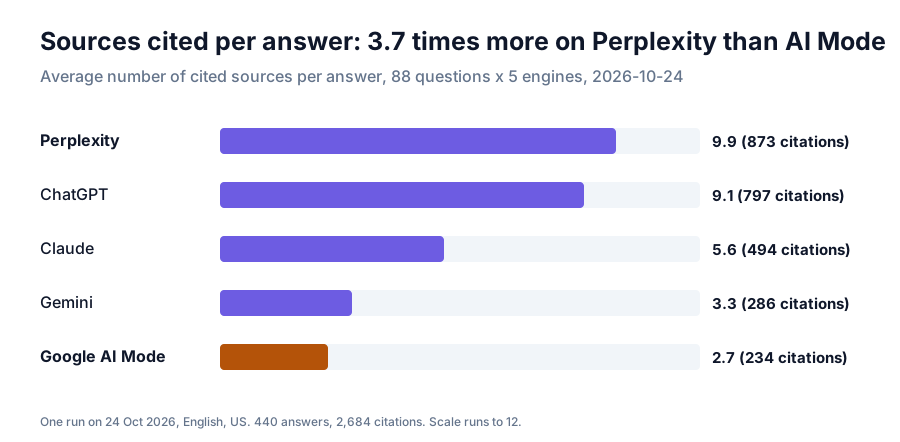
Perplexity cited 9.9 sources per answer and Google AI Mode 2.7, a gap of 3.7 times. ChatGPT sat close to Perplexity at 9.1, and Claude and Gemini in between, at 5.6 and 3.3.
That changes what "being cited" is worth. An answer with 2.7 slots is a much harder place to appear than one with 9.9, and the engines that cite least also left more answers with no citation at all: 7 of Gemini's 88 answers and 3 of AI Mode's carried none, against 1 for ChatGPT and 0 for Perplexity and Claude.
What the hidden searches add
ChatGPT and Claude record the searches they run behind the scenes, the ones usually called fan-out queries. (The tool we used does not expose them for Gemini, AI Mode or Perplexity, so the comparison below covers two engines.) ChatGPT ran 170 of them and Claude 97, about 1.9 and 1.1 per answer. We counted how many contain a given word, and compared that with how often our 88 questions did.
| Word in the query | Our 88 questions | ChatGPT's hidden searches | Claude's hidden searches |
|---|---|---|---|
| "2026" | 12.5% | 59.4% | 57.7% |
| "best" | 45.5% | 31.2% | 44.3% |
| "official" | 0% | 36.5% | 0% |
| "pricing" | 0% | 40.0% | 6.2% |
| "free" | 22.7% | 20.6% | 20.6% |
| "vs" | 17.0% | 11.2% | 19.6% |
Both engines add the year. One in eight of our questions said "2026". Close to three in five of the engines' own searches did. ChatGPT also appended "official" and "pricing", which our questions never used, so it went looking for primary sources and price pages. One example is a ChatGPT search for a directory's submission page: "submit AI tool directory listing Futurepedia There's An AI For That Toolify official submit". A page that does not say what the searcher is looking for, in the searcher's words, may be less likely to be fetched, though we did not test that.
How fresh the cited pages were
ChatGPT returned a publication date for 264 of its 797 citations (33.1%). We measured each date against the day we ran the questions.
- The median dated page was 47 days old.
- 43.6% were 30 days old or less, and 67.8% were 90 days old or less.
Only ChatGPT gave us dates, so we cannot compare engines on freshness. We also do not know whether a date is the day a page was first published or last changed. What the figures do say is that, on these questions, the pages ChatGPT chose were mostly recent.
What a cited title looks like
We counted the share of cited titles that contain a given word. Where an engine gave only the web address as a title, we left it out.
| In the title | ChatGPT | Gemini | AI Mode | Perplexity | Claude |
|---|---|---|---|---|---|
| "2026" | 29.7% | 62.9% | 47.0% | 54.0% | 73.1% |
| "best" | 23.0% | 45.5% | 33.3% | 44.0% | 55.3% |
| "vs" | 4.3% | 20.3% | 19.7% | 12.5% | 16.4% |
Titles with the year and with "best" were common everywhere except ChatGPT, where fewer than a third carried "2026". Claude's citations were the most likely to carry both. If you could change one thing in a title to match what several engines picked, the year is the cheapest.
Where Google's two AI engines looked
Reddit and YouTube accounted for 11.7% of the citations from Gemini and AI Mode together (61 of 520), against 0.4% from the other three engines (8 of 2,164). In AI Mode alone the share was 23.9%: 27 Reddit threads and 29 YouTube videos among 234 citations. ChatGPT cited Reddit once, Claude never.
An engine that leans on forum threads and videos is a different channel from one that cites editorial pages, and it is worth knowing which of the two your buyers' questions go through.
What this cannot tell you
- That the results hold on another day. This was one run. AI answers change from run to run, so treat it as a snapshot and not a ranking.
- That it applies to every subject. Our 88 questions were about AI tools, in English, from the US.
- How Gemini, AI Mode and Perplexity search behind the scenes. The data does not show it.
- Whether a page was chosen because of its date, its title or its quality. We counted what was cited, not why.
- Whether a citation sent anyone to a page. Citation counts are not visits.
Five changes this suggests
- Say the year and the qualifier in the title where it is true: the year, "best", or "vs".
- Answer in the searcher's words. The engines added "official" and "pricing" themselves, so make sure those pages exist and say so.
- Keep a visible, accurate date and update it when the page changes. Recent pages dominated the engine that gave us dates.
- Treat Reddit and YouTube as part of your Google AI presence, not a side project.
- Measure each engine separately, because the number of slots is different on each.
Find the queries, audit the page, track the engines
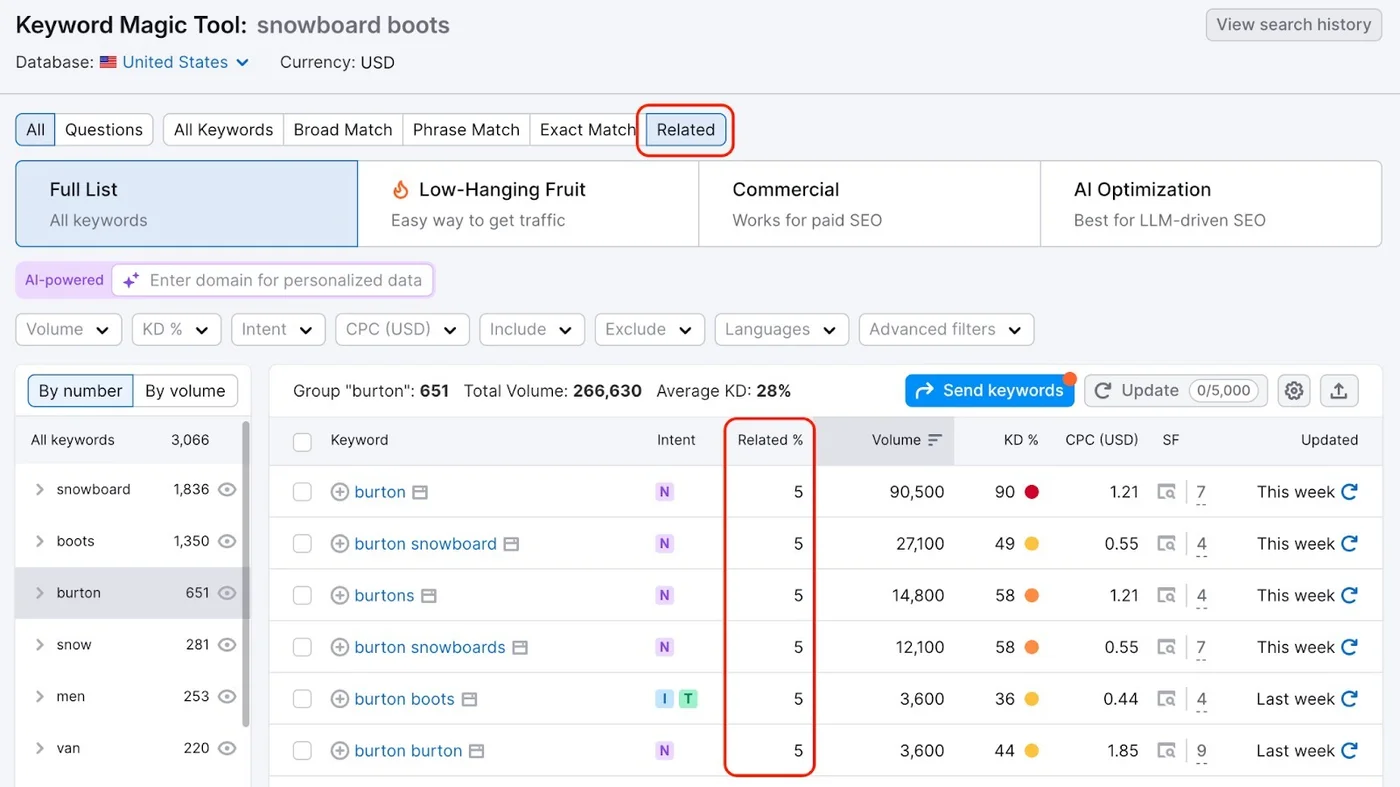
Find the phrases around your topic. The Keyword Magic Tool in the SEO Toolkit expands a seed keyword into related questions and variants with intent and volume, which is where fan-out-style phrases such as a year or "official" can be tested against real demand.
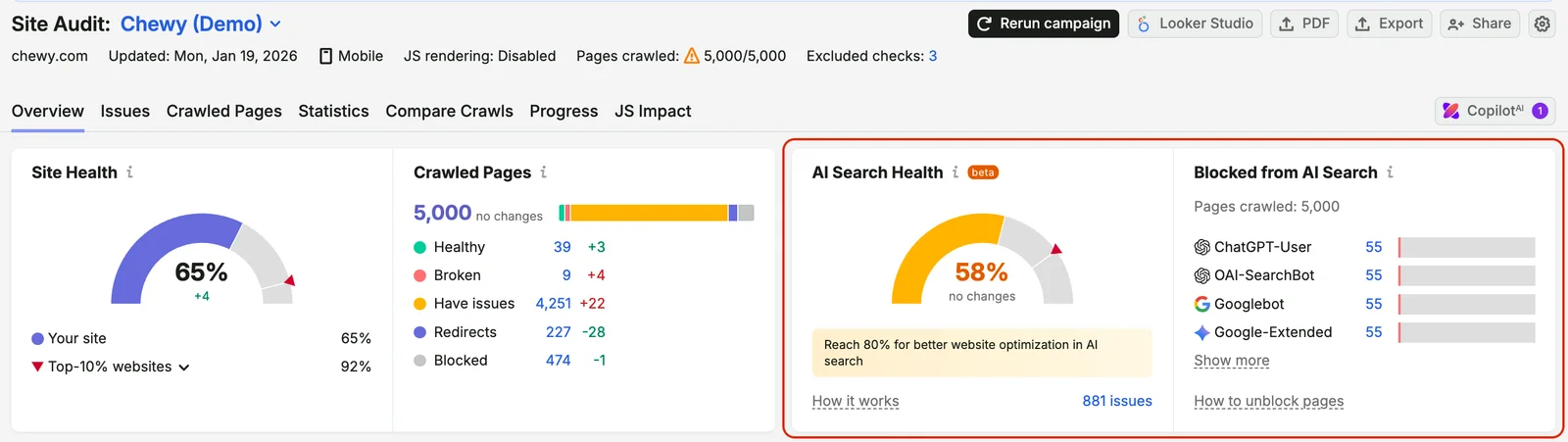
Check that a page can be read and quoted. Site Audit in the SEO Toolkit crawls a site as search engines and AI bots do and reports JavaScript rendering issues and AI Search Health, including pages blocked from AI search bots.
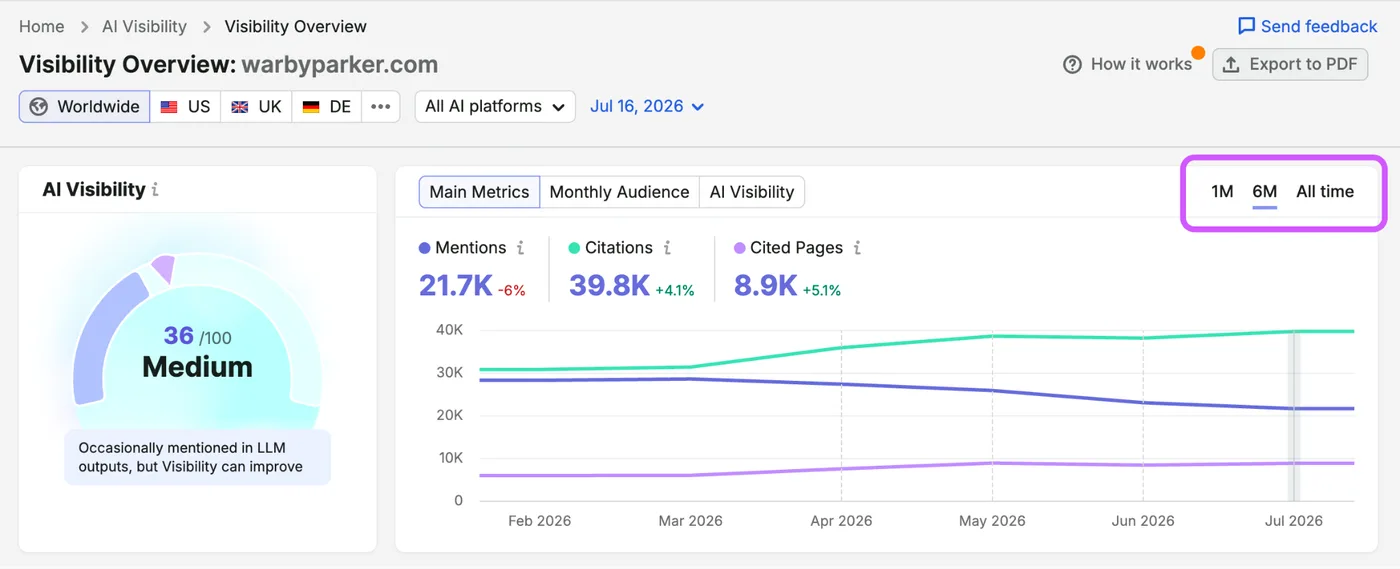
Track each engine on its own. Visibility Overview in the AI Visibility Toolkit breaks mentions and citations down by ChatGPT, AI Overview, AI Mode and Gemini over time, and lets you see where each is citing you or a competitor.
The AI Visibility Toolkit has no free trial of its own; the 7-day free trial is Semrush One's, which includes it alongside the SEO Toolkit. To measure your own brand on each engine before paying, try Semrush One free for 7 days: its page offers "Unlimited access to all Semrush One tools", checked on 16 October 2026. Those are Semrush's published terms, not something we tested; none of the data above came from a Semrush account.
Five engines, five different games
The engines do not share a citation budget, a vocabulary or a taste in sources. Optimising for "AI search" in the singular means optimising for an average that none of them uses. Measure them one at a time.
Try Semrush One free for 7 days
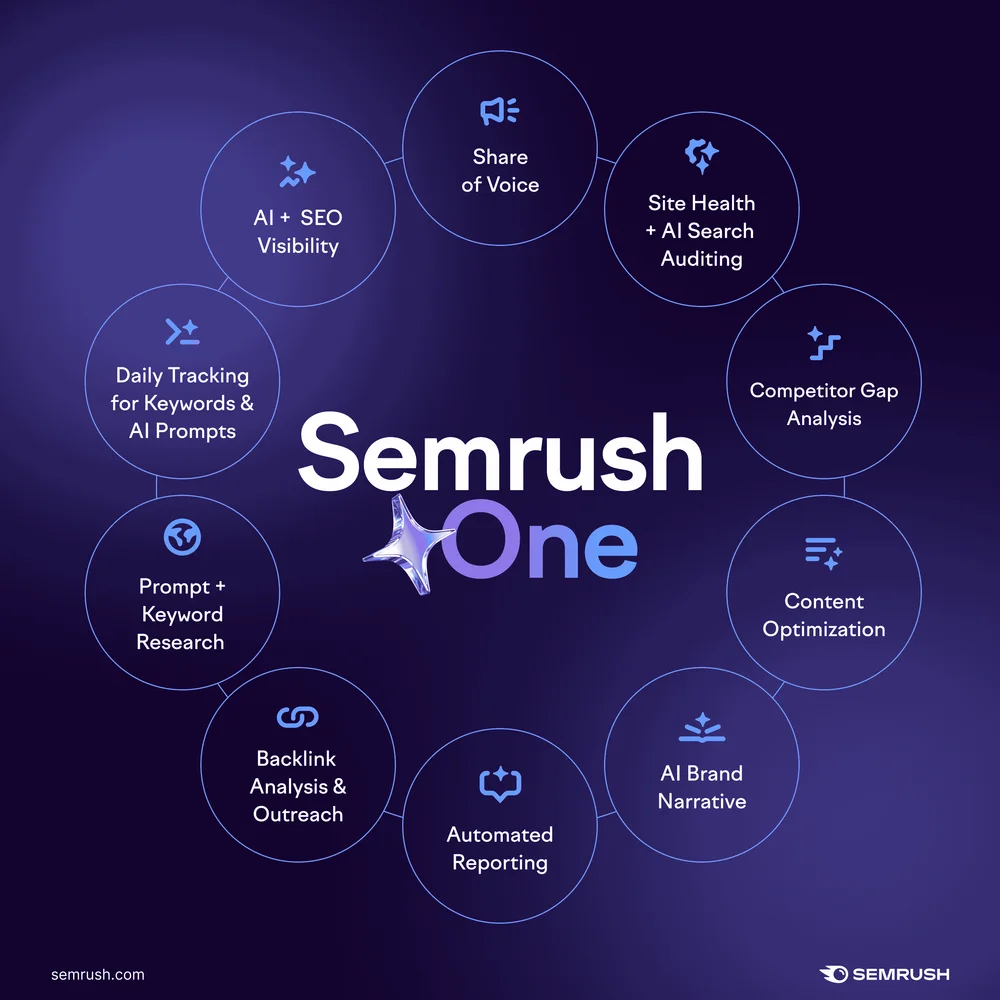
Visibility Overview to see how each AI engine cites your brand, beside Keyword Magic Tool and Site Audit in the SEO Toolkit, together in Semrush One. Free for 7 days for new users.
Try Semrush One free for 7 daysHow we ran it
- Questions: 88 English questions about AI tools: where a founder should list a product, which tool is best for a given task, how AI citations work, and comparisons of well-known tools.
- Engines: ChatGPT (web interface, model gpt-6, search forced on), Gemini (web interface), Google AI Mode, Perplexity (sonar) and Claude (haiku-5-5, web search on), through DataForSEO's LLM scraper, US location, on 24 October 2026. Every question was asked on every engine.
- Counts: all cited sources (2,684 in total) and, for ChatGPT and Claude, the background searches the engine reported (267 in total). Dates and titles are those the engine returned. A word is counted if it appears as a whole word, in any letter case.
- Not shown: which individual sources were cited, our own results on these questions, and any claim that the pattern holds beyond this run.
- Reproduce it: the analysis script is in our research folder (
research/r2-c6-ai-citations-panel/) and reads the saved answers.
Some links may be affiliate links. We may earn a small commission at no extra cost to you.
Related Articles
Explore more guides and reviews from our experts.
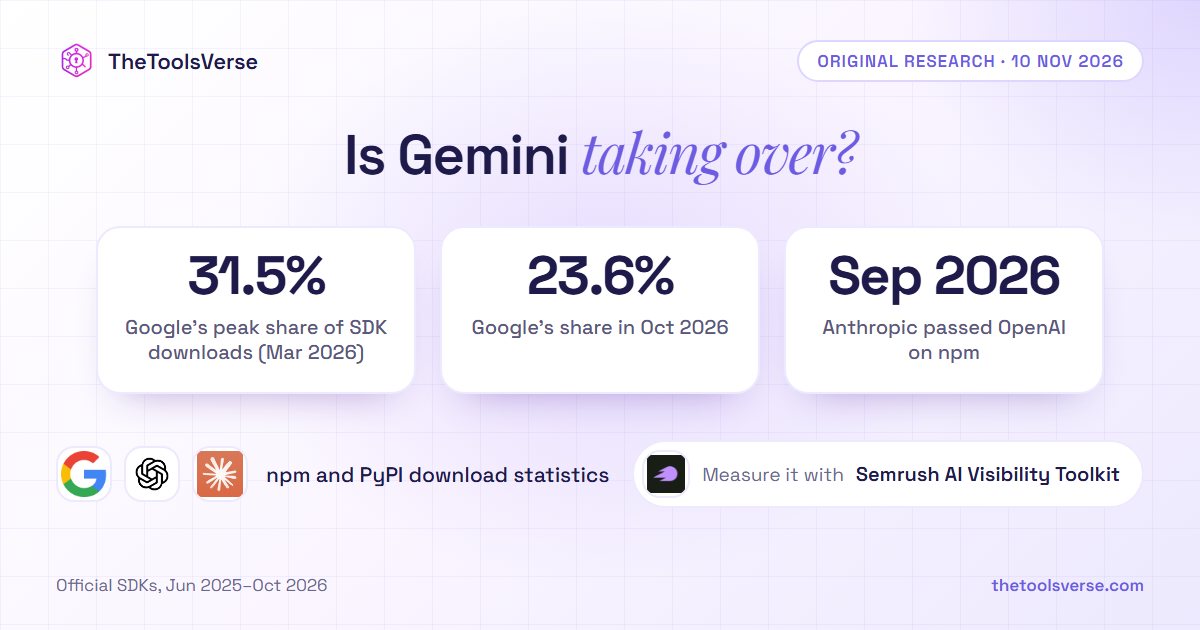
Is Gemini Overtaking ChatGPT? In Developer Downloads, Gemini's Share Peaked in March and Anthropic Passed OpenAI: 17 Months of SDK Data
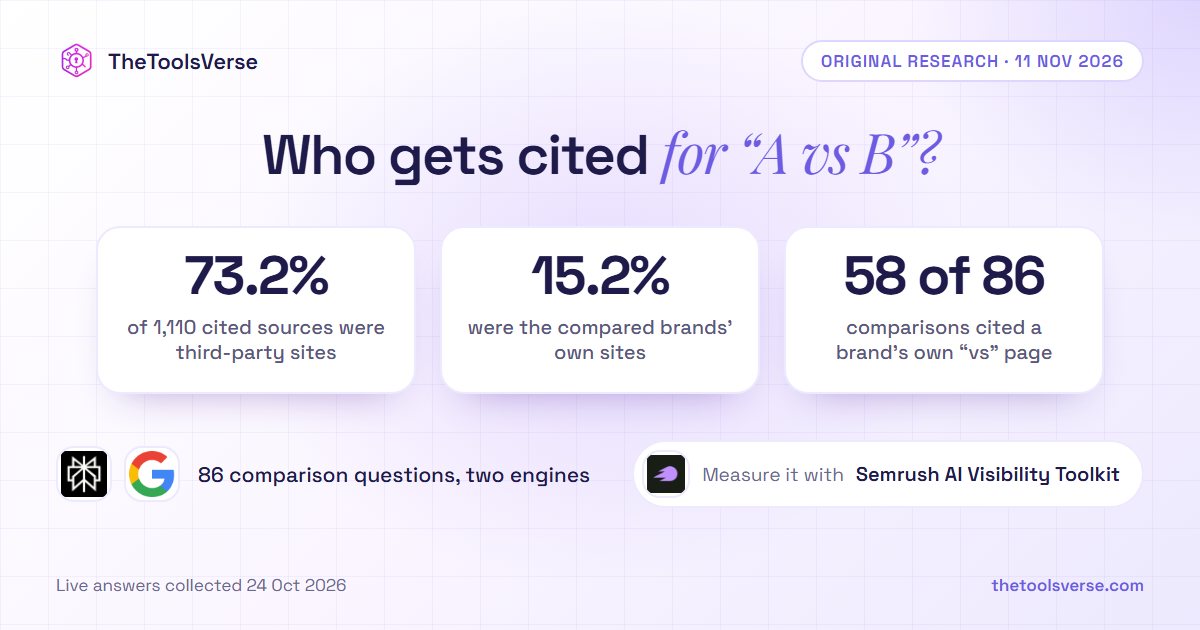
73% of the Sources AI Cited for 86 "A vs B" Questions Were Third-Party Sites and 15% the Brands' Own. Yet Two Comparisons in Three Still Cited a Brand's Own Page