73% of the Sources AI Cited for 86 "A vs B" Questions Were Third-Party Sites and 15% the Brands' Own. Yet Two Comparisons in Three Still Cited a Brand's Own Page
Disclosure
This article is promotional content produced as part of the Semrush Creator Accelerator programme. It contains affiliate links to Semrush — if you buy through them we may earn a commission at no extra cost to you — and we may also receive a reward from Semrush for publishing it. All measurements in this article are our own. Semrush did not supply, review or approve the data, and the conclusions we draw are ours.
A lot of recent advice says the same thing: if you want AI to recommend your brand, spend less time polishing your own site and more time on editorial coverage, review platforms and communities, because those are where the answers come from.
Comparison questions are the cleanest place to test it. When someone asks "A vs B, which is better", an AI answer has to choose whose opinion to cite, and the two brands are right there with their own pages. So we asked 86 of them and sorted every source the answers cited.
Find out who is cited instead of you
See which third-party sources drive mentions of your brand and your competitors across AI answers with Visibility Overview in the AI Visibility Toolkit. To get it with the SEO Toolkit in one subscription, try Semrush One free for 7 days.
The test
On 24 October 2026 we asked "[brand A] vs [brand B] which is better" for 86 pairs of well-known AI and software products on Perplexity and Google AI Mode, in English from the US. The pairs came from the most-searched comparisons in 25 market segments (writing, image generation, CRM, email marketing, coding, meeting notes and others), up to four per segment, each searched at least 50 times a month. Chatbot-versus-chatbot pairs were left out.
That produced 1,110 citations, counting each web address once per question and engine. We put every citation into one of three groups:
- The brands' own sites: the address contains the name of one of the two compared brands.
- Forums, video and review platforms: Reddit, YouTube, Quora, Medium, LinkedIn, GitHub, X, Facebook, G2, Capterra, Trustpilot and Product Hunt.
- Third-party sites: everything else. This includes review and listicle sites, news, and other companies' blogs.
Three in four sources were third-party
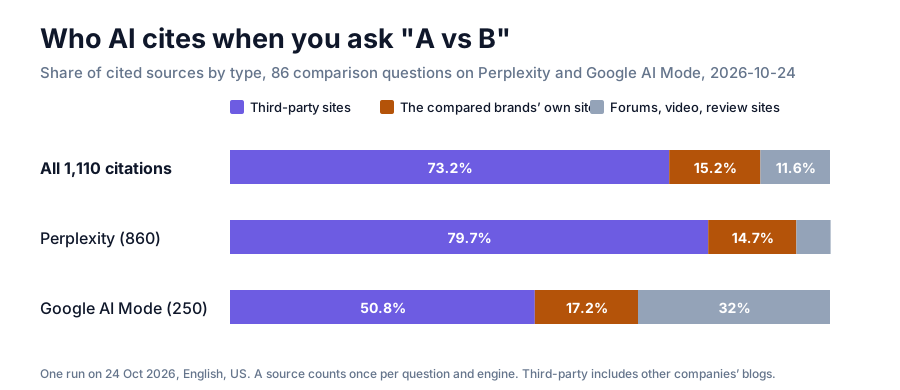
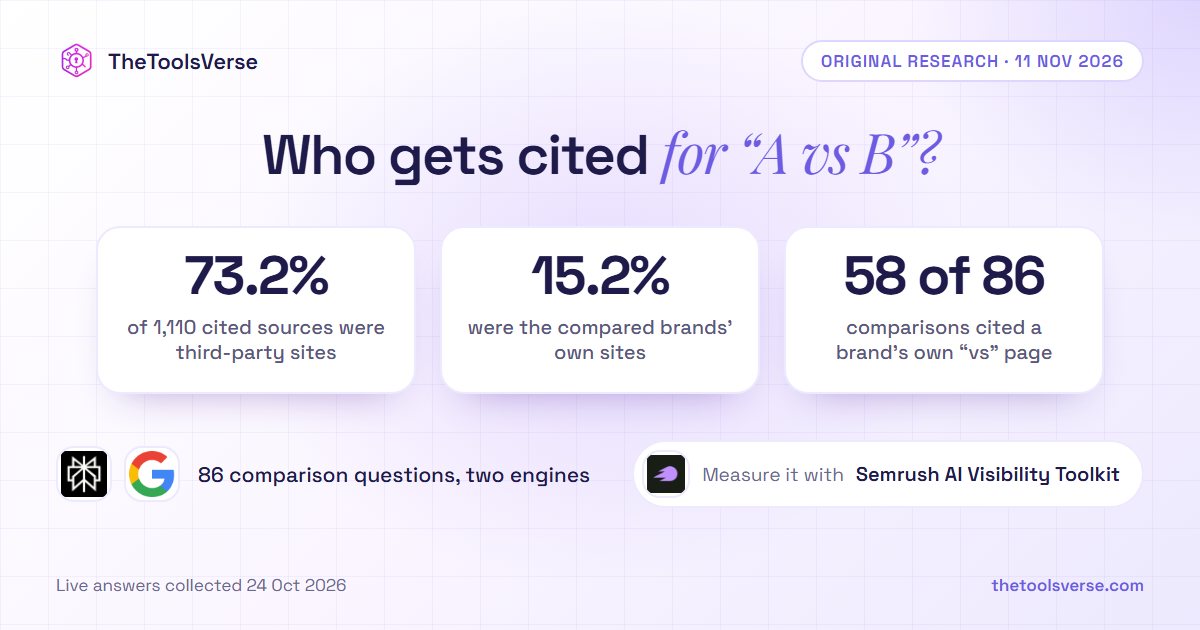
73.2% of the citations (812) went to third-party sites. 15.2% (169) went to the brands themselves, and 11.6% (129) to forums, video and review platforms. The off-site claim holds up on volume: in 15 of the 86 comparisons, at least nine in ten sources were third-party, and in only 8 did they make up under half.
The two engines read the web differently. Perplexity sent 79.7% of its citations to third-party sites and 5.7% to forums and video. Google AI Mode sent 50.8% to third-party sites and 32.0% to forums and video. Across both engines, YouTube (55 citations) and Reddit (41) were the most common forum and video sources.
But the brands' own pages were not shut out
If AI ignored the brands themselves, you would expect almost no brand domains in the citations. That is not what happened.
- 59 of the 86 comparisons cited at least one of the two brands' own sites. The other 27 cited none.
- 58 of them cited a brand page whose address contains "vs", "compare" or "alternative". In other words, nearly every time a brand appeared, it was through a comparison-style page.
So the choice between "off-site" and "on-site" is false. Third-party sites supply most of the sources, and a brand's own comparison page is still often one of them. A site that publishes the page the question is asking for can appear. A site that does not, cannot.
The share varied a lot by market. In four coding comparisons the brands' own sites took 1.9% of citations, and in four automation and no-code comparisons they took 41.5%. (Most segments have four pairs, so treat the range as an indication, not a rule.)
The same few sites keep appearing
Across the 86 comparisons the answers cited 509 different third-party sites, so the long tail is long. But the front of the list is short. We counted the number of comparisons in which each third-party site appeared at least once:
| Site | Comparisons it appeared in (of 86) |
|---|---|
| zapier.com | 23 |
| toolradar.com | 12 |
| selecthub.com | 11 |
| forbes.com | 9 |
| efficient.app | 7 |
| dev.to, aialleyway.com, themexpert.com, techradar.com, itechguides.com | 6 each |
zapier.com alone appeared in more than a quarter of the comparisons (26.7%). A company's own blog counts as third-party here when it compares other companies' products, and Zapier's does. For a brand that wants to be named in an AI comparison, the practical list of places to be covered is a short one, and it is knowable.
Our own site was cited in none of the 86 comparisons.
What this cannot tell you
- That being cited means being recommended. We counted sources, not what the answer said about either brand.
- How other engines behave. We measured two. ChatGPT, Gemini and Claude may differ.
- That the pattern holds on another day or another topic. This was a single run on software and AI tools, and AI answers change from run to run.
- That a "third-party" site is independent. Some are vendors writing about rivals, and some may be paid placements. The groups come from the address, not an editorial check.
- Why a source was chosen. We did not test what made any page win.
What to do with it
- List who gets cited for your comparisons. Ask the "you vs a competitor" questions and write down the third-party sites. That is your off-site target list.
- Publish the comparison page yourself. Nearly every brand citation was a comparison-style page.
- Be present on the recurring sites, with a review, a listing or a fair comparison, before spending on the long tail.
- Treat forums and video as part of the same job, especially for Google's AI.
- Re-run it every month. The mix will move.
Find the sources, find the gaps, find the story
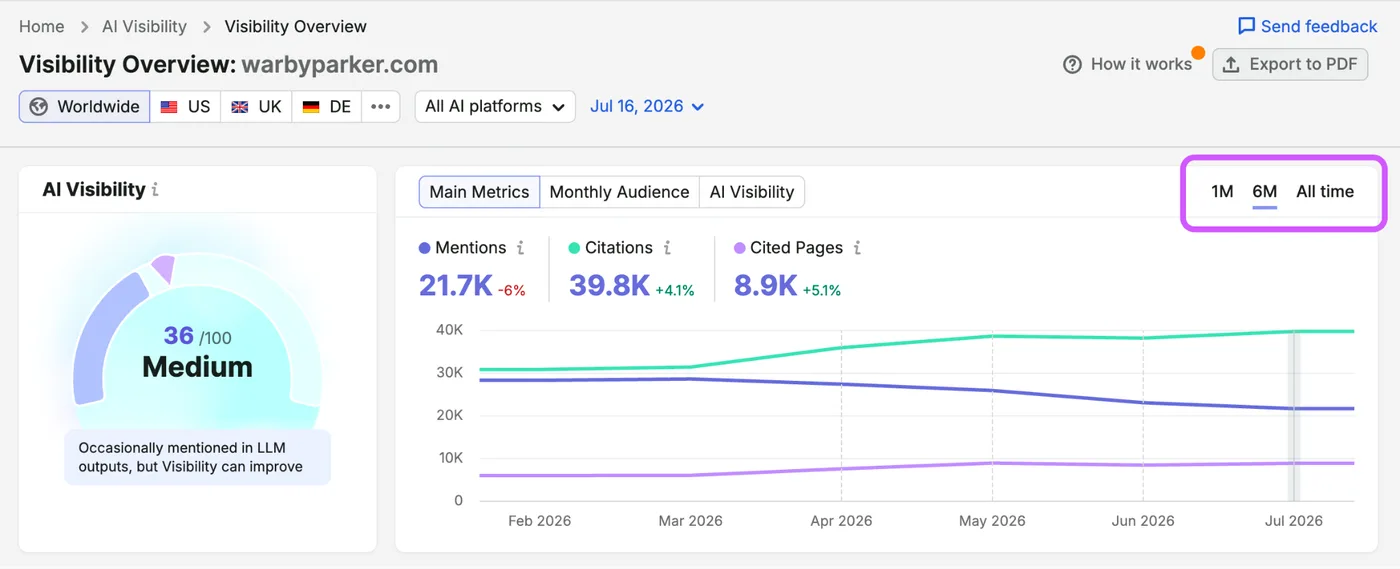
Find which sources feed AI answers about you and your rivals. Visibility Overview in the AI Visibility Toolkit tracks mentions and citations across AI platforms, with the prompts and the cited pages for your brand and for competitors.
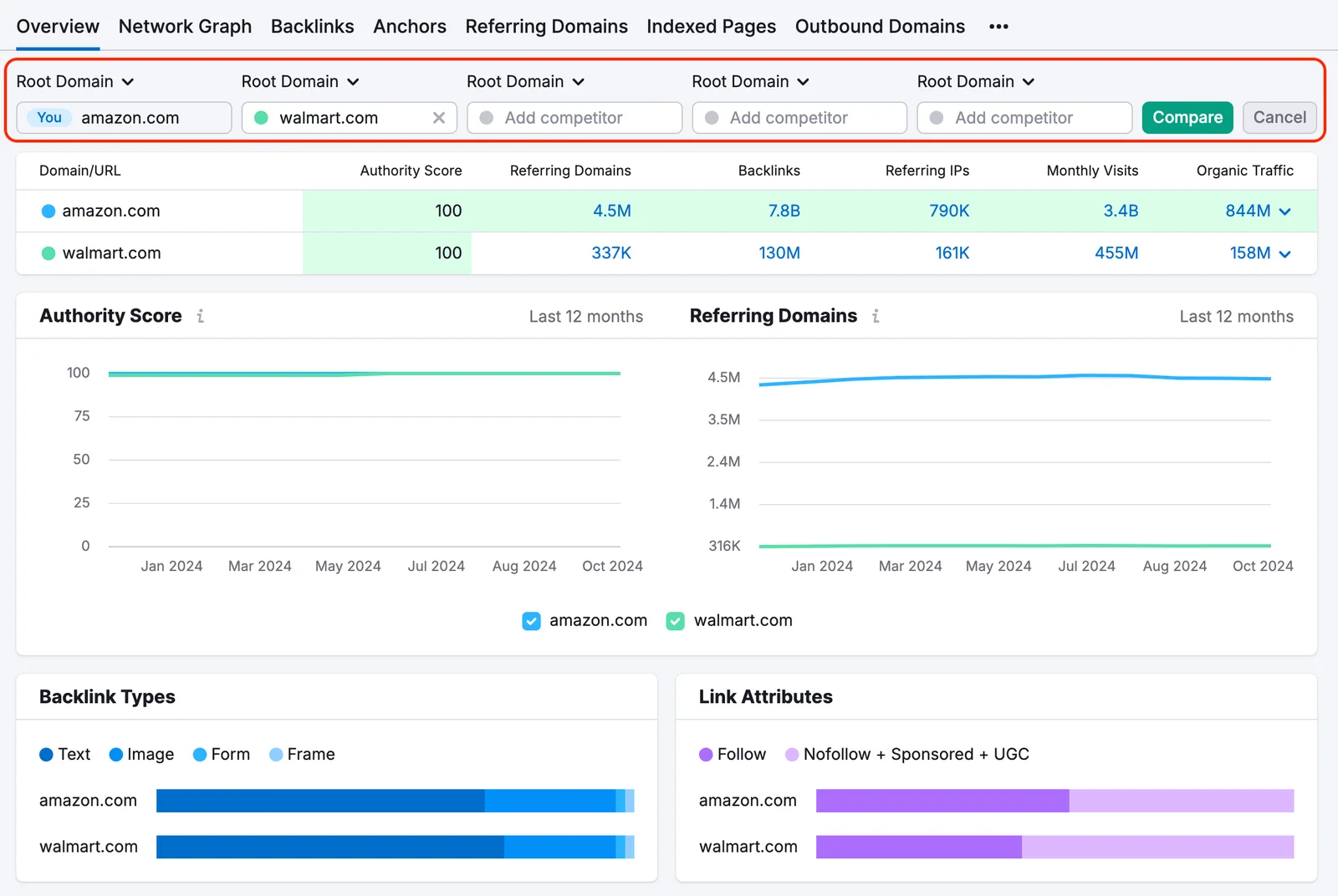
See who links to your competitors. Competitive Research starts with Backlink Analytics in the SEO Toolkit, which compares domains on Authority Score, referring domains and backlinks over time.
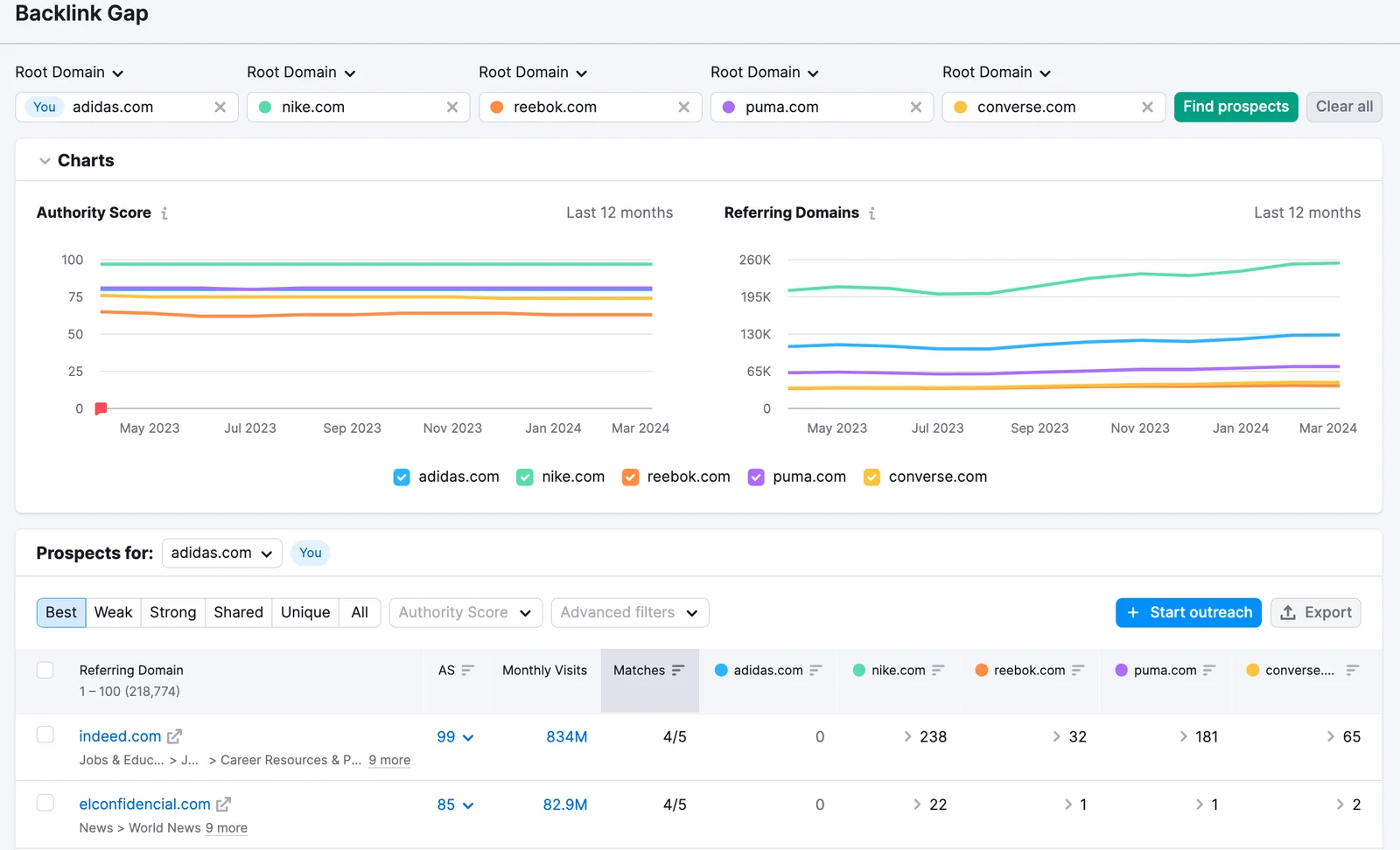
Build the prospect list. Backlink Gap lists the sites that link to up to four competitors but not to you, which is where link building and outreach for editorial coverage can begin.
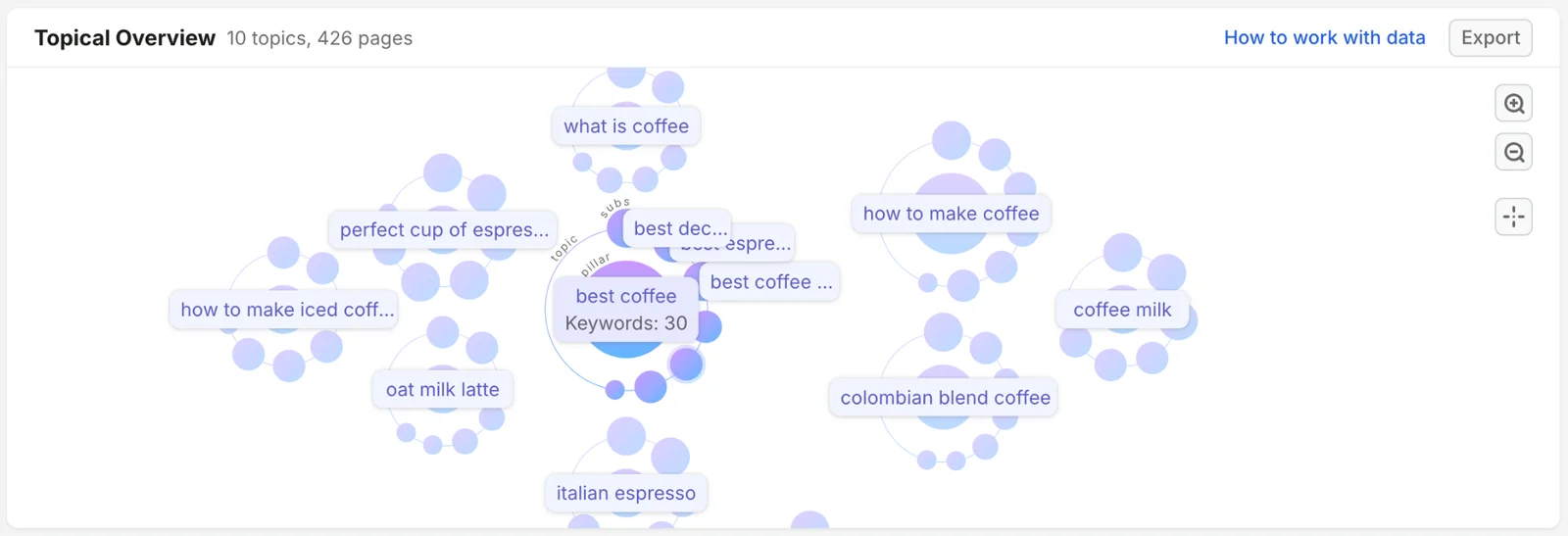
Plan the content worth covering. Keyword Strategy Builder groups related terms into topics and pillar pages, which helps find the comparison and research pages a publisher might cover.
The AI Visibility Toolkit has no free trial of its own; the 7-day free trial is Semrush One's, which includes it alongside the SEO Toolkit. To see which sources cite your brand and your competitors before paying, try Semrush One free for 7 days: its page offers "Unlimited access to all Semrush One tools", checked on 16 October 2026. Those are Semrush's published terms, not something we tested; none of the data above came from a Semrush account.
Your site is a source, not the only one
The data does not say to stop caring about your own pages. It says that most of what AI cites about a comparison lives somewhere else, and that the part that is yours is the comparison page. Know who the third parties are, and give them something to cite.
Try Semrush One free for 7 days
Visibility Overview to see which sources shape AI answers about your brand, with Backlink Analytics and Backlink Gap in the SEO Toolkit to find who links to your rivals, together in Semrush One. Free for 7 days for new users.
Try Semrush One free for 7 daysHow we counted
- Questions: 86 questions of the form "[A] vs [B] which is better", from the most-searched comparisons in 25 market segments, at least 50 searches a month each, up to four per segment. Chatbot pairs were excluded.
- Engines and date: Perplexity (model sonar) and Google AI Mode, through DataForSEO, US location, on 24 October 2026. One question per pair per engine.
- Citations: the web addresses listed as references or annotations in each answer, once per question and engine, with Google's own addresses removed: 860 from Perplexity and 250 from AI Mode, 1,110 in total.
- Groups: the brands' own sites when the host name contains one of the compared brands' names or known aliases of at least three letters; forums, video and review platforms from the fixed list above; third-party for everything else. A comparison page is a brand address containing "vs", "versus", "compar" or "alternative".
- Not shown: the individual answers, what each said about either brand, and any result for ChatGPT, Gemini or Claude.
- Reproduce it: the script and its summary are in our research folder (
research/r2-c7-vs-pairs-sources/) and read the saved answers.
Some links may be affiliate links. We may earn a small commission at no extra cost to you.
Related Articles
Explore more guides and reviews from our experts.
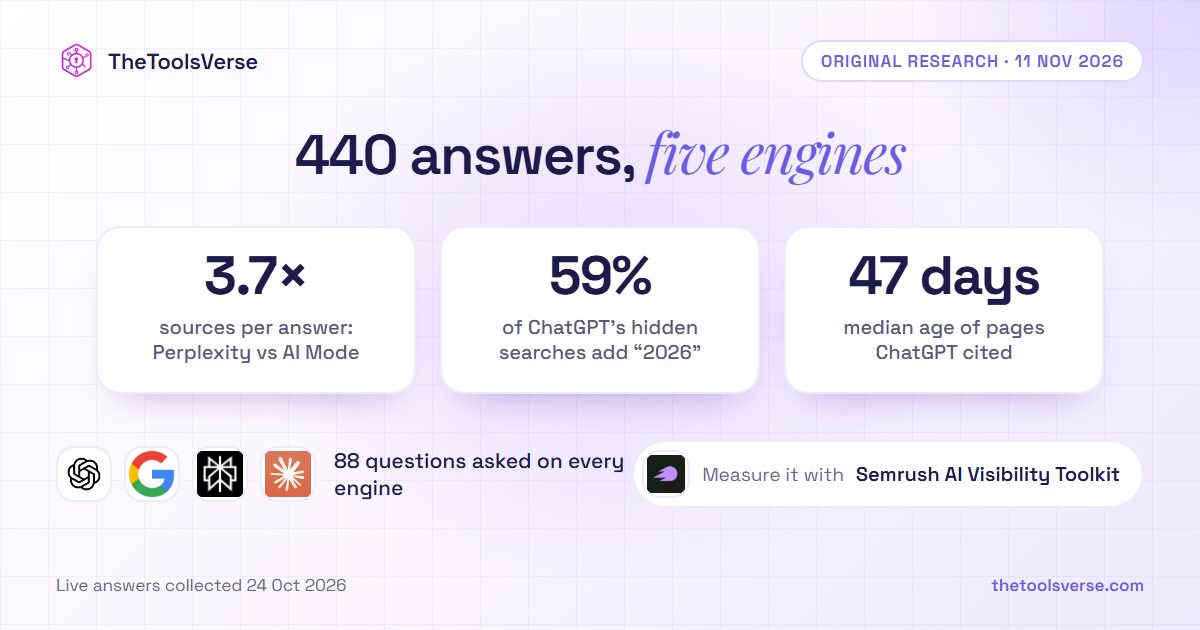
We Asked 88 Questions on 5 AI Engines. Perplexity Cited 3.7 Times as Many Sources as Google AI Mode, and ChatGPT's Hidden Searches Add "2026" to 59% of Queries
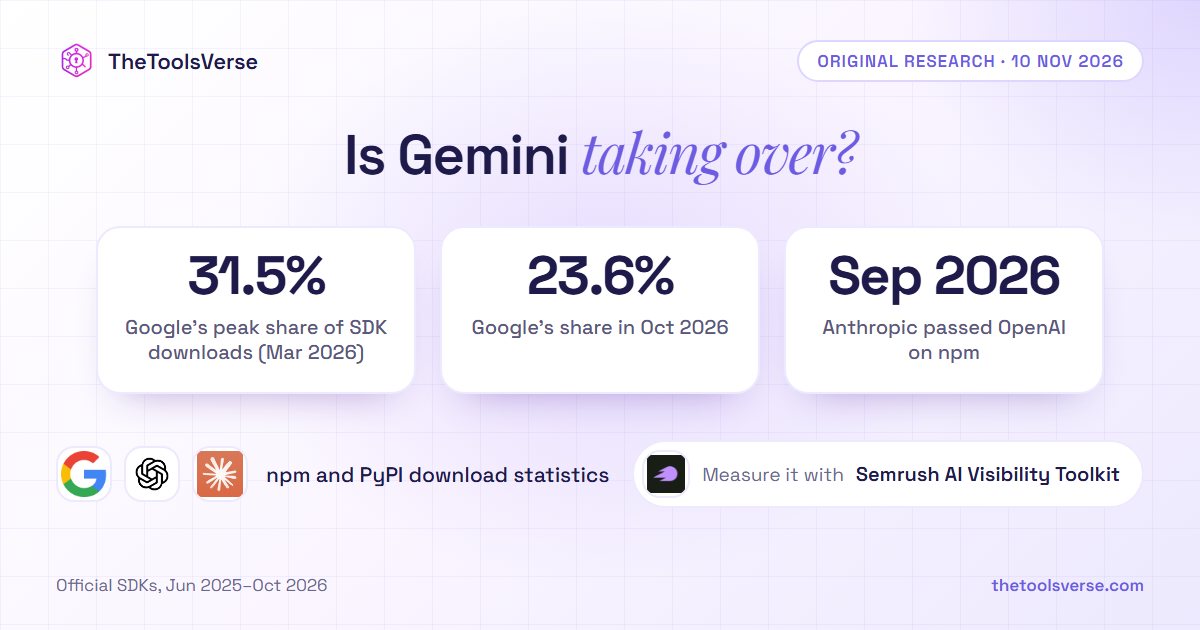
Is Gemini Overtaking ChatGPT? In Developer Downloads, Gemini's Share Peaked in March and Anthropic Passed OpenAI: 17 Months of SDK Data