Pangram vs GPTZero: Which AI Detector Is More Accurate in 2026?
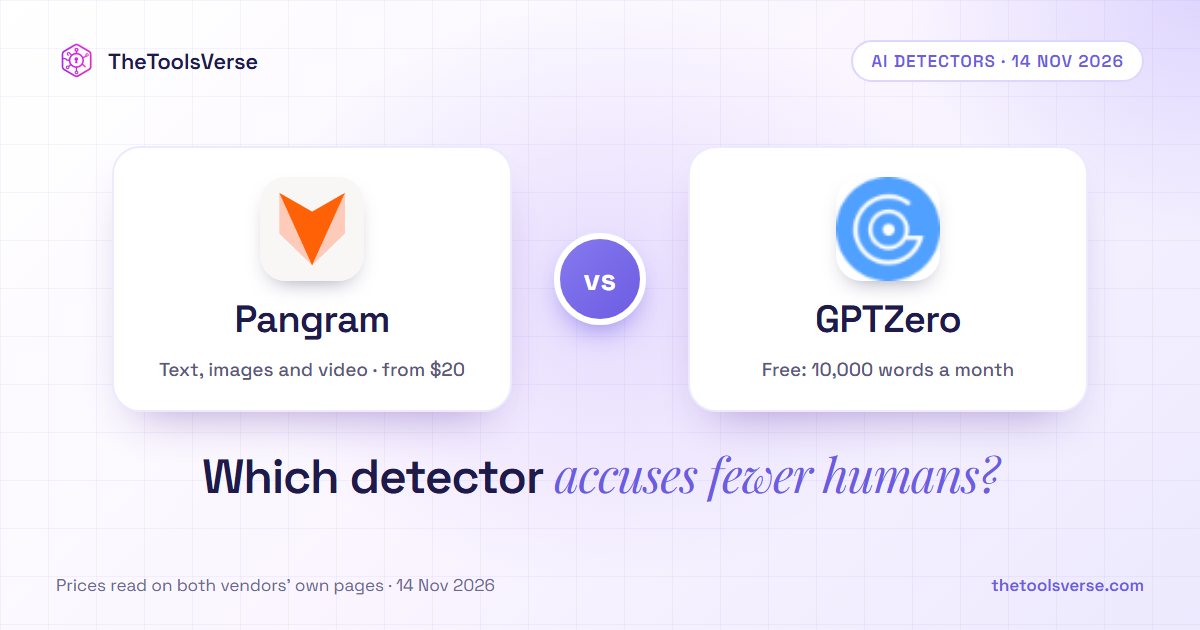
If you have to decide whether a piece of writing came from a person or a model, the detector you use matters more than almost any other choice. A false accusation can cost a student a grade or a freelancer a client, and a missed one lets machine text through. Pangram and GPTZero are the two names that come up most often when people ask which detector to trust, so this comparison puts them side by side on what matters most: how often each one gets it wrong.
The best evidence available is independent. In 2025, two economists at the University of Chicago Booth School of Business ran a large independent head-to-head test of commercial AI detectors, and both Pangram and GPTZero were in it. Their findings sit at the centre of this article, alongside each product's features and pricing, read from the vendors' own pages on 13 and 14 November 2026.
The short version
Pangram is the more accurate detector on the independent evidence. In the University of Chicago Booth study it had the lowest false-positive rate of the commercial tools tested, and it was the only detector that held what the researchers call policy-grade accuracy across all four AI models they tested. It also highlights exactly which passages are AI-written, checks images and video, and cost about a third as much as GPTZero per correct detection. GPTZero is a strong, well-known option with a generous free monthly allowance and classroom tools such as writing replay. If being wrong is expensive for you, choose Pangram.
Pangram vs GPTZero at a glance
| Pangram | GPTZero | |
|---|---|---|
| False positives in the Chicago Booth study | Lowest of the commercial detectors tested | Below 1%, higher than Pangram in 5 of 6 writing types |
| "Policy-grade" accuracy on all four AI models | Yes, the only detector to hold it | No |
| Cost per correct detection (study) | About $0.023 | About three times Pangram's |
| Shows which passages are AI | Yes, including passages edited by AI | Yes, sentence highlighting |
| Images and video | Yes, Pangram Image 1.0 | Not listed on its pricing page |
| Languages | 20+, from Arabic and Hindi to Japanese | Fully supports 5: English, German, Portuguese, French, Spanish |
| Free use | 20 credits a day after signup (1 credit = 100 words) | 10,000 words a month |
| Paid plans | Individual $20 a month, Professional $65 a month | Premium and Professional, priced by region |
| Integrations | Chrome, Google Docs, Gmail, API, MCP, Canvas, Moodle, Google Classroom, Brightspace | Chrome, Google Docs, API, LMS on Professional |
What the independent research found
The study is "Artificial Writing and Automated Detection" by Brian Jabarian and Alex Imas of Chicago Booth, published as NBER Working Paper 34223 in September 2025 and summarised by Chicago Booth Review in December 2025. The researchers built their own set of human-written and AI-generated texts across six kinds of writing, generated the AI versions with four different models, and ran every text through Pangram, GPTZero, Originality.ai and an open-source baseline.
Three findings matter most for anyone choosing between the two.
1. Pangram wrongly flagged the least human writing. A false positive is the costly mistake: a real person's work labelled as AI. Pangram had the lowest false-positive rate of the commercial detectors, described in the Booth Review summary as "essentially 0 across most decision thresholds". Here are the false-positive rates by type of writing, as published on Pangram's site from the study:
| Type of human writing | Pangram | GPTZero |
|---|---|---|
| Product review | 0.5% | 2.4% |
| Blog post | 0% | 0.5% |
| News article | 0.1% | 1.0% |
| Novel excerpt | 0% | 0.5% |
| Restaurant review | 0.8% | 1.0% |
| Résumé | 0% | 0% |
Pangram's rate is lower in five of the six categories and tied in the sixth. On product reviews, GPTZero flagged almost five times as many genuine human reviews as Pangram did.
2. Pangram was the only detector that stayed reliable everywhere. The researchers set a "policy-grade" bar: the level of accuracy you would want before letting a detector inform a real decision. Pangram was, in the study's words, "the only AI detector maintaining policy-grade levels on our main metrics when evaluated on all four generative AI models". When the researchers capped false positives at a strict 0.5%, Pangram was the only tool that kept high detection accuracy, according to The Decoder's report on the study.
3. Pangram was the cheapest per correct answer. Price per month only tells you part of the cost. The study also measured cost per correctly identified AI text, and Pangram came out at about $0.023, roughly a third of GPTZero's, as reported by The Decoder.
To be fair to GPTZero, it also performed well. All three commercial detectors in the study kept false positives below 1% on most tests, far ahead of the open-source baseline, which wrongly flagged between 30% and 78% of human writing. GPTZero is a serious tool. On the evidence, Pangram is simply the more dependable one.
Why false positives matter most
A detector that misses some AI text is an inconvenience. A detector that accuses a person who wrote their own work is a real harm, to a student, an employee or a freelancer. That is why the false-positive rate is the first number to check, and it is where Pangram leads.
Pangram: built for accuracy
Pangram is a dedicated AI detector. You paste text, upload a file or enter a URL, and it reports how much of the document is AI-written, highlighting the specific passages rather than giving one score for the whole thing. That matters for mixed documents: a report where a person wrote most of it and used a model for one section shows up as exactly that. Pangram also highlights passages that were edited by AI rather than fully generated, which it lists as included on the free plan.
Pangram says its false-positive rate is currently 1 in 10,000, and it detects the latest models from OpenAI, Anthropic, Google, xAI, DeepSeek and Meta; its site says it benchmarks against 26 models. Beyond text, Pangram Image 1.0 checks images (JPG, PNG or WebP) and videos (MP4, MOV or WebM) for AI generation, something GPTZero's pricing page does not list.
It fits into the places people already check work: a Chrome extension, a Google Docs add-on, Gmail, an API, an MCP server for AI assistants, and LMS integrations for Canvas, Moodle, Google Classroom and Brightspace. It supports more than 20 languages, from Arabic and Hindi to Japanese and Vietnamese.
Pros & Cons
Pros
- +Lowest false-positive rate of the commercial detectors in the Chicago Booth study
- +The only detector to hold policy-grade accuracy across all four AI models tested
- +Highlights which passages are AI-written, including passages edited by AI
- +Checks images and video as well as text
- +Supports 20+ languages, against the 5 GPTZero says it fully supports
- +About a third of GPTZero's cost per correct detection in the study
- +Integrations for Chrome, Google Docs, Gmail, API, MCP and four LMS platforms
Cons
- −Free use is 20 credits a day after signup, about 2,000 words, rather than a monthly allowance
- −Plagiarism checking needs a paid plan
- −Data-retention period is not stated on the pricing page
GPTZero: built for the classroom
GPTZero is one of the best-known AI detectors and was built with teachers in mind. It gives a probability that a text is AI-written and highlights the sentences driving that score. Its strengths are around the classroom: Writing Replay, which lets a student show how a document was written, an official partnership with the American Federation of Teachers, and a large user base. It also offers a plagiarism checker and a hallucination detector for checking AI-written claims.
Its free plan is generous by volume, at 10,000 words a month with a basic scan, one free advanced scan, and five AI highlights in its Chrome extension. Premium raises that to 300,000 words a month with advanced scans, multilingual detection and downloadable reports; Professional allows 500,000 words, up to 2 million words of overage, and batch scanning of up to 250 files.
Pros & Cons
Pros
- +Generous free plan: 10,000 words a month
- +Writing Replay and classroom tools for teachers
- +Plagiarism checker and hallucination detector
- +Batch scanning of up to 250 files on Professional
Cons
- −More false positives than Pangram in 5 of 6 writing types in the Chicago Booth study
- −Did not hold policy-grade accuracy across all four AI models in the study
- −About three times Pangram's cost per correct detection in the study
- −Fully supports 5 languages, against Pangram's 20+
- −No image or video detection listed on its pricing page
- −Prices are shown in local currency and vary by region
Pricing
Pangram (read from pangram.com/pricing on 13 November 2026):
- Free: 20 credits a day after signing up, where one credit covers 100 words, with AI-assistance detection included.
- Individual: $20 a month, with a 7-day free trial, 300,000 words and 100 image scans a month, plus $10 of API credits; save $60 a year billed annually.
- Professional: $65 a month, with five times the words and image scans and $200 of API credits a month; save $240 a year billed annually.
GPTZero (read from gptzero.me/pricing on 14 November 2026):
- Free: 10,000 words a month, basic scan, one free advanced scan.
- Premium: 300,000 words a month, advanced scan, multilingual detection, downloadable reports.
- Professional: 500,000 words a month, up to 2 million words of overage, batch scanning.
- GPTZero shows prices in local currency, so the figure you see depends on where you are, and annual billing saves up to 45%.
At the same 300,000-word monthly allowance, the deciding factor is not the sticker price but how often each tool is right. On the study's cost-per-correct-detection measure, Pangram is the better value.
Which one should you choose?
- You need to be confident before you act on a result (a teacher, an editor, an HR or compliance team) → Pangram, for the lowest false-positive rate on the independent evidence.
- You check documents that mix human and AI writing → Pangram, which highlights the AI and AI-edited passages.
- You also need to check images or video, or work in languages beyond the main European ones → Pangram.
- You check large volumes and care about cost → Pangram, at about a third of GPTZero's cost per correct detection in the study.
- You are a teacher who wants students to prove their process with writing replay → GPTZero's classroom tools are built for that.
- You only need an occasional free check of a long document → GPTZero's 10,000 free words a month go further than Pangram's daily credits.
Our pick
For most people who need a detector they can trust, Pangram is the better choice. It made the fewest false accusations in a large independent test of commercial detectors, stayed reliable across every model tested, and shows you which passages it flagged so you can judge the result yourself. Try Pangram free.
Frequently Asked Questions
Is Pangram more accurate than GPTZero?
On the independent evidence, yes. In the University of Chicago Booth study (NBER Working Paper 34223, 2025), Pangram had the lowest false-positive rate of the commercial detectors tested and was the only one to keep policy-grade accuracy across all four AI models. GPTZero also performed well, with false positives below 1% on most tests.
Which AI detector has the fewest false positives?
In the Chicago Booth study, Pangram. Its false-positive rate was 0% on blog posts, novel excerpts and résumés, and lower than GPTZero's in five of the six types of writing tested. Pangram reports a current false-positive rate of 1 in 10,000.
Is Pangram free?
Yes, there is a free plan: 20 credits a day after signing up, where one credit covers 100 words, so about 2,000 words a day. It includes detection of AI-assisted passages. Paid plans start at $20 a month with a 7-day free trial.
Is GPTZero free?
GPTZero has a free plan with 10,000 words a month, a basic scan and one free advanced scan. Advanced scans, multilingual detection and reports need a paid plan.
Can Pangram detect AI in images and videos?
Yes. Pangram Image 1.0 checks JPG, PNG and WebP images and MP4, MOV and WebM videos for AI generation. GPTZero's pricing page lists text detection only.
Does Pangram show which parts of a document are AI?
Yes. Pangram reports how much of a document is AI-written and highlights the specific passages, including passages that were edited by AI rather than fully generated.
Final verdict
Both are serious detectors, and both are far better than the free open-source alternatives. But when the question is which one to trust before you act on a result, the independent evidence points one way. Pangram made the fewest false accusations, held up across every AI model in the Chicago Booth test, highlights exactly what it flagged, covers images and video, and costs less per correct answer.
Choose Pangram when accuracy matters. Choose GPTZero if your main need is a classroom workflow built around writing replay.
Try Pangram free
Check text, images and video for AI with the detector that made the fewest false accusations in the University of Chicago Booth study. Twenty free credits a day after signup.
Try Pangram freeArticle by Sohail Akhtar, Founder of TheToolsVerse. Study findings from NBER Working Paper 34223 (Jabarian and Imas, 2025), Chicago Booth Review (2 December 2025) and The Decoder (2 November 2025). Pangram's prices and features read from pangram.com on 13 November 2026; GPTZero's from gptzero.me on 14 November 2026.
Pangram is an affiliate partner of TheToolsVerse: we earn a commission if you subscribe through our links, at no extra cost to you. GPTZero did not pay for this comparison. How partnerships work.
Some links may be affiliate links. We may earn a small commission at no extra cost to you.
Make an AI tool? Get it into a comparison like this.
Related Articles
Explore more guides and reviews from our experts.
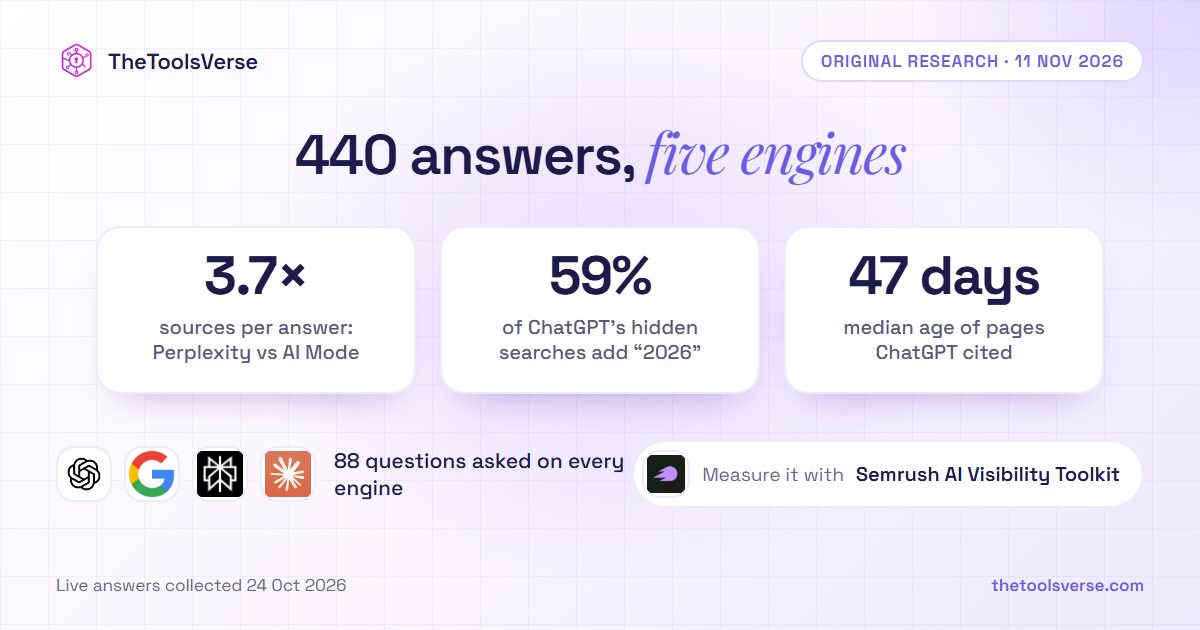
We Asked 88 Questions on 5 AI Engines. Perplexity Cited 3.7 Times as Many Sources as Google AI Mode, and ChatGPT's Hidden Searches Add "2026" to 59% of Queries
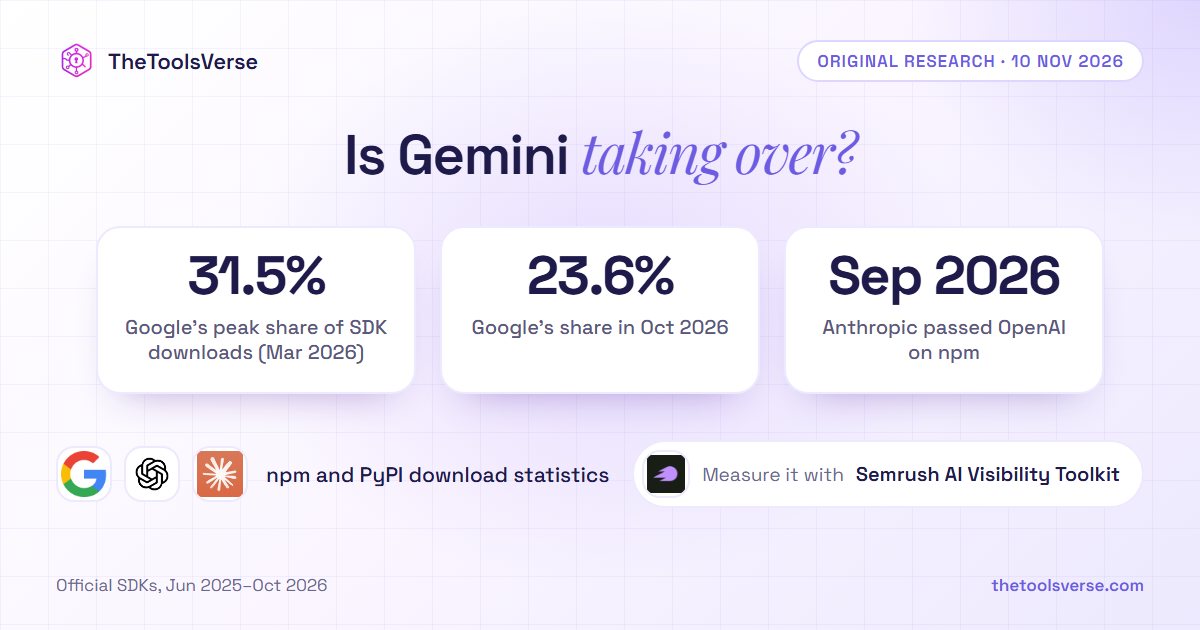
Is Gemini Overtaking ChatGPT? In Developer Downloads, Gemini's Share Peaked in March and Anthropic Passed OpenAI: 17 Months of SDK Data