We Audited the Product Pages AI Shopping Answers Cite Against Microsoft's GEO Checklist
Disclosure
This article is promotional content produced as part of the Semrush Creator Accelerator programme. It contains affiliate links to Semrush — if you buy through them we may earn a commission at no extra cost to you — and we may also receive a reward from Semrush for publishing it. All measurements in this article are our own. Semrush did not supply, review or approve the data, and the conclusions we draw are ours.
Microsoft Advertising has published a guide for retailers on being found in AI shopping answers: From Discovery to Influence: A Guide to AEO and GEO. Its starting point is familiar — "The base remains the same: up-to-date product feeds and clear, crawlable, structured content." — and its first section is a concrete checklist. We wanted to know whether the product pages AI answers actually cite follow it.
See how AI answers present your products
Track how your brand shows up in Google AI Mode, ChatGPT and AI Overviews — and how it compares with competitors — with Brand Performance in the AI Visibility Toolkit. To get it with SEO and AI Overview tracking in one subscription, try Semrush One free for 7 days.
The checklist
Under "Data structure: Make your catalog machine-readable", the guide asks retailers to "Deploy Product, Offer, AggregateRating, Review, Brand, ItemList, and FAQ schema types." and to "Include dynamic fields: price, availability, color, size, SKU, GTIN, and dateModified." It adds: "Use ItemList markup for collections and category pages so AI understands product groupings."
That is 14 items — seven schema types and seven fields — which a crawler can check on any page. So we checked them.
The audit
We wrote 40 shopping questions across eight product categories — kitchen knives, yoga mats, backpacks, board games, sunglasses, desk lamps, water bottles and bed sheets: three naming a product ("wusthof classic 8 inch chef knife", "stanley quencher 40 oz price") and two "best" questions in each. On 17 October 2026 we asked each one of Google AI Mode and ChatGPT and collected Google's top 10. Then we fetched every page any of them pointed to and read its structured data.
A product page here is any page we could read that carries Product markup — usually a brand or retailer listing, sometimes a review site marking up the products it reviews. That gave us 143 product pages: 93 that AI Mode or ChatGPT cited, and 50 in Google's top 10 that neither cited.
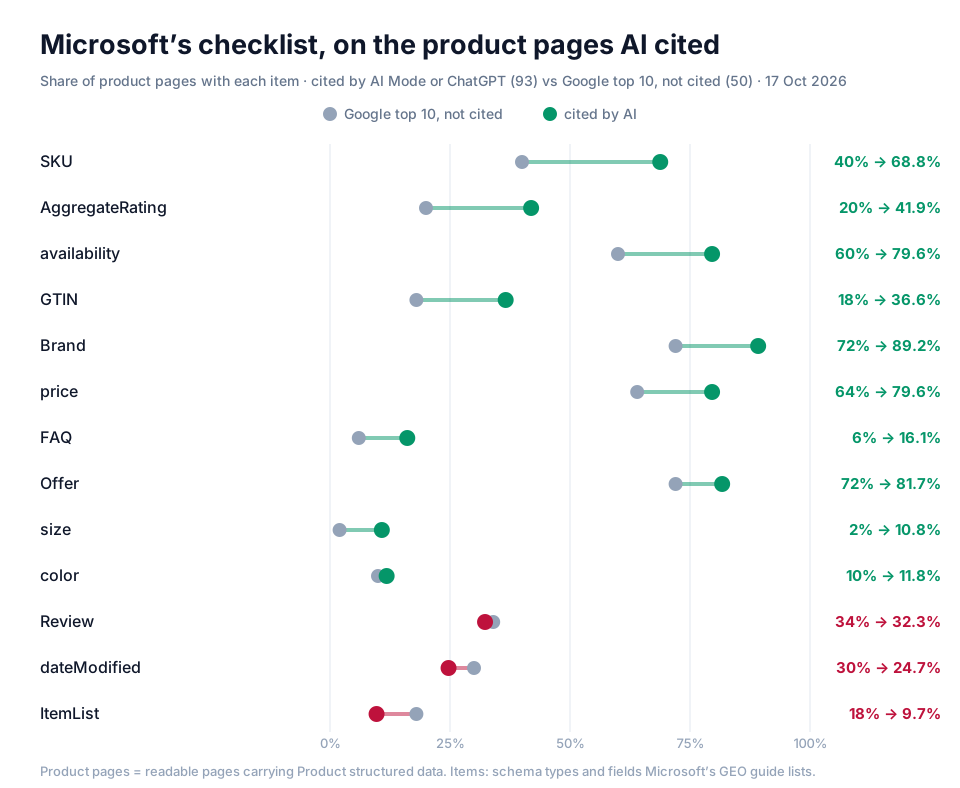
Item by item: cited pages vs skipped pages
| Checklist item | Cited by AI (93 pages) | Google top 10, not cited (50) |
|---|---|---|
| Checklist items met (median, of 14) | 7 | 5 |
| Offer | 81.7% | 72% |
| AggregateRating | 41.9% | 20% |
| Review | 32.3% | 34% |
| Brand | 89.2% | 72% |
| ItemList | 9.7% | 18% |
| FAQ | 16.1% | 6% |
| price | 79.6% | 64% |
| availability | 79.6% | 60% |
| color | 11.8% | 10% |
| size | 10.8% | 2% |
| SKU | 68.8% | 40% |
| GTIN | 36.6% | 18% |
| dateModified | 24.7% | 30% |
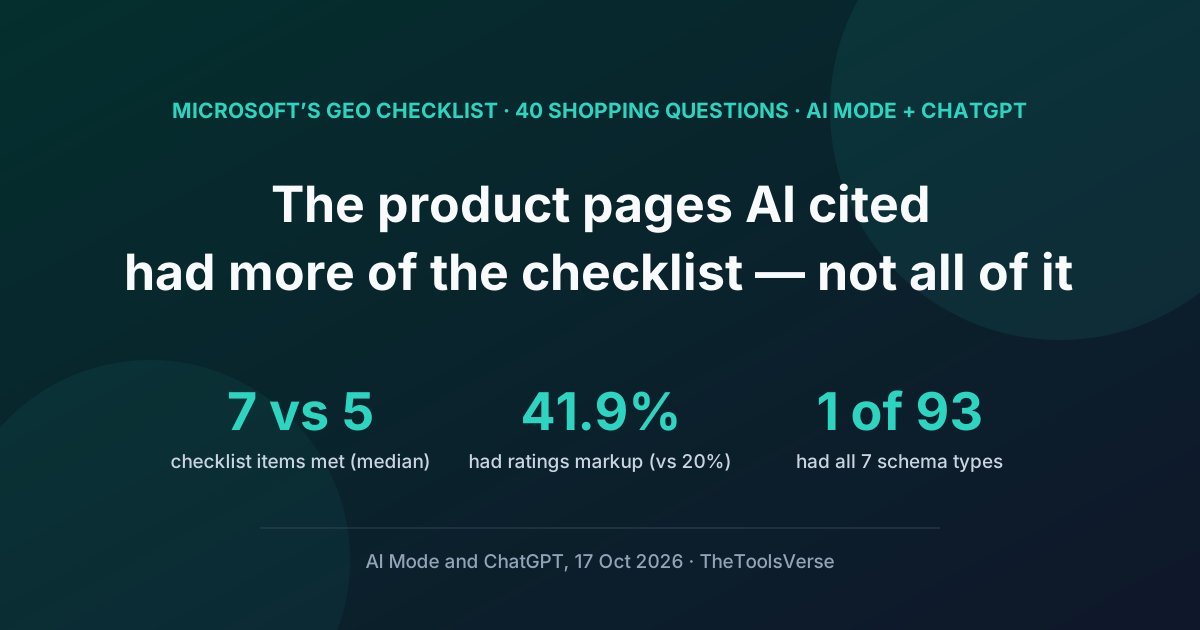
| All seven schema types | 1 of 93 | 1 of 50 |
The pages AI cited met more of the checklist: a median of 7 of 14 items against 5. Split by engine, the picture was the same — a median of 7 for the 46 product pages AI Mode cited and for the 59 ChatGPT cited.
What separated cited pages: the identifiers
The biggest gaps were in the fields that tell a machine exactly which product this is and what it costs:
- SKU: on 68.8% of cited pages, 40% of uncited ones.
- Ratings (AggregateRating): 41.9% against 20% — more than twice as common.
- GTIN: 36.6% against 18%.
- Brand: 89.2% against 72%.
- Price and availability: 79.6% each against 64% and 60%.
These are the fields an AI shopping answer can repeat — the product, its price, whether it is in stock, how buyers rate it. Pages that stated them in markup were cited more often.
What didn't: freshness dates, item lists and reviews
Three items on Microsoft's list were less common on cited pages. dateModified appeared on 24.7% of cited pages against 30% of uncited ones; ItemList on 9.7% against 18%; individual Review markup was level at 32.3% and 34%. ItemList is meant for category pages, and most cited pages were single products, so its absence is no surprise. Color and size were rare everywhere — 11.8% and 10.8% of cited pages.
Almost nobody follows the whole list
Only 1 of the 93 cited product pages carried all seven schema types the guide names — and 1 of the 50 uncited ones. The pages AI relied on were not complete checklists; they were pages that got the identifiers right. If you can only do part of Microsoft's list, the audit suggests starting with SKU, GTIN, price, availability, brand and ratings.
One more pattern: most pages AI cited for shopping questions were not product pages at all. Of the cited pages we could read, 38.3% of AI Mode's and 36.6% of ChatGPT's carried Product markup; the rest were reviews, buying guides and forum threads. The product page is one way into the answer, not the only one.
Measuring the influence the guide talks about
Microsoft's guide frames AI shopping as influence rather than clicks — whether the answer names your product, describes it well and recommends it. That has to be measured inside the answers.
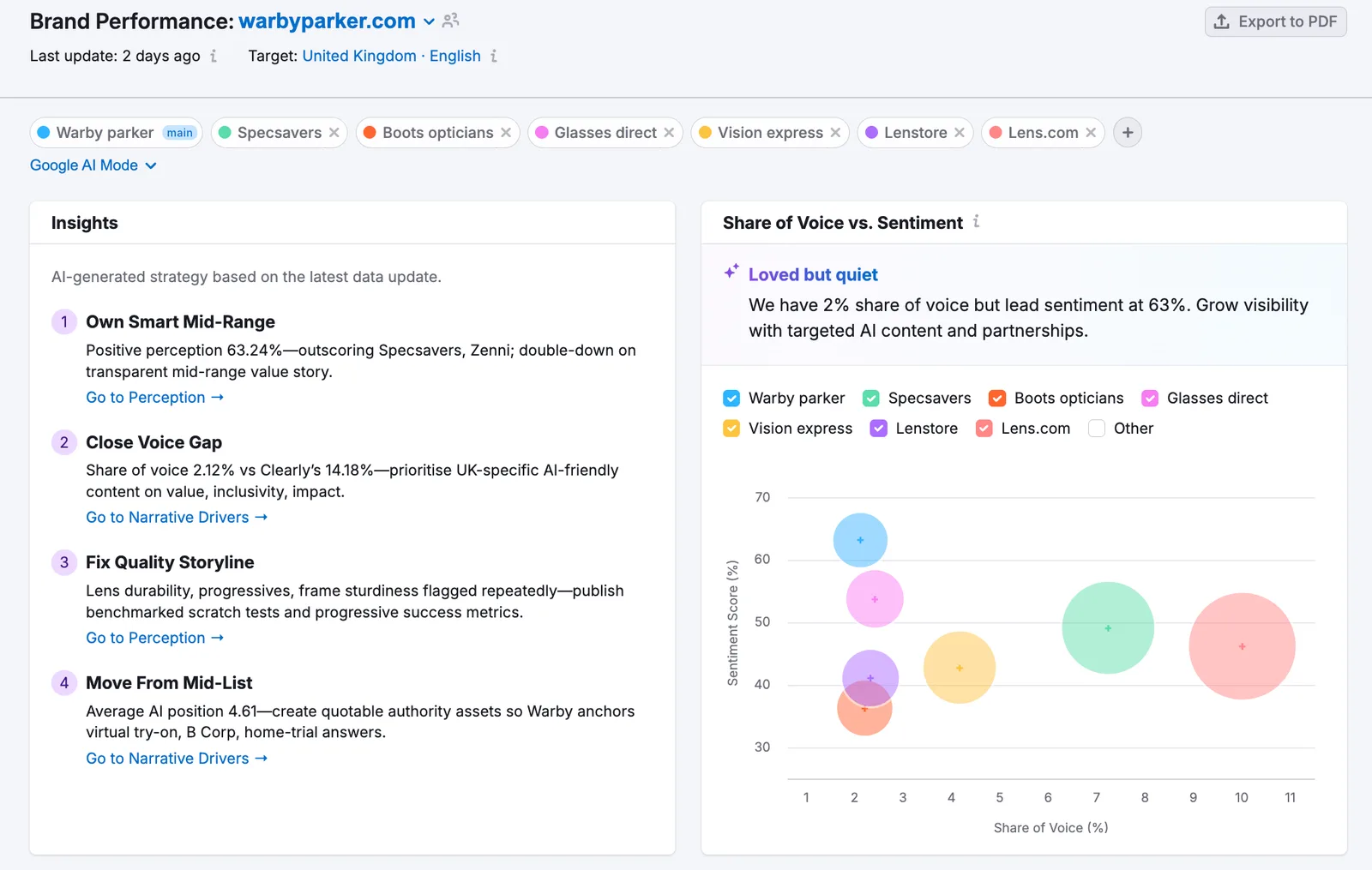
Monitor your brand's AI mentions. Brand Performance, in the AI Visibility Toolkit, "offers a set of reports within the AI Visibility Toolkit allowing you to track your brand's share of voice and sentiment across several AI platforms". The example below shows eyewear retailers in Google AI Mode.
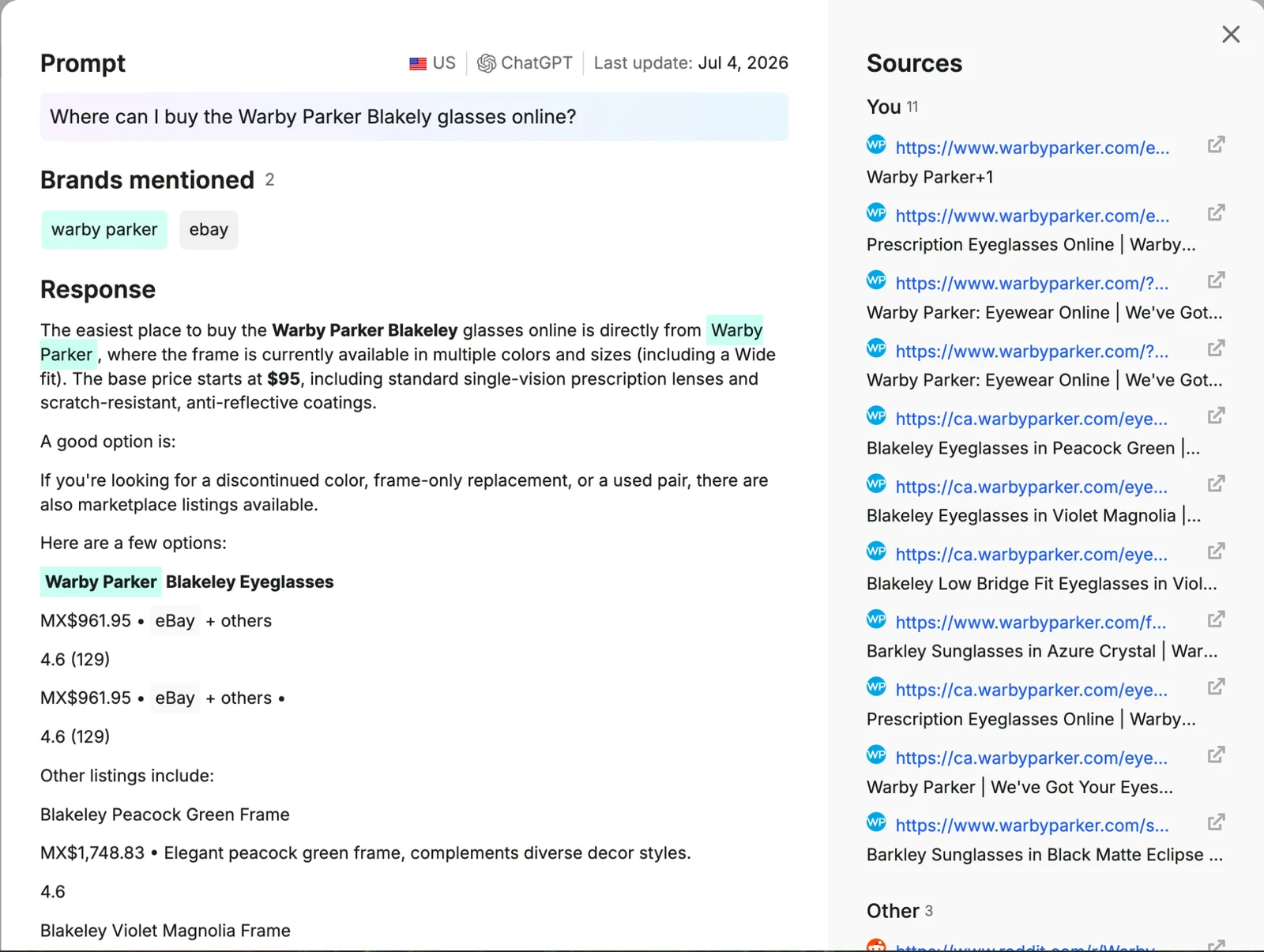
Read the answer a shopper sees. In Visibility Overview, "View full response" opens the full AI answer for a tracked prompt, with the brands it mentioned and the sources it cited — split into your own pages and everyone else's.
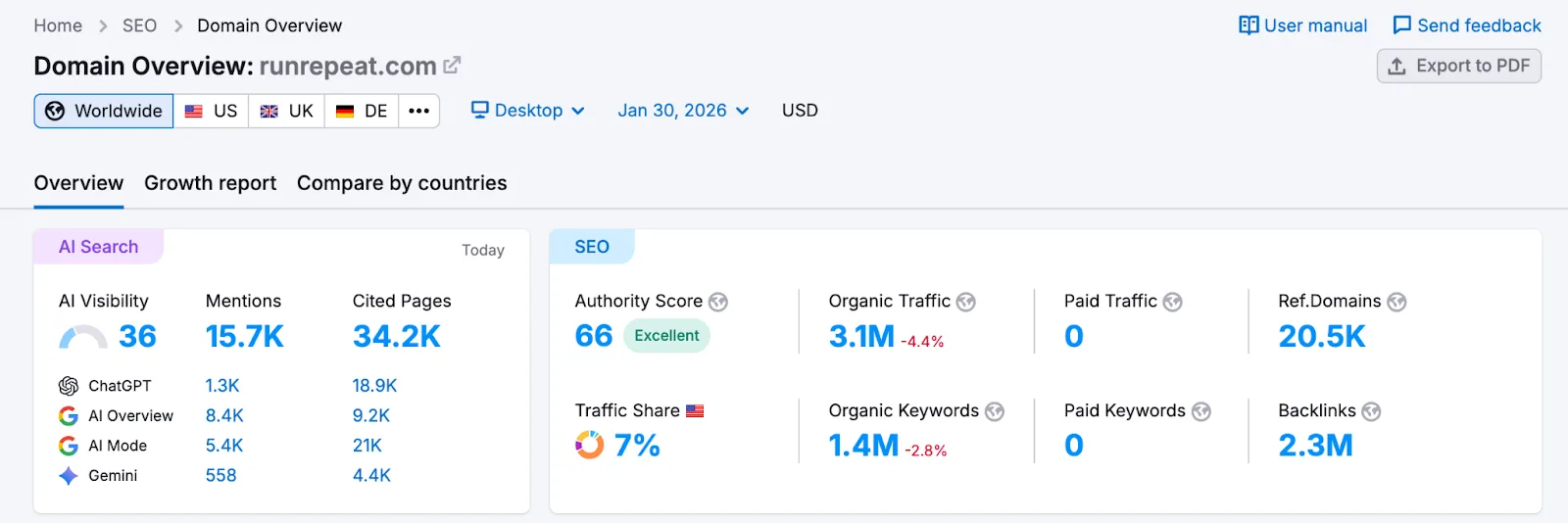
Track AI Overviews alongside rankings. Domain Overview, in the SEO Toolkit, "provides a unified snapshot of any domain's visibility across both traditional search and AI platforms", and Position Tracking tracks "appearances in AI Overviews, and mentions across AI platforms like ChatGPT and AI Mode" for the products you choose. AI Overview tracking comes with any Semrush plan; for the AI platforms, its Knowledge Base notes "Tracking on AI platforms: Available with Semrush One or the AI Visibility Toolkit".
Check the markup itself. Site Audit crawls your whole site and reports on its structured data markup, so the checklist can be reviewed across a catalogue rather than page by page.
Semrush One bundles the SEO Toolkit and the AI Visibility Toolkit, and the 7-day free trial is Semrush One's — the AI Visibility Toolkit has no free trial of its own. To audit and track your own catalogue before paying, try Semrush One free for 7 days: its page offers "Unlimited access to all Semrush One tools", "Offer available to new users only", checked on 16 October 2026. Those are Semrush's published terms, not something we tested; none of the data above came from a Semrush account.
Partial credit is what got cited
Microsoft's checklist is sound, and the audit supports its direction: the product pages AI Mode and ChatGPT cited carried more of it than the pages they skipped. But almost none carried all of it. The fields that identify the product — SKU, GTIN, brand, price, availability and ratings — separated cited pages from the rest; freshness dates and item lists did not. Start there.
Try Semrush One free for 7 days
Brand Performance and Visibility Overview to see how AI answers present your products, and Position Tracking, Domain Overview and Site Audit for AI Overviews, rankings and markup — the AI Visibility Toolkit and the SEO Toolkit together in Semrush One. Free for 7 days for new users.
Try Semrush One free for 7 daysHow the audit was done
- Questions (40): eight categories × five shopping questions (three naming a product, two "best"), none overlapping another study of ours.
- Answers and results: Google AI Mode (US English) and ChatGPT (web search forced, logged out, US English; model reported as
gpt-6) through DataForSEO, one answer each, plus Google's US top 10 (desktop), 17 October 2026. A page is cited if it is among an answer's sources or links. - Pages: every Google top-10 page and every cited page, fetched once — a plain request first, DataForSEO's OnPage crawler with browser rendering for pages that refused it. 479 of 643 page appearances could be read; the rest were mostly Reddit, eBay and large retailers that refuse automated requests.
- Checklist: the seven schema types and seven fields Microsoft's guide names, read from each page's JSON-LD (including nested offers, ratings and brands). Counts are page appearances: a page cited for two questions counts twice.
- What this cannot show: association, not cause — pages with full markup may also come from bigger retailers. We read structured data, not product feeds, which the guide also recommends and which AI platforms receive directly. One answer per engine per question, on one day.
| Figure | Source | Date |
|---|---|---|
| Checklist wording and quotes | Microsoft Advertising, "From Discovery to Influence: A Guide to AEO and GEO" (PDF) | downloaded 2026-10-17 |
| 40 AI Mode and 40 ChatGPT answers; Google top 10 for the 40 shopping questions | DataForSEO AI Mode API, LLM Scraper (ChatGPT) and SERP API, US English | 2026-10-17 |
| Structured data on 479 readable page appearances | Our fetch of each page | 2026-10-17 |
| Every count and percentage above | Our analysis of the saved answers, SERPs and pages | 2026-10-17 |
| Brand Performance, Visibility Overview, Domain Overview and Position Tracking descriptions; screenshots | Semrush Knowledge Base | 2026-10-17 |
| Semrush One graphic and trial terms | Creator Accelerator affiliate resources; Semrush One page | 2026-09-26 to 2026-10-16 |
Written by Sohail Akhtar. The saved answers, pages and analysis script can be re-run.
Some links may be affiliate links. We may earn a small commission at no extra cost to you.
Related Articles
Explore more guides and reviews from our experts.