Tracking AI Citations With DataForSEO: 440 Answers for $2.69
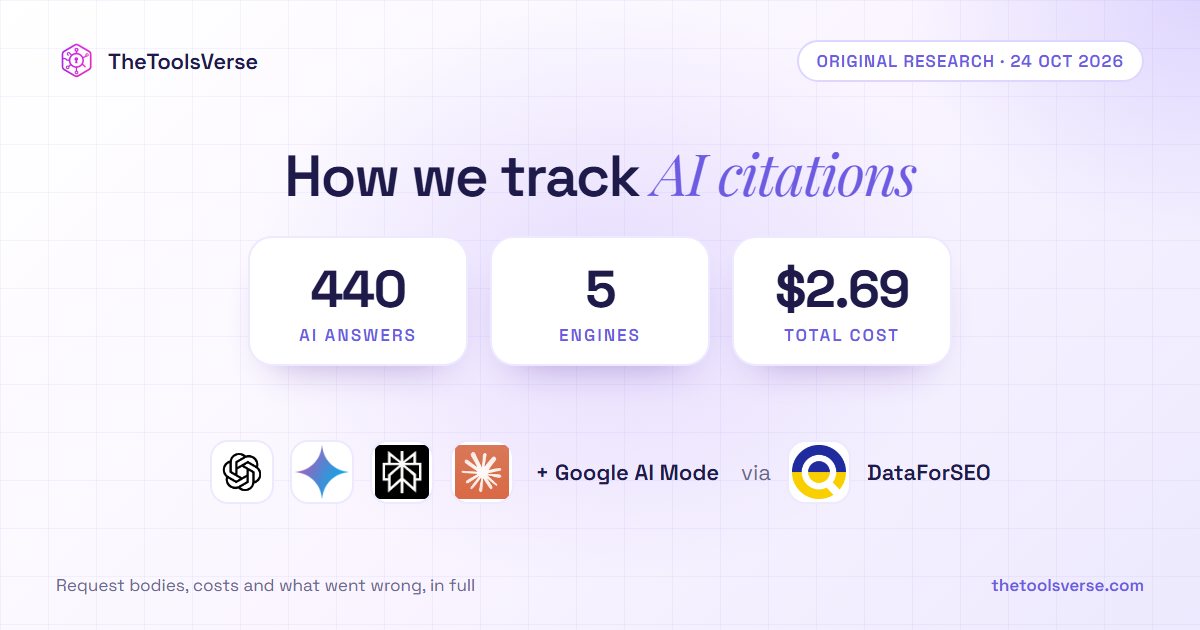
Short answer: you can measure where ChatGPT, Gemini, Google AI Mode, Perplexity and Claude cite your site for about $0.006 per answer with DataForSEO's AI Optimization API. On 24 October 2026, TheToolsVerse asked those five engines 88 questions each. That is 440 answers, every one returned, for $2.69, with every cited source, plus the background searches ChatGPT and Claude ran. The whole day of research, including 826 comparison pairs and a competitor scoreboard, cost $8.84.
This post gives the exact cost of each endpoint, the request bodies we sent, what went wrong, and what the 440 answers showed. We are a small AI tools directory, not an SEO agency, so this is written for people like us: a founder or a two-person team who wants real numbers instead of a $300-a-month dashboard.
Key numbers at a glance (24 October 2026)
• $0.004 per answer from ChatGPT (web interface), Gemini (web interface) and Google AI Mode. • $0.006 per answer from Perplexity (sonar) and $0.0125 from Claude (Haiku 5.5 with web search). • 440 of 440 answers came back; nothing failed after retries. • Freshness rules the citations: 36% of the dated pages the engines cited were published or updated in October 2026, the month we asked. • Google AI Mode cited Reddit and YouTube more than any website across our 88 questions.
What we measured, and why
TheToolsVerse wanted to know three things:
- Which AI engines cite us at all.
- For which questions they do.
- Who they cite instead when they don't.
So we wrote 88 questions in three groups:
- 15 that founders ask ("where should I submit my AI tool?").
- 58 that buyers ask about AI tool categories ("what is the best free AI video generator?").
- 15 that our own research answers ("do backlinks help you get cited by ChatGPT?").
We asked each one on five engines, from a US location, and kept every response.
The headline for us was humbling. 8 of the 440 answers cited TheToolsVerse: six on Perplexity, one on ChatGPT, one on Claude, and none on Gemini or Google AI Mode. It is a baseline, and that is the point of measuring it.
What each endpoint cost
These are the cost values DataForSEO returned on our account on 24 October 2026, divided by the number of calls.
| What we did | Endpoint | Cost |
|---|---|---|
| ChatGPT answer, as a user sees it, with sources | ai_optimization/chat_gpt/llm_scraper/live/advanced | $0.004 per answer |
| Gemini answer, as a user sees it, with sources | ai_optimization/gemini/llm_scraper/live/advanced | $0.004 per answer |
| Google AI Mode answer with references | serp/google/ai_mode/live/advanced | $0.004 per answer |
| Perplexity answer with citations (sonar) | ai_optimization/perplexity/llm_responses/live | $0.006 per answer (includes model tokens) |
| Claude answer with web search (Haiku 5.5) | ai_optimization/claude/llm_responses/live | $0.0125 per answer (includes tokens and search) |
| Our own mentions in the ChatGPT database | ai_optimization/llm_mentions/search/live | $0.157 (57 rows) |
| A 6-domain competitor scoreboard | ai_optimization/llm_mentions/multi_target_metrics/live | $0.106–0.107 per call |
| AI search volume for 197 keywords | ai_optimization/ai_keyword_data/keywords_search_volume/live | $0.0297 in total |
| "brand vs" searches for 222 brands | dataforseo_labs/google/keyword_suggestions/live | $4.37 in total, about $0.02 per brand |
Per full five-engine panel of 88 questions: $2.69. That makes a weekly check about $12 a month. The most expensive thing we did all day was not the AI answers but the keyword research behind our comparison backlog.
The request bodies
The client is about 30 lines of Node: one fetch to https://api.dataforseo.com with Basic auth, and a retry on 5xx and 429. These are the bodies we sent, one task per call.
// ChatGPT, as a user sees it (sources + background searches)
[{ "keyword": "claude code vs cursor which is better",
   "location_code": 2840, "language_code": "en", "force_web_search": true }]

// Perplexity, with citations
[{ "user_prompt": "claude code vs cursor which is better",
   "model_name": "sonar", "web_search_country_iso_code": "US" }]

// Claude, forced to search the web
[{ "user_prompt": "claude code vs cursor which is better",
   "model_name": "claude-haiku-5-5", "web_search": true, "force_web_search": true,
   "web_search_country_iso_code": "US", "max_output_tokens": 1500 }]

// Competitor scoreboard: every target needs a "key" and a "target" array
[{ "platform": "chat_gpt", "location_code": 2840, "language_code": "en",
   "targets": [
     { "key": "thetoolsverse.com", "target": [{ "domain": "thetoolsverse.com", "search_scope": ["sources"], "include_subdomains": true }] },
     { "key": "toolradar.com", "target": [{ "domain": "toolradar.com", "search_scope": ["sources"], "include_subdomains": true }] }
   ] }]
From each answer we kept the cited URLs, ChatGPT's search results (what it retrieved but chose not to cite), and the fan-out queries, which are the searches the engine ran behind the scenes (ChatGPT and Claude return them). The fan-out queries turned out to be the most useful field of all (see below).
What 440 AI answers showed
1. The engines cite very different amounts. Average sources per answer: Perplexity 9.9, ChatGPT 9.1, Claude 5.6, Gemini 3.3, Google AI Mode 2.7. A page has far more chances on Perplexity and ChatGPT than on Google's two engines.
2. Freshness dominates. Of the 264 cited pages that carried a date, 36% were dated October 2026 and 55% September or October. Of all the cited titles in our category questions, 60% contained "2026" and 49% contained "best".
3. Small sites win the open slots. In 45 of our 58 category questions, independent editorial sites took 55–90% of the citations (the median was 69%), and many were blogs no bigger than ours.
4. Google AI Mode leans on Reddit and YouTube. They were its two most-cited domains, ahead of every website. If Google's AI is your target, being discussed on Reddit and YouTube matters as much as your own pages.
5. ChatGPT answers questions about itself from its maker. For "what searches does ChatGPT run in the background when you ask about brands?", one of its fan-out searches was limited to OpenAI's own help pages (site:help.openai.com). Our own studies on how AI engines cite were cited by Perplexity, not ChatGPT.
6. The fan-out queries tell you what to write. For "where should I submit my AI tool to get users", ChatGPT searched "best places to launch and submit an AI tool startup directory Product Hunt AI directories 2026". For a similar question it added "There's An AI For That Futurepedia". That is the year, "best", and the brand names it expects to see. A page whose title and opening lack those words is not retrieved at all.
7. AI answers repeat old prices. Cursor has changed its plans. Of the five answers to our Claude Code vs Cursor questions that gave a Cursor price, four quoted plans Cursor no longer sells to new customers, even when one cited Cursor's own pricing page. We wrote that up in Claude Code vs Cursor.
8. The citation leaders are pulling away. In DataForSEO's ChatGPT mentions database, toolradar.com had 806 citations on 24 October, up from 390 when we checked on 2 October. TheToolsVerse had 13 on both dates.
What went wrong, and how we worked around it
- The web-interface scrapers take longer. A typical ChatGPT answer took 21 seconds and a Gemini answer 26, with the slowest just under two minutes. Running five calls at a time, our 88 questions took 8 minutes on ChatGPT and 10 on Gemini. Google AI Mode took 3 minutes, and Perplexity and Claude 2 each.
- Keyword suggestions need cleaning. Asking for "gamma vs" returned gamma rays vs x rays and gamma-aminobutyric acid vs gabapentin before anything about Gamma the presentation app. We kept only pairs where both sides matched a brand on our list: 826 of the results.
- AI search volume sees topics better than prompts. Short keywords got numbers ("ai humanizer" 6,778), but 53 of the 62 phrases of six words or more returned 0, including "where should I submit my AI tool to get users". Use it to rank topics, not prompts.
- Our estimate was low. We budgeted about $3 for the keyword research and spent $4.37. Run one call, read its
costfield, and multiply before launching a batch. - Bing results need a sanity check. In an earlier session in September, 4 of 5 Bing SERP responses we requested came back for a truncated query (for example, "free games" for free ai api key). Check that the results match your query, and retry if not.
- Errors are free. Our first scoreboard calls failed on a schema mistake (the
keyandtargetfields). Nothing was charged until the request was right.
Who should do this, and how to start
If you need a polished dashboard for a team, a dedicated AI-visibility tool will save you time. If you want the raw answers, your own questions, your own competitors and a cost you can predict to the cent, the API is hard to beat. A 25-question weekly check across all five engines costs under $0.80.
To start:
- Create a DataForSEO account and read your credentials from the API dashboard.
- Send one question to one engine, and read the
costfield. - Save every raw response. You will want to re-read old answers once you know what to look for.
- Re-run the same questions on a schedule. One run is a snapshot; the trend is the insight.
We run ours from Claude Code through DataForSEO's MCP server and a small REST helper. The research in our AI tool directories study and our ChatGPT citation studies used the same setup.
Frequently Asked Questions
How much does it cost to track ChatGPT citations with DataForSEO?
On 24 October 2026, one ChatGPT answer with its sources cost $0.004 through the LLM Scraper endpoint. Tracking 25 questions a week costs about $0.10 a week for ChatGPT alone.
Which DataForSEO endpoint should I use for Perplexity and Claude?
The LLM Responses endpoints: perplexity/llm_responses/live with the sonar model (web search is on by default), and claude/llm_responses/live with web_search and force_web_search set to true. Both return the cited URLs; Claude also returned its fan-out queries in every answer, while Perplexity returned none in our runs.
Can DataForSEO show Google AI Overview citations?
Its LLM Mentions database covers two platforms, Google AI Overviews and ChatGPT; the ChatGPT data is US and English only. For live Google answers, the serp/google/ai_mode/live/advanced endpoint returns AI Mode answers with their references for $0.004 each.
How long does a run take?
Running five calls at a time, our 88 questions took 2 minutes on Perplexity and Claude, 3 on Google AI Mode, 8 on ChatGPT and 10 on Gemini. The web-interface answers from ChatGPT and Gemini are the slowest, at about 20–30 seconds each.
The bottom line
For less than the price of a coffee, TheToolsVerse learned which engines cite us, which never do, which pages win the slots we want, and what words those engines search for. The data changed our plans the same day: we rewrote our directories study in the words ChatGPT searches with, and picked our next 35 comparisons from the questions where AI answers are still open.
See what else we measure
Original research on AI search, AI citations and AI tools, from TheToolsVerse.
Read our AI researchResearch and article by Sohail Akhtar, Founder of TheToolsVerse. All costs are the cost values DataForSEO returned on our account on 24 October 2026. The 440 answers were collected the same day from a US location.
Disclosure: DataForSEO gave TheToolsVerse free API credits, which paid for part of this research. Links to DataForSEO in this article are affiliate links: if you sign up through them, we may earn a commission at no cost to you. The costs, findings and opinions are our own.
Some links may be affiliate links. We may earn a small commission at no extra cost to you.
Related Articles
Explore more guides and reviews from our experts.