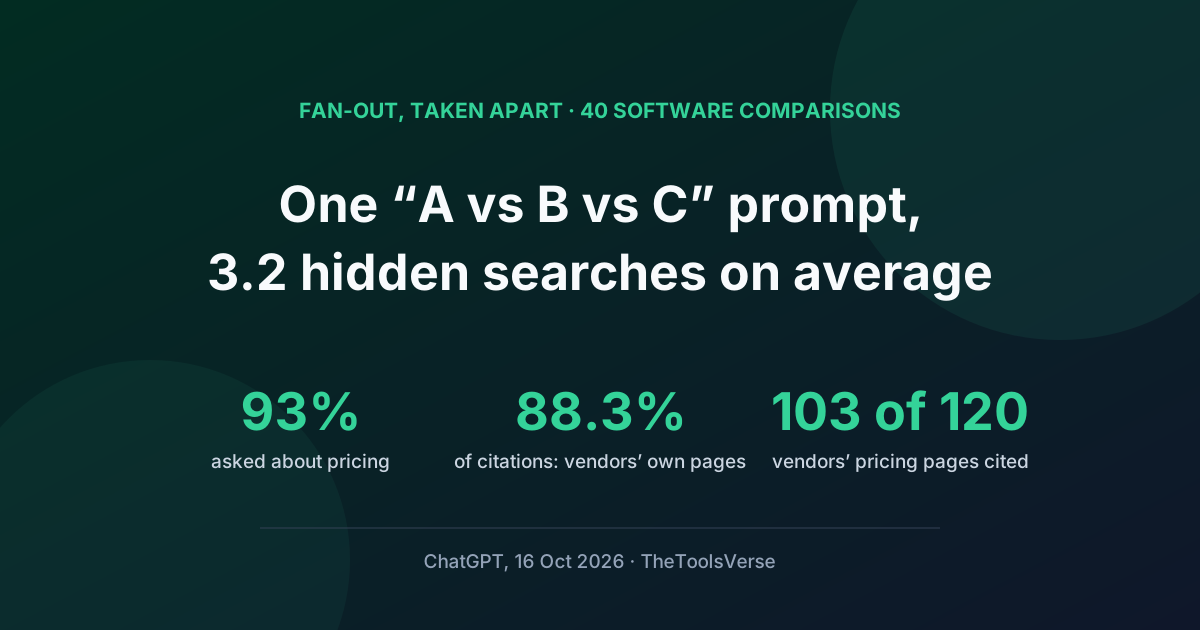
Behind 40 "A vs B vs C" Prompts, ChatGPT Ran 129 Hidden Searches. 93% Asked About Pricing.
Disclosure
This article is promotional content produced as part of the Semrush Creator Accelerator programme. It contains affiliate links to Semrush — if you buy through them we may earn a commission at no extra cost to you — and we may also receive a reward from Semrush for publishing it. All measurements in this article are our own. Semrush did not supply, review or approve the data, and the conclusions we draw are ours.
When a buyer asks ChatGPT to compare three products, ChatGPT does not search for the question the buyer typed. It writes its own searches — "fan-out" queries — runs them, and builds the answer from what they return. The buyer never sees them. We wanted to know what they actually ask for, so we read every one behind 40 software comparisons.
See the prompts behind your category
Find the prompts and questions buyers bring to AI in your category with Prompt Research and the Questions report in the AI Visibility Toolkit. To get them with keyword research in one subscription, try Semrush One free for 7 days.
One prompt, taken apart
On 16 October we typed "Zapier vs Make vs n8n" into ChatGPT with web search on. Behind the answer, it ran four searches of its own:
| # | ChatGPT's hidden search, verbatim |
|---|---|
| 1 | Zapier vs Make vs n8n 2026 pricing features comparison official |
| 2 | Zapier pricing official plans tasks integrations |
| 3 | Make pricing official operations plans |
| 4 | n8n pricing official cloud self hosted |
One search for the comparison, then one search per vendor, each asking for that vendor's official pricing. The answer cited eight pages, and all eight belonged to the three vendors: Zapier's pricing page and three of its help-centre articles (what the free plan includes, Zap limits, and what Zapier is), Make's pricing page under two addresses, and n8n's pricing page and its own documentation on GitHub.
Now look at what ranks on Google for the same words. Google's top 10 for "Zapier vs Make vs n8n" on the same day held seven results, from seven other websites — one of them a YouTube video. None was a page from Zapier, Make or n8n, and ChatGPT cited none of them. The pages that win the Google search were not where the answer came from.
129 hidden searches behind 40 comparisons
One prompt is an anecdote, so we ran 40: three-way comparisons across note-taking, design, developer platforms, analytics, automation, collaboration, content and sales software — Notion vs Coda vs Confluence, Figma vs Sketch vs Adobe XD, Vercel vs Netlify vs Cloudflare Pages, Hotjar vs Microsoft Clarity vs FullStory, Gong vs Chorus vs Clari and 35 more.
ChatGPT ran 129 hidden searches — 3.2 per prompt on average. 25 of the 40 prompts got four searches, the pattern above; 10 got two, 3 got one, 2 got three.
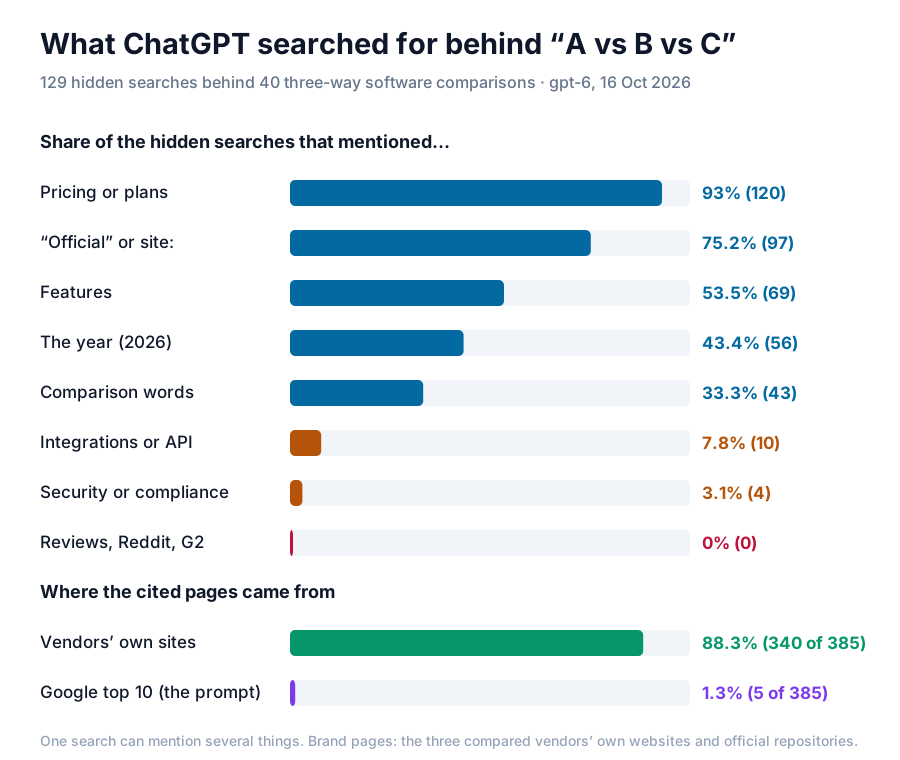
| The hidden searches… | Count | Share of 129 |
|---|---|---|
| mentioned pricing or plans | 120 | 93% |
| asked for "official" pages or used a site: search | 97 | 75.2% |
| mentioned features | 69 | 53.5% |
| added the year (every one said 2026) | 56 | 43.4% |
| used comparison words ("vs", "compare") | 43 | 33.3% |
| named just one of the three vendors | 75 | 58.1% |
| used a site: search on a vendor's domain | 38 | 29.5% |
Every one of the 40 prompts got at least one pricing search. In 27 of them ChatGPT searched at least one vendor on its own, and in 22 it gave all three vendors a search of their own — usually in the shape [vendor] pricing official [product words] or site:[vendor's domain] pricing.
What none of the searches asked for
The surprises are in the bottom rows. Of 129 hidden searches:
- None mentioned reviews, Reddit, G2, Capterra, pros and cons or complaints.
- 10 (7.8%) mentioned integrations or an API.
- 4 (3.1%) mentioned security or compliance.
- 2 (1.6%) mentioned a use case such as "for small business".
For a comparison between three products, ChatGPT went looking for facts it could check at the source — current price, current plans, current features — not for opinions. It also cited no Reddit thread and no YouTube video in any of the 40 answers.
Where the answers came from
ChatGPT cited 385 distinct pages across the 40 answers:
| Pages | Share | |
|---|---|---|
| The three vendors' own sites (incl. help centres, docs, official repositories) | 340 | 88.3% |
| Third-party pages (comparison sites, blogs, publishers) | 45 | 11.7% |
- 119 of the 120 vendors (40 prompts × 3) had at least one of their own pages cited. The one that didn't was Okta.
- 103 of the 120 had their pricing page cited — a page with pricing, plans, cost, billing, upgrade or subscription in its address. In 28 of the 40 answers, all three vendors' pricing pages were cited.
- Third-party pages appeared in 23 of the 40 answers, but never as the main source.
The Google comparison was the starkest number. On Google, the 120 vendors held only 34 of the 325 top-10 results for the 40 comparison searches — exactly as many as Reddit alone, which ChatGPT never cited. And only 5 of the 385 pages ChatGPT cited ranked in Google's top 10 for the prompt itself — 1.3%. Four of those five were third-party comparison posts.
The 17 vendors without a cited pricing page include free or mostly free tools such as draw.io, Logseq and Discord. For most of them, ChatGPT cited the vendor's homepage, product pages or documentation instead.
Four lessons for software vendors
- Your pricing page is the fan-out target. 93% of the hidden searches asked about pricing, and 103 of 120 vendors' pricing pages were cited. If the price, the plan limits and what the free tier includes are not stated plainly on a page a search engine can read, ChatGPT will take them from somewhere else — or leave you out.
- "Official" is in the query. ChatGPT asked for official pages in three searches out of four, and it cited help centres and documentation as well as marketing pages — Zapier's help articles, n8n's docs. Keep them current: 43% of the searches added the year.
- Ranking for "A vs B vs C" on Google is a different contest. The comparison posts that hold Google's top 10 were rarely cited. The comparison article is still worth having for Google, but it is not the page ChatGPT relied on for the answer.
- The hidden searches are basic. "[vendor] pricing official plans" is a search any vendor can answer. Fan-out sounds exotic; in our sample it mostly meant "go and read the vendor's pricing page".
Map your own fan-out in five steps
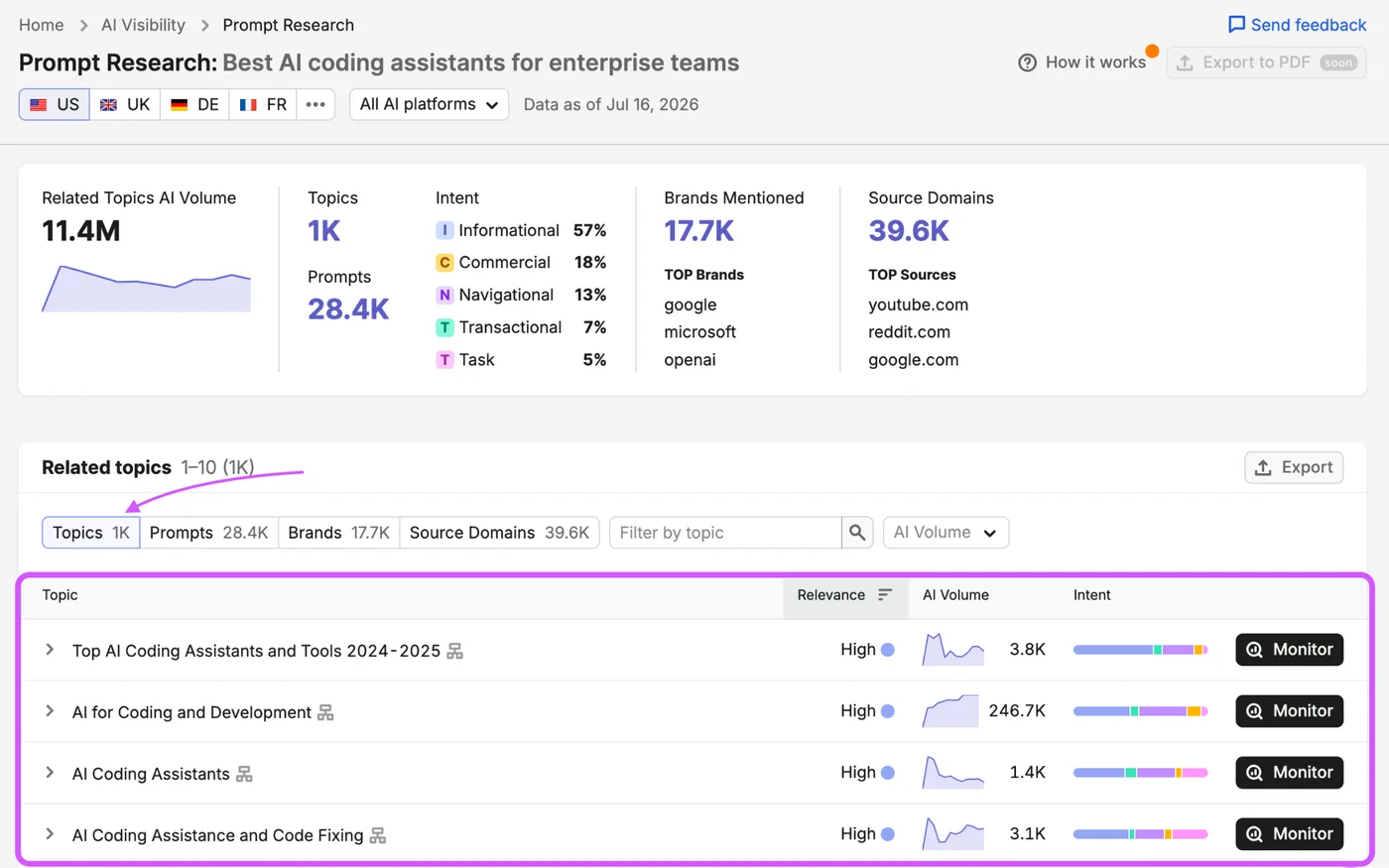
1. List the prompts buyers bring to AI in your category. Prompt Research, in the AI Visibility Toolkit, "helps you discover and prioritize the topics and prompts people use in AI-generated search", and for each topic reports "Brands mentioned: the number of unique brands appearing in LLM responses on this topic, including the top three brands" — so you can see which three-way shortlists your product is part of.
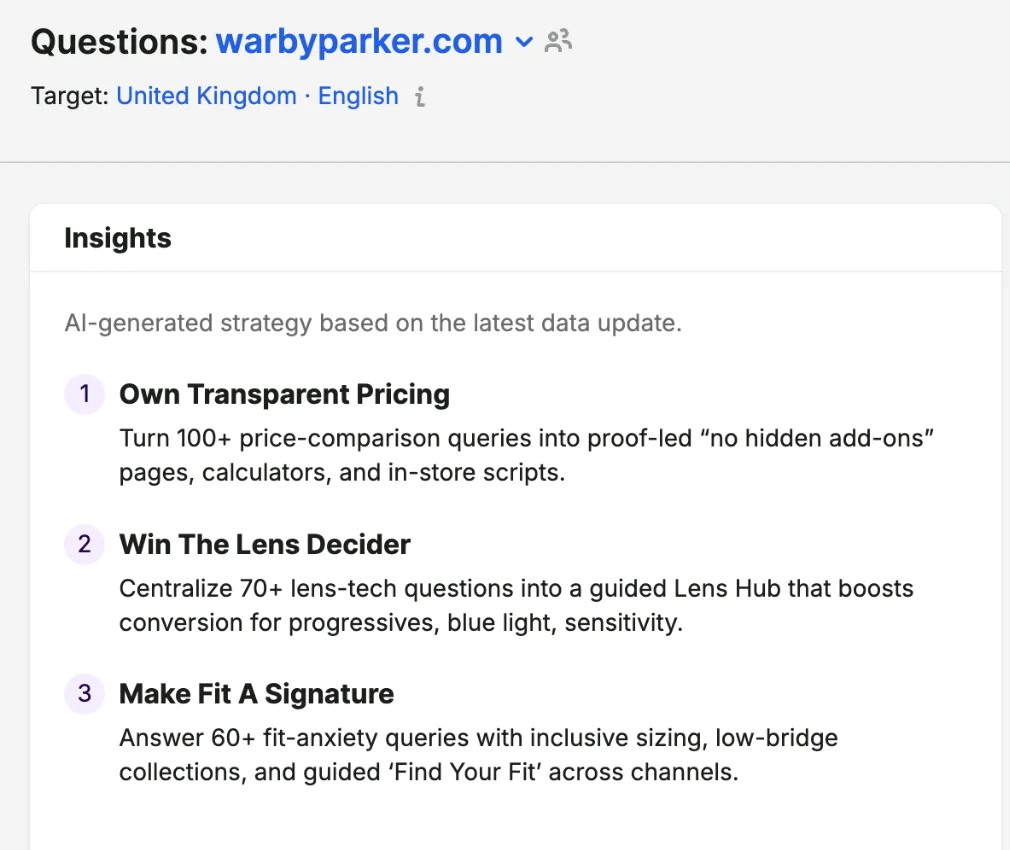
2. Find the questions behind those prompts. The Questions report "helps you gain insight into your audience's intent by analyzing the questions they ask AI". In Semrush's own example its first recommendation is the same one our data points to — pricing.
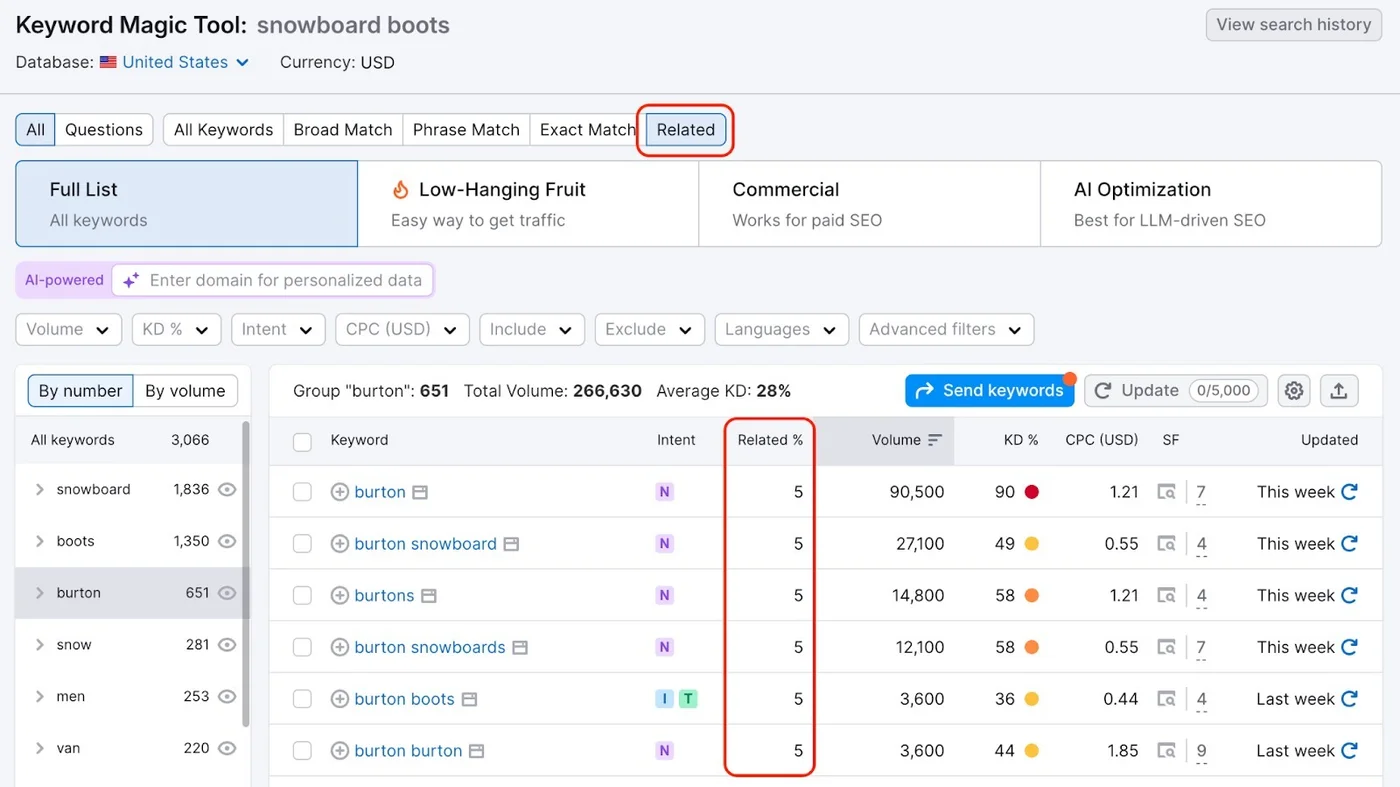
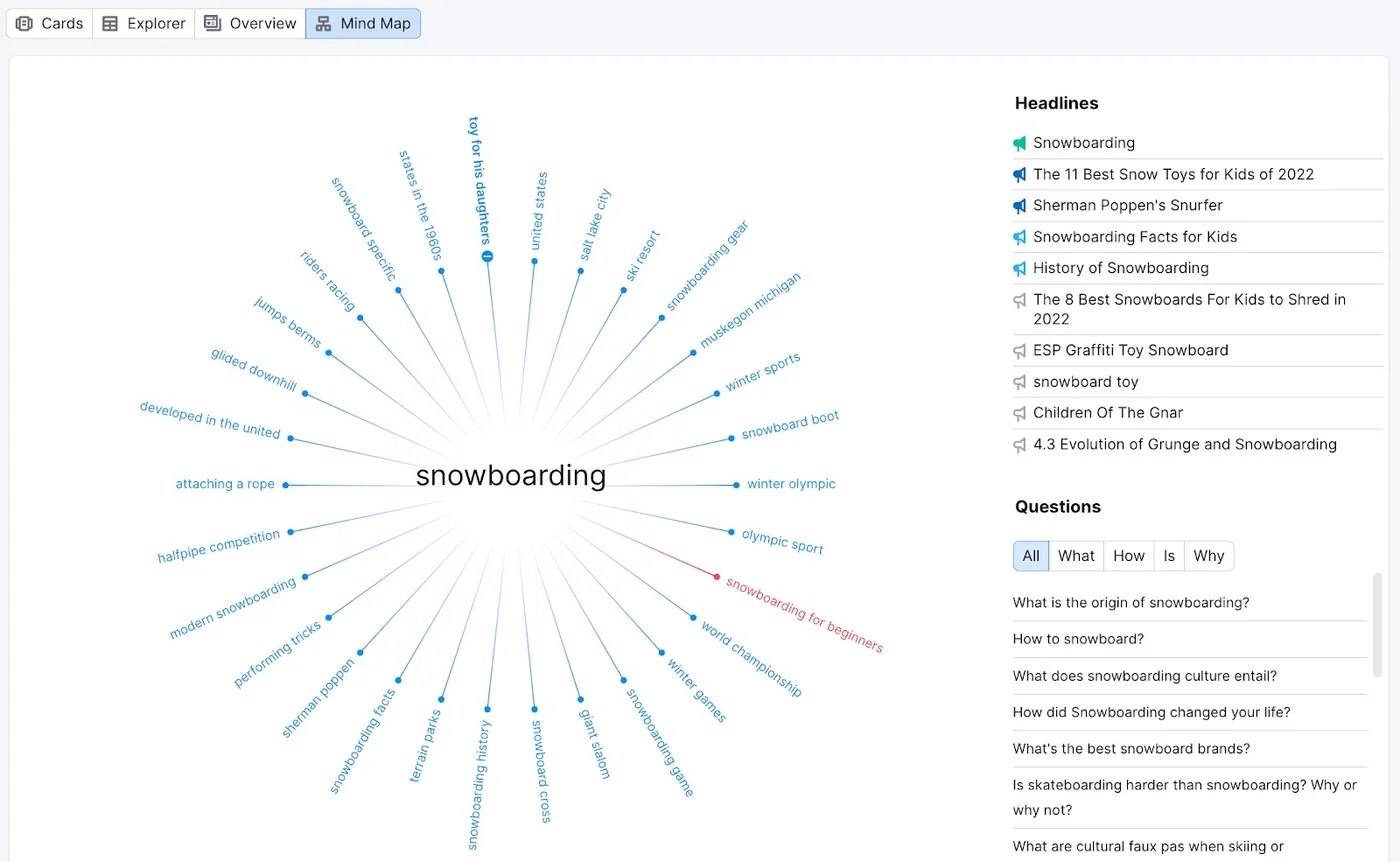
3. Write down the facets, then check each one on your own site. For each prompt, list the things a hidden search will ask about you — pricing, plans, free tier, limits, features, integrations — and the page on your site that answers each. The Keyword Magic Tool does the same breakdown for search: "Keyword groups appear in the left sidebar, organizing related terms by shared themes", and its Knowledge Base suggests you "Use these groups to discover subtopics around your main keyword." Topic Research, in the Content Toolkit, "helps you find content ideas, headlines, and questions" around a topic.
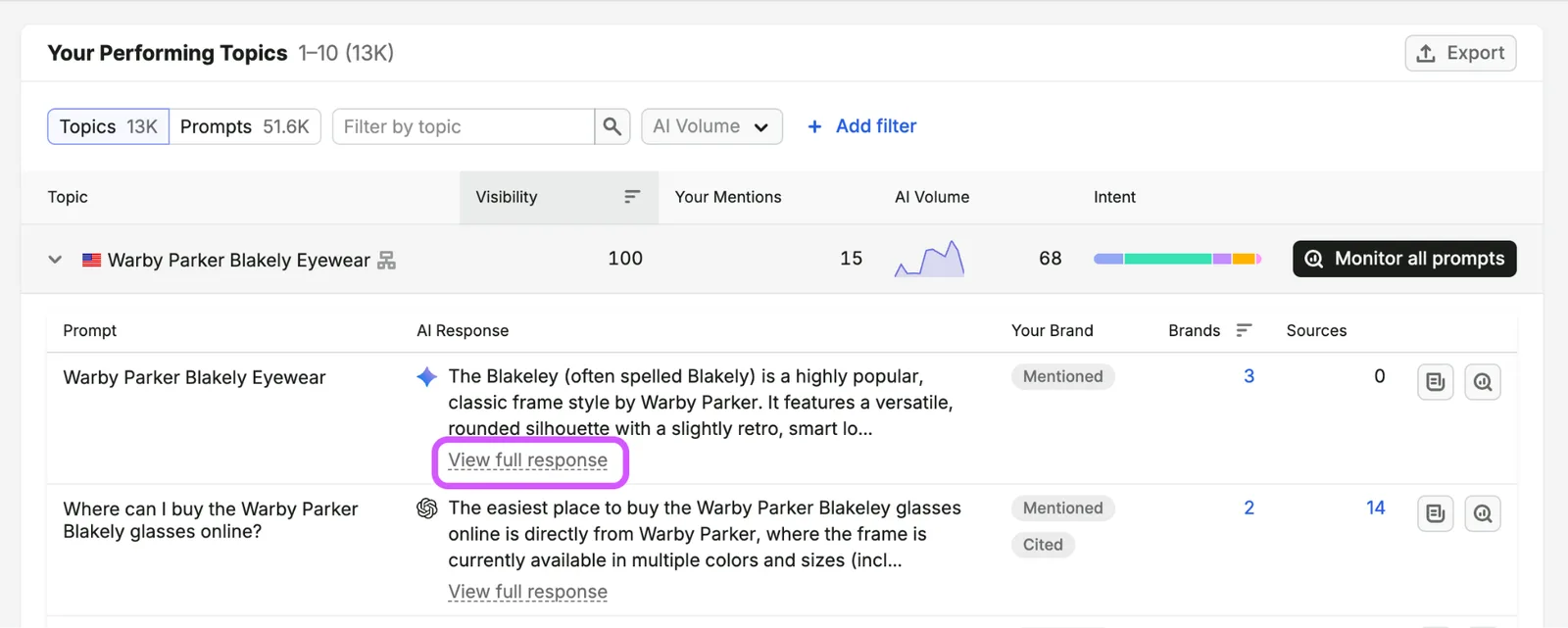
4. See which pages the answers actually cite. In Visibility Overview, "View full response" opens "a detailed view of the AI-generated answer" for any prompt, alongside whether your brand was mentioned and cited and how many sources the answer used. The Citations metric counts "The number of AI responses that cite your domain as a source", and the Cited Sources tab lists "The websites that AI systems reference when generating answers" — which tells you whether it is your pricing page or someone else's summary of it.
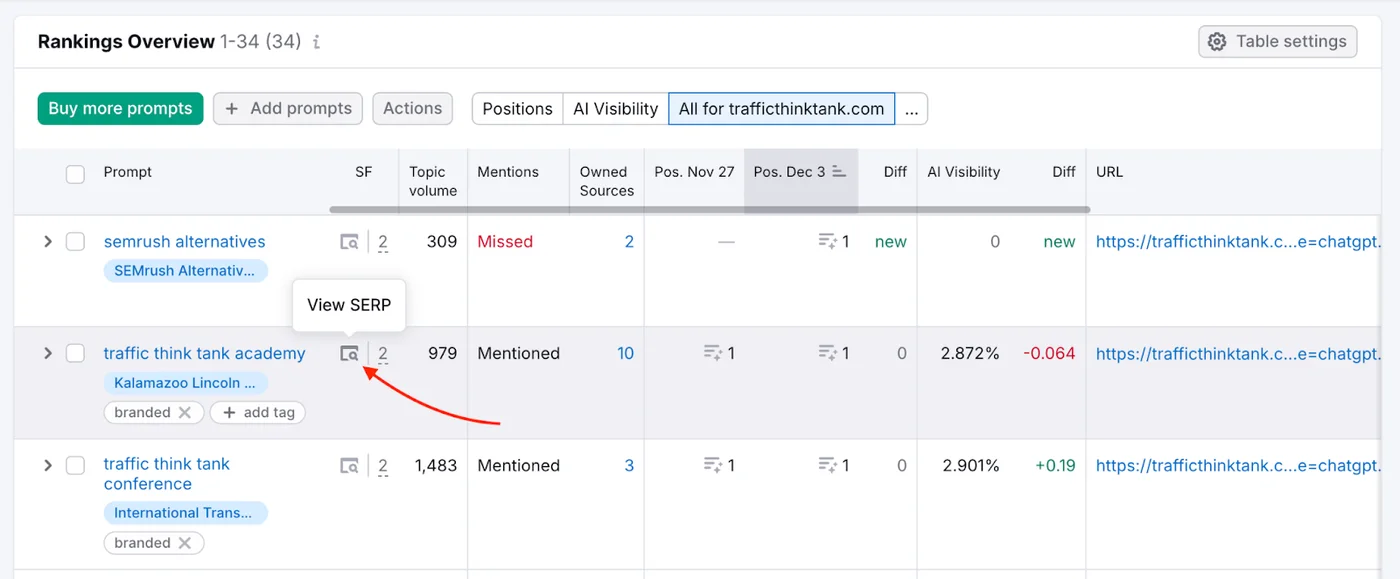
5. Track the comparisons you care about every day. Prompt Tracking "lets you monitor your brand's daily visibility for a custom set of prompts across AI search platforms"; its Knowledge Base adds that you "Get daily updates on position changes in AI search." The hidden searches are rewritten for every answer, so the answer — and the pages it cites — is the thing to track.
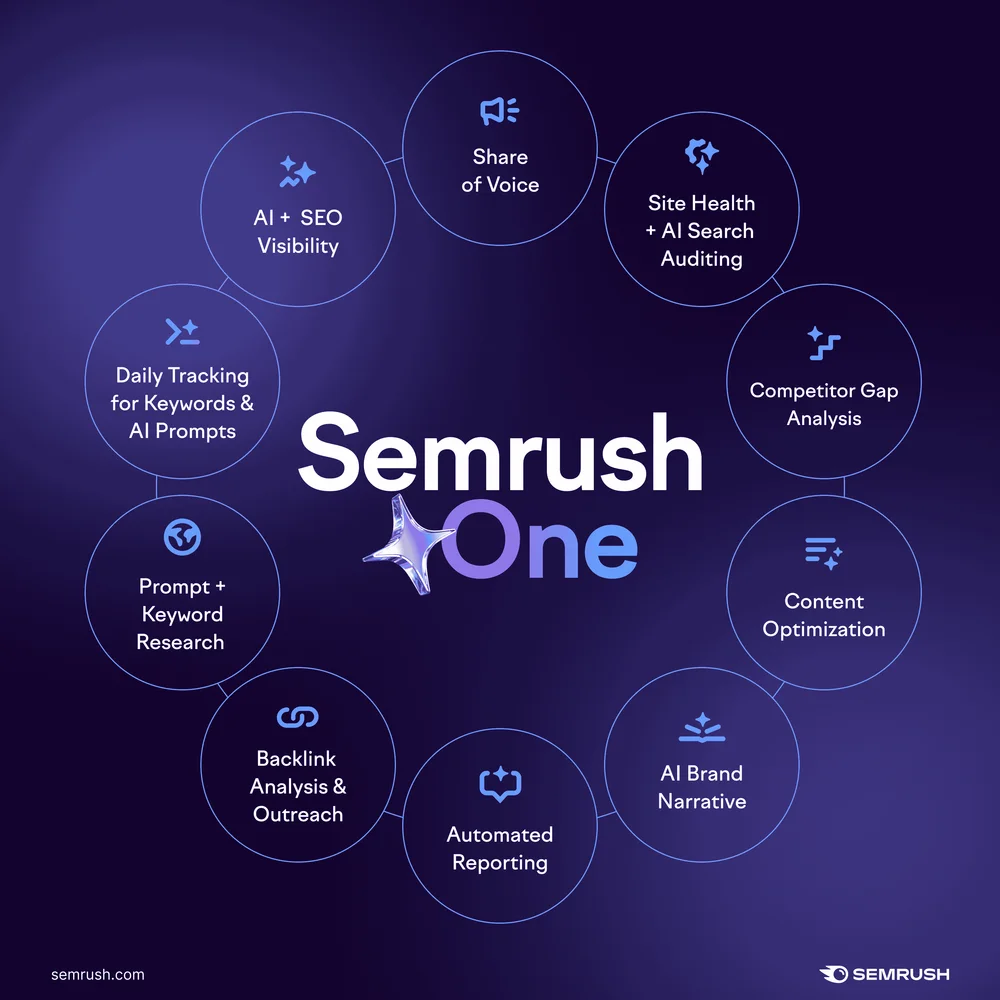
Steps 1, 2, 4 and 5 are in the AI Visibility Toolkit and step 3 is keyword and topic research; Semrush One puts them in one subscription. The AI Visibility Toolkit has no free trial of its own — the 7-day free trial is Semrush One's. To map your own category before paying, try Semrush One free for 7 days: its page offers "Unlimited access to all Semrush One tools", "Offer available to new users only", checked on 16 October 2026. Those are Semrush's published terms, not something we tested; none of the searches or answers above came from a Semrush account.
The answer was built from the vendors' own pages
Fan-out is usually described as AI search exploding one question into dozens of hard-to-predict ones. Behind 40 software comparisons, it was more predictable than that: three or four searches, nearly all about price, most asking for the official source. The pages that answered them were the vendors' own pricing pages, plan tables and help articles — not the comparison posts that rank on Google for the question. If you sell software, the most important page for this kind of prompt is one you already own.
Try Semrush One free for 7 days
Prompt Research and the Questions report to find the prompts behind your category, Prompt Tracking and Citations to see which pages the answers cite, and the Keyword Magic Tool for the facets — together in Semrush One. Free for 7 days for new users.
Try Semrush One free for 7 daysNotes on the 40 prompts
- Prompts: 40 three-way comparisons written as a buyer would type them ("Zapier vs Make vs n8n"), across eight kinds of software. We left out SEO tools, so the sponsor of this article could not shape the sample, and chose categories no other study of ours has used.
- Answers: ChatGPT with web search forced on, logged out, US English, through DataForSEO's LLM scraper; the model reported itself as
gpt-6every time. One run per prompt, 16 October 2026, 15:06–15:13 UTC. The hidden searches are thefan_out_queriesthe scraper returns with each answer, read verbatim. - Counting the searches: a search can mention several things, so the shares add up to more than 100%. "Pricing" means the words price, pricing, plan(s), cost, free, tier or billing; "official" means the word official or a site: search. A vendor counts as named if any form of its name appears.
- Vendors' own pages: the vendor's websites, help centres, documentation and official repositories (for example n8n's documentation on GitHub), plus owners' sites — twilio.com for Segment, salesloft.com after its merger with Clari. A pricing page is one with pricing, plans, cost, billing, upgrade or subscription in its URL.
- Google: the top 10 organic results for each prompt, US English, desktop, collected through DataForSEO on 16 October 2026. We also collected Google results for each hidden search but do not report them: Google's results ignored the site: operator in our data and ChatGPT's keyword-heavy strings often returned unrelated pages, so they say little about the index ChatGPT actually searched.
- What one run can't show: ChatGPT writes different hidden searches each time it answers, as our study of repeated questions found for its sources. These are 40 answers on one day — the pattern, not a guarantee for any single prompt.
| Figure | Source | Date |
|---|---|---|
40 answers, 129 hidden searches, 385 cited pages; model gpt-6 | DataForSEO LLM Scraper (ChatGPT), web search forced, US English | 2026-10-16 15:06–15:13 UTC |
| Google top 10 for the 40 prompts (325 results) | DataForSEO SERP API, Google organic, US English, desktop | 2026-10-16 |
| Every count and percentage above | Our analysis of the saved answers and SERPs | 2026-10-16 |
| Prompt Research, Questions, Visibility Overview, Citations, Cited Sources, Prompt Tracking, Keyword Magic Tool and Topic Research descriptions | Semrush Knowledge Base | 2026-10-13 to 2026-10-16 |
| Screenshots (Semrush's illustrations), the Semrush One graphic and trial terms | Semrush Knowledge Base; Creator Accelerator affiliate resources; Semrush One page | 2026-09-26 to 2026-10-16 |
Written by Sohail Akhtar. The saved answers, SERPs and analysis script can be re-run.
Some links may be affiliate links. We may earn a small commission at no extra cost to you.
Related Articles
Explore more guides and reviews from our experts.