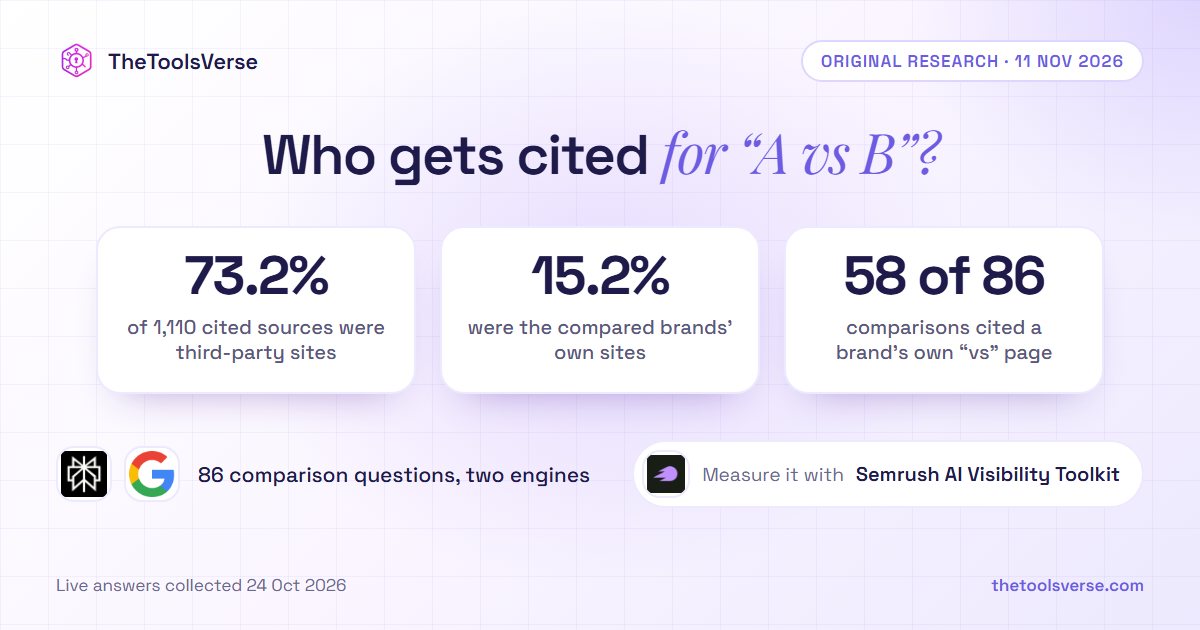
Bing's AI Cited Our Site 310,489 Times in 90 Days. One Page Took 61%, and Search Clicks Came to About 1.5 per 100 Citations
Disclosure
This article is promotional content produced as part of the Semrush Creator Accelerator programme. It contains affiliate links to Semrush — if you buy through them we may earn a commission at no extra cost to you — and we may also receive a reward from Semrush for publishing it. All measurements in this article are our own. Semrush did not supply, review or approve the data, and the conclusions we draw are ours.
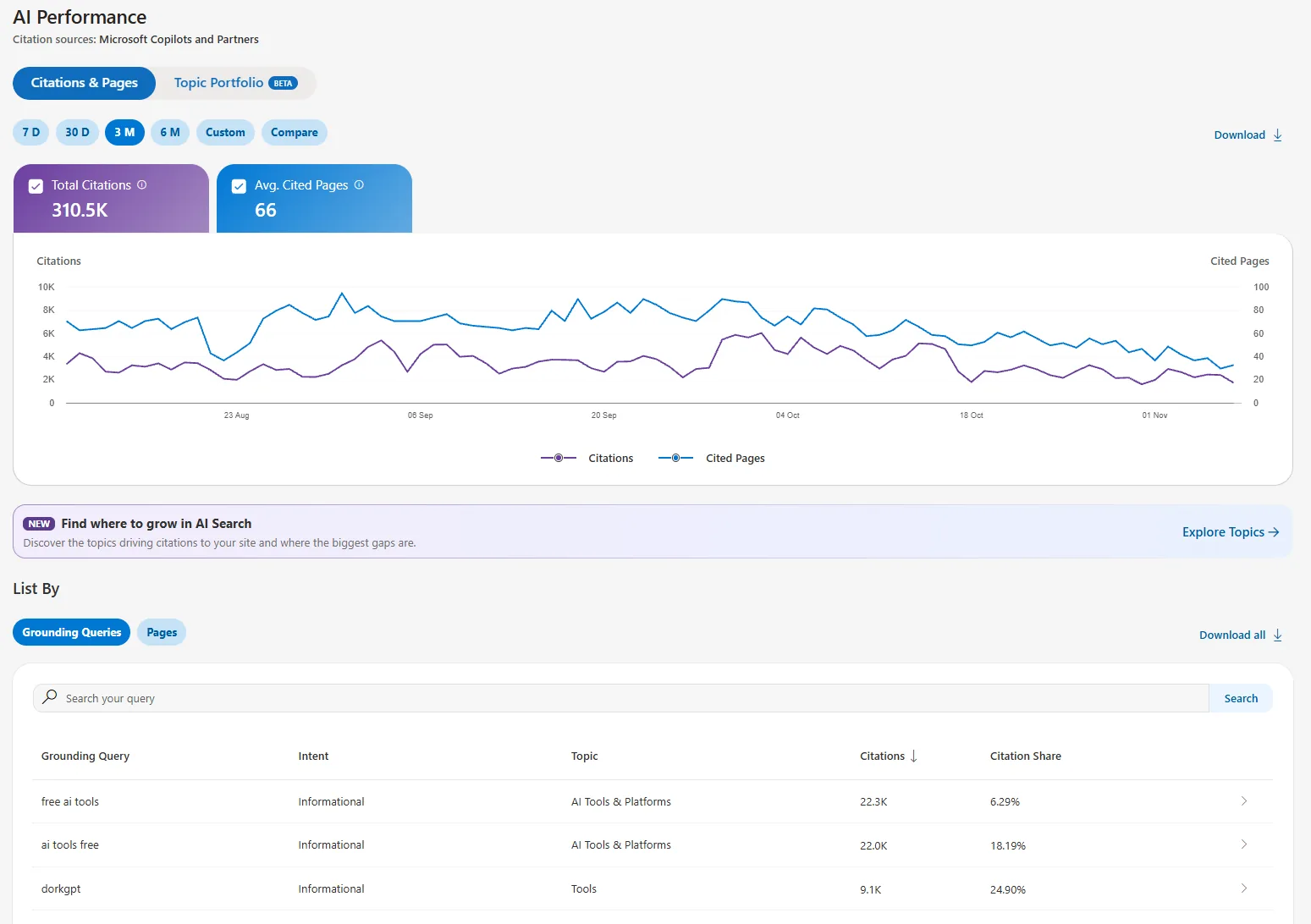
On 10 February 2026 Microsoft opened AI Performance in Bing Webmaster Tools as a public preview. It reports when a site's content is cited as a source in Microsoft Copilot, in AI-generated summaries in Bing and in select partner integrations. For the first time a search engine hands site owners their own AI citation counts.
We verified our site and downloaded three exports: the daily overview, the page report and the grounding queries. They cover 10 August to 7 November 2026. Then we did the thing the dashboard does not do, and set the citations beside Bing's own search-click data for the same pages. The headline is that a citation is a very different thing from a visit, and that the citations we collect are not spread the way we assumed.
Bing shows Bing. Your buyers use more than Bing
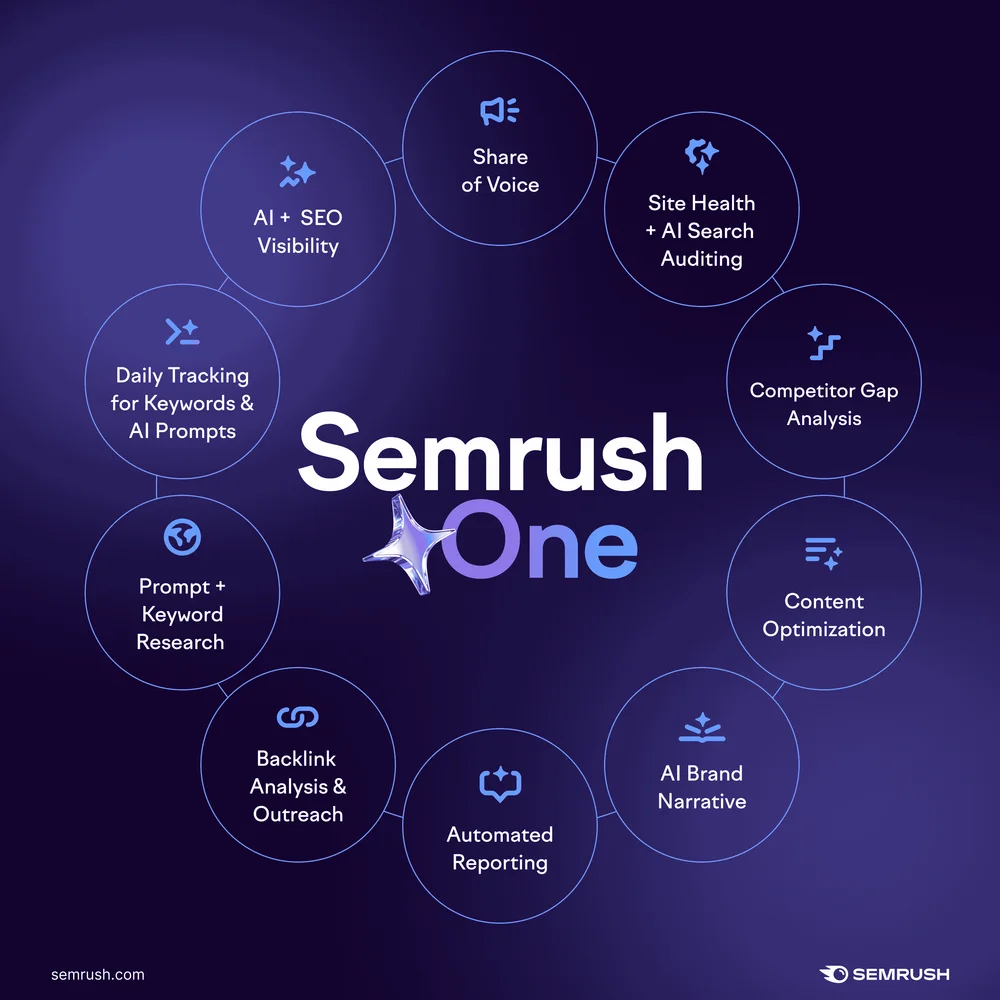
See how ChatGPT, Gemini and Google's AI answers cite you too with Visibility Overview in the AI Visibility Toolkit. To get it together with the SEO Toolkit in one subscription, try Semrush One free for 7 days.
One page took 61% of the citations
The dashboard total is 310,489 citations over 90 days. The page report lists 236 URLs that add up to 302,137 of them (97%). The distribution is steep.
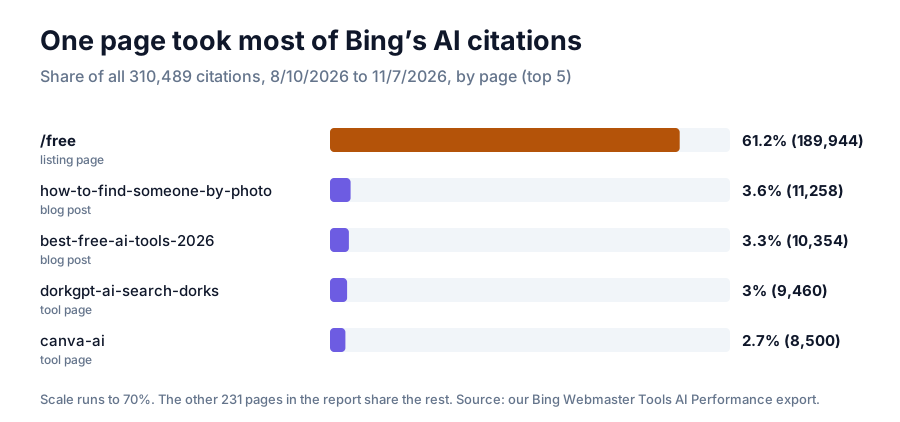
- One page, 189,944 citations. Our
/freelisting alone holds 61.2% of the dashboard total. - Five pages, 76% of the page report. The top 20 pages hold 90.5%.
- 208 tool pages hold 86,812 citations between them, and 16 blog posts hold 22,018.
A single listing page, one that gathers many free tools under one address, is what Microsoft's AI reaches for when it is asked for free AI tools. That is a fact about this one site. It is also a reminder that a "citations" total can be one page wearing a trench coat. If you read your own number as breadth, check the page report before you celebrate.
Citations are not clicks
Microsoft's own definition is narrow: Total Citations is "the total number of citations that are displayed as sources in AI-generated answers", shown "without indicating placement or presentation within a specific answer". Its announcement describes no click metric. So we pulled Bing's separate page report, which records search impressions and clicks per page in weekly buckets, and divided.
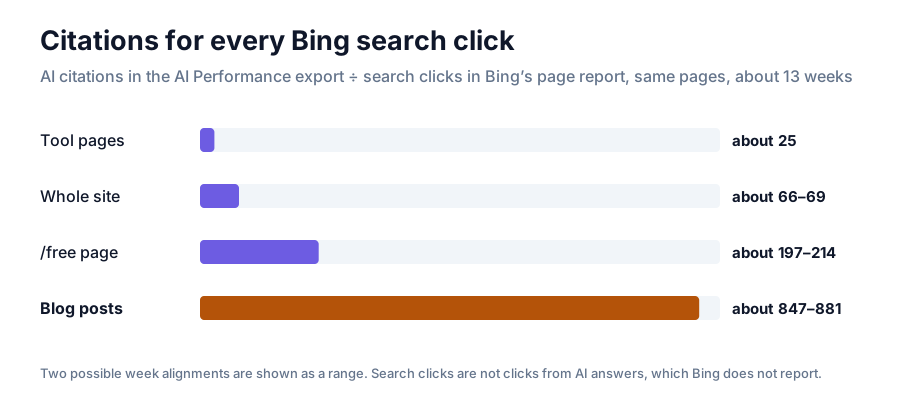
| Pages | Citations (90 days) | Citations per Bing search click |
|---|---|---|
| Whole site (236 pages) | 302,137 | about 66 to 69 |
Whole site without /free | 112,193 | about 31 to 32 |
/free | 189,944 | about 194 to 211 |
| 208 tool pages | 86,812 | about 25 |
| 16 blog posts | 22,018 | about 847 to 881 |
We give ranges because Bing's weekly buckets carry a date, and the report does not say whether that date marks the start or the end of the week. We counted 13 weeks both ways. The ratios barely move.
Three things stand out.
- Blog posts get the fewest clicks for their citations. 16 posts took 22,018 citations and very few search clicks. One example: our free-AI-tools guide was cited 10,354 times and does not appear in Bing's page report with any search activity at all.
- The tool pages convert best. Our tool pages run at about 25 citations per click, and the page for a household-name product we list ran at about 5. That page is also one that ranks in Bing's ordinary results. We cannot show cause, but it is consistent with the idea that a page needs to be a destination people already look for, and not only a source an answer draws on.
- Many of the most-cited pages have no search click to compare. Of the 81 pages cited at least 100 times, 44 to 46 got no Bing search click in the matching weeks. Of those, 25 to 28 do not appear in Bing's page report at all, so they had no recorded search activity, and 18 to 19 were shown but never clicked. Together they account for about 10.5% of the citations on those 81 pages.
One limit matters more than any other. These are search clicks, not clicks from AI answers. Bing does not tell us how many people clicked a citation inside an answer, so a visit that came from a Copilot citation is not in this table. The ratio shows how weakly a citation count predicts ordinary search traffic. It does not show how many visits the citations sent.
What Bing's AI was actually searching for
The grounding-queries export lists the phrases Microsoft's AI searched for while building its answers. Ours has 1,149 rows covering 226,325 citations, 72.9% of the dashboard total.
- "Free" is in 57.3% of the queries and 73.7% of the citations. The biggest query, free ai tools, drew 22,314 citations. The ten biggest queries carry about 38.5% of the total.
- 85% of citations come from queries Bing labels informational. Commercial queries are 6.5%, comparisons 1.0%, research 1.6%. The dashboard says the intent and topic labels are AI-generated, so treat them as a rough sort.
- The long tail is long. 696 of the 1,149 queries (60.6%) have fewer than 50 citations. 116 queries run seven words or longer; they are 10.1% of the rows and only 3.5% of the citations.
- The queries keep the user's typos. frre ai, artifical analysis ai and context revesro each appear with their misspelling intact, so a grounding query is not always a clean keyword.
- The same question comes in many languages. One tool's "free versus paid" question appears as English variants with country names, and in German, French, Turkish, Italian, Spanish and Portuguese. In all, 59 queries mention that tool and share 2,508 citations. It reads as the AI rewriting one question many ways, though the export does not say so.
Microsoft's June update added a Citation Share column, defined as "the percentage of citations attributed to your site out of all citations shown across all sites" for a query (Microsoft, 16 June 2026). Microsoft calls it observational and says it does not represent traffic share. Used as a ratio it still tells you how big the field is. Our top query, free ai tools, has 22,314 citations at a 6.29% share, which implies a cited space of about 355,000 citations in the sample for that one query. Across the 288 queries with at least 100 citations, we hold roughly 10.7%, weighted by citations (an estimate, built from rounded shares).
The trend is down, and the data is still settling
| First 14 days (from 10 Aug) | Last 14 days (to 7 Nov) | Change | |
|---|---|---|---|
| Citations per day | 3,126 | 2,418 | −22.6% |
| Cited pages per day | 62.5 | 44.2 | −29.3% |
We cannot tell from the export why. Microsoft says the data is a sample of overall citation activity and that it will keep refining metrics as more data is processed, so the newest days may move. Citation patterns can also shift with user behaviour, model changes and freshness. A fall in the last two weeks of a 90-day window is something to watch, not a conclusion.
What the exports cannot tell you
- Clicks from AI answers. There is no click column.
- Which model cited you. The exports do not split by Copilot, Bing summaries or partners.
- Which query led to which page. The three files we downloaded have no column joining a grounding query to a page.
- Other engines. The report's citation sources are Microsoft Copilots and Partners. ChatGPT, Gemini and Google AI answers are outside it.
Five checks to run on your own export
- Find your biggest page. Divide its citations by the total. If one URL holds more than half, your "AI visibility" is one page's visibility.
- Join citations to search clicks. Use the page report and Bing's search stats for the same weeks, and keep both week alignments.
- List your pages with 100 or more citations and no search activity. They are cited, but nobody finds them through search.
- Read the grounding queries as language, not as keywords. Look for typos, other languages and rewritten questions.
- Check the date range twice. The last days can be revised.
Take the same question beyond Bing
Bing's report is a good first signal for one ecosystem. The next questions are which prompts other AI answers use, how you compare, and what to change.
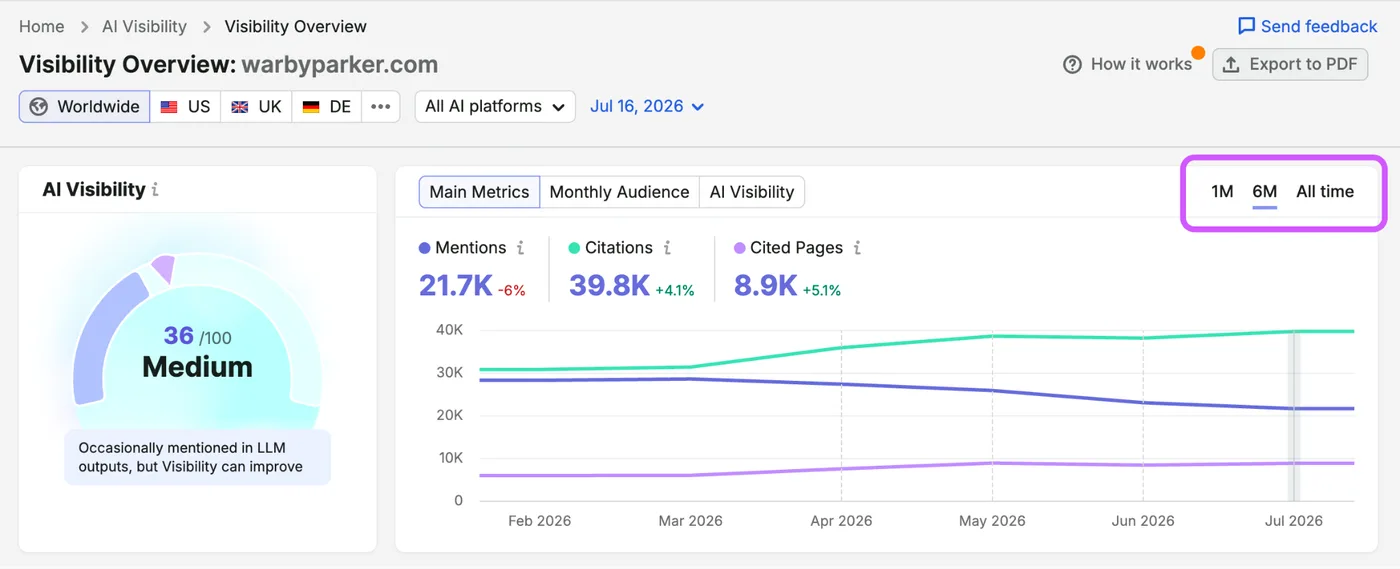
Track mentions and citations across AI platforms. Visibility Overview and Prompt Tracking in the AI Visibility Toolkit report an AI Visibility score with mentions, citations and cited pages over time, and break mentions down by ChatGPT, AI Overview, AI Mode and Gemini, the platforms a Bing export cannot see.
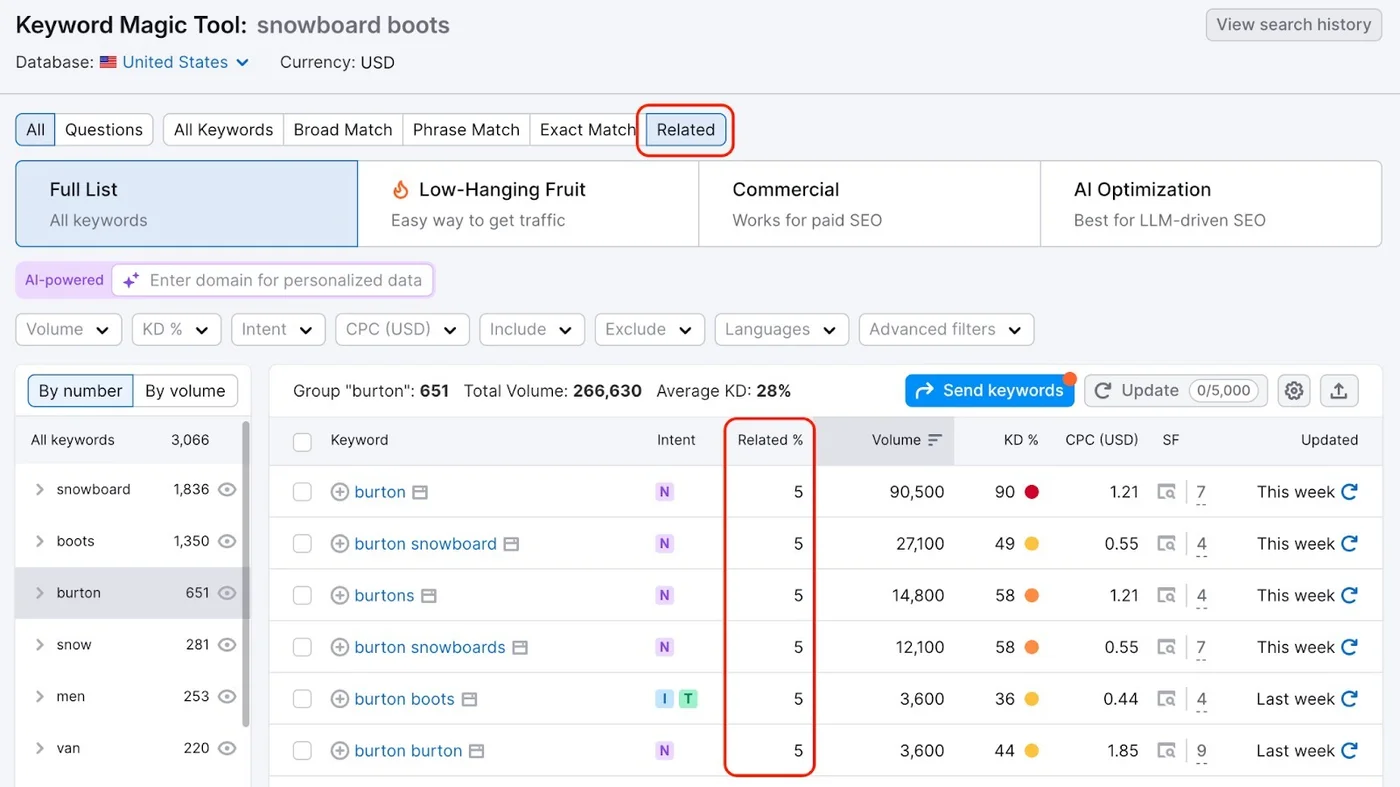
Turn grounding phrases into a keyword plan. The Keyword Magic Tool in the SEO Toolkit groups related keywords and shows intent and volume, so a list like free ai tools and its variants can be sorted into the questions a page should answer.
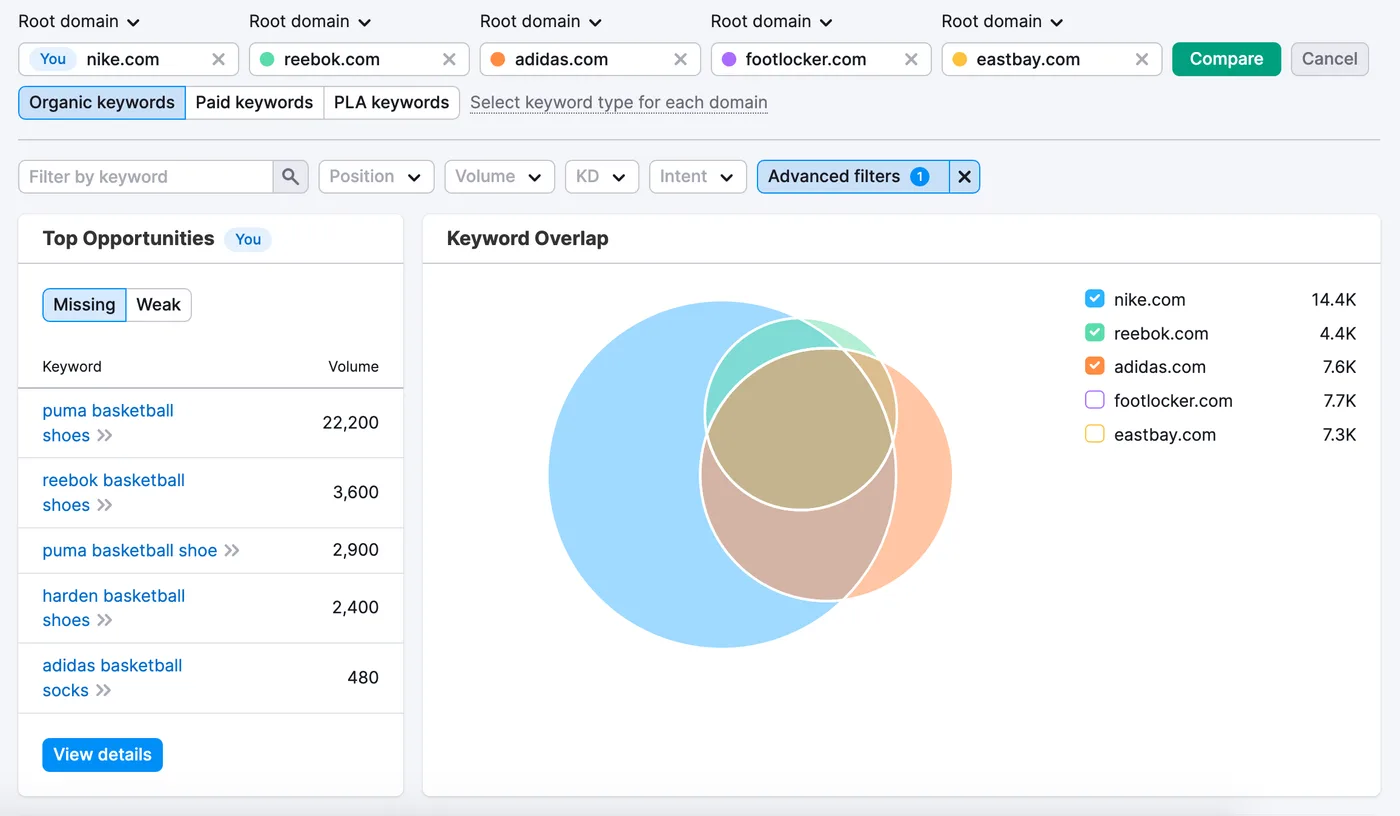
Compare with competitors. Competitive Research is the part Bing's report leaves out, because it shows only your own site. Keyword Gap compares your domain with others and lists the keywords they rank for and you do not.
Check what an AI crawler can reach. On-Page & Technical SEO is the work of making pages readable and retrievable. Site Audit in the SEO Toolkit reports AI Search Health, including pages blocked from AI search bots.
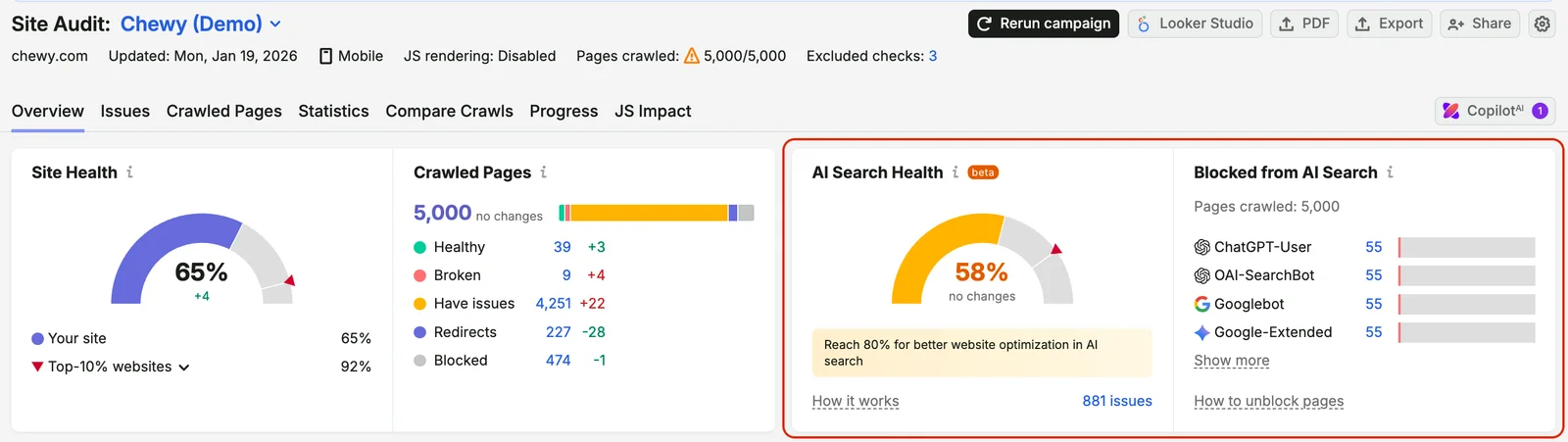
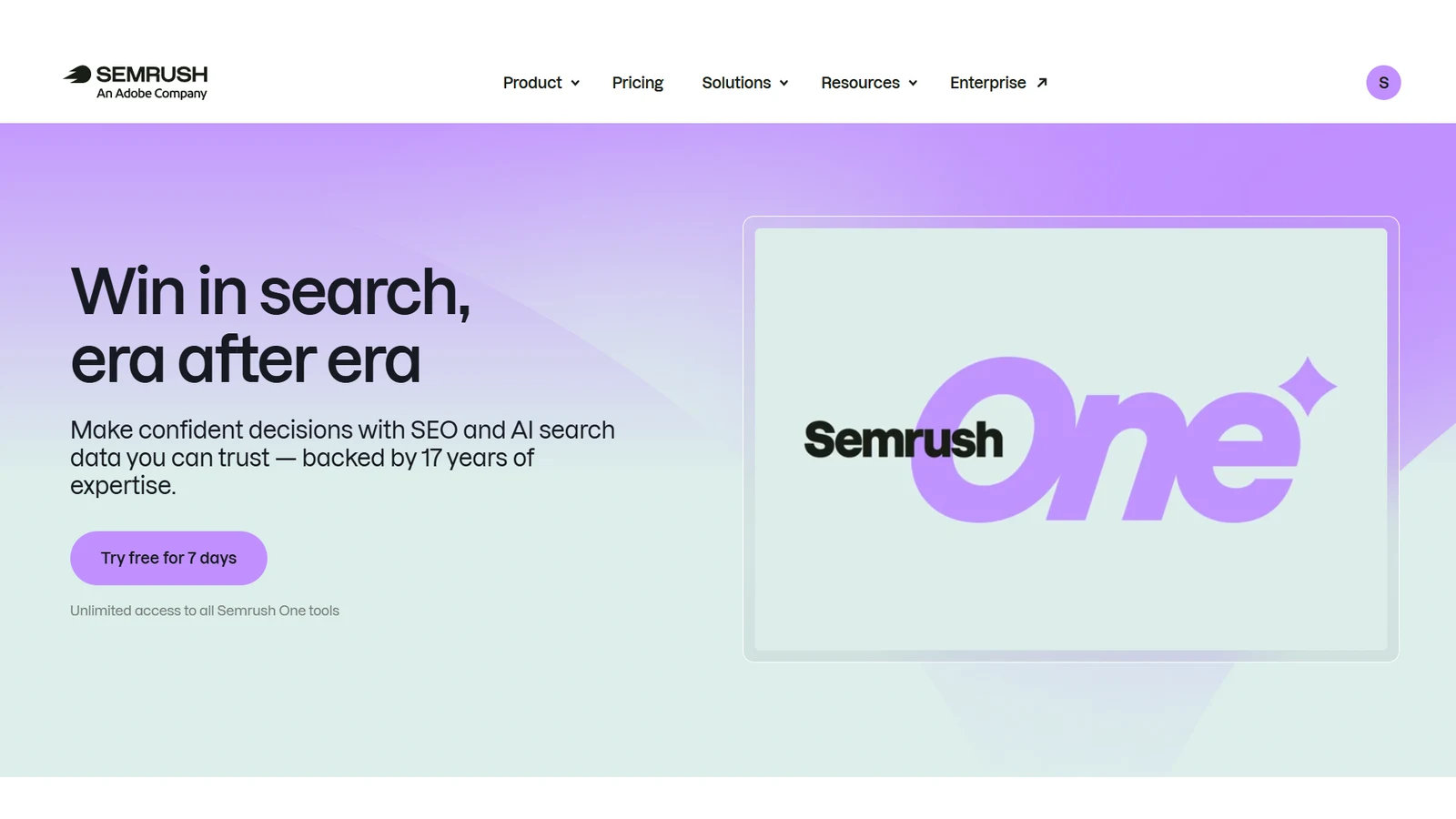
The AI Visibility Toolkit has no free trial of its own; the 7-day free trial is Semrush One's, which includes it alongside the SEO Toolkit. To see your own numbers across platforms before paying, try Semrush One free for 7 days: its page offers "Unlimited access to all Semrush One tools", checked on 16 October 2026. Those are Semrush's published terms, not something we tested; none of the data above came from a Semrush account.
Be cited, then be worth the click
For us the numbers say two things. A citation is a signal that a machine found a page useful, and it is not a visit. And one page can carry most of it. The useful work is to read the dashboard as a map of where you are already a source, then decide which of those pages deserves to be a destination.
Try Semrush One free for 7 days
Visibility Overview and Prompt Tracking to see how ChatGPT, Gemini and Google's AI answers cite your brand, beside the SEO Toolkit — together in Semrush One. Free for 7 days for new users.
Try Semrush One free for 7 daysWhat we exported, and how
- Exports: Bing Webmaster Tools, AI Performance, the 3 M view, downloaded on 10 November 2026: the daily overview (90 days, 10 August to 7 November), the page report (236 URLs) and the grounding queries (1,149 rows). Microsoft's own notice on the screen reads that the data is a sample of overall activity and may be refined, and that intent and topic labels are AI-generated.
- Click data: Bing's page-level search statistics for our site, retrieved on 10 November 2026 through the Bing Webmaster API. Rows are page by weekly bucket. We summed 13 weekly buckets two ways (14 August to 6 November, and 7 August to 30 October). URLs with and without
wwwwere merged. - Ratios: citations from the page report divided by search clicks from the click data for the same URLs. These are two different Bing reports, so they are approximate. We publish ratios and not click counts.
- Not shown: clicks that came from inside an AI answer, other AI engines, and any claim about why citations fell in the last two weeks.
- Reproduce it: the exports, the saved click data and the script are in our research folder (
research/r2-c1-bing-ai-performance/).
Some links may be affiliate links. We may earn a small commission at no extra cost to you.
Related Articles
Explore more guides and reviews from our experts.
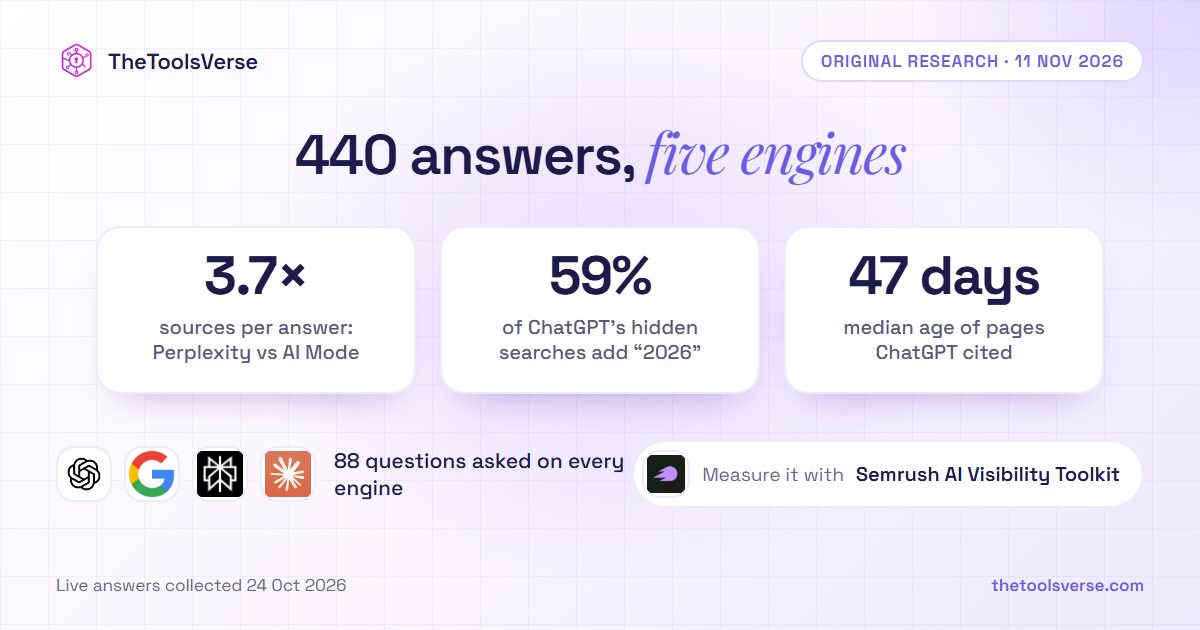
We Asked 88 Questions on 5 AI Engines. Perplexity Cited 3.7 Times as Many Sources as Google AI Mode, and ChatGPT's Hidden Searches Add "2026" to 59% of Queries
Is Gemini Overtaking ChatGPT? In Developer Downloads, Gemini's Share Peaked in March and Anthropic Passed OpenAI: 17 Months of SDK Data