We Audited 20 Amplemarket Duo Copilot Drafts: What Held Up and What Needed a Human
Disclosure
Paid partnership with Amplemarket. TheToolsVerse is an Amplemarket partner: links to Amplemarket in this article are partner links, and we may earn a commission and a content reward from Amplemarket if you sign up. We are partners, not Amplemarket employees, and we don't speak for the company. Amplemarket gave us a one-month account to create content, not to prospect with, so we contacted nobody. Everything below comes from that account, with no mailbox or LinkedIn connected. We read the feed on 10 November 2026 and checked it again on 12 November. We opened recommendations to read and photograph them, and we didn't send, dismiss or edit any. We name no company or person from the feed, and every name in the screenshots is blurred.
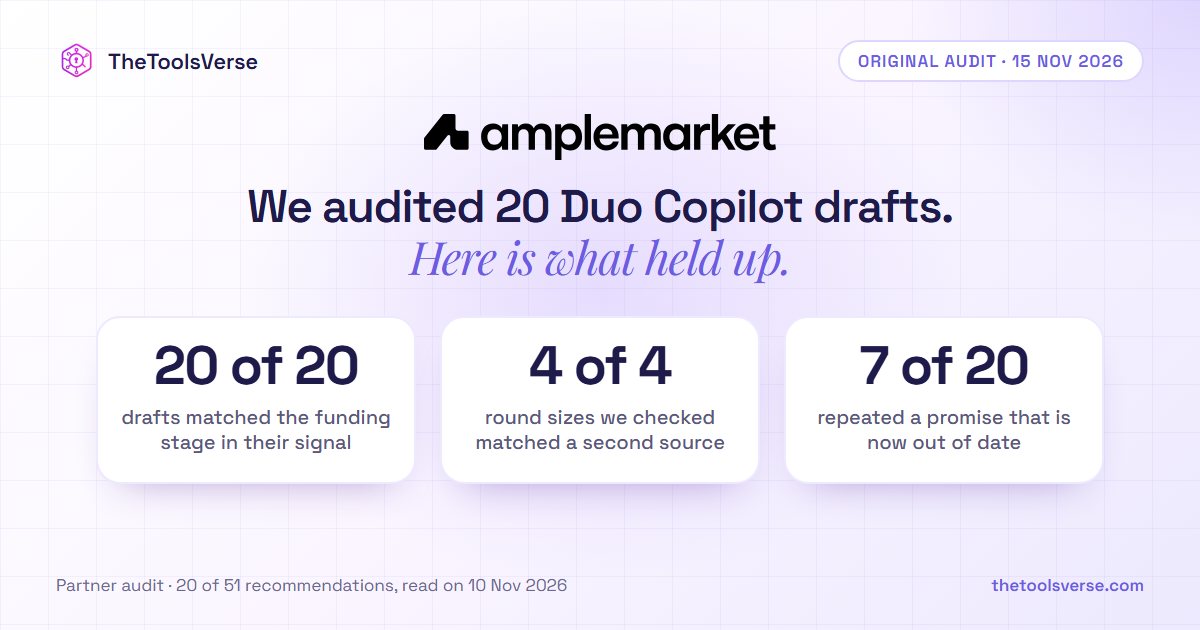
Short answer: Amplemarket Duo Copilot wrote six-step outreach for 51 companies on our account, and the drafts were good. In the newest 20 that we read line by line, every funding stage matched its signal, every number Duo Copilot quoted about our directory was right, and all four funding amounts we checked against a second source were correct. What needed a human was different: 2 drafts congratulated a company with a different name from the one on the lead, 7 repeated a promise we had stopped keeping, and 6 leads had a company record that didn't match the contact's own email. Then the feed paused, by design: Duo Copilot's own banner said it had stopped generating leads because we weren't acting on them.
We had already written about a weekly Duo Copilot routine and the first ten leads. This is the larger audit, with the method so you can run the same one on your own feed.
What we audited, and how
On the night of 4 November we created one Duo Copilot agent, called "Funding - AI tools". It watches for Pre-Seed, Seed and Series A rounds, and it targets founders, CEOs and marketing or growth leaders at small companies. We left Autopilot off. By the evening of 10 November the feed held 51 recommendations, none acted on.
We read the newest 20 in full through Amplemarket MCP from Claude Code, using only read tools. For each lead we recorded the details below. Where we could check something against the world outside Amplemarket, we did.
| Check | How we did it |
|---|---|
| Funding stage | Compared the stage in the signal with the stage in the drafted emails |
| Company name | Compared the company on the lead record with the company named in the draft |
| Contact's email | Compared the brand in the contact's email domain with the company record. A different domain for the same brand name counted as a match |
| Claims about us | Compared every figure about TheToolsVerse in the drafts with our own site data |
| The out-of-date promise | Counted drafts offering to let the buyer "review the copy before paying" |
| Fit | Counted drafts that doubted the fit themselves, and company industry labels outside software or tech |
| Funding amounts | For 4 of the 16 drafts that named an amount, we looked for a second, independent source |
Two cautions before the numbers. Ten of these 20 may overlap with the ten we read for the routine article on 7 November, so please don't add the two sets together. And these are the newest 20 of 51 for one agent, one business and one week.
The result in one chart
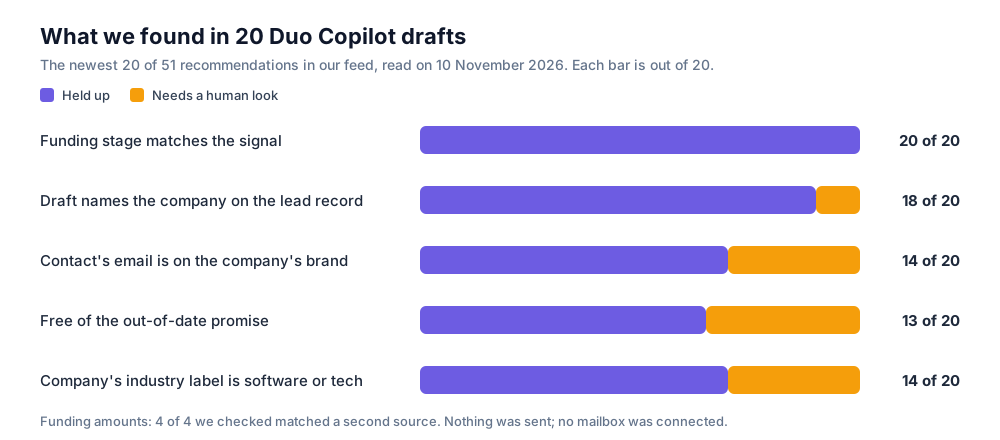
The purple parts are what held up. The amber parts are what a person would have to catch before anything was sent.
What held up
The funding facts. In all 20, the stage in the draft (Pre-Seed or Seed) was the stage in the signal. In 16 of them, the first email named the size of the round, in dollars, Canadian dollars, euros or pounds as the source reported it. We checked four of those against independent funding news, and all four amounts matched, including a large seed round and a pre-seed that one outlet reported in a different currency. The round type was backed by independent coverage in three of the four. For the fourth, the sources we found gave the amount but said the company hadn't stated a round type, so "pre-seed" came from the database behind the signal. That's a reason to open the source link on any lead you plan to write to.
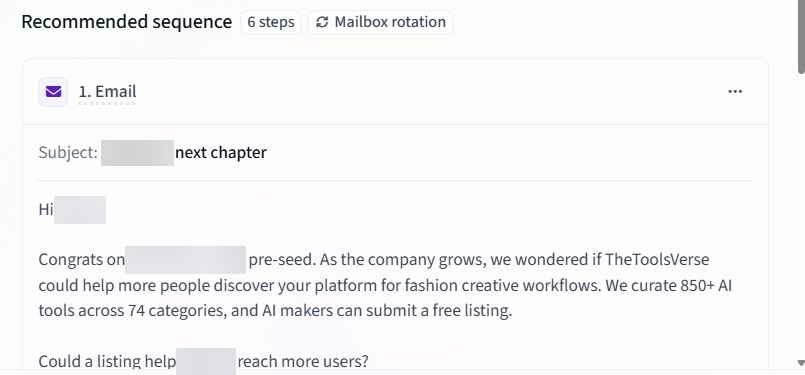
The claims about us. 19 of the 20 drafts quoted a number about our directory. We checked them against our own data: Duo Copilot said "850+ listings" and "74 workflow categories", and we had 852 tools and 74 categories at our most recent site build. Every figure was right. Duo Copilot also described our free listing and the editor-written review accurately, which suggests the setup copy it started from was sound. This is a typical first email:
Honesty about fit. Three of the 20 questioned the fit themselves. One draft told a life-science company "I'm not sure our audience is the right fit for a lab platform", offered to check whether a category existed, and closed with "Should I leave it there, or check fit?" Another ended with this:
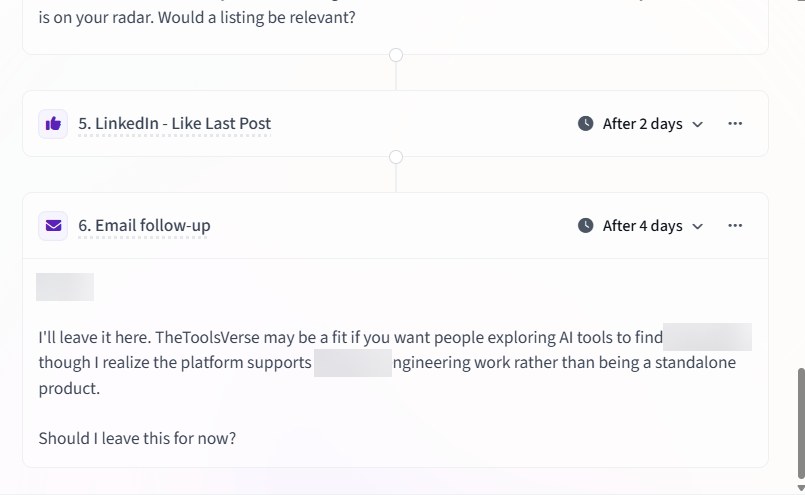
That's more honest than most cold email we've seen, and it's useful, because a draft that doubts itself tells you which leads to dismiss first. It's also a reminder that the six-step sequence still gets written for a lead the draft itself isn't sure about.
What needed a human
1. Two drafts used a different company name from the lead
In 2 of 20, the draft congratulated a company whose name differed from the one shown on the lead. A third was a near miss: the same business under a slightly different name. Here is one of the two. Both names are blurred, so you'll have to take our word for what's under them: the name at the top, in the signal, is the company on the lead. The four blurred names in the email are all a different company:
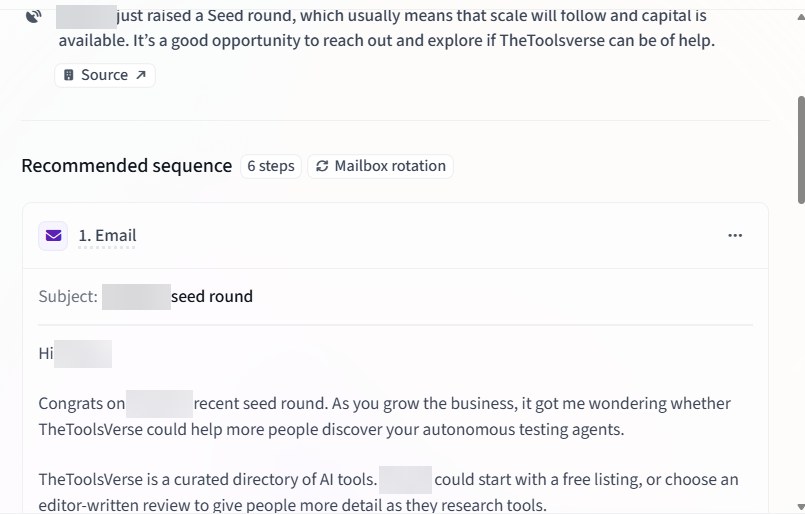
In both clear cases, the name in the draft matched the funding source Duo Copilot linked to and the contact's own email domain, so it's the company record on the lead that looks out of date or wrong. We can't tell whether these are renames or bad matches.
Broaden the check and it appears more often. In 6 of 20 leads, the contact's email was on a different brand from the company record. Some will be rebrands and some will be data errors, and we can't separate them from here. The effect is the same either way: you'd send "Congrats on X" to a person your CRM calls Y.
2. The promise we had stopped keeping
On 3 November, Amplemarket wrote our value propositions during setup, including a line telling buyers they could review the copy for factual accuracy before paying. That was true for our site that day and stopped being true about six hours later. We covered it in the weekly routine article. The audit adds two things.
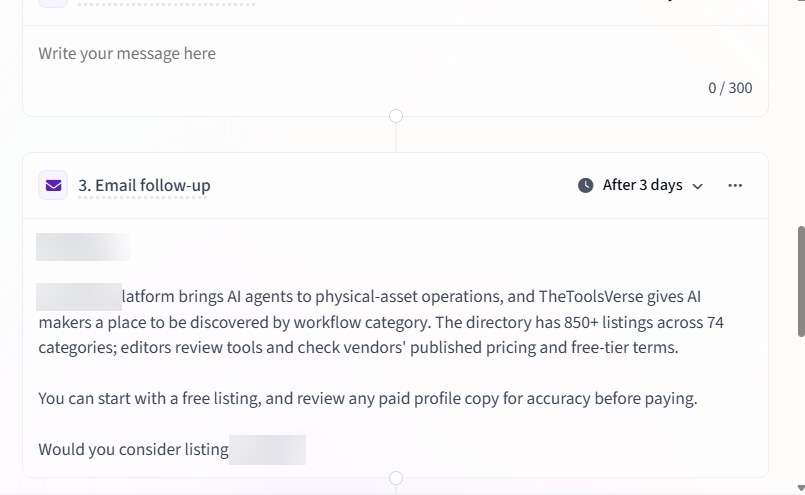
First, it wasn't a one-off. 7 of the 20 drafts repeated it, with wording such as "review any paid profile copy for accuracy before paying":
Second, it's still there. This is the setting on 10 November, six days after we found the problem:
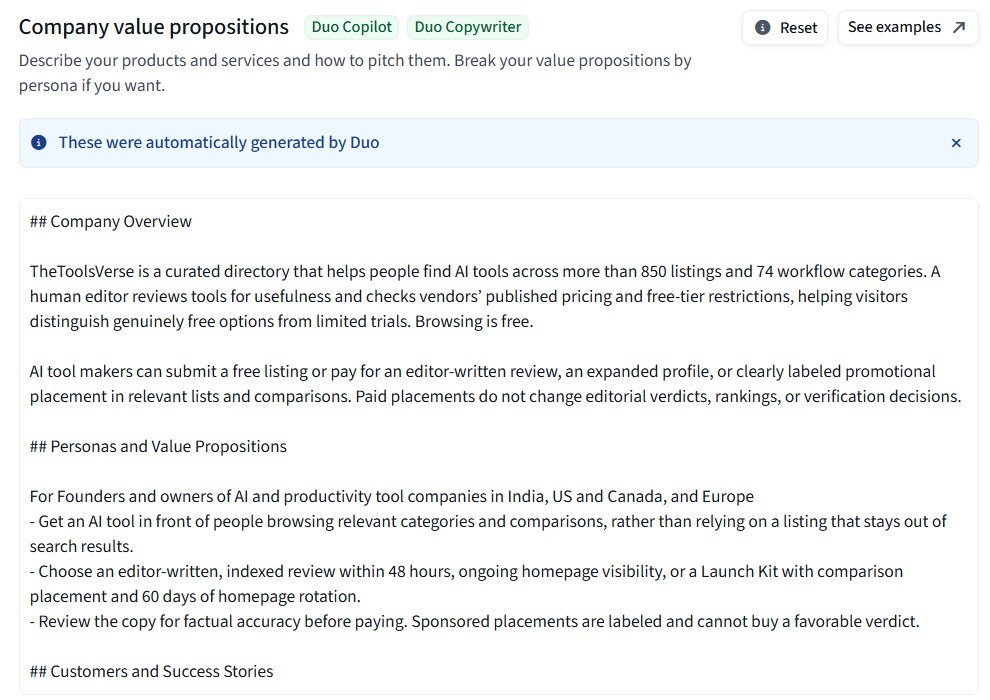
We want to be exact about it. The promise is true for one of our three paid plans, the one that previews before it publishes. The drafts were mostly pitching the editor-written review, which publishes first and can be refunded. Duo Copilot did what it was told. Nothing in these screens changes the copy when your business does.
3. The signal summary is a fixed sentence
Each lead opens with a short explanation under "Signal details". It reads like research, but it's a fixed explanation of the signal type: in all 20 leads it was the same sentence with only the company name and funding stage changed, "just raised a Pre-Seed round, which usually means that scale will follow and capital is available." It also fills in our own company name from the account's data. That read "TheToolsverse" in all 20, and "Toolsverse" on the very first lead, while the drafts, written from our value propositions, spelled it correctly. Check how your own company name is stored before a buyer sees it:
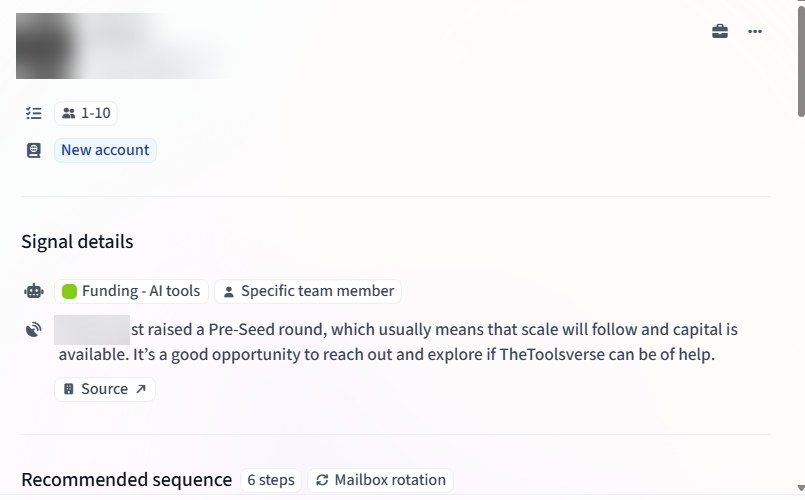
The real evidence on that screen is the Source link. That's the one to open.
4. Who it chose
Six of the 20 companies carried an industry label outside software and tech: health care (two), engineering services, robotics, insurance and environmental programme management. A label isn't a product, and a health-care label can sit on a real AI product, so we don't count these as wrong. But a directory of AI tools has a narrower audience than "funded founders", and we'd rather you see the spread than hear that the agent "found leads". Our filter was keywords plus company size, and it returned what that filter allows.
Then the feed paused itself
The 51 leads arrived between 19:12 UTC on 4 November and 02:47 UTC on 8 November. After that, nothing new. When we opened the feed on 10 November, an orange banner explained why:
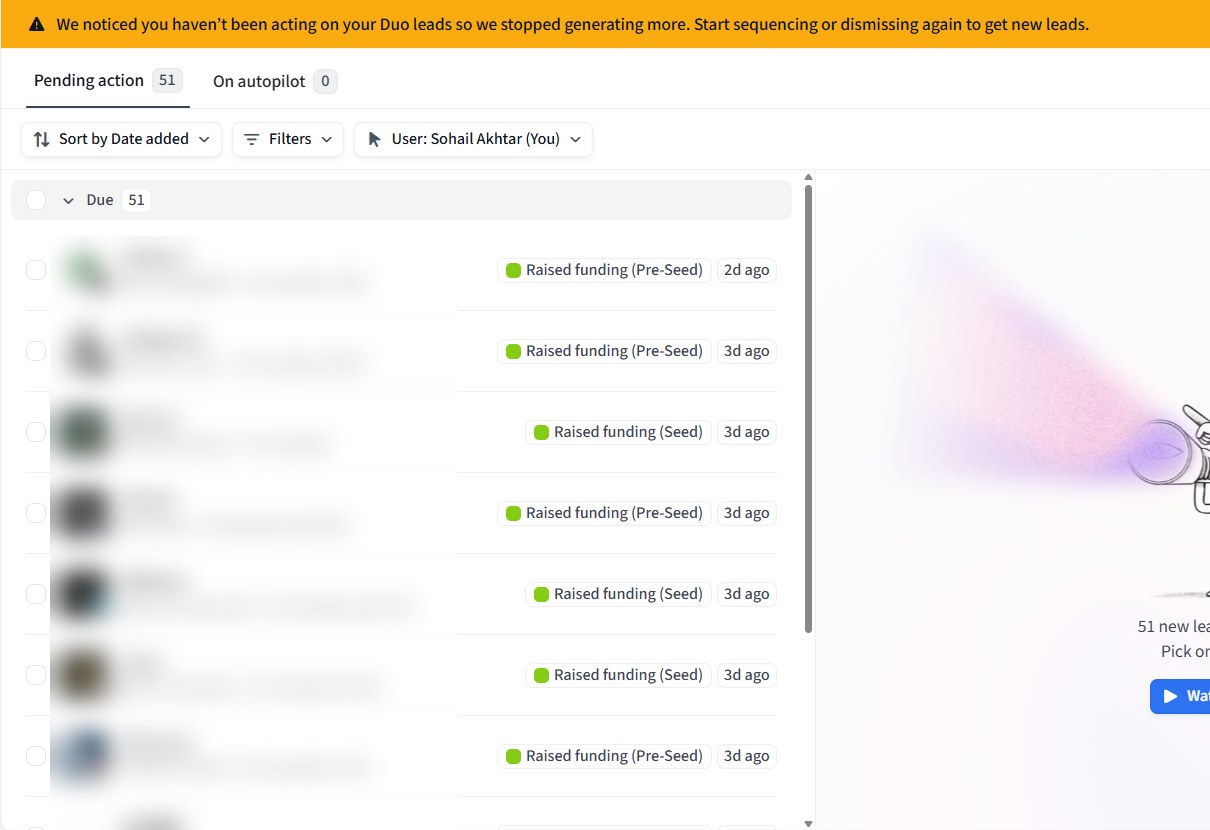
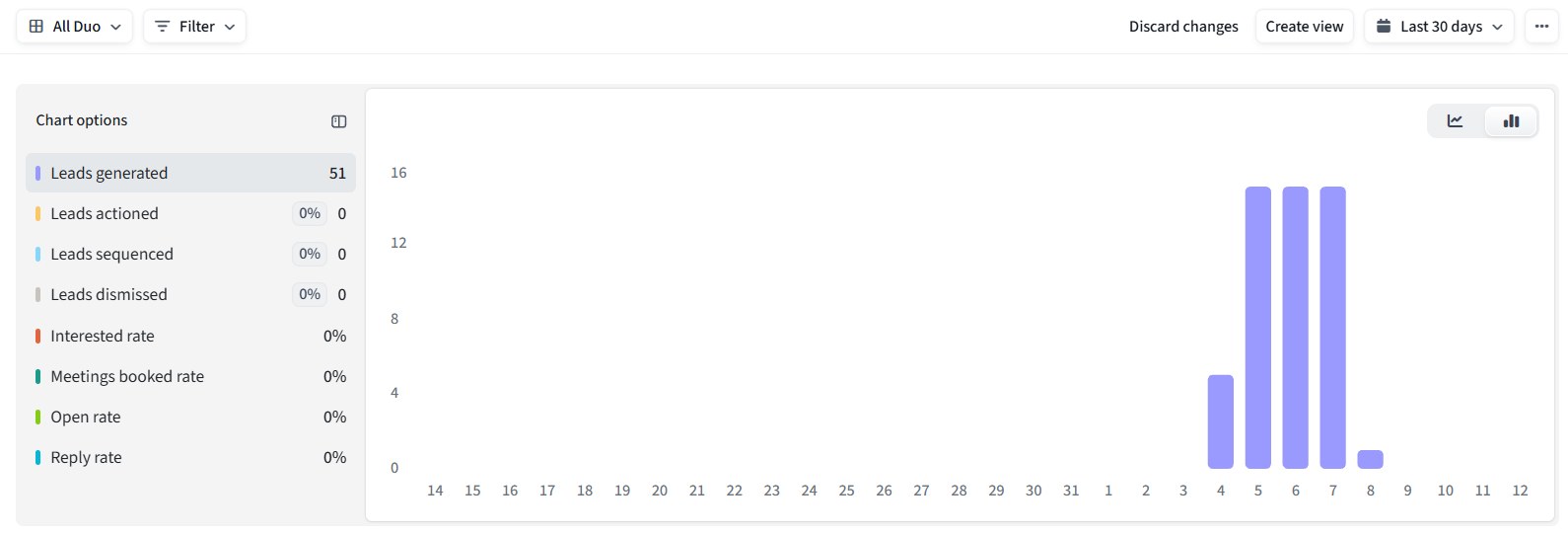
That's Amplemarket's own wording, and the Duo Copilot analytics tell the same story. Over the last 30 days the agent generated 51 leads: about 5 on 4 November, about 15 a day from 5 to 7 November, 1 on 8 November, and none after that. Leads actioned, sequenced and dismissed were all 0:
The agent list shows it too. Its seven-day volume column, empty on the day we created the agent, now shows two full days, a sliver for 8 November, then nothing:
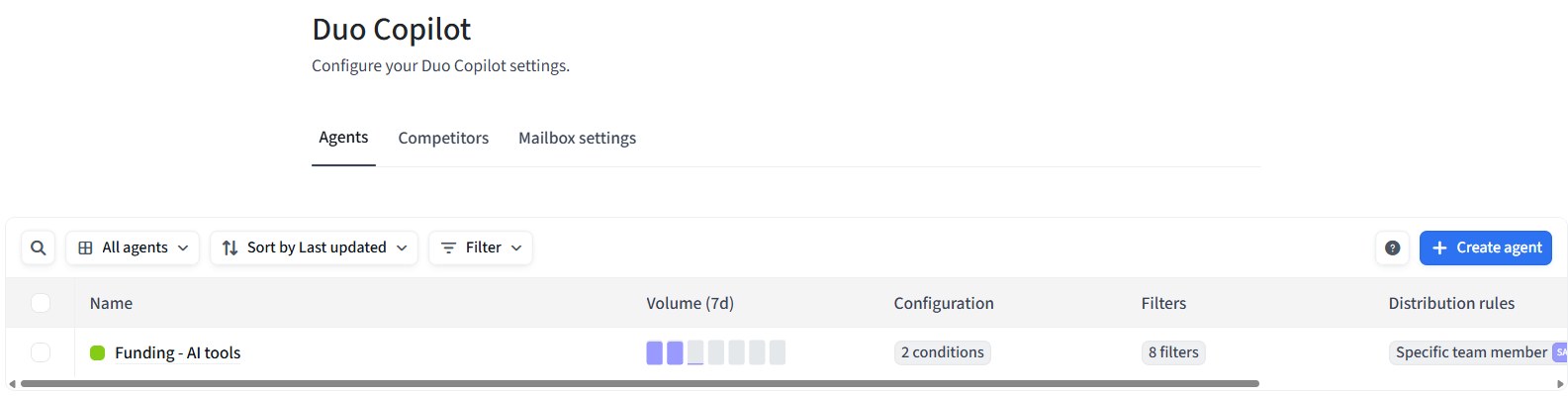
When we checked again on 12 November, the feed still held the same 51 leads, the newest still from 8 November. We haven't tested how much action restarts it. In our view, it's the right design: a tool that kept piling up drafts nobody reads would make a stale list look like progress. The lesson is plain, though. Duo Copilot isn't a firehose you can leave running. It generates leads for a person who works them, and Amplemarket's help centre says a lead goes stale after 14 days with no action. Our oldest lead is from 4 November, so the clearing out starts around 18 November.
If you decide to try it, start a free trial or book a demo, and plan the weekly slot first. Our weekly routine is one way to do it.
A 10-minute audit you can copy
You don't need our setup. Run this once a week on your newest ten leads, or ten per page if you use the MCP:
- Read your messaging settings first (Settings → Duo Control Center → Messaging Settings). Every promise in there will end up in a draft.
- Open ten leads. For each one, put the company name on the lead next to the name in the draft. If they differ, stop and fix that lead.
- Compare the contact's email domain with the company. A different brand is a reason to check the person's role, not necessarily a reason to drop the lead.
- Open the Source link on three of them. Check the amount, the stage and the date against one independent source.
- Check every claim about your own product in the draft against your own site. Our checks were that count of tools, the number of categories and the purchase terms.
- Dismiss with the right reason so Duo Copilot learns. Our dismiss table explains the four.
- Write down four counts (matched, mismatched, out of date, doubted fit). A trend across weeks is more useful than any one week.
If you use Claude or ChatGPT with Amplemarket MCP, the read can be one prompt. This is the kind we ran, and it returned real leads:
List my pending Duo Copilot leads, 10 per page, newest first. For each, show the
company name on the lead, the company name used in the first email, the
signal title and the source link. Read only: don't accept, schedule or
dismiss anything.
Expect a lot of text, because every lead comes with its full six-step draft. One page of ten was large enough to be saved to a file in our setup, so read a page or two at a time, not the whole feed at once.
What we didn't test
- We read 20 of 51 leads, all from one agent for one business, so the counts describe our feed and not Duo Copilot in general. Ten may overlap with the earlier article's sample.
- We checked 4 of 16 funding amounts, and we chose those four. The other twelve are unchecked. We didn't check the timing claims such as "last week" or "this week".
- The oldest lead was outside the sample. It carried the same promise, so the 7 of 20 may understate the problem.
- We sent nothing, so we have no open rates, replies or meetings, and we haven't tested whether Duo Copilot adjusts after edits or dismissals.
- We don't know why the company and email brands differed in 6 leads, or whether the company records are stale or the contacts have moved.
- We haven't tested what restarts the feed after the pause banner, or how Amplemarket decides to show it.
Our take
We went in expecting the drafts to be the weak part, and they weren't. They were specific, polite, and right about the facts that came from a database or from our own website. Every error we found traced back to an input: a company record, a stale setting, a signal summary that's the same sentence for everyone.
That changes where the effort goes. A team that treats Duo Copilot as an SDR it can leave alone will send a promise it no longer keeps, to someone at the wrong company, and then find the feed has paused. A team that spends ten minutes a week on the audit above gets what the product is good at, which is a daily list of companies with a reason to hear from you.
Run the audit on your own feed
Set up one Duo Copilot agent with manual review on, then read your first ten leads using the checklist above. Start a free trial or book a demo with Amplemarket.
Get started with AmplemarketSources
| What | Source | Checked |
|---|---|---|
| All screenshots; every count in the chart and tables; the banner wording; the 51-lead date range | Our own reading of an Amplemarket account provided for partner content, in the app and through Amplemarket MCP in Claude Code | 2026-11-10, re-checked 2026-11-12 |
| Our listing and category counts | TheToolsVerse site data at the 5 November 2026 build (852 tools, 74 categories) | 2026-11-10 |
| Funding amounts and round types for four leads | Independent funding news coverage found by web search; company names withheld | 2026-11-10 |
| The 14-day limit; dismiss reasons | Amplemarket Knowledge Base, linked above | 2026-11-04 |
Written by Sohail Akhtar. The audit method is our own opinion. Amplemarket's product changes over time, so check its documentation for the current version.
Some links may be affiliate links. We may earn a small commission at no extra cost to you.
Related Articles
Explore more guides and reviews from our experts.
Top Sites With Organization Markup Block AI Crawlers Slightly Less, 18.9% Against 23.1%, but Plain JSON-LD Shows No Such Pattern: Joining Two of Our Studies
We Re-Checked 2,098 URLs That Five AI Engines Cited: 91.6% Still Load, 0.8% Are Gone, and 7.7% Cannot Be Verified by a Bot