Wikipedia Pageviews for AI Tools Fell a Median 31% in Nine Months — Almost Five Times Faster Than Wikipedia Itself
Disclosure
This article is promotional content produced as part of the Semrush Creator Accelerator programme. It contains affiliate links to Semrush — if you buy through them we may earn a commission at no extra cost to you — and we may also receive a reward from Semrush for publishing it. All measurements in this article are our own. Semrush did not supply, review or approve the data, and the conclusions we draw are ours.
Zero-click search is hard to see from inside one website. When a click does not happen, there is nothing in your analytics to record it — just a slow drop in visits that could have a dozen causes.
Wikipedia is a useful exception. Every article's readership is public, month by month, through the Wikimedia pageviews API, and a Wikipedia article about a product is exactly the kind of page people used to click when they wanted to know "what is X?" — the question AI answers now answer directly. So we pulled the readership of the Wikipedia articles about the AI tools we list.
Measure the visibility clicks no longer show
Track how often AI answers mention and cite your brand — the visibility that never becomes a click — with the AI Visibility Toolkit, and watch AI Overviews above your rankings with Position Tracking. To get both in one subscription, try Semrush One free for 7 days.
96 articles, two quarters
Of the 613 AI tool companies in our catalogue, 111 have an English Wikipedia article linked from their Wikidata entry (we counted them in an earlier study). For each one we pulled monthly pageviews from October 2025 to September 2026 — human readers only, all devices — and compared the last quarter of 2025 with the third quarter of 2026. We kept the 96 articles with at least 3,000 views in the first quarter, so that small articles did not swing the result.
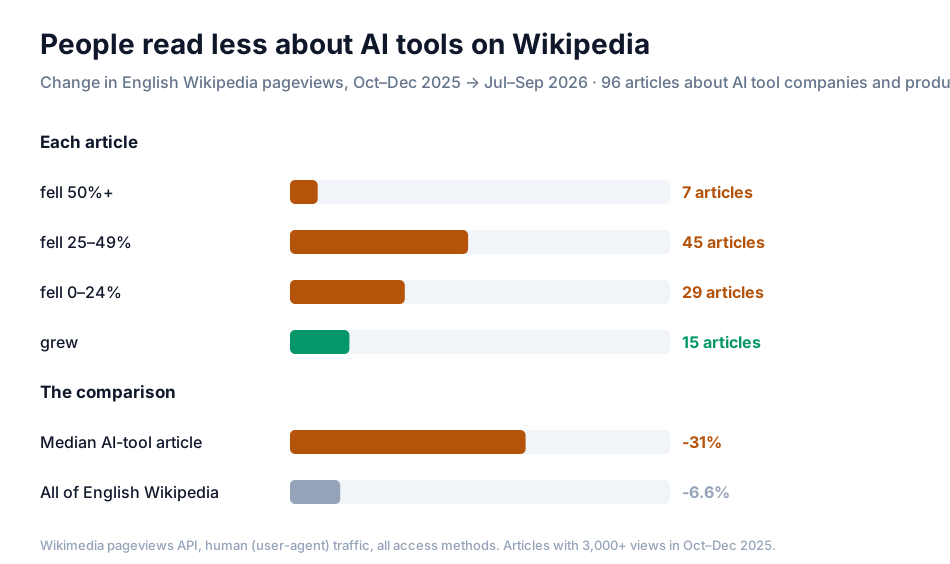
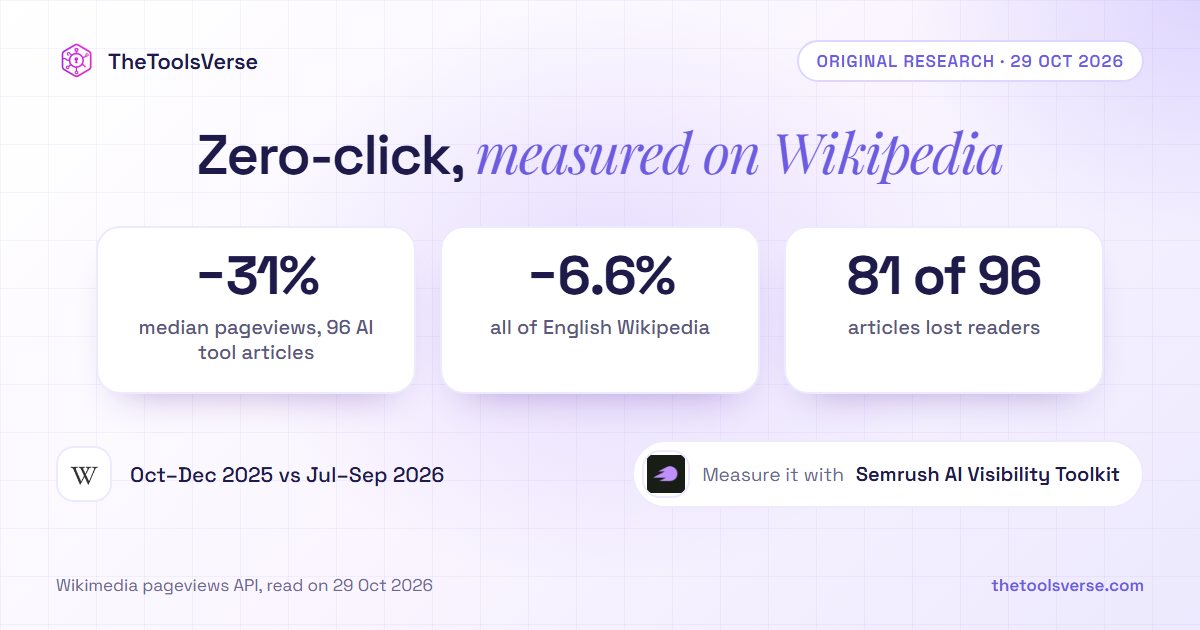
The median article lost 31% of its readers. 81 of the 96 declined, and 52 fell by a quarter or more. Taken together, the 96 articles lost 37% of their pageviews.
English Wikipedia as a whole fell 6.6% over the same months. Wikipedia's overall readership has been under pressure — AI answers summarise it constantly — but the articles about AI tools fell almost five times as fast as the encyclopedia around them.
Who grew
Fifteen articles gained readers. About half are recent launches or new versions, such as Claude 4, Qwen3-Coder, Devstral 2, Eleven Music and Replit Agent, and the rest are established names such as Palantir, Klaviyo and Zendesk AI. That is the other half of the picture: attention in AI moves to whatever is new, and a product's Wikipedia readership can rise around a launch and fade after it. Some of the decline is interest moving on, not clicks disappearing.
What the two together suggest is uncomfortable for anyone measuring brand interest by visits. The questions people ask about established AI tools may increasingly be answered before they reach any page about them, and some of the visits that remain follow whatever is new.
What this means for measurement
- Stop reading falling visits as falling interest. A brand can be discussed and recommended more while its pages are visited less.
- Track presence inside the answers. Mentions, citations and share of voice in AI answers are the visibility that clicks no longer capture.
- Watch the AI Overview, not only your position. A first-place ranking under an AI answer is worth less than it was.
- Keep the content that answers bottom-of-funnel questions. "Buy", "compare" and "pricing" questions still produce clicks; "what is" questions increasingly do not.
- Use public signals as a check. Wikipedia pageviews are free and independent; if your brand has an article, its readership is a useful outside view of how interest — and clicking — is changing.
Measure what never becomes a click
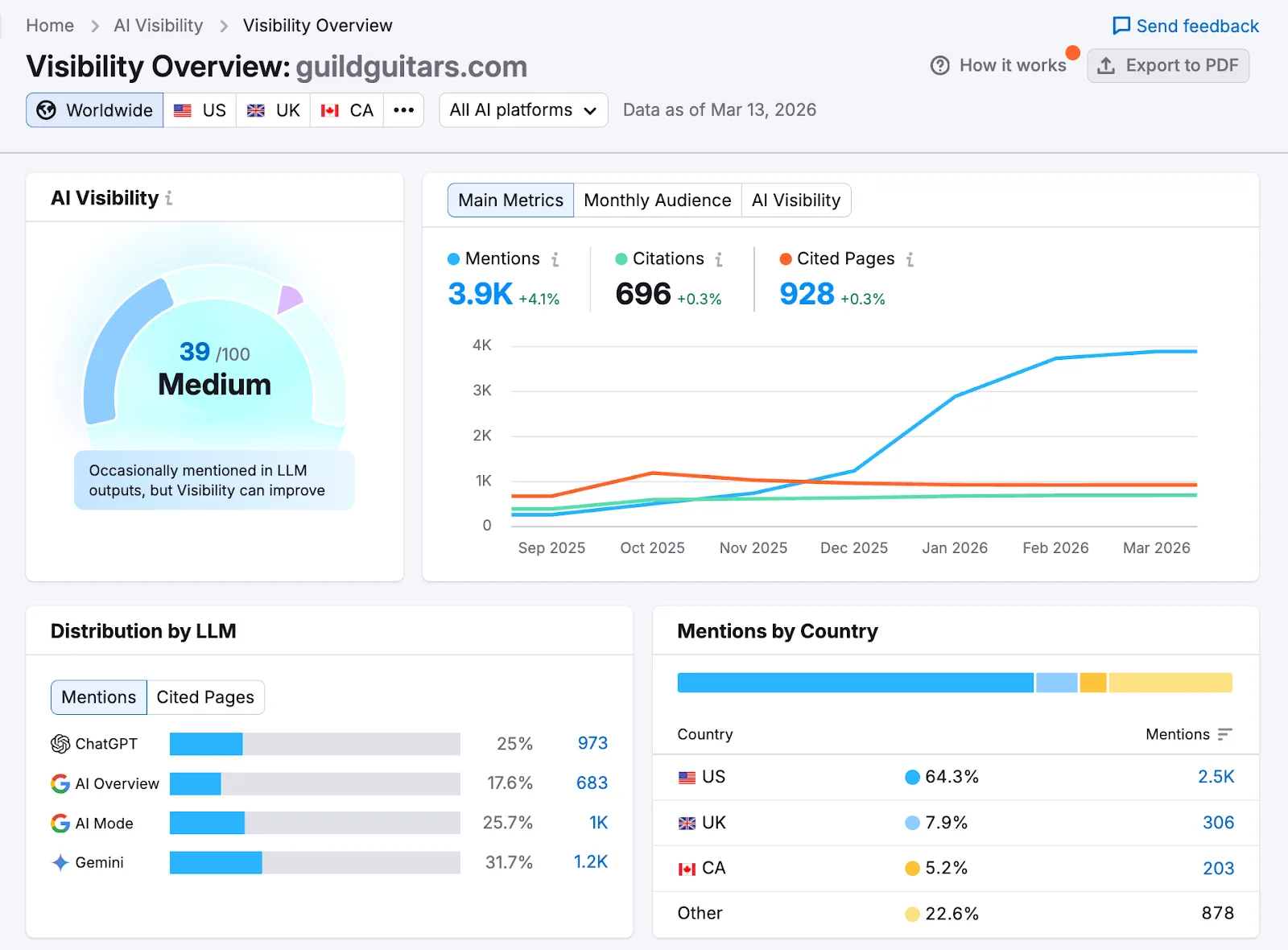
Track mentions and citations across AI platforms. The AI Visibility Toolkit reports an AI Visibility score with mentions, citations and cited pages over time, broken down by ChatGPT, AI Overviews, AI Mode and Gemini.
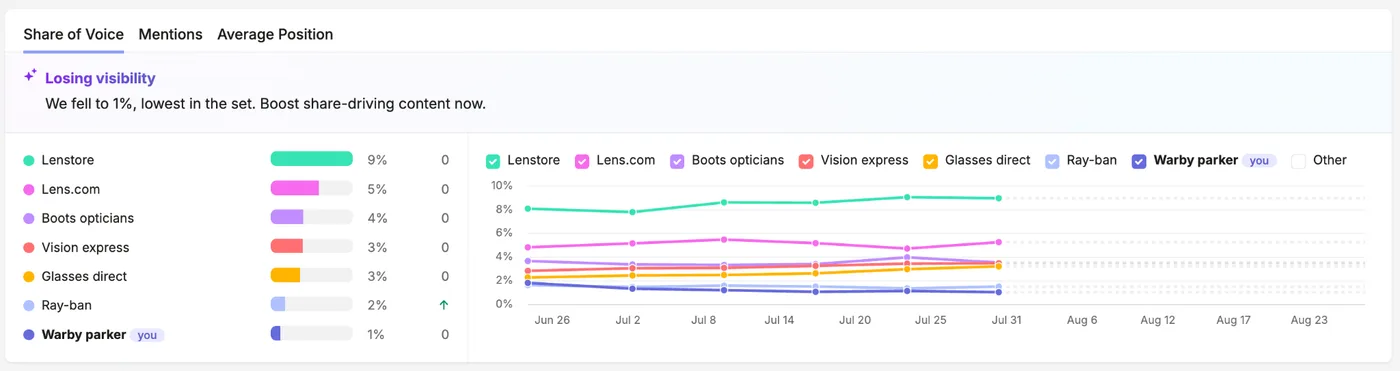
Watch your share of voice move. The Share of Voice report in Brand Performance shows each brand's share of AI mentions and how it changes week by week — the trend line to put next to falling traffic.
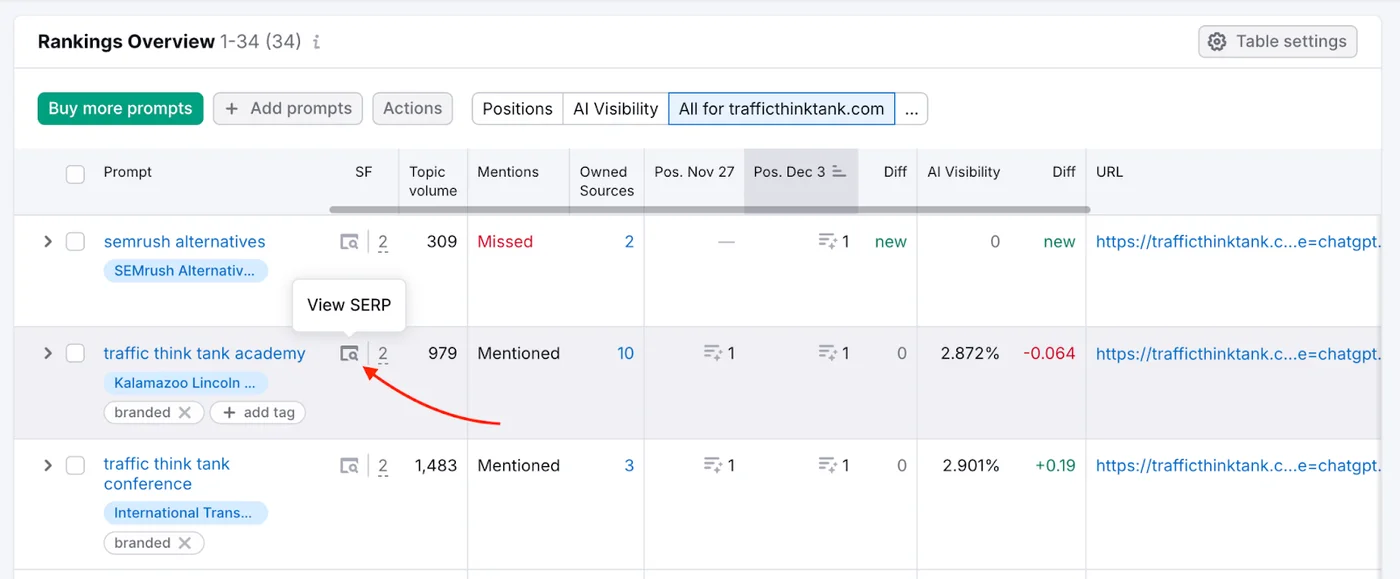
Track prompts, not just keywords. Prompt Tracking follows chosen prompts with whether your brand was mentioned, which of your sources were cited and your AI visibility by date.
Keep AI Overviews in your rank tracking. Position Tracking records whether your keywords trigger an AI Overview, so a click drop at a steady position can be explained.

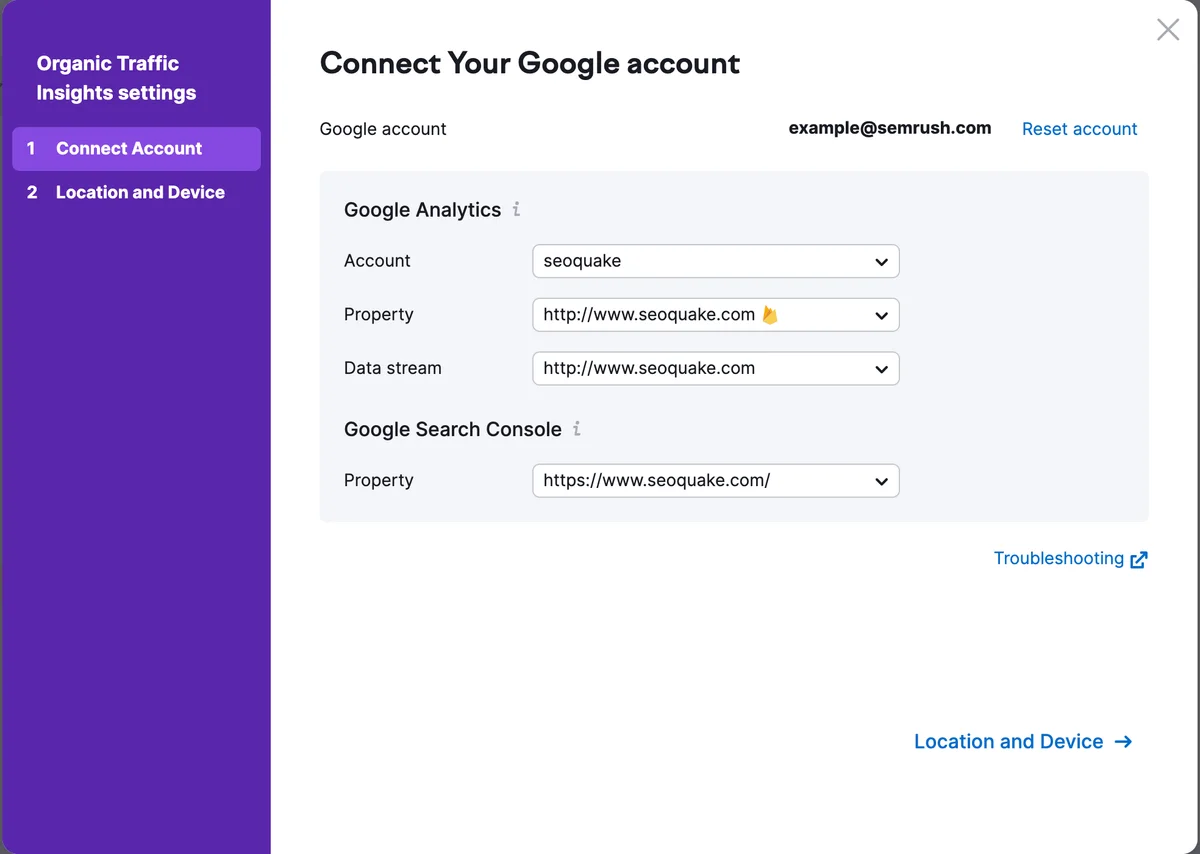
Put your own clicks next to your rankings. Organic Traffic Insights connects Google Analytics and Search Console to Semrush's keyword data at page level. A page whose position holds while its clicks fall is the zero-click pattern above, on your own site.
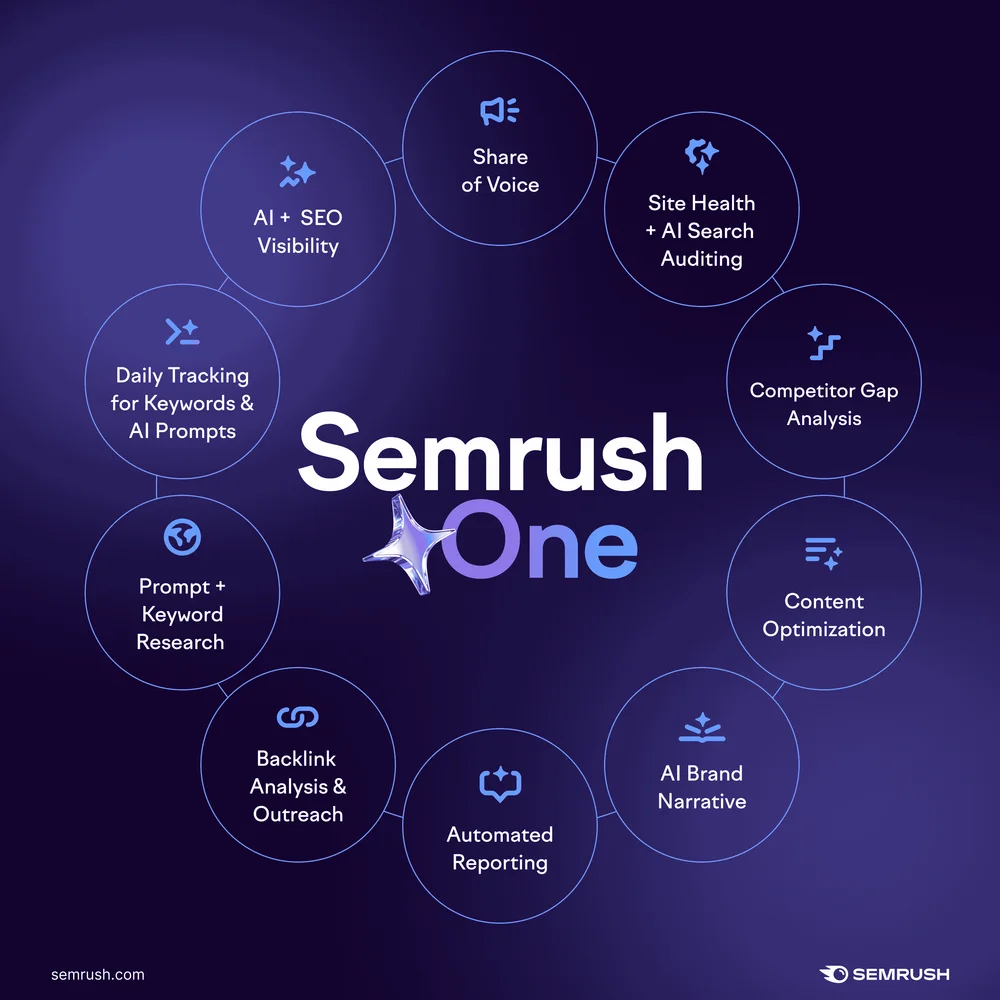
Semrush One includes the SEO Toolkit and the AI Visibility Toolkit, and the 7-day free trial is Semrush One's — the AI Visibility Toolkit has no free trial of its own. To set a baseline for your own brand before paying, try Semrush One free for 7 days: its page offers "Unlimited access to all Semrush One tools" and notes "Offer available to new users only", checked on 28 October 2026. Those are Semrush's published terms, not something we tested; none of the data above came from a Semrush account.
The click is the part that's disappearing
Interest in AI tools has not collapsed in nine months — but the habit of clicking through to read about them has. Wikipedia's articles about AI tools lost a median 31% of their readers while Wikipedia lost 6.6%. If your measurement only counts visits, you are measuring the part of visibility that is shrinking fastest.
Try Semrush One free for 7 days
The AI Visibility Toolkit to measure mentions, citations and share of voice in AI answers, and Position Tracking to see AI Overviews above your rankings — together in Semrush One. Free for 7 days for new users.
Try Semrush One free for 7 daysWhere the pageviews come from
- Articles (111 found, 96 analysed): English Wikipedia articles linked from the Wikidata entries of AI tool companies in the TheToolsVerse catalogue (entries matched by official website, 29 October 2026). Analysed: articles with at least 3,000 views in October–December 2025.
- Pageviews: Wikimedia REST API,
per-article, en.wikipedia, all-access, agent = user (human readers; known bots excluded by Wikimedia), monthly. Baseline: the same API's aggregate for all of English Wikipedia. Change = July–September 2026 versus October–December 2025. - Why this is not proof of cause: why any article lost readers. Seasonality, news cycles, renamed articles, the shift of attention to newer products and Wikipedia's own falling traffic all play a part; AI answers are one plausible cause among them, not a measured one.
| Figure | Source | Date |
|---|---|---|
| Monthly pageviews for 96 articles | Wikimedia REST pageviews API | 2026-10-29 |
| English Wikipedia total pageviews | Wikimedia REST pageviews API (aggregate) | 2026-10-29 |
| Article list | Wikidata sitelinks for our matched entries | 2026-10-29 |
| Every median and percentage above | Our analysis of the saved pageviews | 2026-10-29 |
| AI Visibility Toolkit, Brand Performance, Prompt Tracking, Position Tracking and Organic Traffic Insights descriptions; screenshots | Semrush Knowledge Base | 2026-10-29 |
| Semrush One graphic and trial terms | Creator Accelerator affiliate resources; Semrush One page | 2026-10-28 |
Written by Sohail Akhtar. The saved pageviews and analysis script can be re-run.
Some links may be affiliate links. We may earn a small commission at no extra cost to you.
Related Articles
Explore more guides and reviews from our experts.
Amplemarket Duo Copilot: A Weekly Signal Routine for a Small Sales Team
Most AI Crawlers Don't Run JavaScript. We Rendered 515 AI Tool Home Pages Both Ways: 67 Show a Crawler Less Than Half Their Words