Two in Three AI Tool Companies Don't Exist Where Machines Check Facts: We Looked Up 613 on Wikidata
Disclosure
This article is promotional content produced as part of the Semrush Creator Accelerator programme. It contains affiliate links to Semrush — if you buy through them we may earn a commission at no extra cost to you — and we may also receive a reward from Semrush for publishing it. All measurements in this article are our own. Semrush did not supply, review or approve the data, and the conclusions we draw are ours.
A growing number of SEO practitioners describe the same shift: from optimizing a page to making a brand something AI systems can verify — an entity whose name, website, founders and profiles agree with each other across independent sources. A page says what a company claims about itself. An entity record is where a machine can check it.
There is no single public list of the sources AI systems check, but one is open, structured and widely reused: Wikidata, the knowledge base behind Wikipedia's infoboxes. An entry there ties a name to an official website and to identifiers on other services. So we asked a narrow, checkable question about the AI tools we list: does each company exist on Wikidata as itself?
See how AI answers describe your brand
Find out what AI platforms say about your brand — and the questions people ask about it — with Brand Performance in the AI Visibility Toolkit. To get it with SEO tracking in one subscription, try Semrush One free for 7 days.
The lookup: an entry only counts if it points home
We took the 613 AI tool companies in our catalogue whose websites answered on 28 October 2026 and looked each one up on Wikidata on 29 October in two ways: by name, and directly by official website. An entry counted only if its "official website" property points to the company's live domain. A name match alone does not count — Wikidata is full of things called Aura, Storm and Hunter.
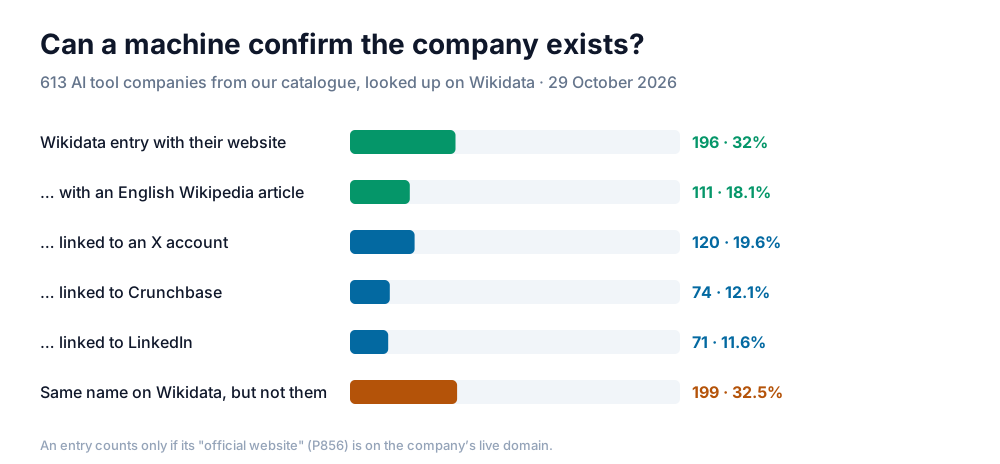
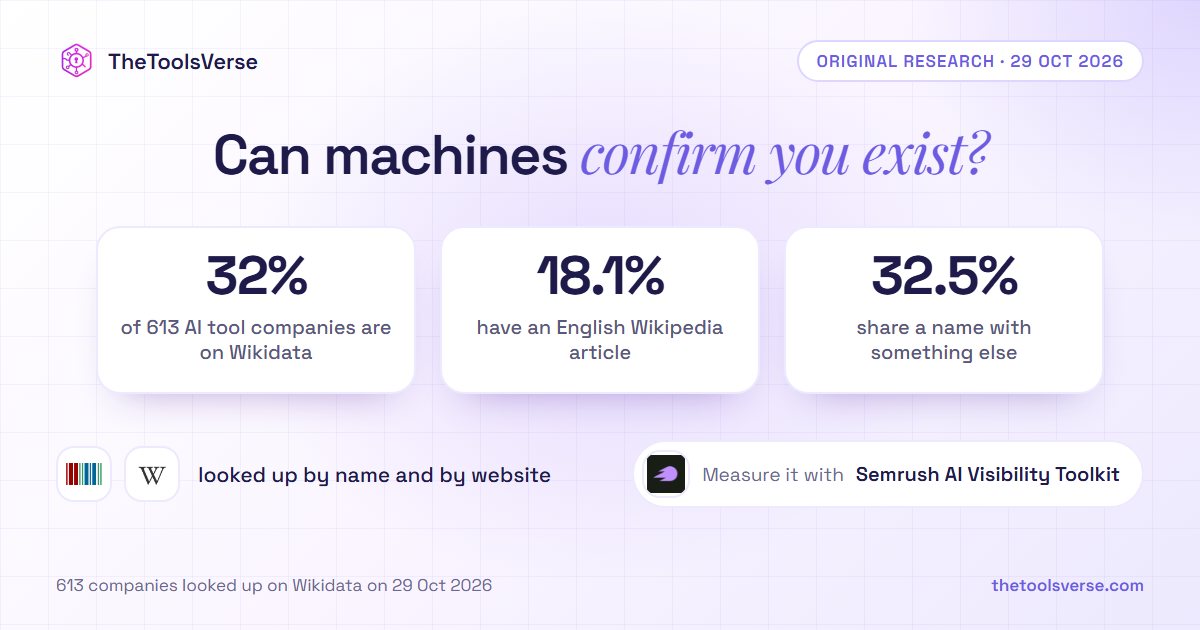
196 of the 613 companies (32%) have a Wikidata entry that points to their website. 111 (18.1%) also have an English Wikipedia article. Among them are the names you would expect — Canva, Notion, Picsart, Character.AI, Hunter.io.
Fewer still are connected to the rest of the web through the entry. 120 entries carry an X account, 74 a Crunchbase profile and 71 a LinkedIn company page. Those identifiers are what let a system join "this name" to "this company" across sources; a bare entry with a website and nothing else corroborates very little.
The name problem
The amber bar is the one we did not expect to matter so much. For 199 companies (32.5%), Wikidata has entries with the same name — and none of them is the company. A search for the brand finds a city, a film, a fashion retailer, an older product. For an AI system trying to decide which Aura or which Zara a question means, a company with no entry of its own and several namesakes is the hardest case: the evidence it finds is about someone else.
Short, common-word brand names are popular with AI startups. They are also the names that most need an entity record to tell them apart.
Corroboration follows fame
We also looked up how often people search for each brand name on Google in the US.
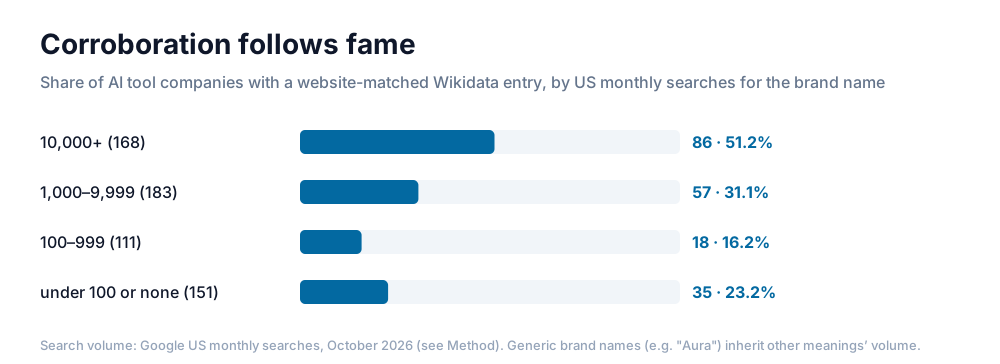
Half of the most-searched brands (86 of 168, 51.2%) have an entry; among brands searched 100 to 999 times a month, 16.2% do. That is not surprising — Wikidata entries tend to follow coverage — but it describes a loop. The brands AI already knows about are the ones it can corroborate, and the newer, smaller tools that most need to be recognised are the least likely to have anything independent to point to. (The last band is higher than the one above it partly because generic names attract search volume that belongs to other meanings.)
What a company can actually do
Wikidata is a community project with notability rules; it is not a place to write your own marketing. But the gap above is usually not about notability. It is about facts nobody has connected:
- Check whether an entry exists for you, and whether its official website is right. Rebrands and domain moves leave entries pointing at old sites.
- Make your own site agree with the record. Organization markup with
sameAslinks to your real profiles, one consistent name, one founding date, one address. - Earn the independent coverage that entries cite. Press, reviews and research by others are what make an entity notable — the same sources AI answers lean on.
- Watch for namesakes. If your brand shares a common word, the description, website and identifiers are what separate you from everything else called the same thing.
- Measure what AI says about you, not only whether a record exists.
Measure how AI systems see the entity
An entity record is evidence AI systems can use. Whether they describe your brand correctly is something to measure directly.
Read how AI answers describe you. Brand Performance, in the AI Visibility Toolkit, includes a Questions report that shows the questions people ask AI about a brand, grouped by topic and intent — the places where a misidentified entity shows up first.
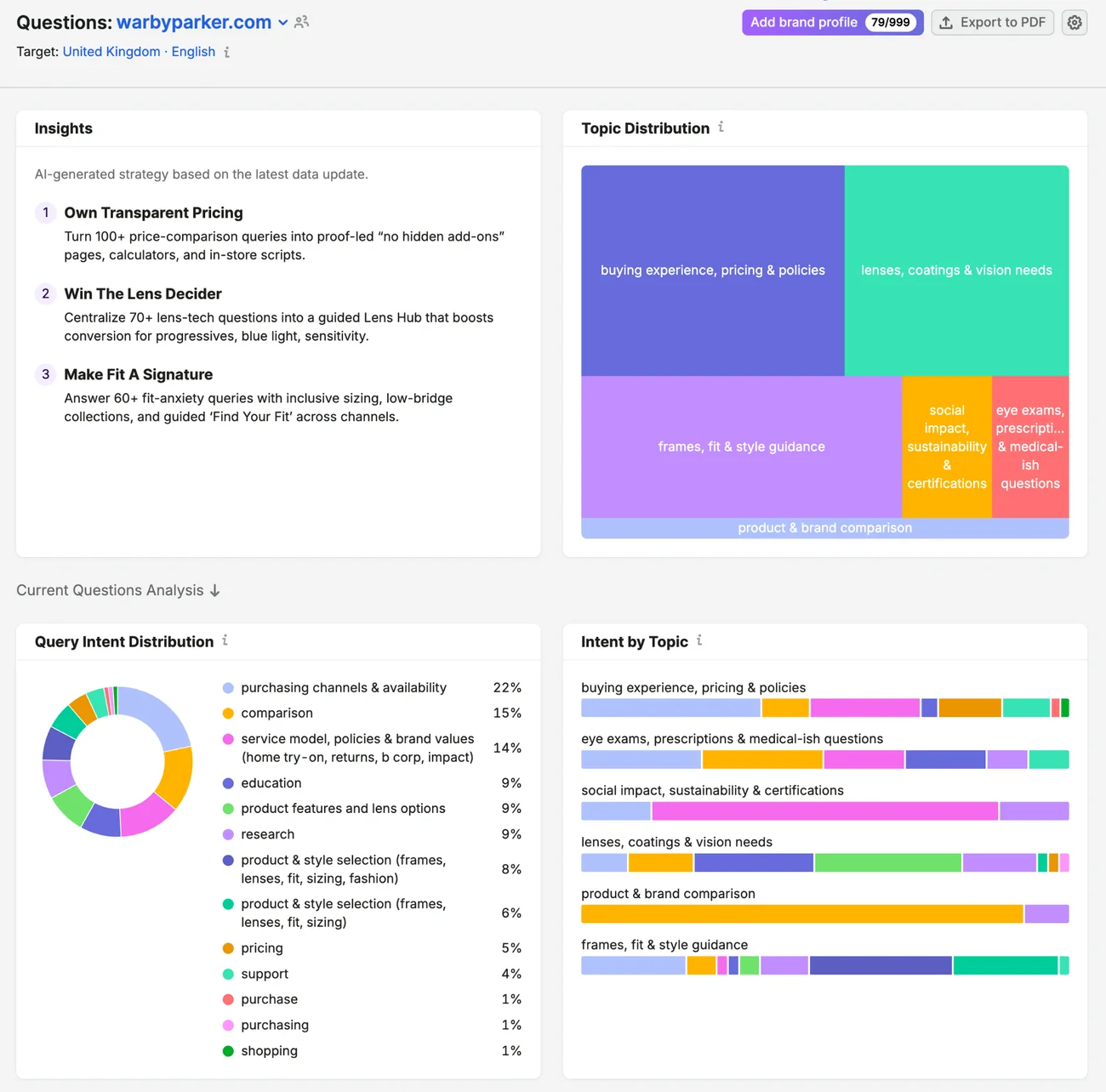
See which sources shape the narrative. The Narrative Drivers report lists the domains AI answers cite most when they talk about you and your competitors — often the same independent sources an entity record draws on.
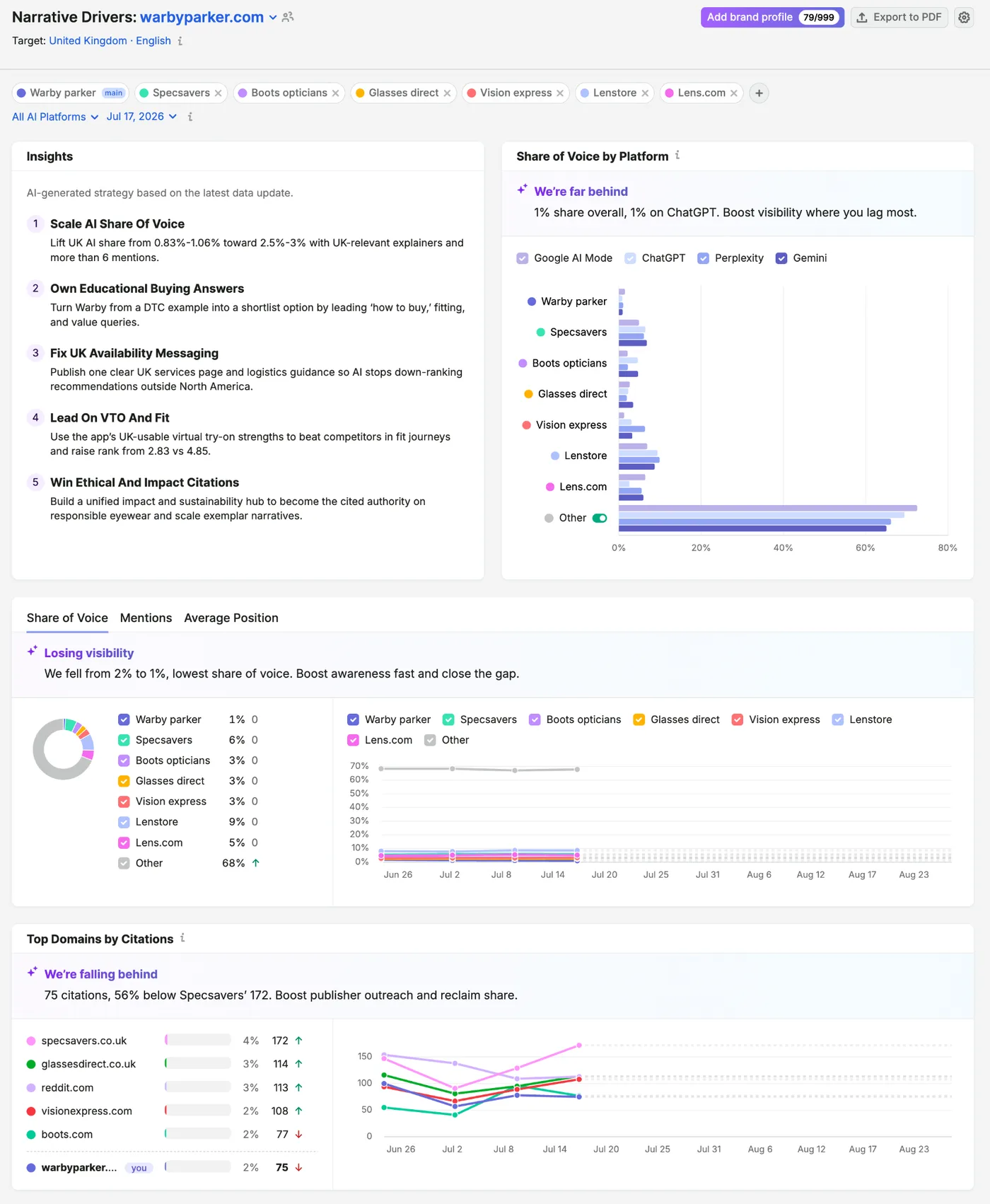
Track your brand prompt by prompt. Prompt Tracking follows chosen prompts on AI platforms with your visibility, mentions and position, while Position Tracking does the same for keywords in traditional search — the gap between the two is where entity problems tend to sit.
Fix the signals the entity is built from
Measuring tells you what AI systems say. The record itself is built from signals you can check.
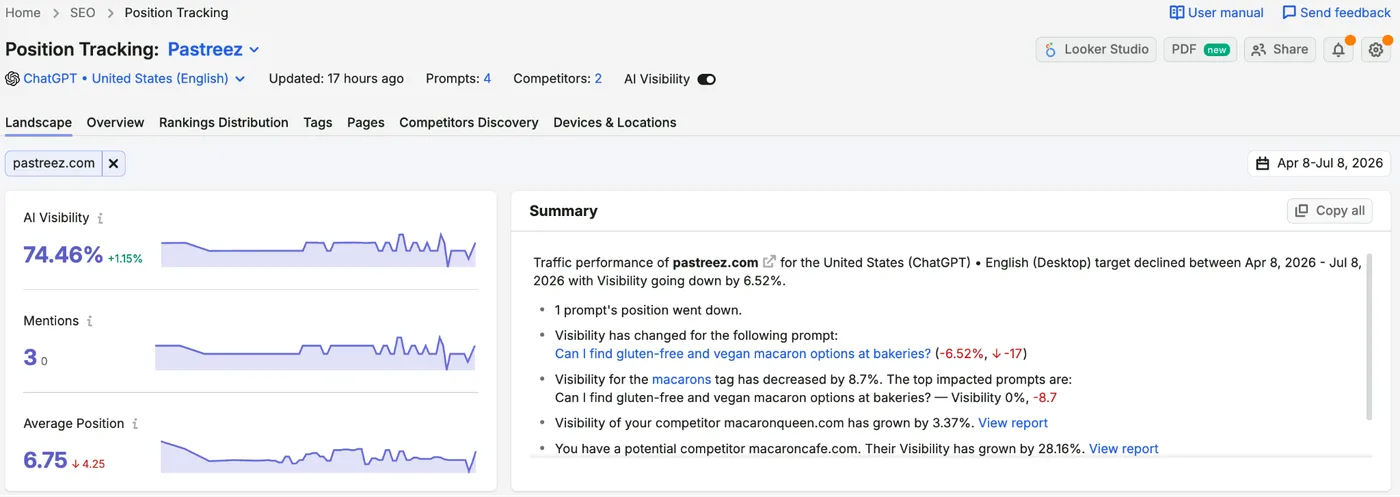
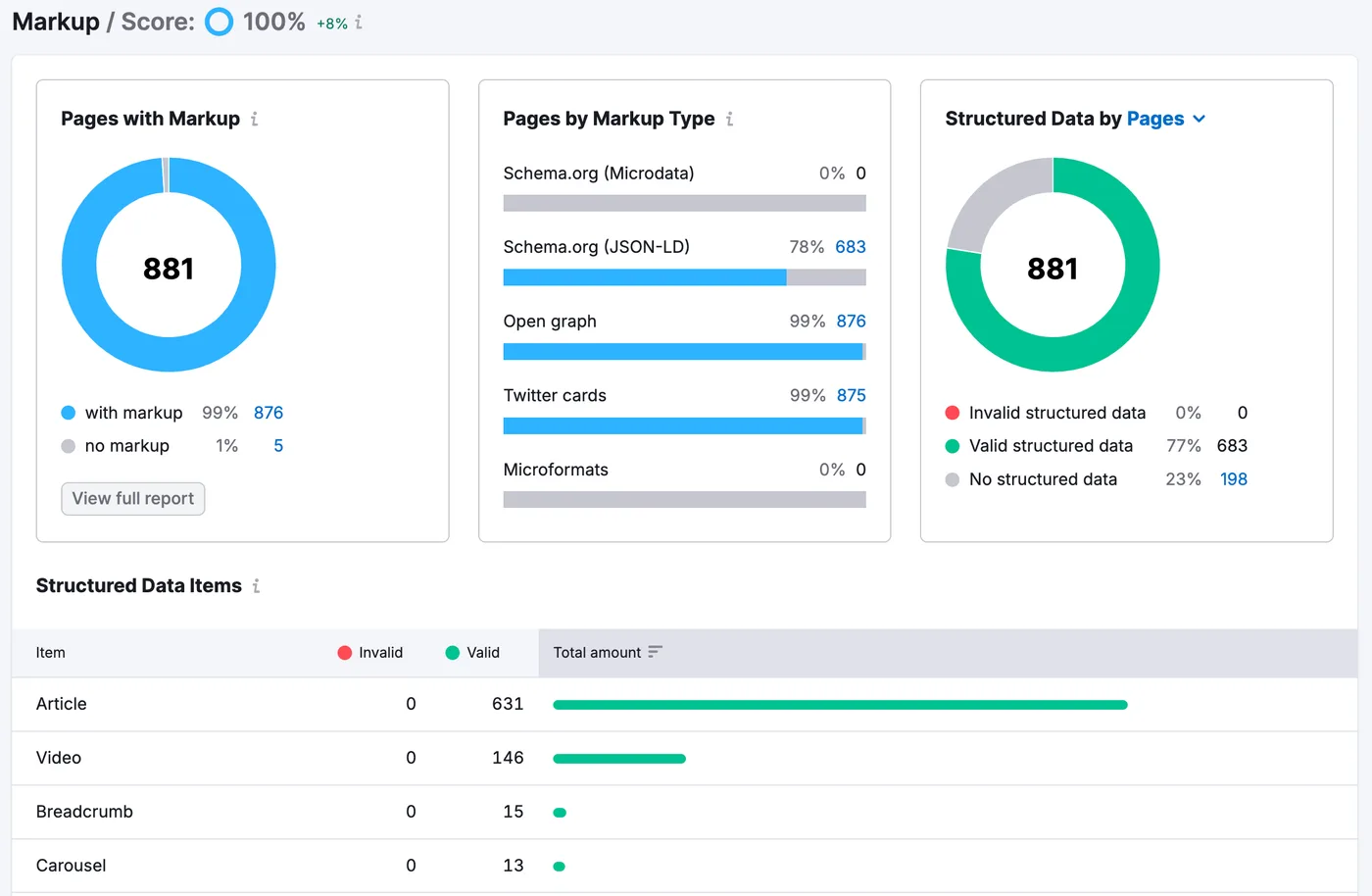
Your own markup. Site Audit in the SEO Toolkit has a Markup report that shows which pages carry structured data and whether it is valid. That is where an Organization entry with sameAs links to your real profiles either exists or doesn't.
Who ranks next to you. Organic Rankings (formerly Organic Research) shows the keywords a domain ranks for. Run it on a namesake and you can see whose pages Google already treats as the answer to your brand name.
Who writes about you. The Brand Monitoring app tracks mentions of a brand across the web, which shows which third-party sources describe you and whether they agree on your name, website and founders.
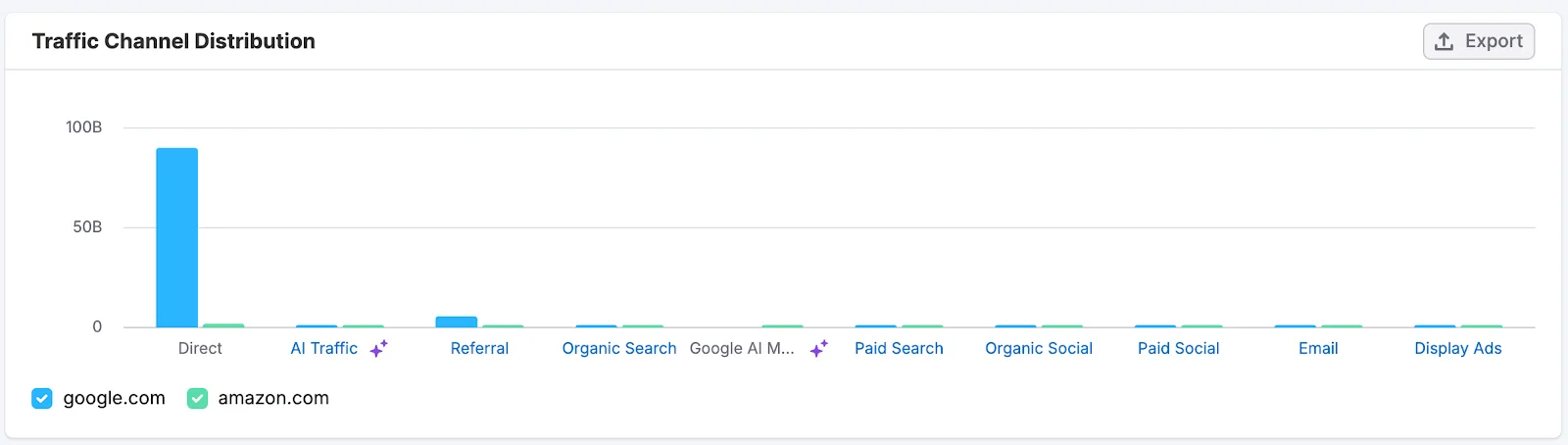
Where the independent coverage lives. Traffic Analytics in the Traffic & Market Toolkit estimates a competitor's traffic by channel, including referral traffic from review sites, directories and press. Its Market Overview report (the old Market Explorer) maps the players in a category. Together they show which off-site sources your better-known rivals have that you don't. The Traffic & Market Toolkit is sold separately and is not part of Semrush One.
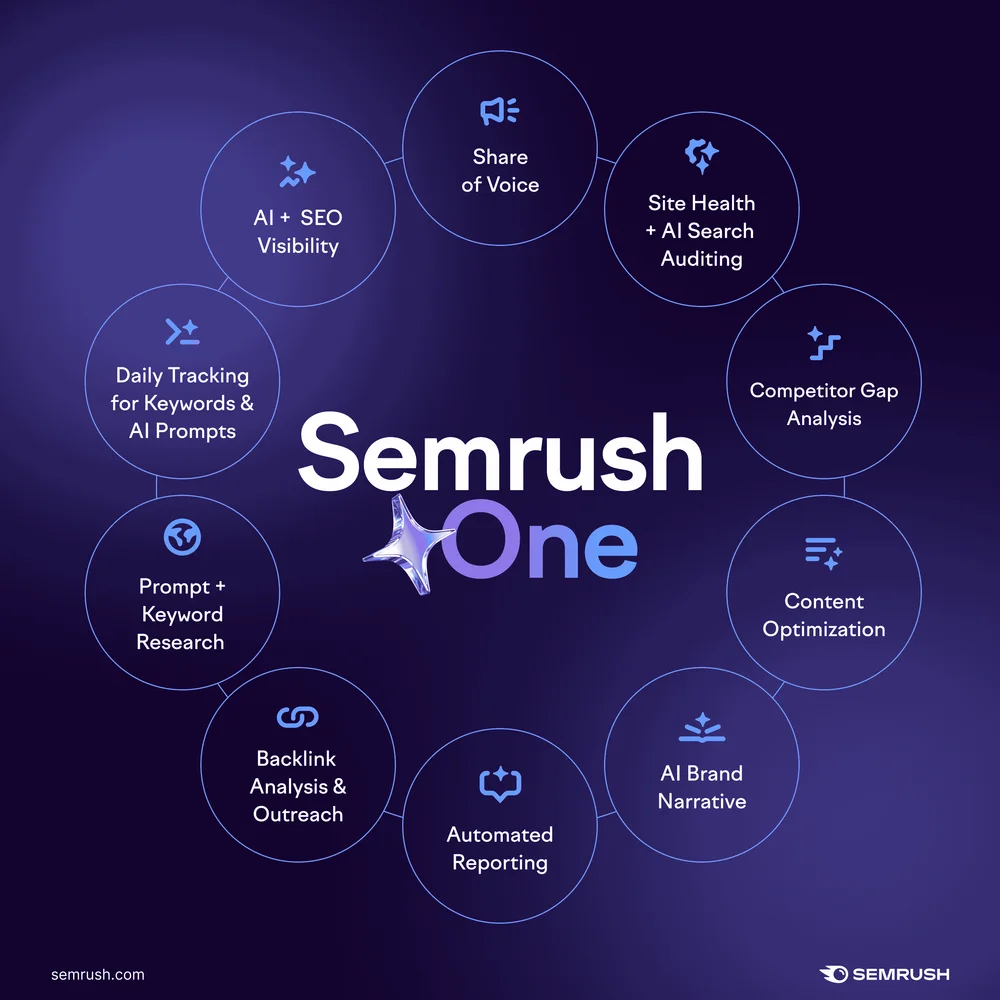
The AI Visibility Toolkit has no free trial of its own; the 7-day free trial is Semrush One's, which bundles it with the SEO Toolkit. To check how AI describes your own brand before paying, try Semrush One free for 7 days: its page offers "Unlimited access to all Semrush One tools" and notes "Offer available to new users only", checked on 28 October 2026. Those are Semrush's published terms, not something we tested; none of the data above came from a Semrush account.
Corroborate the company, not just the page
Two in three of the AI tool companies we list have no Wikidata entry that points to them, and one in three shares its name with entries that belong to something else. The cheapest entity work is not a new page: it is making sure the facts about the company exist outside its website, agree with each other, and can't be confused with a namesake.
Try Semrush One free for 7 days
Brand Performance and Narrative Drivers to see how AI answers describe your brand and which sources shape it, and Prompt Tracking and Position Tracking to follow it — the AI Visibility Toolkit and the SEO Toolkit together in Semrush One. Free for 7 days for new users.
Try Semrush One free for 7 daysMethod and sources
- Companies (613): the AI tool companies in the TheToolsVerse catalogue whose home pages answered on 28 October 2026.
- Lookup (29 October 2026): Wikidata's search API by brand name (the catalogue name before any dash, plus the domain name), checking up to 12 candidate entries; then a direct search for entries whose official website (P856) equals the company's URL in its common spellings. An entry counts only if P856 is on the company's live domain. From the matched entry we read the English Wikipedia sitelink and the Crunchbase (P2088), LinkedIn (P4264), X (P2002) and GitHub (P2037) identifiers. Requests that failed were retried; name search on Wikidata is not fully deterministic, so a handful of entries may still be missed.
- "Same name, not them": at least one Wikidata entry was found by name search, and none of them points to the company's domain.
- Search demand: Google US monthly search volume for each brand name, DataForSEO Labs keyword overview, 29 October 2026. Generic names carry volume from their other meanings.
- What this cannot show: whether any AI system uses Wikidata for a given answer, or how much weight an entity record carries. Wikidata is one corroborating source among many.
| Figure | Source | Date |
|---|---|---|
| Entries, Wikipedia sitelinks and identifiers for 613 companies | Wikidata API | 2026-10-29 |
| Brand search volume | DataForSEO Labs, Google US | 2026-10-29 |
| Every count and percentage above | Our analysis of the saved lookups | 2026-10-29 |
| Brand Performance, Narrative Drivers, Prompt Tracking, Position Tracking, Site Audit, Organic Rankings, Brand Monitoring, Traffic Analytics and Market Overview descriptions; screenshots | Semrush Knowledge Base | 2026-10-29 |
| Semrush One graphic and trial terms | Creator Accelerator affiliate resources; Semrush One page | 2026-10-28 |
Written by Sohail Akhtar. The saved lookups and analysis script can be re-run.
Some links may be affiliate links. We may earn a small commission at no extra cost to you.
Related Articles
Explore more guides and reviews from our experts.
28% of AI Image, Video and Voice Generators Sell "No Watermark". 2 of 143 Tell You Their Output Is Marked as AI
We Read 1,921 Blog Titles From 136 AI Tool Companies. 39% Are the Generic Posts AI Now Answers Itself; 1.2% Are Original Research