AI Answers Quote Your Price. We Read 427 AI Tool Pricing Pages Like a Crawler: 1 in 4 Shows No Price, and 4 Say When They Were Updated
Disclosure
This article is promotional content produced as part of the Semrush Creator Accelerator programme. It contains affiliate links to Semrush — if you buy through them we may earn a commission at no extra cost to you — and we may also receive a reward from Semrush for publishing it. All measurements in this article are our own. Semrush did not supply, review or approve the data, and the conclusions we draw are ours.
"How much does it cost?" is one of the first questions anyone asks about software, and more and more often an AI answer replies before the buyer reaches the vendor's site. When that answer is wrong — an old price, a plan that no longer exists, a free tier that was withdrawn — the brand pays for it, in a summary it did not write and cannot correct directly.
That risk now has a court behind it. On 28 May 2026, Munich Regional Court I granted two publishers an interim injunction against Google over false claims in AI Overviews (case 26 O 869/26), treating claims not found in the sources as "the defendant's own statements", as The Decoder reported (case record). Google says the decision "is not yet final", and it applies in Germany. Whatever happens on appeal, a court order is not a monitoring plan: a brand still has to find out what the summaries say about it, and give them something accurate to draw on.
The best defence a company controls is its own pricing page: the one source that should be the most current and the easiest to read. We run a directory that verifies AI tool pricing, and wrong prices are the most common error we find. So we checked how readable that source is — to a machine that does not run JavaScript, which is how many AI crawlers fetch pages.
Know what AI says about your brand
Track how ChatGPT, Gemini, Perplexity and Google AI Overviews mention and describe your brand with the AI Visibility Toolkit, and audit the pages they should be quoting with Site Audit. To get both in one subscription, try Semrush One free for 7 days.
427 pricing pages, read without JavaScript
On 29 October 2026 we looked for the pricing page of each AI tool company in our catalogue whose website answered — following the "Pricing" or "Plans" link on the home page, or /pricing — and found one for 427 companies. We fetched each once, without running scripts, and read the text: prices in a currency, billing periods, free plans, "contact sales" wording, prices in structured data, and any statement of when the prices were last updated.
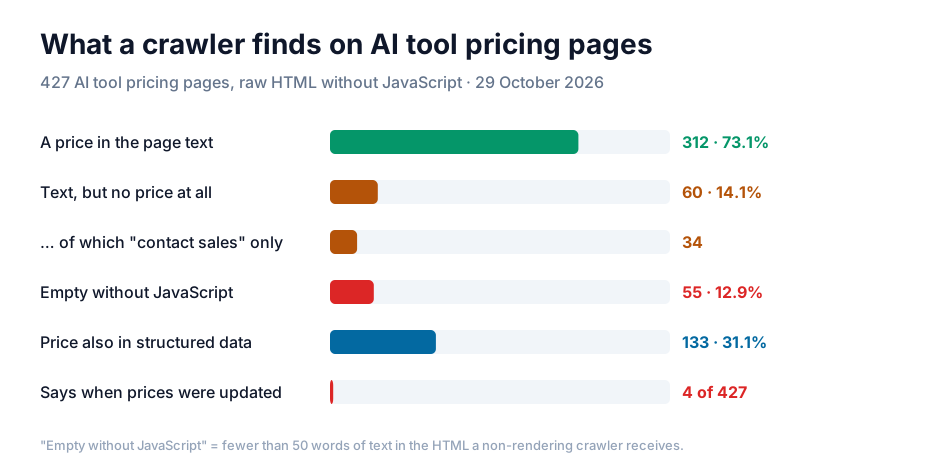
312 of the 427 pricing pages (73.1%) show a price in the text a crawler receives. That is the good news, and it is most of the pages.
The other 115 — 27% — give a crawler no price at all. 55 are effectively empty until JavaScript runs: fewer than 50 words of text, the pricing table drawn entirely in the browser. 60 have plenty of text and no price; 34 of those say only "contact sales" or "request a quote". For a model asked what one of those products costs, the vendor's own page offers nothing to quote, so the answer has to come from somewhere else — a review site, a reseller, a two-year-old blog post.
The date nobody publishes
The most striking number is the smallest. Only 4 of the 427 pricing pages say when their prices were last updated.
Software prices change constantly — plans are renamed, limits move, free tiers shrink. A page that never says when it was last checked gives a reader no way to tell a current price from an old one, and gives an AI system no reason to prefer it over a stale copy elsewhere. Freshness is one of the few signals a vendor can add to a page in a single line.
Structured data is under-used too. 133 pages (31.1%) carry a price in Offer or price markup — a machine-readable statement of exactly the figure a buyer is asking about.
Five fixes for a pricing page AI can quote
- Put the prices in the HTML. If your pricing table is rendered by JavaScript, a crawler that doesn't run it sees an empty page. Server-render the plans, or include them in the initial HTML.
- Give a number, even with "contact sales". "From $X per seat" or "Enterprise plans from $Y a year" is something an answer can repeat accurately.
- Say when it was updated. "Prices updated 29 October 2026" is one line, and it is the line 423 of these 427 pages are missing.
- Mark it up. Offer markup with price, currency and billing period makes the figure unambiguous.
- Check what AI answers actually say. Ask the assistants your buyers use what your product costs, and track it — the gap between that answer and your page is the problem to fix.
Watch what AI says about you
Monitor how AI platforms describe your brand. The AI Visibility Toolkit tracks mentions and citations across ChatGPT, Gemini, Perplexity and Google AI Overviews; its Brand Performance reports include the questions people ask AI about a brand and recommendations drawn from them.
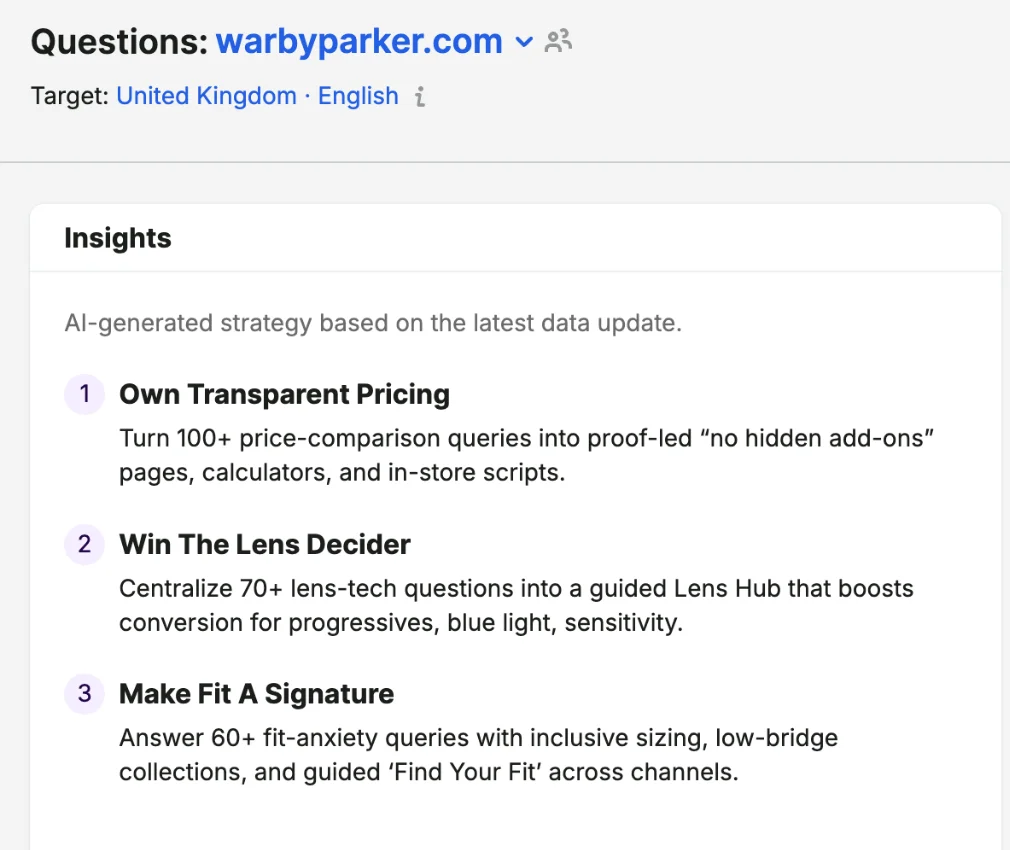
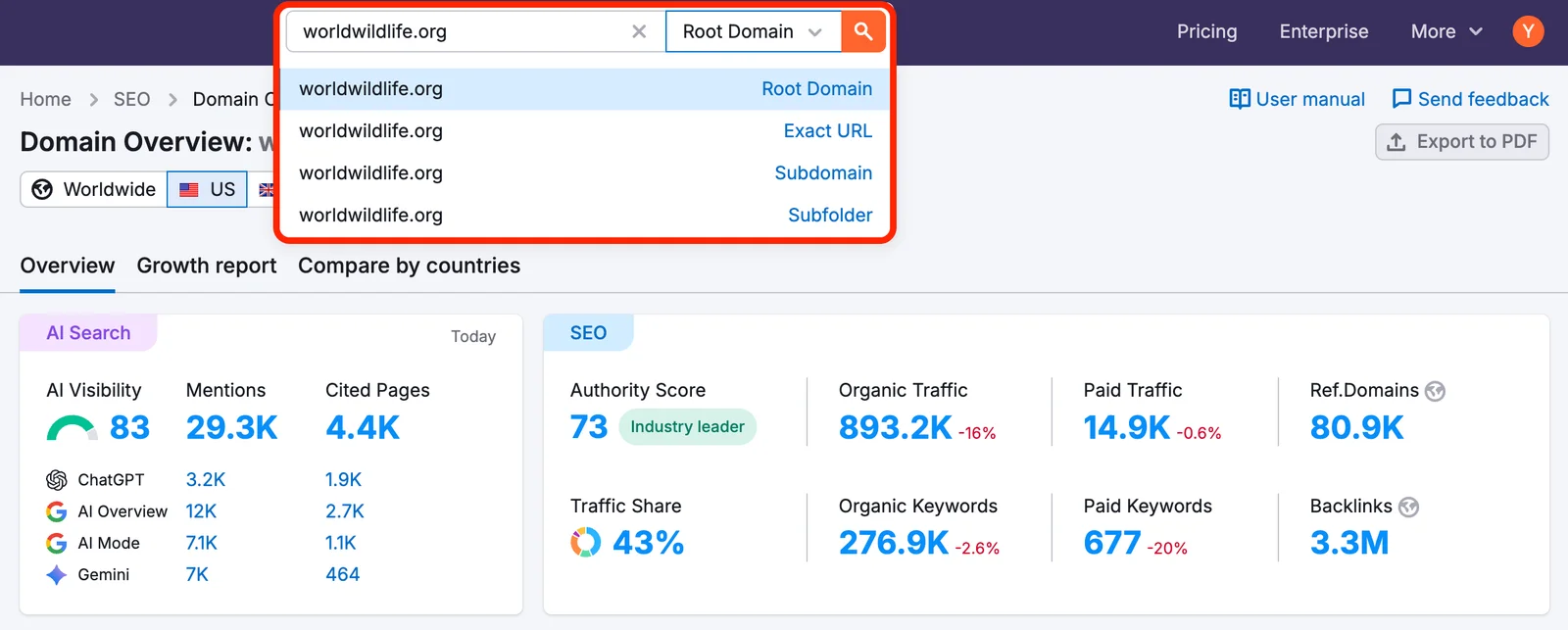
Check your pricing page's own visibility. Domain Overview can be set to an exact URL, showing how a single page — your pricing page — performs in AI search and traditional search side by side.
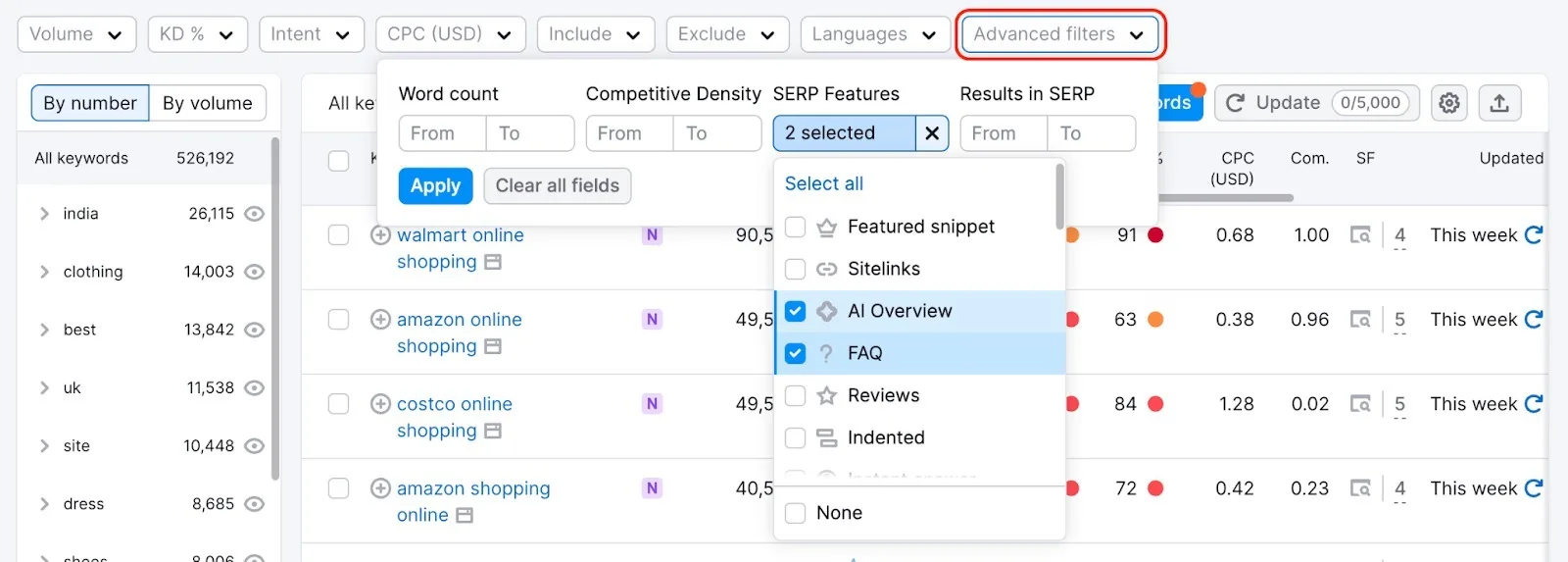
Find the price questions that trigger AI Overviews. Keyword Magic Tool can filter keywords by the SERP features they trigger, including AI Overviews — so "[your brand] pricing" and "[your brand] cost" can be checked for the answers shown above your page.
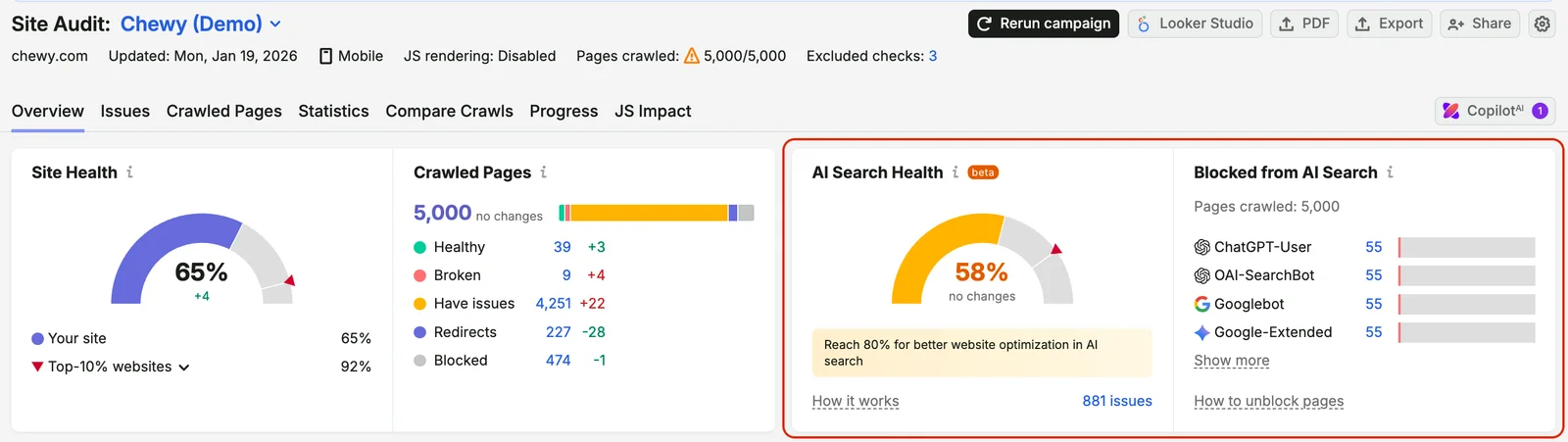
Audit the markup and rendering. Site Audit checks structured data across a site and can crawl with JavaScript rendering on or off — the difference between the two is exactly what a non-rendering AI crawler misses.
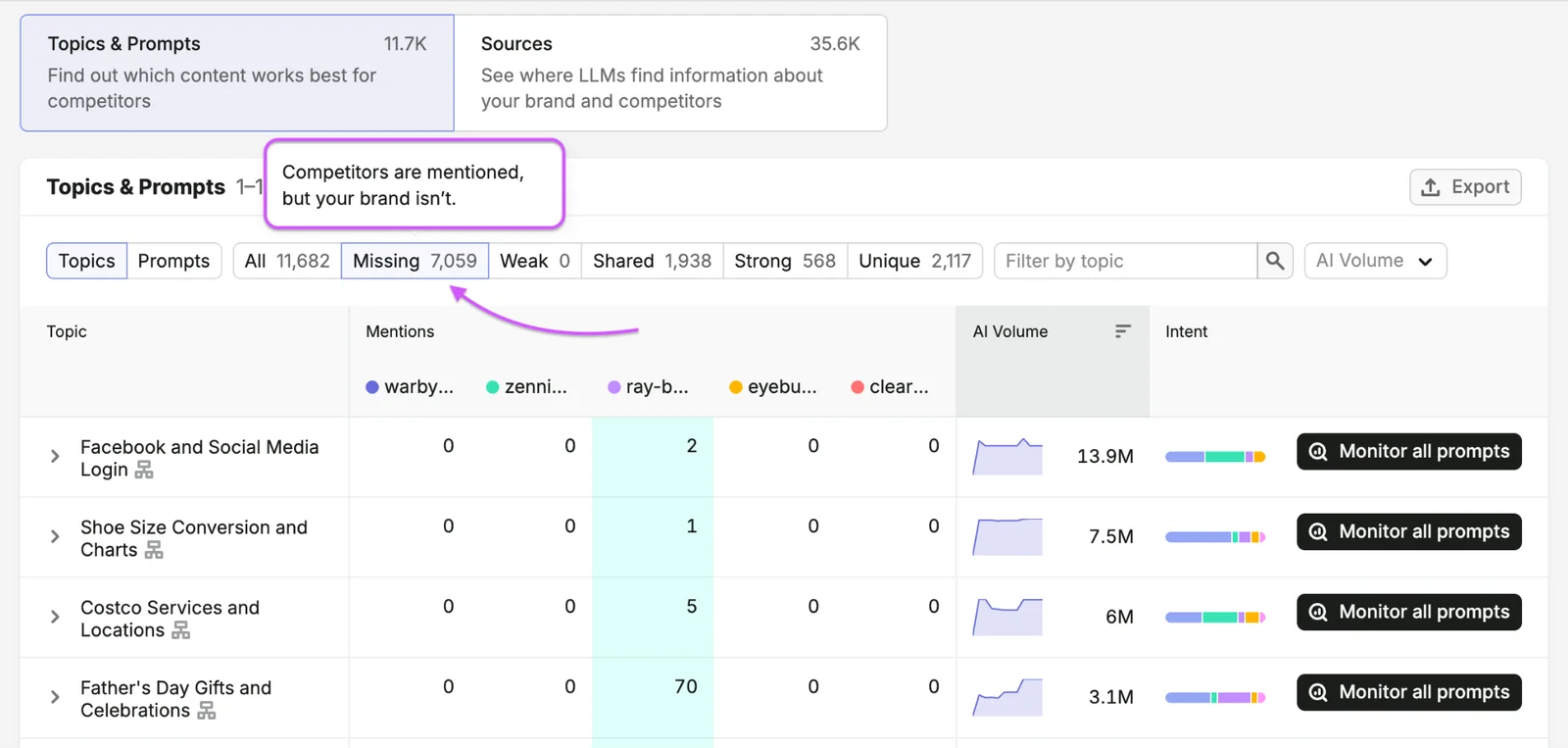
Benchmark the brands an answer names instead of you. Competitor Research in the AI Visibility Toolkit compares your AI visibility with your competitors', so you can see who is being described when a buyer asks what a tool in your category costs.
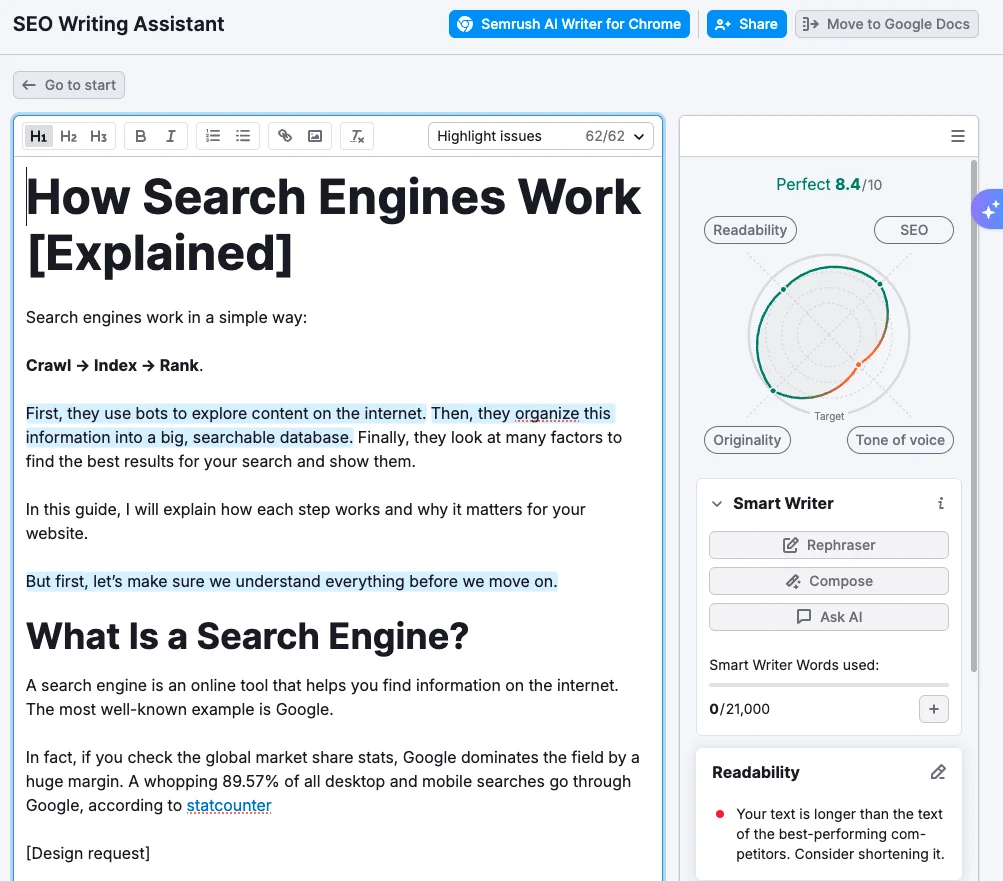
Rewrite the page so the answer is in the words. SEO Writing Assistant, part of the Content Toolkit (sold separately from Semrush One), scores a draft for readability, SEO and tone as you write. Use it on the plain-text version of your pricing page: plan names, prices and what each plan includes, written as sentences an AI answer can quote.
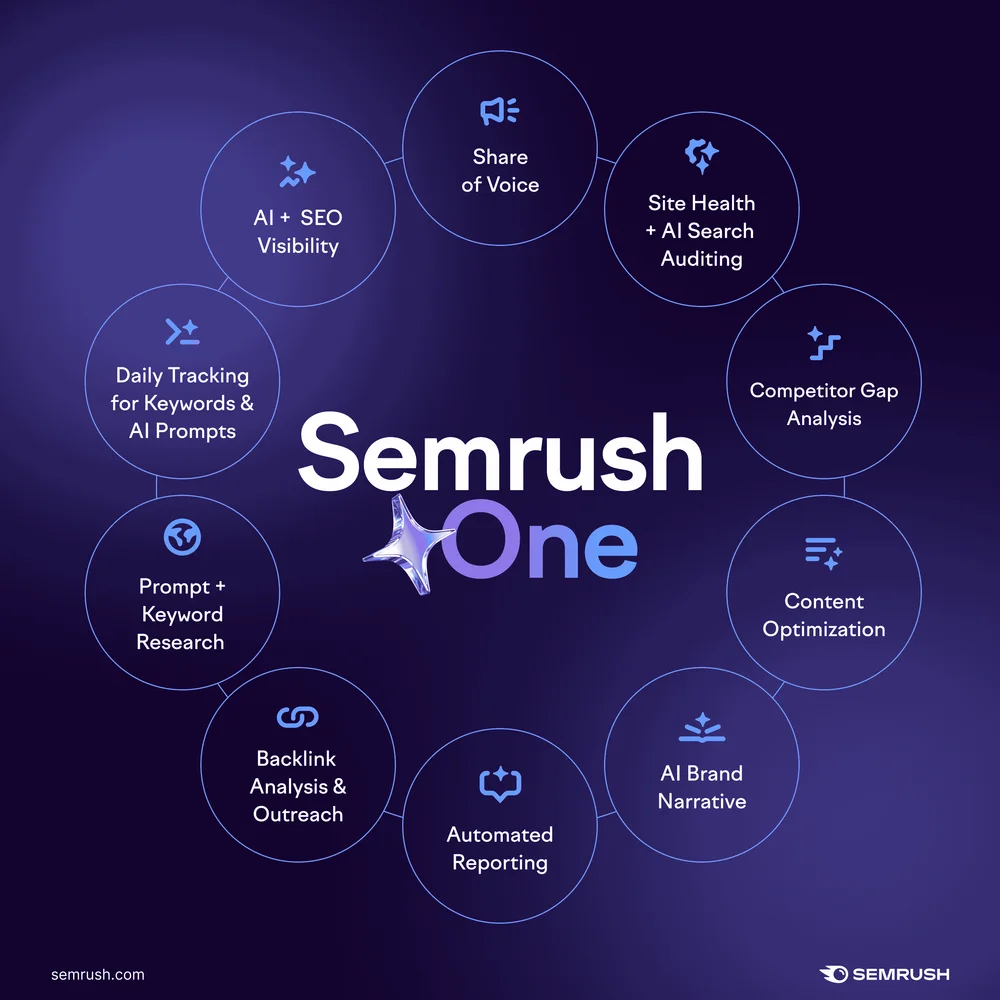
Semrush One bundles the SEO Toolkit and the AI Visibility Toolkit, and the 7-day free trial is Semrush One's — the AI Visibility Toolkit has no free trial of its own. To check what AI says about your own pricing before paying, try Semrush One free for 7 days: its page offers "Unlimited access to all Semrush One tools" and notes "Offer available to new users only", checked on 28 October 2026. Those are Semrush's published terms, not something we tested; none of the data above came from a Semrush account.
The page AI should be quoting
Three in four AI tool pricing pages give a crawler a price to repeat; one in four gives it nothing, and almost none say how current their figures are. If you want AI answers to quote your price correctly, publish it in the HTML, put a date next to it, and check what the assistants say. The alternative is letting someone else's old page answer for you.
Try Semrush One free for 7 days
The AI Visibility Toolkit to see what AI answers say about your brand and prices, and Site Audit, Domain Overview and Keyword Magic Tool to make your pricing page the source they quote — together in Semrush One. Free for 7 days for new users.
Try Semrush One free for 7 daysHow the pricing pages were read
- Pages (613 websites, 427 pricing pages): for each AI tool company in the TheToolsVerse catalogue whose website answered on 28 October 2026, the home-page link labelled "Pricing", "Plans" or pointing to
/pricingor/planson the same domain, else/pricing; pages that redirected to the home page were not counted. Fetched once on 29 October 2026 with a desktop browser user agent, without running JavaScript. - Reading: visible text only. A price = a currency symbol or code next to a number ($, €, £, ₹, USD, EUR, GBP, INR). "Empty without JavaScript" = under 50 words of text. "Contact sales" = phrases such as "contact sales", "talk to sales", "request a quote", "custom pricing". Structured data = Offer or AggregateOffer types, or a numeric
pricefield, in the page source. "Updated" = a phrase such as "last updated" followed by a date. - Not covered here: whether a price is correct or current, or what any AI system says about it. Some AI crawlers render JavaScript; many do not. Prices shown only after choosing a plan or region are missed.
| Figure | Source | Date |
|---|---|---|
| Munich Regional Court I, case 26 O 869/26, and Google's response | The Decoder; Digital Policy Alert | ruling 2026-05-28, read 2026-11-05 |
| Prices, wording and markup on 427 pricing pages | Our fetch of each pricing page | 2026-10-29 |
| Every count and percentage above | Our analysis of the saved pages | 2026-10-29 |
| AI Visibility Toolkit, Brand Performance, Competitor Research, Domain Overview, Keyword Magic Tool, Site Audit and SEO Writing Assistant descriptions; screenshots | Semrush Knowledge Base | 2026-10-29 |
| Semrush One graphic and trial terms | Creator Accelerator affiliate resources; Semrush One page | 2026-10-28 |
Written by Sohail Akhtar. The saved pages and analysis script can be re-run.
Some links may be affiliate links. We may earn a small commission at no extra cost to you.
Related Articles
Explore more guides and reviews from our experts.
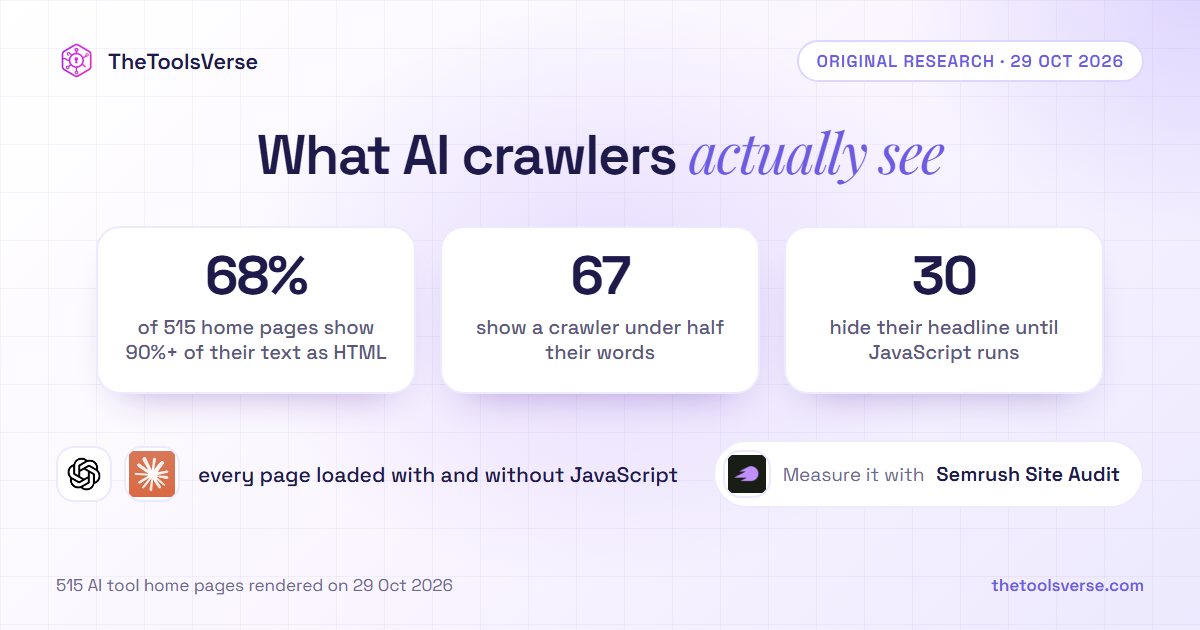
Most AI Crawlers Don't Run JavaScript. We Rendered 515 AI Tool Home Pages Both Ways: 67 Show a Crawler Less Than Half Their Words
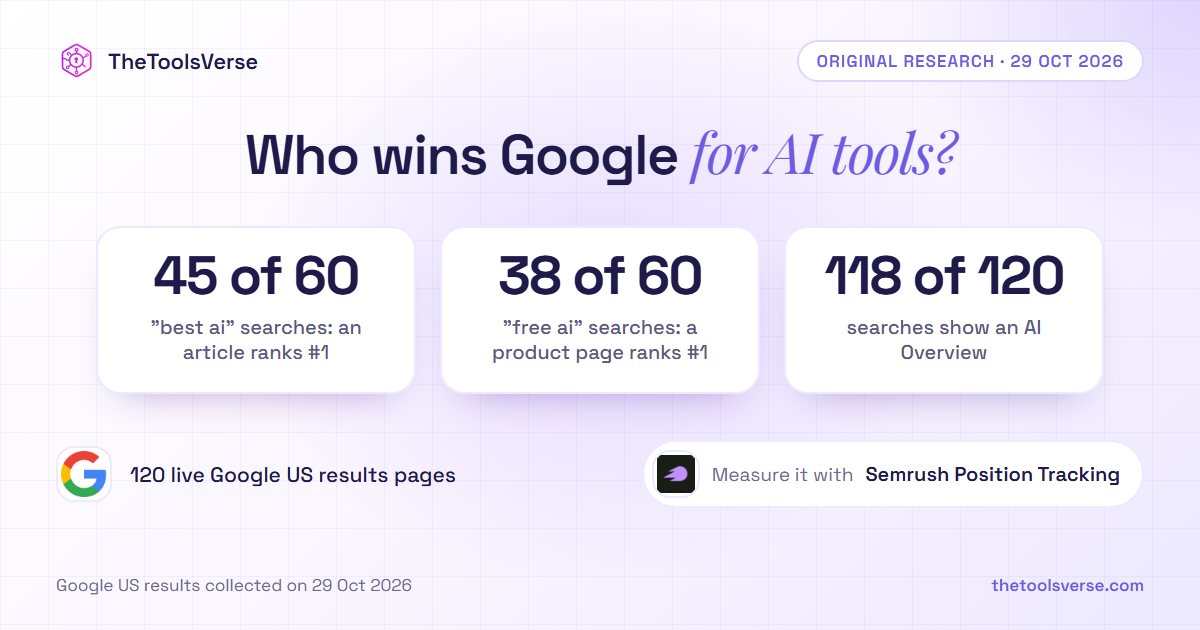
Is Google Rewarding Brands Over Content Sites? In 120 AI-Tool Searches, It Depends on One Word