We Read 493 AI Tool Home Pages Like an AI Would. 79% of the Big Claims Link to Nothing That Could Check Them
Disclosure
This article is promotional content produced as part of the Semrush Creator Accelerator programme. It contains affiliate links to Semrush — if you buy through them we may earn a commission at no extra cost to you — and we may also receive a reward from Semrush for publishing it. All measurements in this article are our own. Semrush did not supply, review or approve the data, and the conclusions we draw are ours.
An AI answer that recommends a product is making a claim on someone else's behalf. The safer that claim is to repeat, the easier the recommendation. That is the idea behind what marketers have started calling credibility nuggets: a short, specific proof point — a sourced statistic, a customer result, an independent review — placed next to the claim it supports, so that a reader, or a model, can check it without leaving the page to go looking.
We list hundreds of AI tools, so we wanted to know how often their own home pages do this. Not whether their claims are true — we cannot test that — but whether the page gives anyone a way to check.
See which sources AI answers trust in your category
Find the pages and third-party sites AI answers cite for the prompts you care about with the Sources tab in Prompt Tracking, part of the AI Visibility Toolkit. To get it with SEO tracking in one subscription, try Semrush One free for 7 days.
The audit: claims that invite "says who?"
On 29 October 2026 we fetched the home page of every AI tool company in our catalogue that answered — 613 sites — and kept the 493 that show at least 250 words of text in their HTML. The other 120 are mostly pages that draw everything with JavaScript; a crawler that does not run scripts sees almost no words on them, so it sees no claims and no proof either.
We counted four kinds of claim, defined narrowly so that ordinary phrasing ("the best way to…", "in minutes") does not count:
| Claim type | Examples we matched | Home pages making it |
|---|---|---|
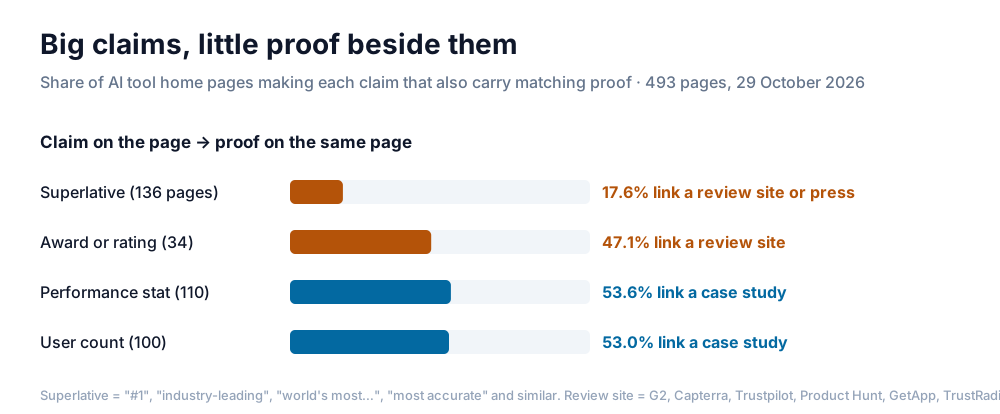
| Superlative | "industry-leading", "most powerful", "leading AI…", "most advanced", "most accurate", "world's most…", "best-in-class", "#1" | 136 (27.6%) |
| Performance statistic | "10x faster", "3x more", "99% accuracy", "30% less" | 110 (22.3%) |
| User count | "trusted by 50,000+ teams", "used by 2 million creators" | 100 (20.3%) |
| Award or rating | "award-winning", "Product of the Day", "rated 4.8 out of 5" | 34 (6.9%) |
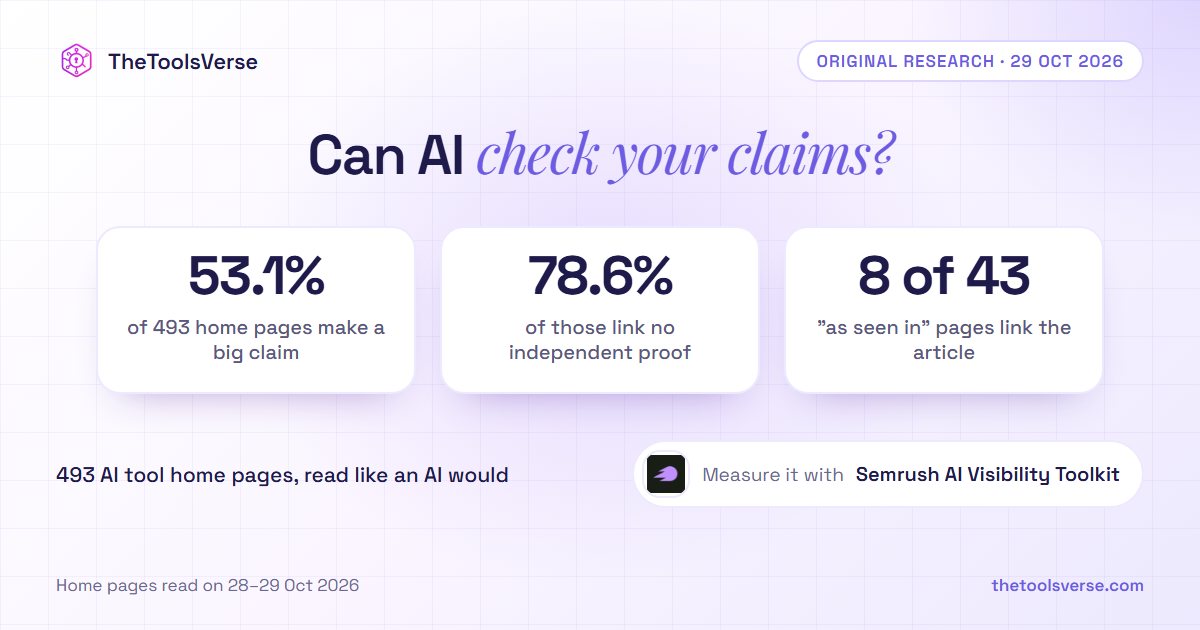
| Any of the four | 262 (53.1%) |
The most common superlative was "industry-leading" (28 pages), then "most powerful" (23) and "leading AI" (22). The most common statistic was "10x faster", on 14 home pages.
The proof check
For each page we then looked for evidence an outsider could follow: a link to an independent review site (G2, Capterra, Trustpilot, Product Hunt, GetApp, TrustRadius), a link to a major news outlet, a link to a case study or customer story, or a named security certification. We were generous: proof anywhere on the page counts, not only beside the claim. A stricter test, with the proof next to the claim it supports, would score lower still.
Of the 262 home pages making a strong claim, 206 — 78.6% — link to no review site and no press article anywhere on the page. 106 of them (40.5%) show no case study link and no named certification either: the claim is the only evidence for the claim.
Superlatives fare worst. Of the 136 pages calling themselves "industry-leading", "most accurate" or the like, 24 (17.6%) link anything independent. Statistics and user counts do better, because about half of those pages also link a customer story somewhere — but a "10x faster" in the hero section and a case-study link in the footer are not the same thing as a sourced number.
Saying it is not linking it
The clearest gap is between naming a source of proof and pointing to it.
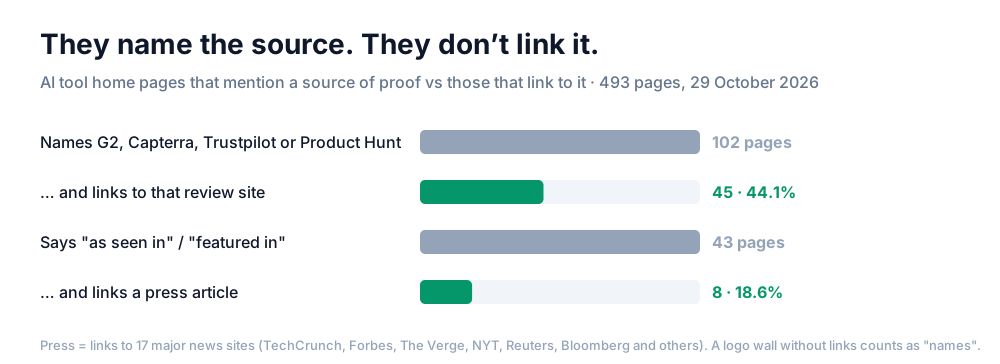
102 home pages mention G2, Capterra, Trustpilot or Product Hunt — usually as a badge or a star rating — and 45 of them link to the profile behind it. 43 pages carry an "as seen in" or "featured in" strip; 8 of them link a single article. A logo wall is proof to a person who already trusts it. To a system deciding whether a claim is safe to repeat, an unlinked logo is just another thing the brand said about itself.
The structured data tells the same story from the other side. 274 of the 493 pages (55.6%) carry Organization markup with sameAs links to the company's own profiles; 78 (15.8%) carry AggregateRating markup. Pointing to your own accounts is common. Pointing to someone else's verdict on you is not.
The review sites that were linked: G2 (45 pages), Trustpilot (28), Product Hunt (23), Capterra (16), GetApp and TrustRadius (4 each), Software Advice (2).
One claim, rewritten
The fix is rarely more copy. It is usually one link and one number in the right place. A made-up example in the style of the pages we read:
| Before | After | |
|---|---|---|
| The claim | "The most accurate AI transcription tool, trusted by 50,000+ teams." | "97.8% word accuracy on our public English benchmark (method and audio set linked) — rated 4.7/5 from 1,200 reviews on G2." |
| What a reader can check | Nothing on the page | The benchmark page, the method, the G2 profile |
| What an AI answer can safely repeat | "Calls itself the most accurate" | "Reports 97.8% accuracy on its published benchmark; rated 4.7 on G2" |
The second version is longer by a dozen words and it changes what can be said about the product without hedging. Adding proof does not guarantee that an AI answer will cite or recommend the page — nothing does — but it removes the reason not to.
A five-question check for your most important page
- Pick the three biggest claims on the page. Could a stranger check each one without leaving the page or searching?
- Does every number say where it came from — your own benchmark, a customer, a third party — and link there?
- Is every badge a link to the profile or award it represents?
- Is the proof in the HTML, or does it only appear once JavaScript runs?
- Do independent sources say the same thing? If a review site rates you 3.9 and your home page says "best-rated", the page loses the argument.
Find the proof AI answers already use
The audit above tells you whether your page offers evidence. It cannot tell you which evidence AI answers actually lean on in your category — which review sites, publications and competitors they cite. That is the other half of the work, and it means measuring two outcomes: track citations and brand mentions separately, because a cited page is not necessarily a recommended brand.
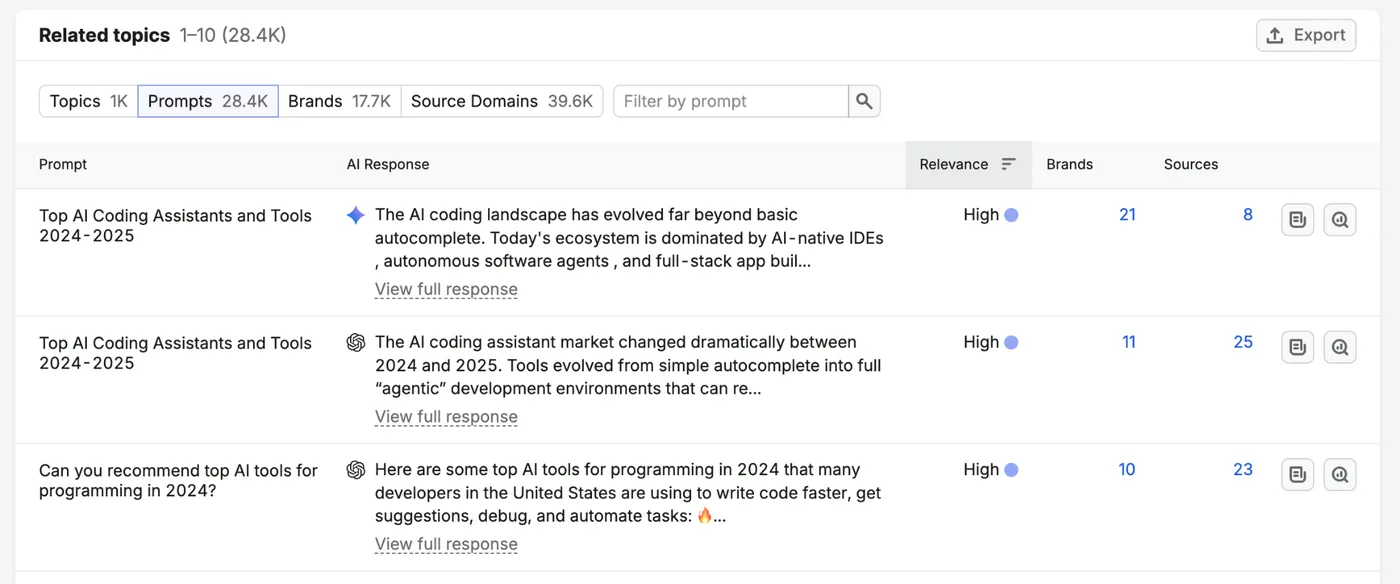
Start from the questions buyers ask. Prompt Research, in the AI Visibility Toolkit, lists prompts in your topic with the AI response, the brands it mentions and the number of sources it cites — the questions whose answers your page has to be safe to quote in.
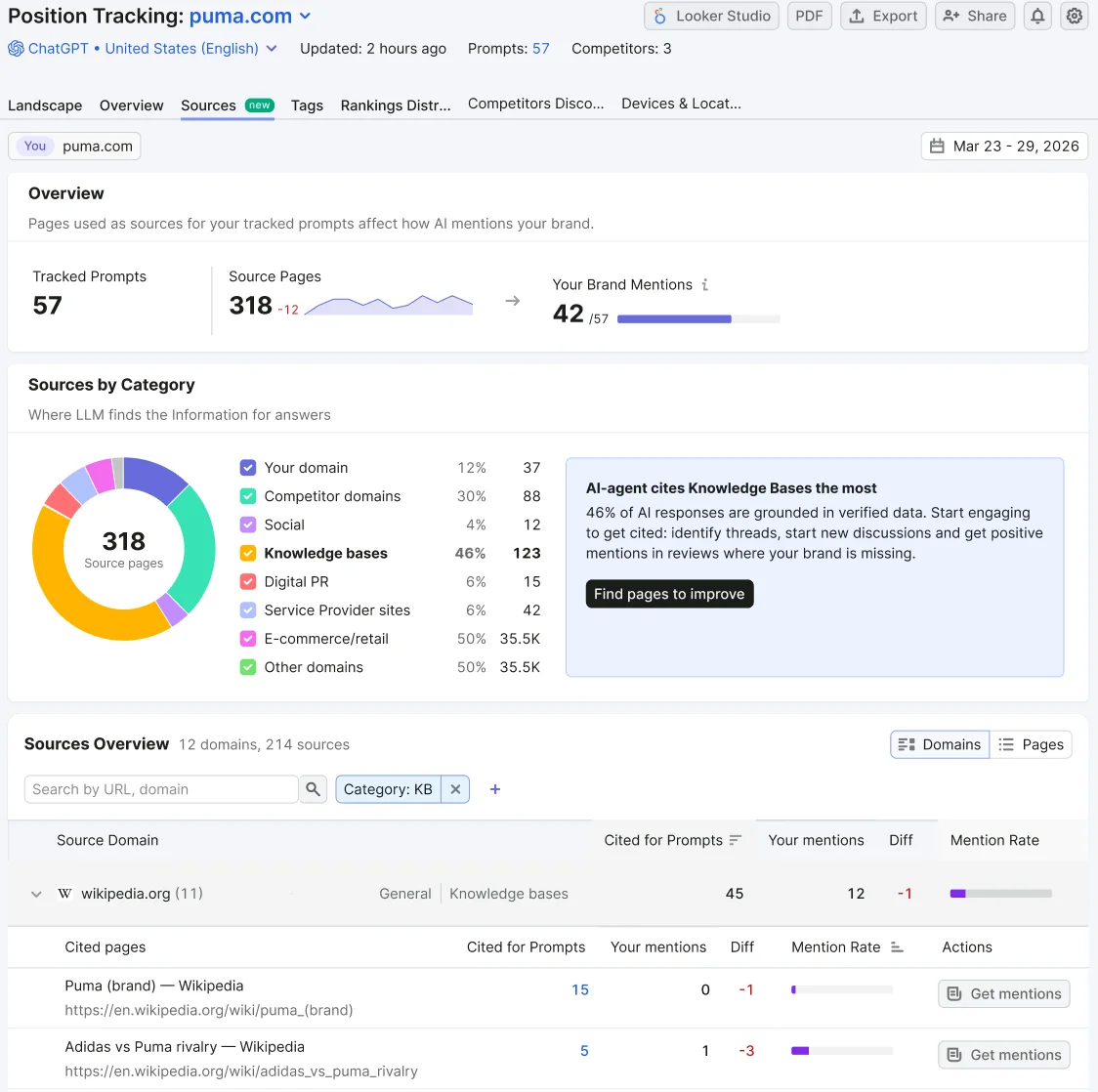
See which third-party sources get cited. The Sources tab in Prompt Tracking groups the pages cited for your tracked prompts by category and shows how often each domain is cited — a list of the review sites and publications worth earning a place on.
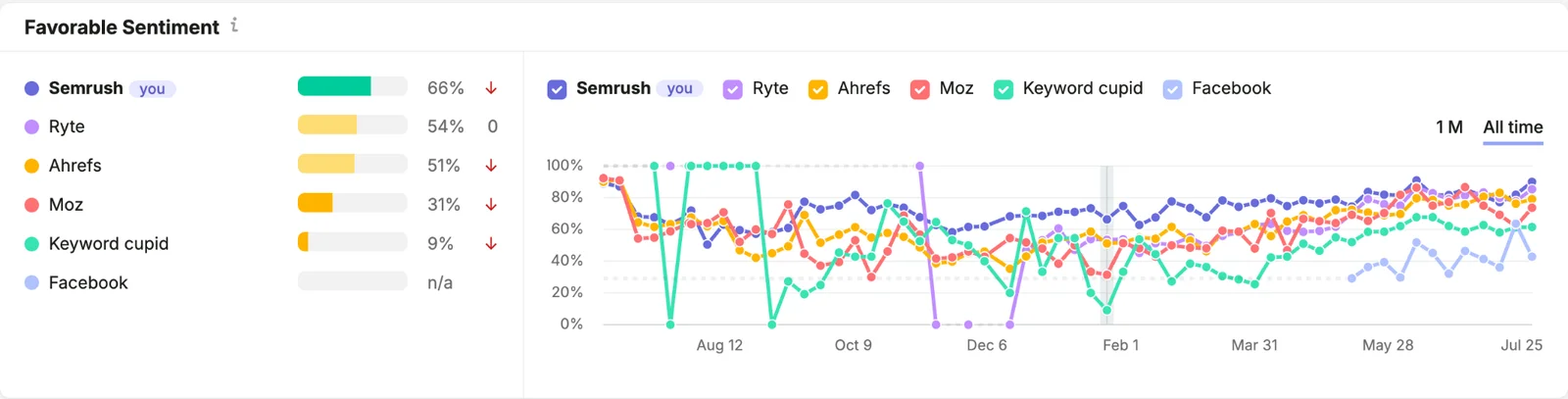
Check how AI answers describe you. Brand Performance reports how AI platforms talk about your brand against competitors, including the share of favorable mentions — the measure of whether your proof is landing.
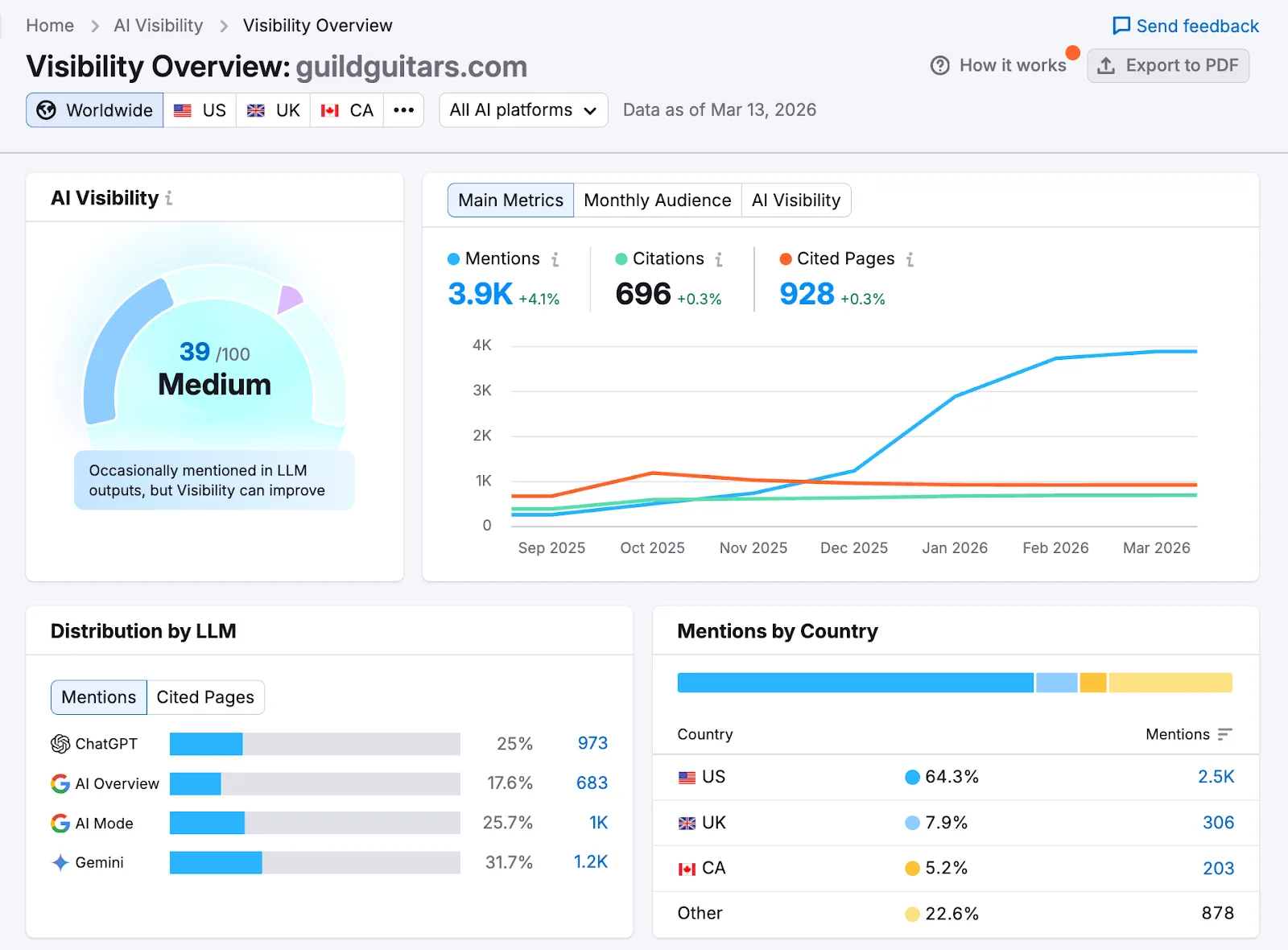
Benchmark the outcome. Visibility Overview gives an AI Visibility score with mentions, citations and cited pages over time, split by AI platform — the number to watch after you add proof to a page.
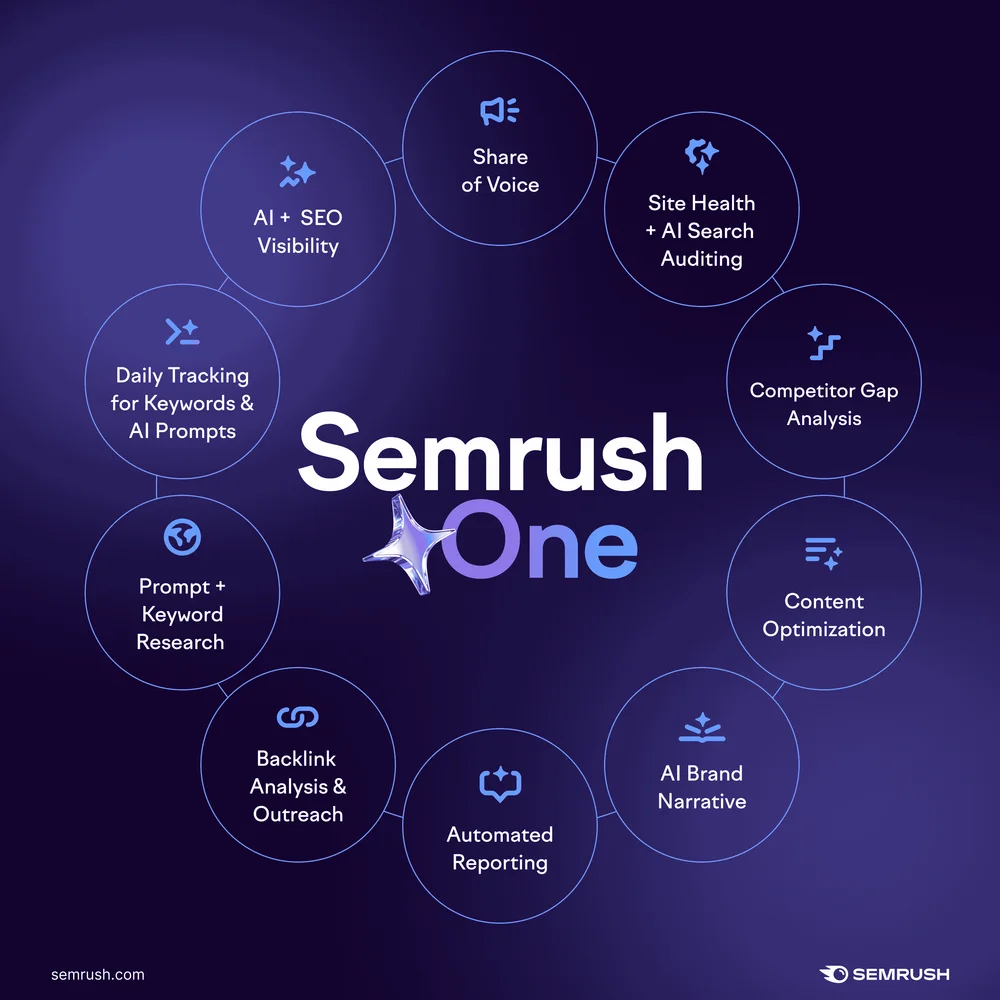
These reports are part of the AI Visibility Toolkit, which has no free trial of its own; the 7-day free trial is Semrush One's, which bundles the AI Visibility Toolkit with the SEO Toolkit. To audit your own category before paying, try Semrush One free for 7 days: its page offers "Unlimited access to all Semrush One tools" and notes "Offer available to new users only", checked on 28 October 2026. Those are Semrush's published terms, not something we tested; none of the data above came from a Semrush account.
Proof is a link, not a logo
Half of the AI tool home pages we read make a claim a buyer would want backed up, and four in five of those give no independent way to check it. The cheapest credibility work on most of these pages is not new copy: link the review profile behind the badge, source the number in the hero, and put the proof in the HTML where a crawler can read it.
Try Semrush One free for 7 days
Prompt Research and Prompt Tracking to see which sources AI answers cite in your category, Brand Performance for how they describe you, and Visibility Overview to benchmark the result — the AI Visibility Toolkit and the SEO Toolkit together in Semrush One. Free for 7 days for new users.
Try Semrush One free for 7 daysMethod and sources
- Pages (613 fetched, 493 analysed): the home pages of the AI tool companies in the TheToolsVerse catalogue whose sites answered on 28 October 2026, fetched once on 29 October 2026 with a desktop browser user agent, without running JavaScript. Pages with fewer than 250 words of visible text were excluded.
- Claims: four narrow phrase patterns (table above), matched on the visible text. A page counts once per claim type however often it repeats the claim.
- Proof: links in the page HTML to the seven review sites named above; links to 17 major news sites (TechCrunch, Forbes, The Verge, The New York Times, The Wall Street Journal, Reuters, Bloomberg, CNBC, Business Insider, Fast Company, ZDNet, Engadget, VentureBeat, Axios, Wired, the BBC and The Guardian); links whose address contains case-study, customer-story, success-story or testimonial; and SOC 2, ISO 27001, HIPAA or GDPR-compliant named in the text. Proof anywhere on the page counts.
- What this cannot show: whether any claim is true, whether the proof supports it, or how AI systems weigh any of it. Pattern matching misses claims phrased differently and proof that sits on other pages. Pages that render with JavaScript are under-counted. The before-and-after example is invented for illustration.
| Figure | Source | Date |
|---|---|---|
| Claims and proof on 493 home pages | Our fetch of each home page | 2026-10-29 |
| Every count and percentage above | Our analysis of the saved pages | 2026-10-29 |
| "Credibility nuggets" framing and "measure both outcomes" | Semrush Creator Accelerator Content & Promo Ideas | 2026-10-21 |
| Prompt Research, Prompt Tracking, Brand Performance and Visibility Overview descriptions; screenshots | Semrush Knowledge Base | 2026-10-29 |
| Semrush One graphic and trial terms | Creator Accelerator affiliate resources; Semrush One page | 2026-10-28 |
Written by Sohail Akhtar. The saved pages and analysis script can be re-run.
Some links may be affiliate links. We may earn a small commission at no extra cost to you.
Related Articles
Explore more guides and reviews from our experts.
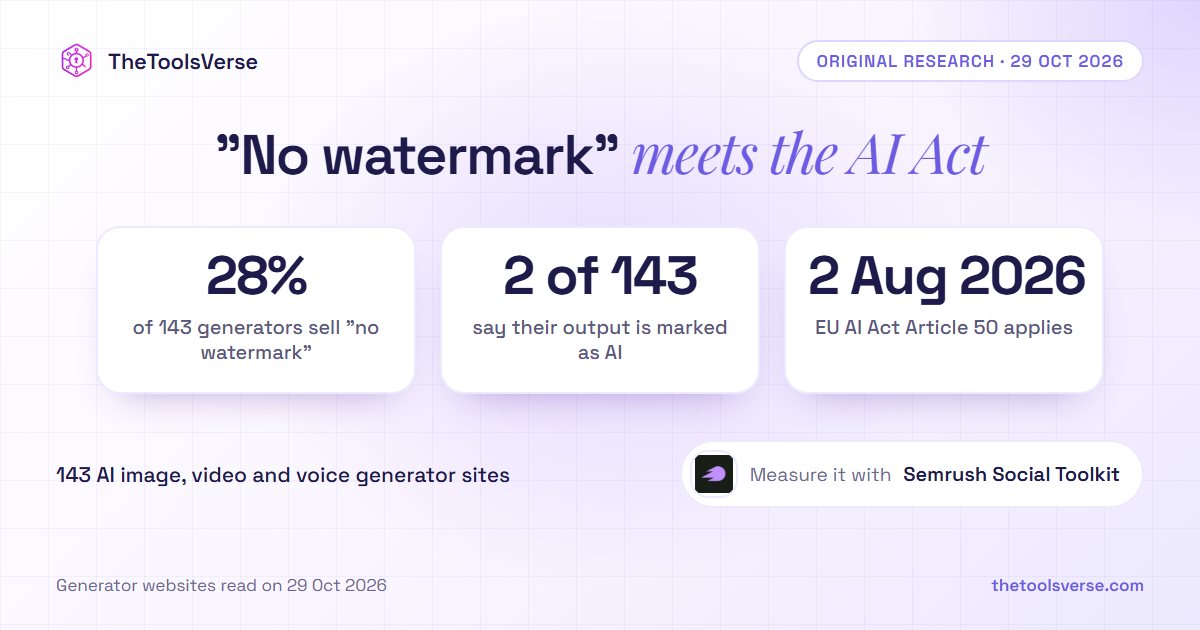
28% of AI Image, Video and Voice Generators Sell "No Watermark". 2 of 143 Tell You Their Output Is Marked as AI
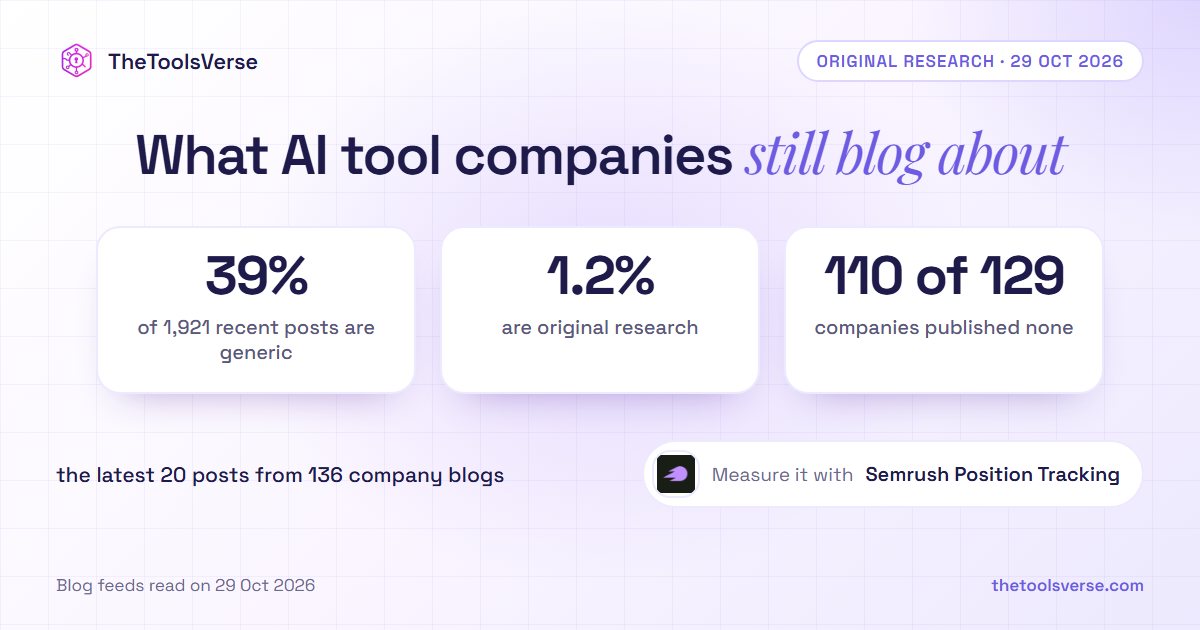
We Read 1,921 Blog Titles From 136 AI Tool Companies. 39% Are the Generic Posts AI Now Answers Itself; 1.2% Are Original Research