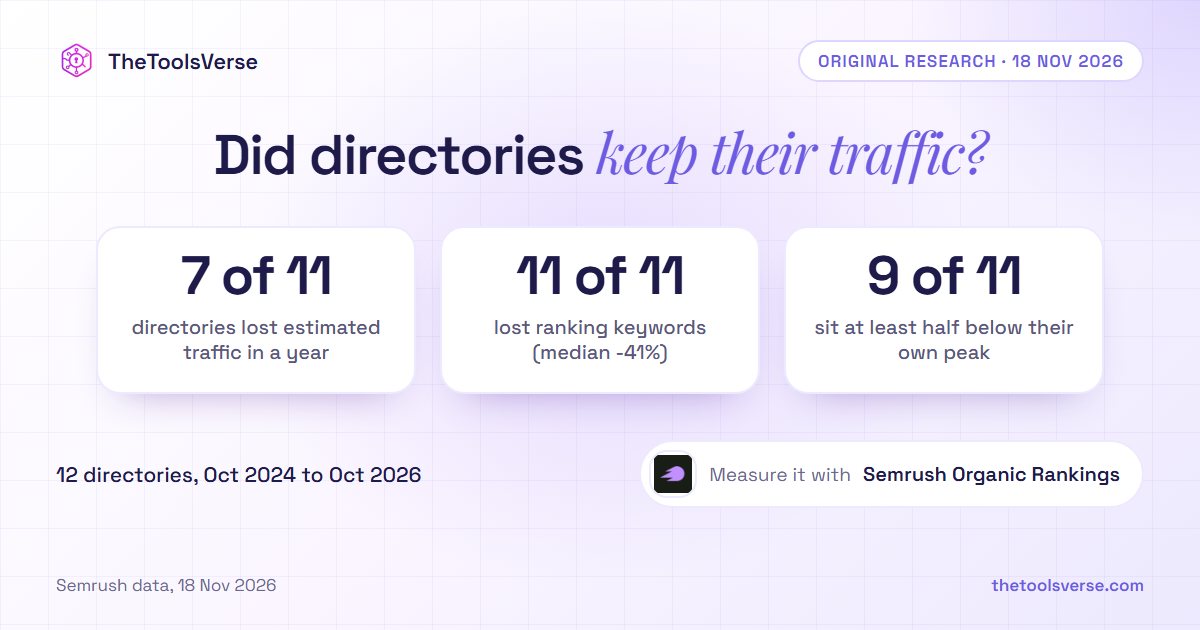
Did AI Tool Directories Keep Their Google Traffic? Semrush Estimates 7 of 11 Lost Traffic in a Year and 4 Gained, but All 11 Lost Ranking Keywords and 9 Sit at Least Half Below Their Own Peak
Disclosure
This article is promotional content produced as part of the Semrush Creator Accelerator programme. It contains affiliate links to Semrush — if you buy through them we may earn a commission at no extra cost to you — and we may also receive a reward from Semrush for publishing it. The data comes from Semrush's own database: we queried its domain history through the Semrush MCP connector on 18 November 2026. We chose the sites, the method and the conclusions; Semrush did not review or approve them.
Directories and listing sites are built on one promise: send a searcher to the right page, and let the visit pay for the site. When Google answers more of those searches itself, that promise is tested first on sites that list and compare things.
So we looked at twelve well-known directories. For each one, Semrush's US history shows how many keywords it ranks for, how many of those are in the top 3, and what traffic Semrush estimates for it, month by month. Did the directories keep their Google traffic, and what happened to the keywords underneath it?
Benchmark your category before you read your own chart
A traffic line means little until you can see the sites around you. Organic Rankings in the SEO Toolkit gives any domain's keyword and traffic history, so you can set your peers beside you. To see whether AI answers cite you as well, the AI Visibility Toolkit is part of Semrush One: try Semrush One free for 7 days.
The twelve directories
We chose ten directories of AI tools: theresanaiforthat.com, futurepedia.io, toolify.ai, topai.tools, aixploria.com, dang.ai, opentools.ai, futuretools.io, aitoolhunt.com and easywithai.com. We added two long-running software directories for contrast: saashub.com and alternativeto.net.
For each, Semrush's US domain history gave us the same columns for 28 months: keywords it ranks for, keywords in positions 1 to 3, and the traffic Semrush estimates. We compare October 2024, October 2025 and October 2026, so seasons do not distort the change.
One of the twelve no longer exists as a directory. Semrush shows aitoolhunt.com falling from 17,013 ranking keywords in December 2025 to one in May 2026 and none from June. When we requested its home page on 18 November 2026, it redirected to an unrelated site that offers app downloads. We count it separately and leave it out of the medians below, which cover the other 11.
Seven lost estimated traffic, four gained
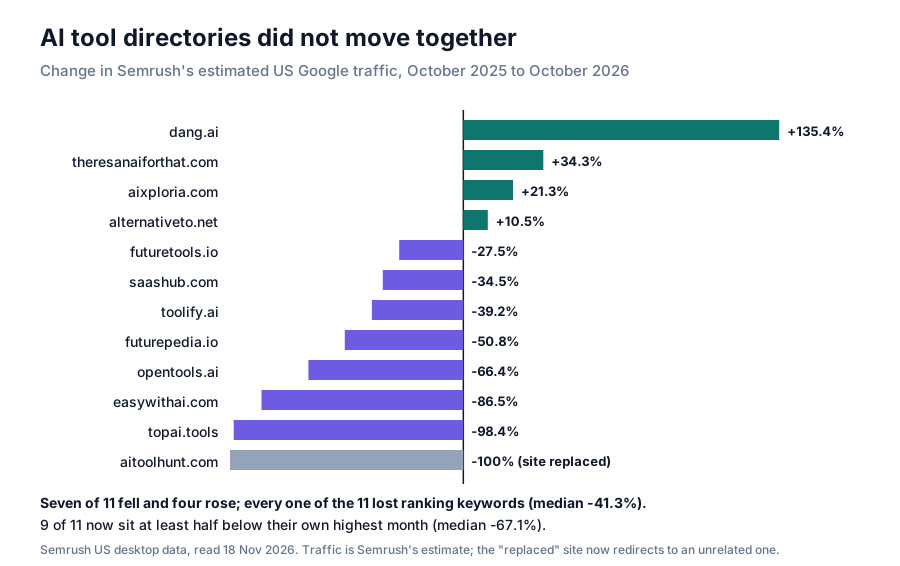
Over the past year, the median directory's estimated Google traffic changed by -34.5%. Seven of the 11 fell and four rose. Four fell by half or more: futurepedia.io, opentools.ai, easywithai.com and topai.tools.
- dang.ai rose 135.4%, theresanaiforthat.com 34.3%, aixploria.com 21.3% and alternativeto.net 10.5%.
- topai.tools fell 98.4%. Semrush's October reading shows 494 ranking keywords after 13,945 in September, so some of that drop may be a gap in Semrush's data. We show it as Semrush reports it.
Nine of the 11 are at least half below their own peak
The year-on-year view hides when each site did best. For the median directory, October 2026's estimated traffic was 67.1% below its own highest month in the 28 we pulled. Nine of the 11 sit at least 50% below their peak.
The peaks are spread out. Five directories peaked between September and December 2024, four between June and October 2025, and two in 2026: theresanaiforthat.com in May and dang.ai in September. Even theresanaiforthat.com, up 34.3% on a year ago, is 58.6% below its May 2026 peak.
Every one of them lost ranking keywords
This is the one result with no exceptions. All 11 directories rank for fewer keywords than a year ago, a median 41.3% fewer, including the four whose traffic estimate rose.
How can traffic rise while keywords fall? Look at the top 3. For three of the four gainers, keywords in the top 3 went up even though their total keywords went down: theresanaiforthat.com by 21.3%, dang.ai by 182.6% and aixploria.com by 2.8%. They rank for fewer things, but higher. The fourth, alternativeto.net, lost top-3 keywords (-43.4%) and still added 10.5% in estimated traffic, so the same pattern does not explain every site. Semrush also shows an AI Overview on most of what these directories still rank for; how that spread across content sites is in our earlier look at 20 of them.
Site by site
| Directory | Type | Traffic estimate, 1-year change | vs own peak month | Ranking keywords, 1-year change |
|---|---|---|---|---|
| dang.ai | AI tools | +135.4% | -15.5% (Sep 2026) | -42.5% |
| theresanaiforthat.com | AI tools | +34.3% | -58.6% (May 2026) | -32% |
| aixploria.com | AI tools | +21.3% | -40% (Dec 2024) | -20.9% |
| alternativeto.net | software | +10.5% | -79.7% (Nov 2024) | -41.3% |
| futuretools.io | AI tools | -27.5% | -62.4% (Sep 2024) | -39.1% |
| saashub.com | software | -34.5% | -67.1% (Jul 2025) | -53% |
| toolify.ai | AI tools | -39.2% | -94.3% (Jun 2025) | -51.5% |
| futurepedia.io | AI tools | -50.8% | -50.8% (Oct 2025) | -32% |
| opentools.ai | AI tools | -66.4% | -97.1% (Jun 2025) | -78.6% |
| easywithai.com | AI tools | -86.5% | -97% (Sep 2024) | -41.3% |
| topai.tools | AI tools | -98.4% | -99.5% (Sep 2024) | -99% |
| aitoolhunt.com | AI tools | -100% | -100% (Dec 2025) | -100% |
What to check in your own category
- Chart the peers, not only yourself. A 30% fall means one thing if your peers fell 35% and another if they rose. Here the medians hid a split: four directories grew while seven shrank.
- Separate the peak from the trend. Compare the same month a year apart, then compare today with your own best month. A site can be up on last year and still far below where it was.
- Count keywords and top-3 keywords separately. Fewer keywords with more of them in the top 3 can still grow, as it did for three of these directories. Fewer keywords and fewer top-3 positions rarely does.
- Put your own clicks next to the estimate. A third-party traffic estimate cannot show the clicks you actually lost. Search Console can.
Doing it in Semrush
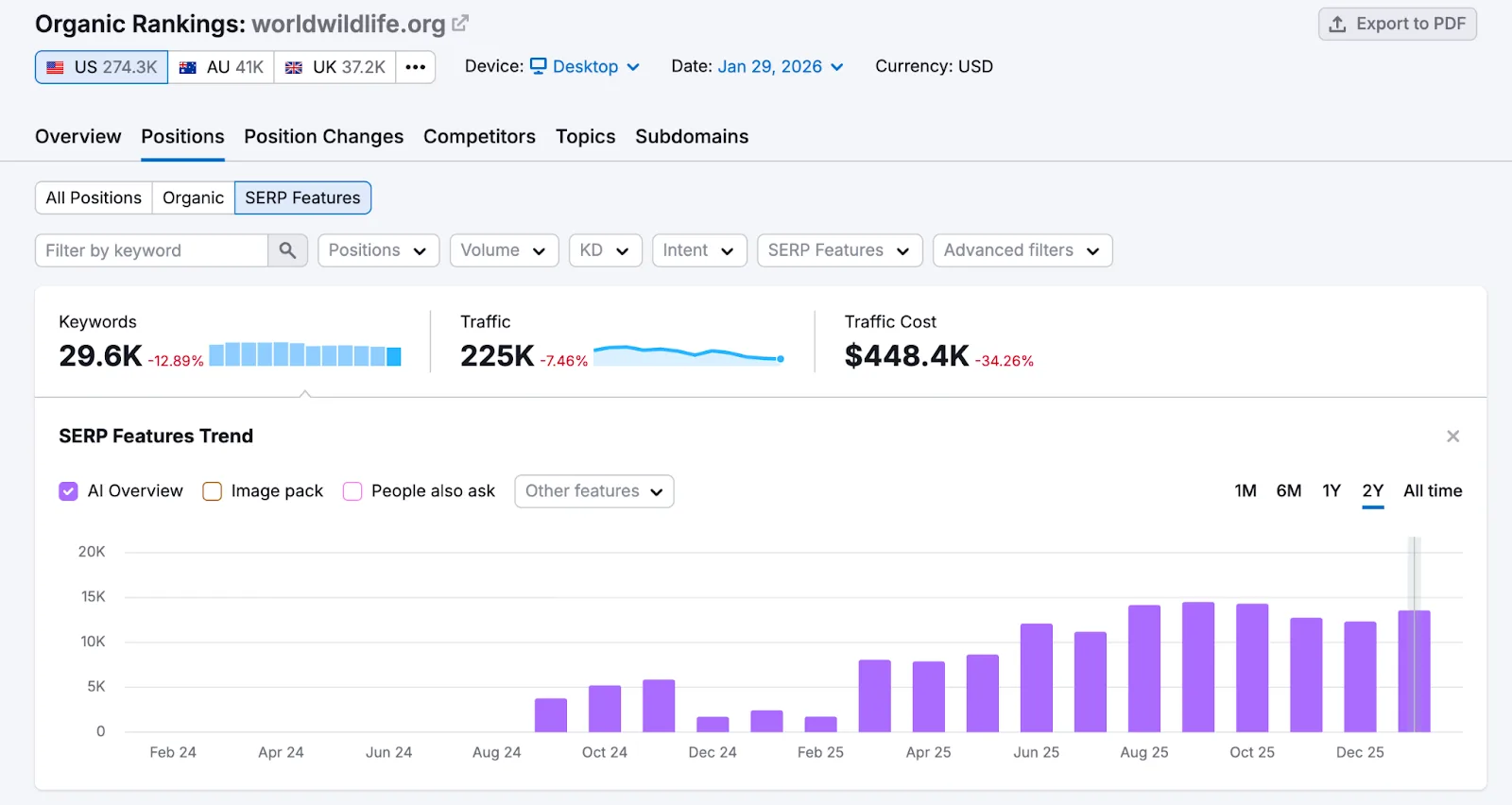
Pull any competitor's history. Organic Rankings, in the SEO Toolkit, shows a domain's ranking keywords, positions and estimated traffic over time, with a SERP Features Trend chart for how many of its keywords trigger an AI Overview each month.
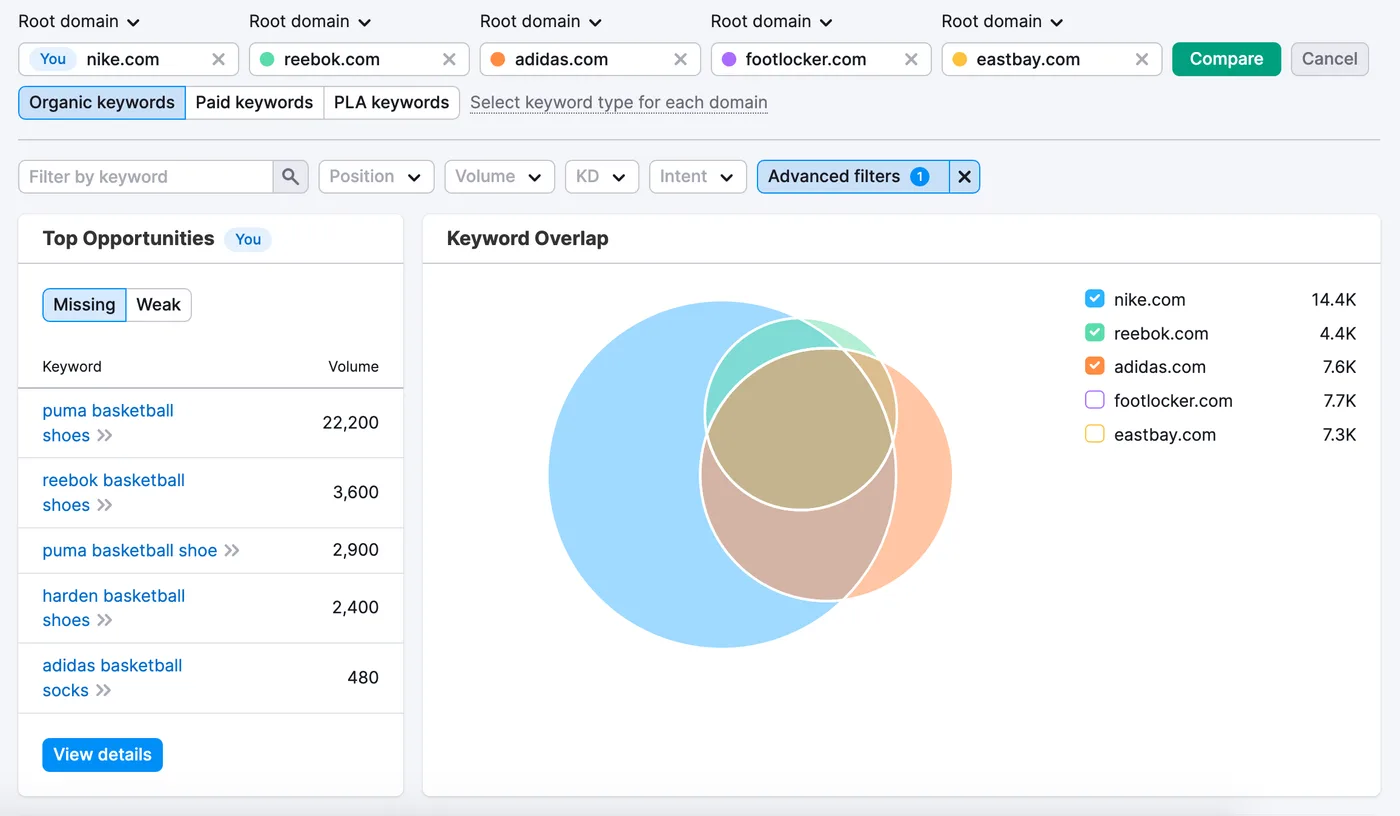
See what peers rank for that you do not. Keyword Gap compares up to five domains and lists the keywords your competitors rank for and you do not.
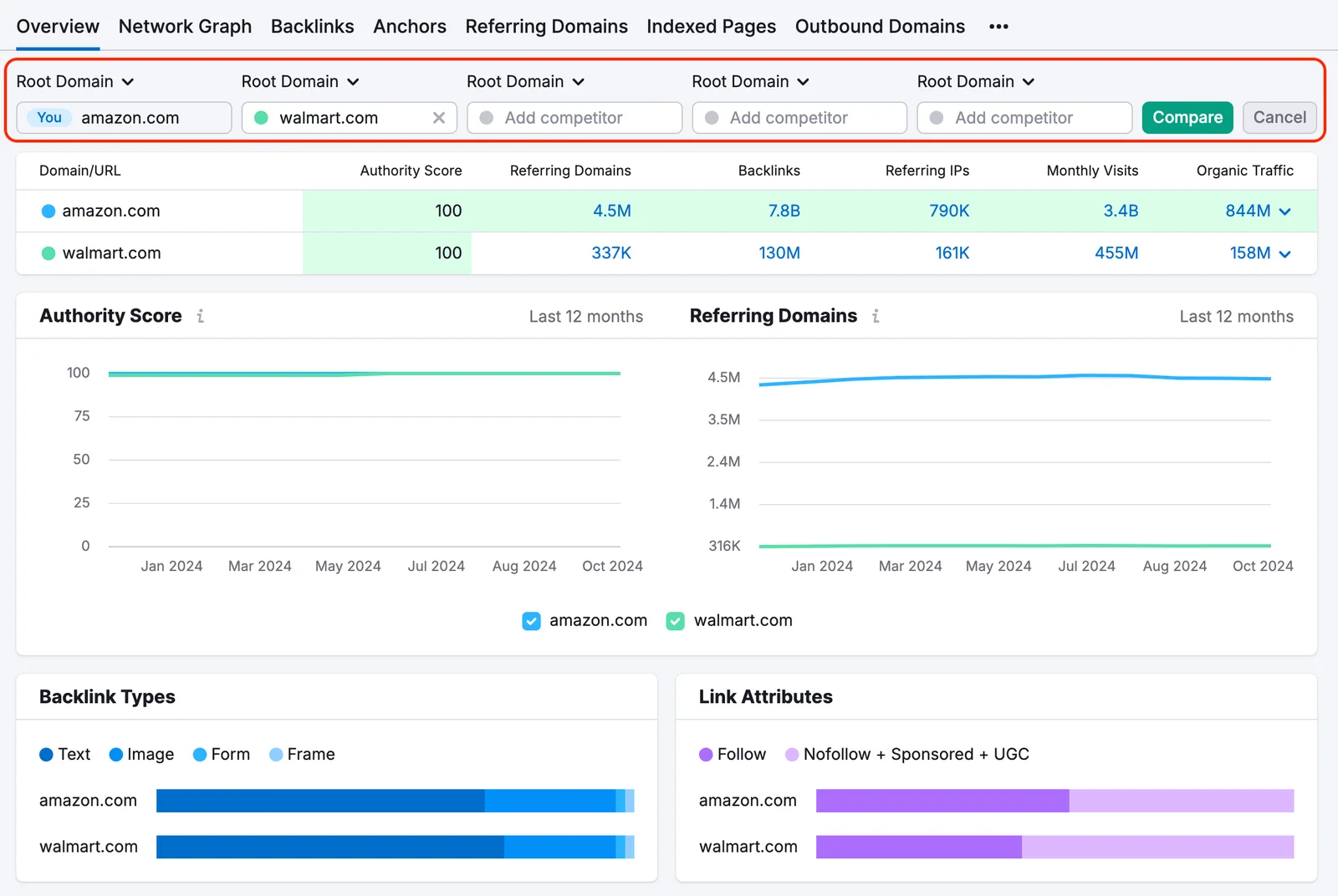
Compare link strength. Backlink Analytics compares domains on Authority Score, referring domains and backlinks over time, which shows whether a peer that gained traffic also gained links.
Follow your own rankings daily. Position Tracking monitors the keywords you choose and can show where an AI Overview appears among them.
Semrush One includes the SEO Toolkit and the AI Visibility Toolkit, and the 7-day free trial belongs to Semrush One. To benchmark your own category before paying, try Semrush One free for 7 days. Semrush's product page describes the offer as "Unlimited access to all Semrush One tools" (read on 16 October 2026). The numbers in this article came from Semrush's database through its MCP connector, not from the trial.
One category, two directions
Directories did not rise or fall as one. Over a year, four grew and seven shrank, and all eleven ranked for fewer keywords. Look at your peers' history before you decide what your own chart means.
Try Semrush One free for 7 days
Benchmark any category's keyword and traffic history in Organic Rankings, and follow AI citations in the AI Visibility Toolkit, both included in Semrush One. Free for 7 days for new users.
Try Semrush One free for 7 daysHow we counted
- Source: Semrush domain history (the
resource_rank_historyreport), US desktop database, queried on 18 November 2026 through the Semrush MCP connector: 28 monthly rows per site, July 2024 to October 2026. - Columns: organic keywords; keywords in positions 1 to 3; organic traffic (Semrush's estimate).
- Changes: October 2026 against October 2025 (and October 2024), per site, then the median. "Own peak" is the highest monthly traffic estimate in the 28 months we pulled.
- Aitoolhunt.com: Semrush shows no keywords or traffic from June 2026 (one keyword in May). On 18 November 2026 a request to its home page redirected to an unrelated site. We excluded it from the medians and show it in the table.
- Limits: 12 sites chosen by us, not every directory; one database (US desktop); traffic is Semrush's estimate, not the sites' own analytics; Semrush's keyword counts can shift with how deep it tracks results; we did not check why any site gained or lost.
- Reproduce it: the scripts and saved results are in
research/r2-i2-directories/.
Some links may be affiliate links. We may earn a small commission at no extra cost to you.
Related Articles
Explore more guides and reviews from our experts.
AI Tool Home Pages Redirect to HTTPS 94.5% of the Time, but Only 63% Send HSTS, 35% a Content-Security-Policy and 6% All Six Basic Security Headers: We Checked 601
Insightful Pricing (2026): Three Plans, a 50-Seat Minimum and a 14-Day Work Audit