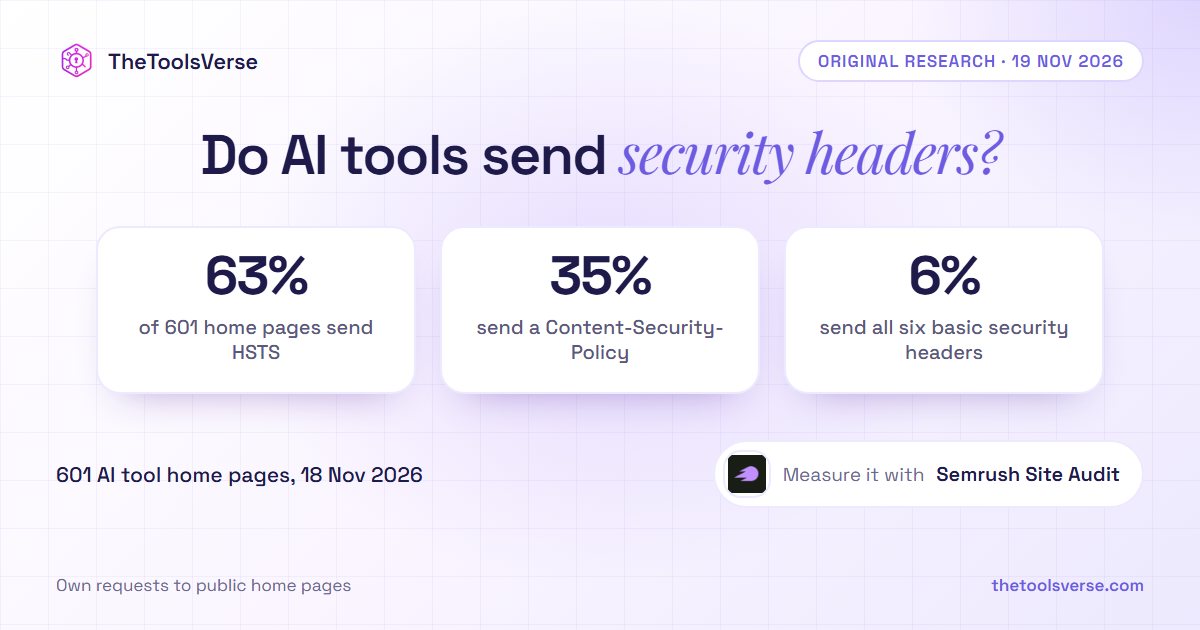
AI Tool Home Pages Redirect to HTTPS 94.5% of the Time, but Only 63% Send HSTS, 35% a Content-Security-Policy and 6% All Six Basic Security Headers: We Checked 601
Disclosure
This article is promotional content produced as part of the Semrush Creator Accelerator programme. It contains affiliate links to Semrush — if you buy through them we may earn a commission at no extra cost to you — and we may also receive a reward from Semrush for publishing it. The data comes from our own requests to public home pages on 18 November 2026, not from Semrush; Semrush did not review or approve our method or conclusions. We read Semrush's Site Audit issue list on 19 November 2026 to describe what it checks.
An AI tool asks you to trust it with prompts, files and sometimes a card number. Part of that trust sits in the first response its server sends: a handful of headers that tell your browser how to treat the page. They cost nothing to add and nobody sees them.
So we looked. For 613 AI tool company sites, we requested the home page and read what the server sent back. Which basic security signals do AI tool home pages send, and how many send all of them?
Start with the HTTPS layer
Site Audit lists HTTPS problems on your own site, including HSTS support, the redirect from http to https, mixed content and certificate errors. The AI Visibility Toolkit, part of Semrush One, shows what AI platforms say about your brand: try Semrush One free for 7 days.
What we checked
For each site we made one request for the home page, one for /.well-known/security.txt, and one plain-http request to see whether it redirects to https. We used an identifying user agent. If a site answered with a 401 or 403 we recorded it as unreadable and did not retry under another identity: 8 did. Four more returned another status, and 601 were readable.
Six signals came from the home page's response headers:
- HSTS (Strict-Transport-Security), which tells browsers to use https only.
- nosniff (X-Content-Type-Options), which stops a browser guessing a file's type.
- Clickjacking protection, from X-Frame-Options or the frame-ancestors part of a Content-Security-Policy.
- Content-Security-Policy, which limits what a page may load and run.
- Referrer-Policy, which limits what is sent to other sites when someone clicks a link.
- Permissions-Policy, which limits browser features such as camera and microphone.
HTTPS is nearly universal. The headers are not.
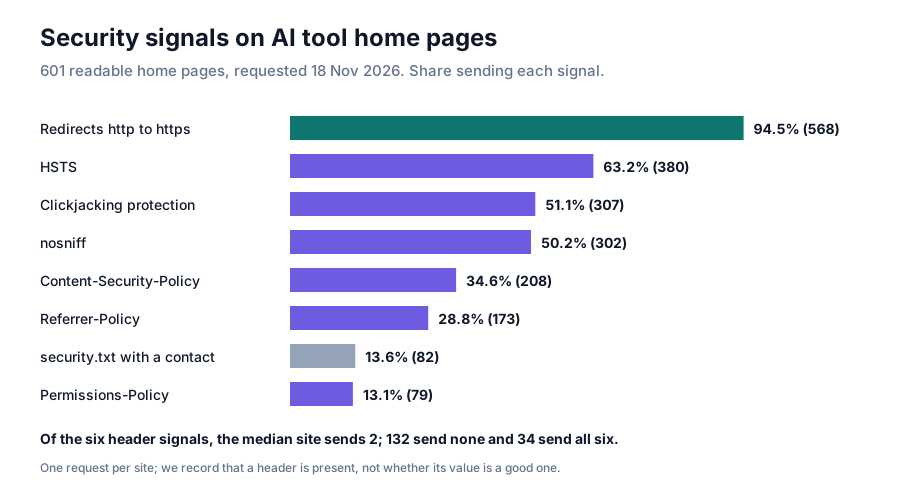
568 of the 601 (94.5%) redirect plain http to https. After that, the numbers fall with each header:
| Signal | Sites | Share of 601 |
|---|---|---|
| Redirects http to https | 568 | 94.5% |
| HSTS | 380 | 63.2% |
| Clickjacking protection | 307 | 51.1% |
| nosniff | 302 | 50.2% |
| Content-Security-Policy | 208 | 34.6% |
| Referrer-Policy | 173 | 28.8% |
| Permissions-Policy | 79 | 13.1% |
| A security.txt file with a contact | 82 | 13.6% |
Of the 380 that send HSTS, 318 set a lifetime of at least a year.
Six signals: a median of two
Counting the six header signals per site, the median site sends 2. 132 sites (22.0%) send none of them, 203 (33.8%) send four or more, and 34 (5.7%) send all six.
The hosting platform shows in the numbers
We grouped sites by the name in their Server header. That header can name a CDN in front of the real server, so read it as "what the response says", not as proof of where a site is hosted.
| Server header says | Sites | Send HSTS | Median of the six |
|---|---|---|---|
| cloudflare | 319 | 62.1% | 3 |
| vercel | 58 | 100% | 1 |
| nginx | 46 | 47.8% | 1 |
| amazons3 | 21 | 42.9% | 0 |
All 58 sites whose Server header says Vercel send HSTS, yet their median is one signal out of six. That looks like a platform default doing one job, not the site owners configuring headers, but we cannot see anyone's configuration. For the Amazon S3 group, the median is none.
How to check your own site
- Run
curl -I https://your-site/and read the headers that come back. - Add HSTS first. It is one line, and it protects every later visit. Wait until all your subdomains work on https before you include them.
- Add nosniff, a clickjacking rule and a Referrer-Policy. They rarely break anything.
- Treat Content-Security-Policy as a project. It can block your own scripts if it is too strict, so test it in report-only mode first.
- Publish a security.txt with a contact, so a researcher knows where to send a finding.
Doing it in Semrush
See what Site Audit checks. According to Semrush's Site Audit issues list (read on 19 November 2026), it flags subdomains that do not support HSTS, a missing redirect from the http version to the https homepage, mixed content, expiring or incorrect certificates, and links on https pages that lead to http pages. Semrush describes an HTTPS Implementation report that gathers them. It does not list checks for the other headers in this article, such as Content-Security-Policy or nosniff, so you would test those with a tool like curl.
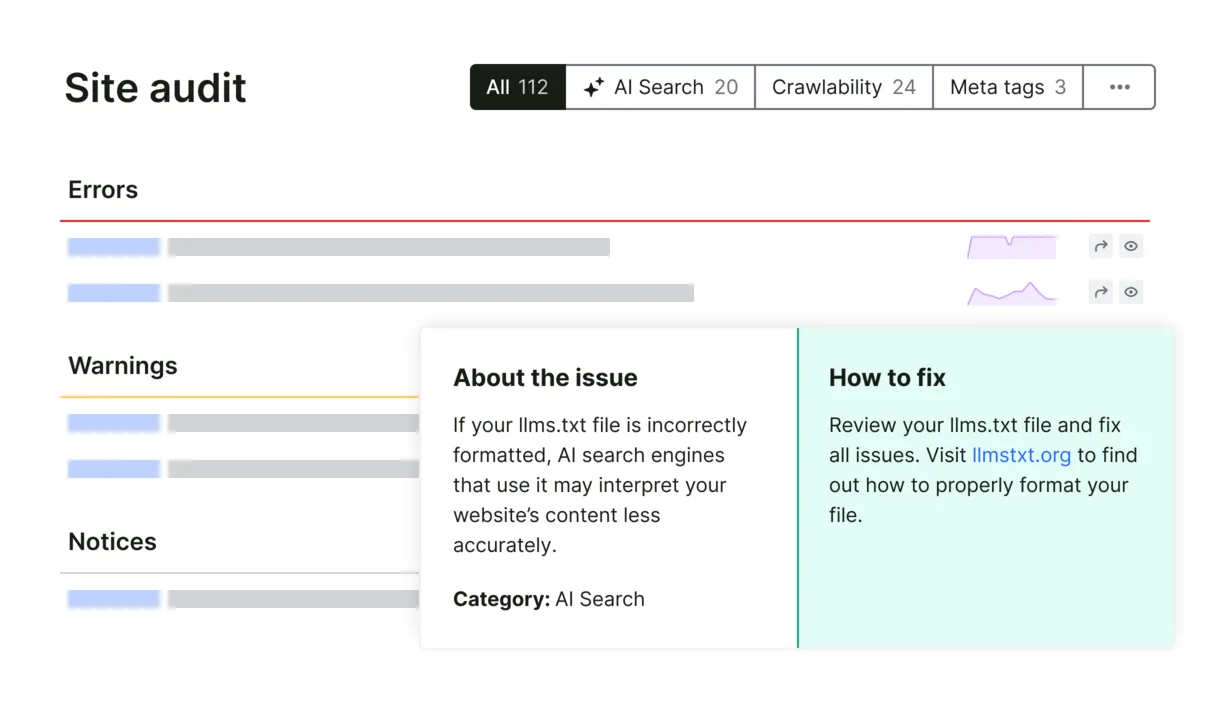
Check whether AI platforms can read your key pages. Site Audit also reports an AI Search Health score and which pages AI search bots are blocked from.
See what AI says about your brand. The AI Visibility Toolkit reports mentions and cited pages across AI platforms, month by month.
Semrush One includes the SEO Toolkit and the AI Visibility Toolkit, and the 7-day free trial belongs to Semrush One. To audit your own site's HTTPS setup before paying, try Semrush One free for 7 days. Semrush's product page describes the offer as "Unlimited access to all Semrush One tools" (read on 16 October 2026). The figures in this article come from our own requests, not from Semrush or the trial.
Near-universal HTTPS, uneven headers
Almost every AI tool site gets you to https. Fewer than two in three tell the browser to insist on it, and only about one in eighteen sends all six basic signals. Check yours with one request.
Try Semrush One free for 7 days
Find HTTPS problems on your own site in Site Audit and follow what AI platforms say about your brand in the AI Visibility Toolkit, both included in Semrush One. Free for 7 days for new users.
Try Semrush One free for 7 daysHow we counted
- Population: 613 AI tool company sites, the same list our earlier AI-tool studies used. No company is named in this article.
- Method: one GET of the home page over https (falling back to the www host if the first request failed), one GET of
/.well-known/security.txt, and one plain-http request that we did not follow, to read the redirect. A 401 or 403 was recorded as unreadable and not retried. A site counts as readable if the home page returned 200 with an HTML content type. - Signals: HSTS present; X-Content-Type-Options contains nosniff; X-Frame-Options present or a Content-Security-Policy containing frame-ancestors; Content-Security-Policy present; Referrer-Policy present; Permissions-Policy present. We record that a header is present, not whether its value is a good one. A security.txt counts only if it is not an HTML page and has a Contact line.
- HSTS lifetime: the max-age value is at least 31,536,000 seconds (one year).
- Hosting groups: the first word of the Server header. A CDN can hide the origin, and 71 sites send no Server header.
- Limits: one request per site on one day; a firewall or CDN can send a different response to a plain request than to a browser; headers on the home page may differ from those on other pages; 12 sites could not be read.
- Reproduce it: the scripts and saved results are in
research/r2-j2-security-headers/.
Some links may be affiliate links. We may earn a small commission at no extra cost to you.
Related Articles
Explore more guides and reviews from our experts.
Insightful Pricing (2026): Three Plans, a 50-Seat Minimum and a 14-Day Work Audit
Did AI Tool Directories Keep Their Google Traffic? Semrush Estimates 7 of 11 Lost Traffic in a Year and 4 Gained, but All 11 Lost Ranking Keywords and 9 Sit at Least Half Below Their Own Peak