45% of AI Tool Privacy Policies Mention Training AI Models. In a Hand-Read Sample, 39% Promise Not to Train on Your Content, 32% Say They Do, and 22% Only Make That Promise About Google Data
Disclosure
This article is promotional content produced as part of the Semrush Creator Accelerator programme. It contains affiliate links to Semrush — if you buy through them we may earn a commission at no extra cost to you — and we may also receive a reward from Semrush for publishing it. The data comes from our own reading of public privacy policies on 18 November 2026, not from Semrush; Semrush did not review or approve our method or conclusions.
Before you paste a contract, a photo or a client's text into an AI tool, the question is simple: will they use it to train their models? The answer should be in the privacy policy. We wanted to know how often it is, and how clear it is.
So we read the privacy policies of 613 AI tool company sites, counted how many mention training AI models at all, and then read a random 80 of them by hand to see what each one actually promises.
Check what AI says about your brand
Whatever your policy says, AI platforms may describe your brand in their own words. The AI Visibility Toolkit shows what AI platforms say about a brand. It is part of Semrush One: try Semrush One free for 7 days.
What we read
We started from 613 AI tool company websites. For each we fetched the home page, found the link to its privacy policy and read the policy page, as a crawler would, from the page's own HTML. We did not run JavaScript, log in or accept cookies. The result:
- 391 policies were readable and hosted on the company's own domain. These are the ones we analyse.
- 44 more were readable but hosted on another domain, such as a policy generator's. We left them out.
- 121 home pages had no privacy-policy link in their HTML.
- 28 policy pages were too short to read, which usually means the text loads through JavaScript.
- 12 policies were blocked by the site's robots.txt, 5 could not be reached, and 12 home pages could not be read.
174 of 391 mention training AI models
A policy counts as mentioning training if it has a sentence that contains both "train" (or training, trained) and a word like model, AI, machine learning or algorithm. 174 of the 391, or 44.5%, do.
That is a floor, not a ceiling: a policy can say "we may use your content to improve our services" and never use the word. The median policy runs 3,490 words, and 70.6% show a "last updated" or "effective" date.
What they actually promise
A sentence that mentions training can say very different things. We drew a random 80 of the 174, read the matching sentences from each, and sorted them by hand into six groups. Eight were not training statements at all (menu text on the page, or another company's wording), which leaves 72.
| What the policy says | Policies | Share of 72 |
|---|---|---|
| A general promise not to train on users' content or data, sometimes unless you opt in | 28 | 38.9% |
| It trains on some user data (16 say so only; 7 also make a promise about other data) | 23 | 31.9% |
| Only a narrow promise, almost always about Google account data | 16 | 22.2% |
| Only a statement about its AI providers, not about itself | 5 | 6.9% |
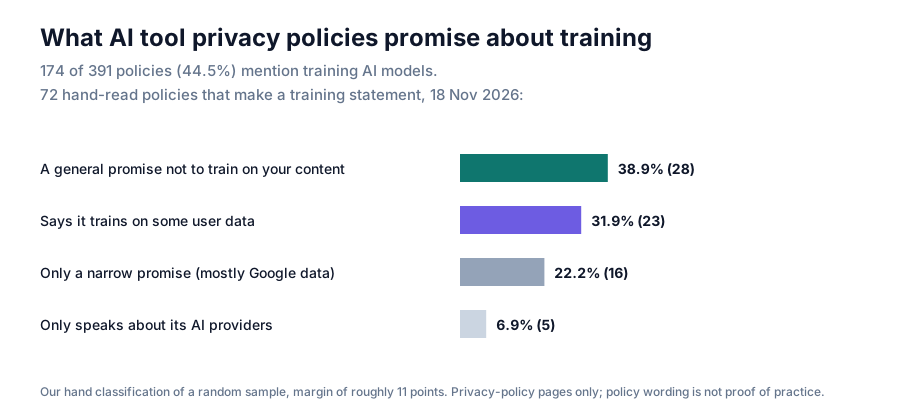
With 72 policies, each share carries a margin of roughly 11 points either way.
The clear promises are short. One reads, "We do not use your private prompts or uploads to train public models unless you opt in, or unless the content is already public on the Service." The ones that say they train are also plain: "to train our algorithms, models and AI products". For some, the only control is a form: "You may request that we not use certain categories of your Content to train our models by completing this online form"
Most of the narrow promises are about Google
Of the 16 policies that make only a narrow promise, 15 are about Google account data and one about a single chat platform. Some use the same sentence word for word, for example "Google Workspace APIs are not used to develop, improve, or train generalized AI and/or ML models." One of them opens its section with "To comply with Google’s Limited Use policy, we affirm".
That is a real promise, and it is worth knowing about, but it covers the data you connect from Google, not the text, files or images you give the tool directly. A reader who sees "we do not train on Google user data" and stops there can come away thinking all of their content is covered. In this sample, 16 policies make only that kind of promise, against 23 that say they train on some user data.
How to read an AI tool's privacy policy
- Search the page for "train". If nothing comes up, the policy has not answered your question. That is different from a "no".
- Check what the promise covers. "Your content", "personal data" and "Google user data" are different things.
- Check whether it is opt-in, opt-out or a flat no. "Unless you opt in" and "unless you opt out" lead to opposite defaults.
- Look for what is said about the AI providers behind the tool. Five policies in our sample speak only about them.
- Check the date. About three in ten policies show no update date.
Doing it in Semrush
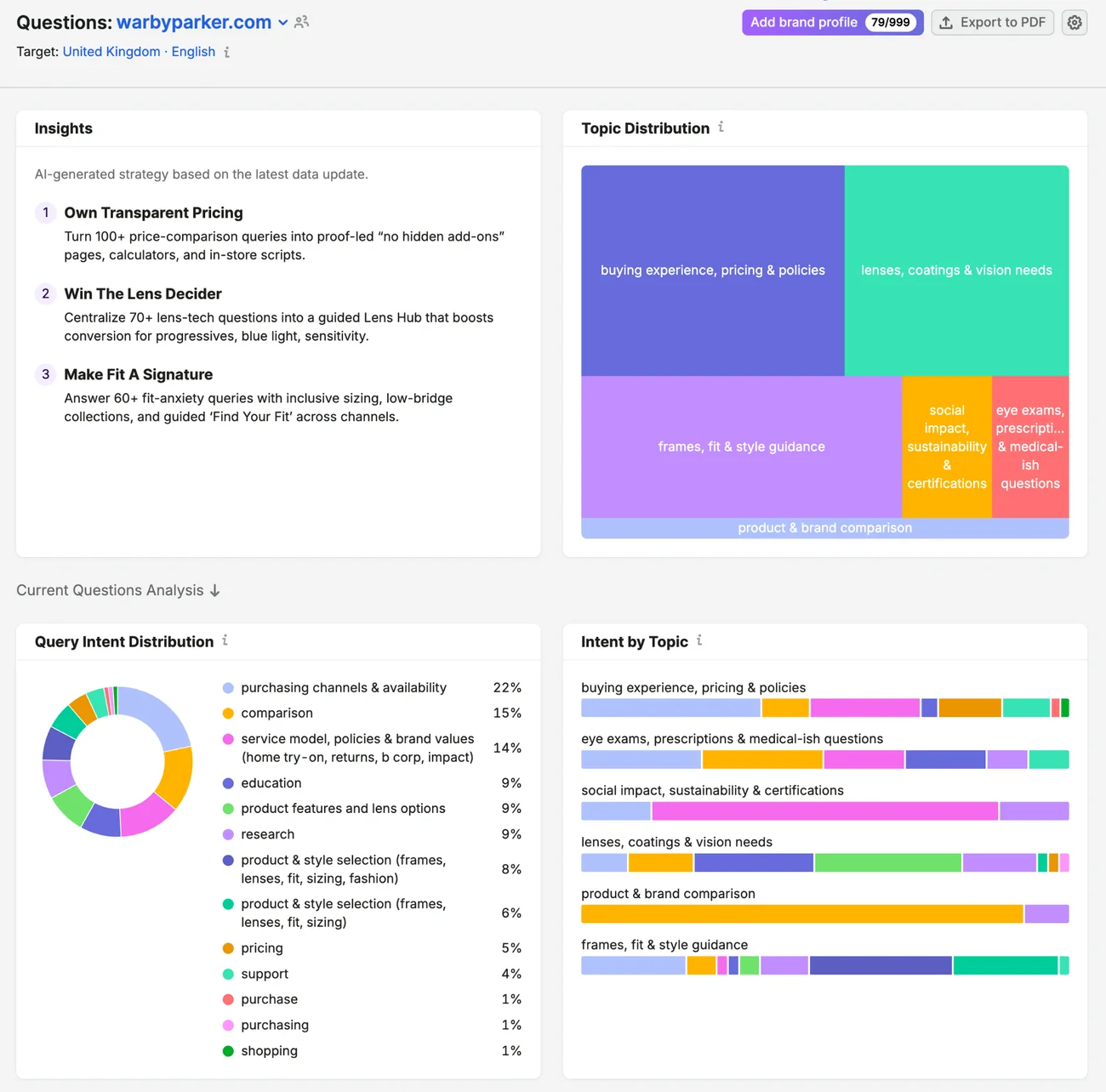
See what AI says about a brand's data practices. The Questions report in Brand Performance, part of the AI Visibility Toolkit, groups the questions people ask AI about a brand by topic and intent.
Make sure the policy can be read. 28 of the policies we fetched were too short to read from their HTML, and 121 sites showed no policy link in theirs. Site Audit reports an AI Search Health score and which pages AI search bots are blocked from, with JavaScript rendering switched on or off.
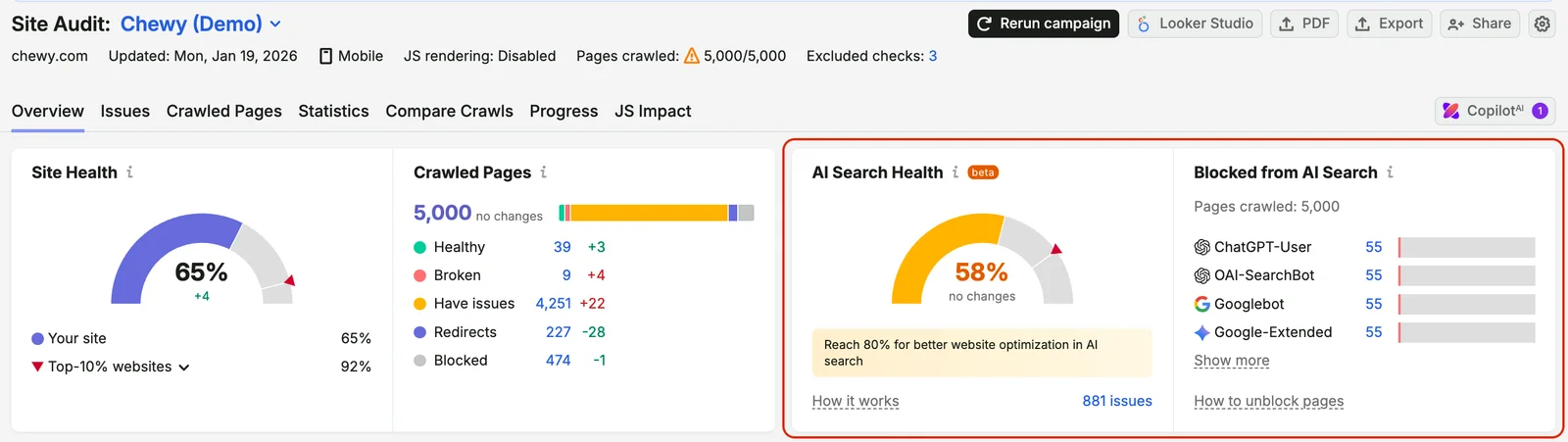
Semrush One includes the SEO Toolkit and the AI Visibility Toolkit, and the 7-day free trial belongs to Semrush One. To see what AI platforms say about your own brand before paying, try Semrush One free for 7 days. Semrush's product page describes the offer as "Unlimited access to all Semrush One tools" (read on 16 October 2026). The figures in this article come from our own reading of public policies, not from Semrush or the trial.
A promise is only as wide as its sentence
Four in ten policies in our sample make a plain promise. Three in ten say they train on some of your data, and two in ten make a promise that does not cover what you paste in. Read what the promise is about before you rely on it.
Try Semrush One free for 7 days
See what AI platforms say about your brand in the AI Visibility Toolkit and check that your key pages can be read in Site Audit, both included in Semrush One. Free for 7 days for new users.
Try Semrush One free for 7 daysHow we counted
- Population: 613 AI tool company sites, the same list our earlier AI-tool studies used. No company is named in this article.
- Method: home page, then the first link whose text or path contains "privacy", fetched with a plain request (no JavaScript, no login) under an identifying user agent. We respected robots.txt for the policy page, and a 401 or 403 was recorded as unreadable and not retried. A policy counted as "own domain" if its registrable domain matched the site's.
- Mentions training: a sentence containing "train", "training" or "trained" and a word such as model, AI, machine learning, LLM or algorithm. Automated.
- Hand-read sample: a seeded random draw of 80 of the 174 policies that mention training. We read the matching sentences for each and sorted them into the groups above. Eight were not training statements and are excluded from the shares, leaving 72. The labels are our judgement, and they are saved with the script. "General promise" includes promises that depend on consent.
- Last updated and retention: whether the policy shows a "last updated" or "effective" date, and whether it mentions a number of days, months or years for keeping or deleting data. Both are automated, not hand-checked.
- Limits: the privacy-policy page only (not terms, data-processing agreements or in-app settings); what a company writes is not proof of what it does; 121 sites showed no policy link in their HTML and may have one that loads through JavaScript; policies change; the sample of 72 carries a margin of roughly 11 points.
- Reproduce it: the scripts, the sample and the labels are in
research/r2-j1-policies/.
Some links may be affiliate links. We may earn a small commission at no extra cost to you.
Related Articles
Explore more guides and reviews from our experts.
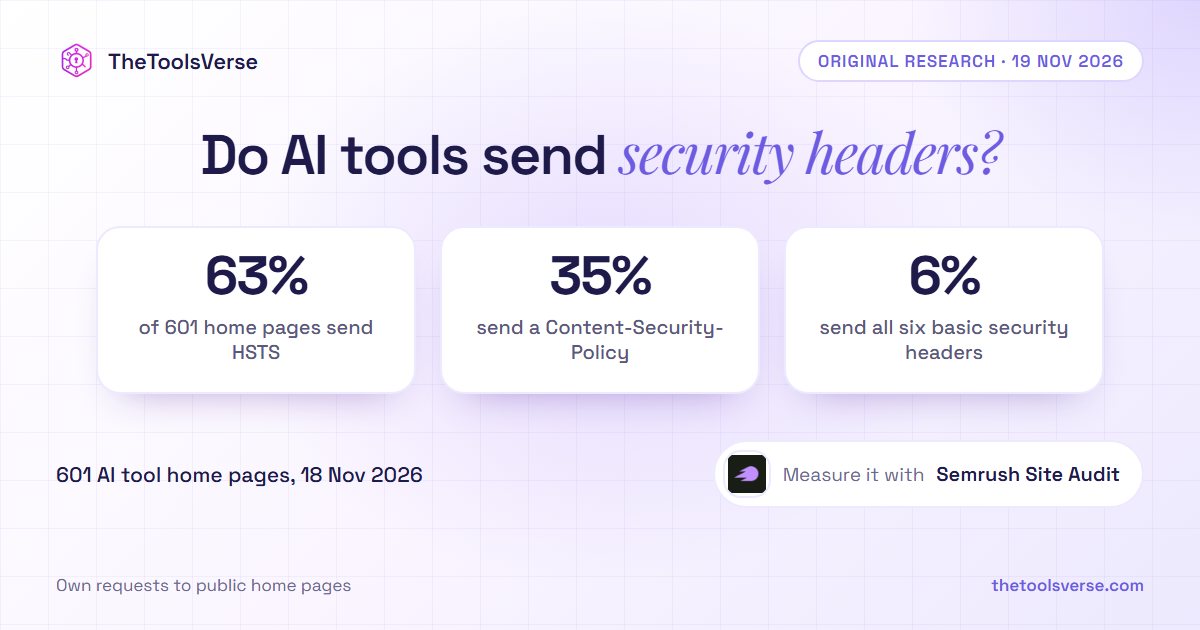
AI Tool Home Pages Redirect to HTTPS 94.5% of the Time, but Only 63% Send HSTS, 35% a Content-Security-Policy and 6% All Six Basic Security Headers: We Checked 601
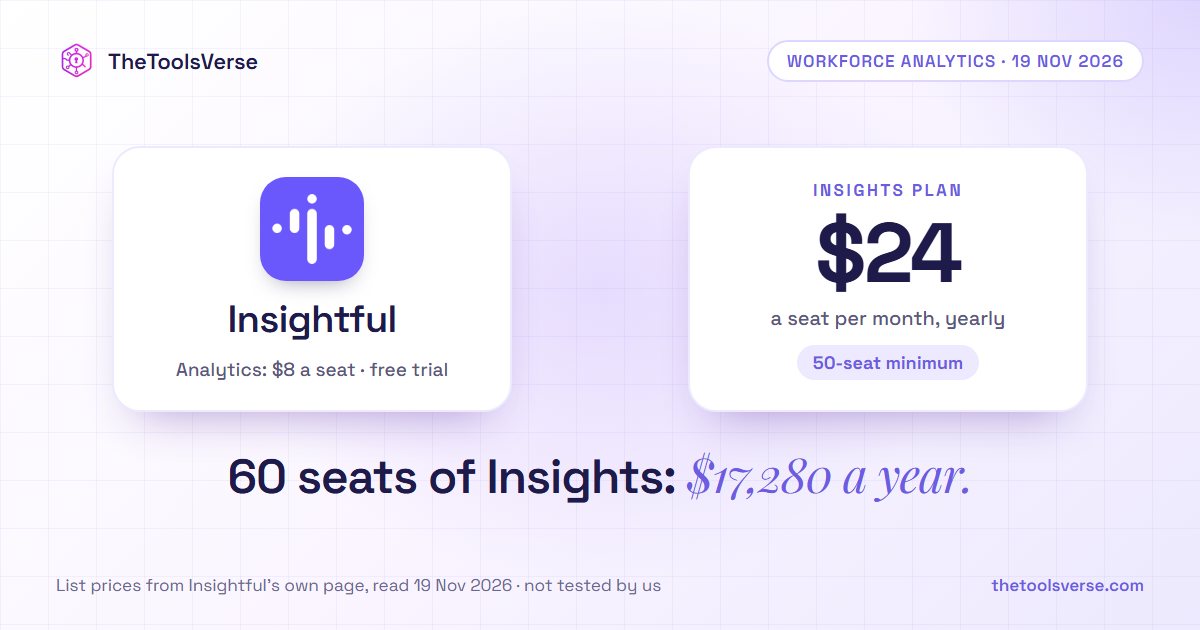
Insightful Pricing (2026): Three Plans, a 50-Seat Minimum and a 14-Day Work Audit