Google Says a Page Needs a Snippet to Appear in AI Features. On the Top 1,000 Sites, None of 551 Readable Home Pages Blocks One, 7 Are Marked noindex and 43 Hide Parts From Snippets
Disclosure
This article is promotional content produced as part of the Semrush Creator Accelerator programme. It contains affiliate links to Semrush — if you buy through them we may earn a commission at no extra cost to you — and we may also receive a reward from Semrush for publishing it. All measurements in this article are our own. Semrush did not supply, review or approve the data, and the conclusions we draw are ours.
Google's guide to generative AI features on Search is mostly a reminder that the basics still apply. One sentence in it is a hard rule, though. On 14 November 2026 we read, in Google's Search Central guide Google's Guide to Optimizing for Generative AI Features on Google Search: "To be eligible to be shown in generative AI features on Google Search, a page must be indexed and eligible to be shown in Google Search with a snippet".
Two things can take a page out of that rule: a directive that keeps it out of the index, and a directive that asks Google not to show a snippet. Both are one line in the page's head. So we asked how many of the biggest sites in the world use them.
Find pages that are noindexed or blocked
Crawl your site the way search engines and AI bots do, and see which pages are noindexed or blocked, with Site Audit in the SEO Toolkit. To get it with the AI Visibility Toolkit in one subscription, try Semrush One free for 7 days.
The test
We took the 1,000 most popular websites in the Tranco ranking (the list we downloaded on 5 November 2026, the same one we used in our structured data study) and requested each home page on 13 November 2026. 551 returned an HTML page. The others refused us, timed out, redirected to something that was not HTML or answered with an error, so every figure below is about those 551.
On each page we read the robots, googlebot and google meta tags, the X-Robots-Tag response header and any data-nosnippet attributes.
None of them blocks snippets
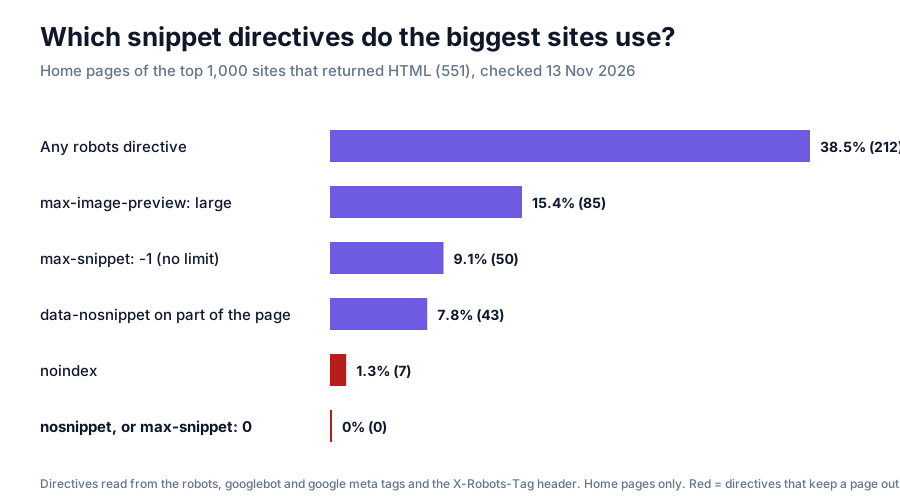
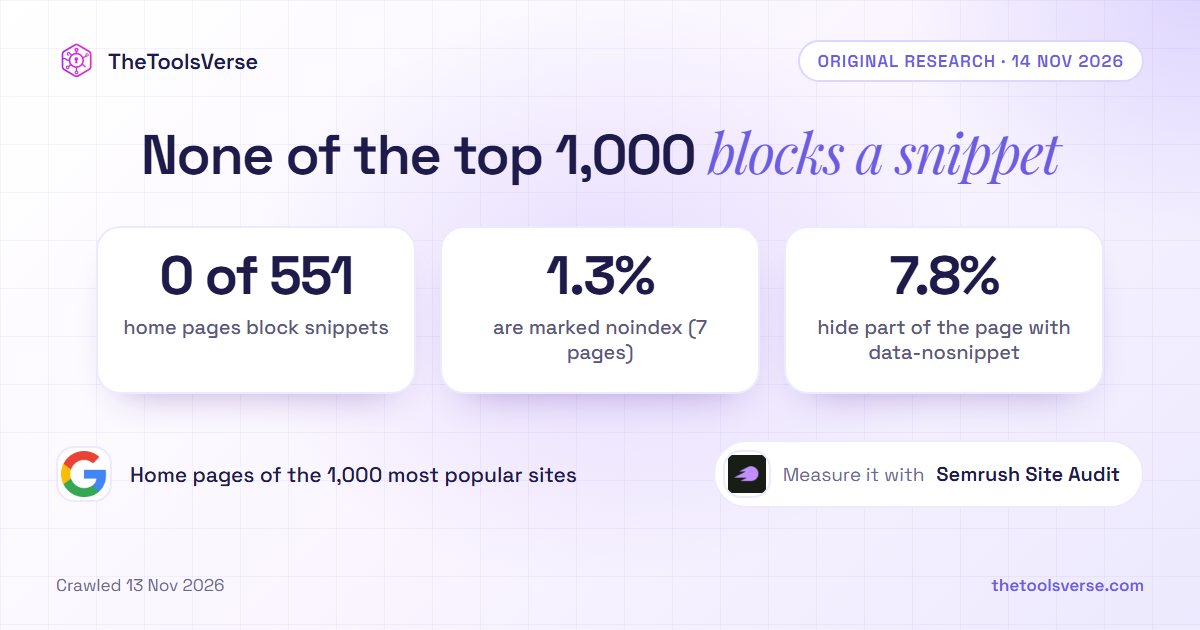
Not one of the 551 home pages used nosnippet or max-snippet:0. None set a snippet length limit either. The directive that Google's rule is about is, on these pages, simply not used.
What the pages did say about snippets:
- 50 (9.1%) say
max-snippet:-1, which allows a snippet of any length. - 43 (7.8%) contain a
data-nosnippetattribute, which hides one part of the page from snippets and leaves the rest eligible. They include apple.com, linkedin.com and mozilla.org. - 85 (15.4%) ask for large image previews with
max-image-preview:large. - 212 (38.5%) set some robots directive at all, including
index,follow,noarchiveornotranslate. 13 pages (2.4%) send anX-Robots-Tagheader.
The real exclusion is noindex
7 of the 551 home pages (1.3%) carried noindex, 5 in a meta tag and 2 in an X-Robots-Tag header. A page that is not indexed cannot meet Google's rule, whatever its snippet settings. Some of these may be redirect or login pages that were never meant to be indexed, since we saw whatever the home address returned to us, so treat the figure as a lower bound on pages that are meant to be found.
Big sites are less likely to ask for large images
Large image previews are a different decision from snippets, but they show how much attention sites give the head of the page. Only 2 of the 62 readable sites in ranks 1 to 100 (3.2%) set max-image-preview:large, against 32 of 206 (15.5%) in ranks 101 to 500 and 51 of 283 (18.0%) in ranks 501 to 1,000. The sites with the most traffic are the least likely to set the directive.
What this cannot tell you
- That a page shows up in Google's AI features. We checked the directives that could keep it out. We did not test whether any page actually appears there.
- How the rest of each site behaves. We looked at home pages. A product, article or help page may carry different directives.
- What the other 449 sites do. They did not return a readable HTML home page to our request, so nothing here describes them.
- That the directives are the same for Google. A site can send different headers to different clients and countries. We fetched each page once, from one location, with an ordinary browser-style request that identified our research project.
- Whether
robots.txtblocks. We did not readrobots.txt, which is a separate control.
What to do with it
- Check your own pages for
noindexandnosnippet. The rule is one sentence, and a stray template directive can take a whole section out. - Look at the headers too. Two of the seven noindex pages used an
X-Robots-Tagheader, which does not show in the page source. - Use
data-nosnippeton purpose. It hides a part of a page, such as a price or a paywalled paragraph, and leaves the rest of the page eligible. - Do not copy the biggest sites. The sites with the most traffic here barely use preview directives, which says little about what a smaller site should do.
- Re-check after template changes. Directives travel with templates, and a release can add or remove them for thousands of pages at once.
Find the pages, check access, find the questions
Find pages that are noindexed, blocked or hard to crawl. Site Audit in the SEO Toolkit lists crawlability and indexability issues, including pages that AI search bots cannot reach.
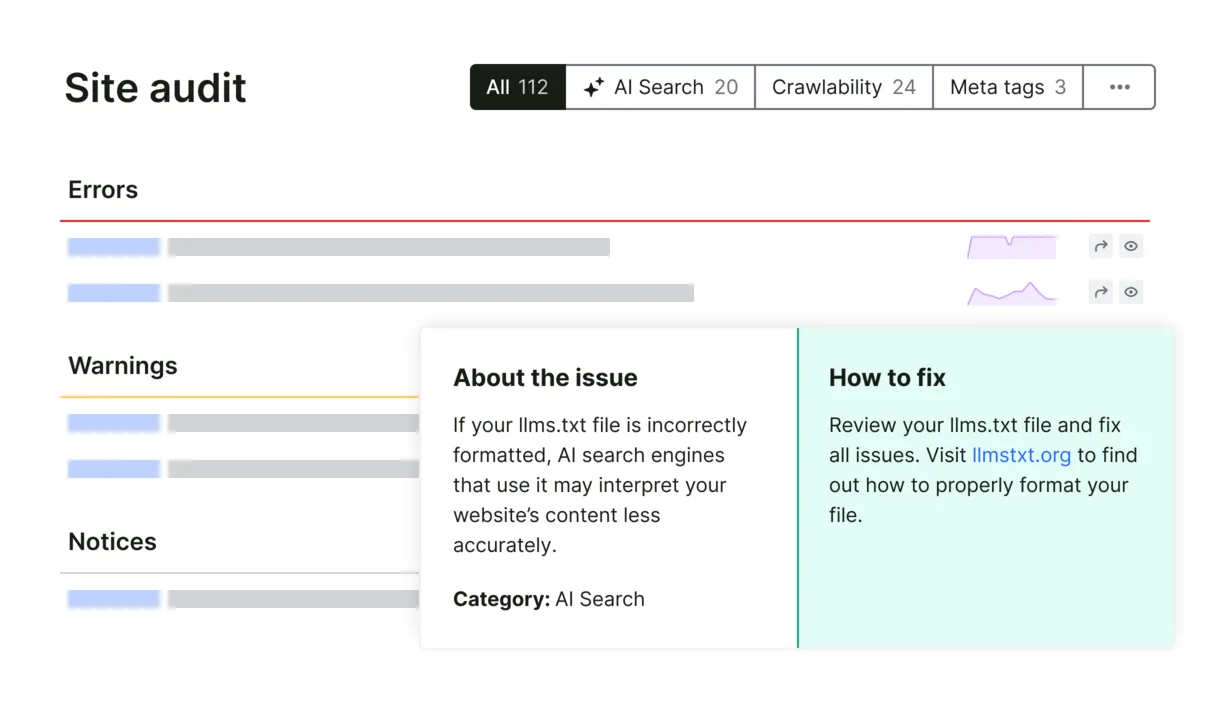
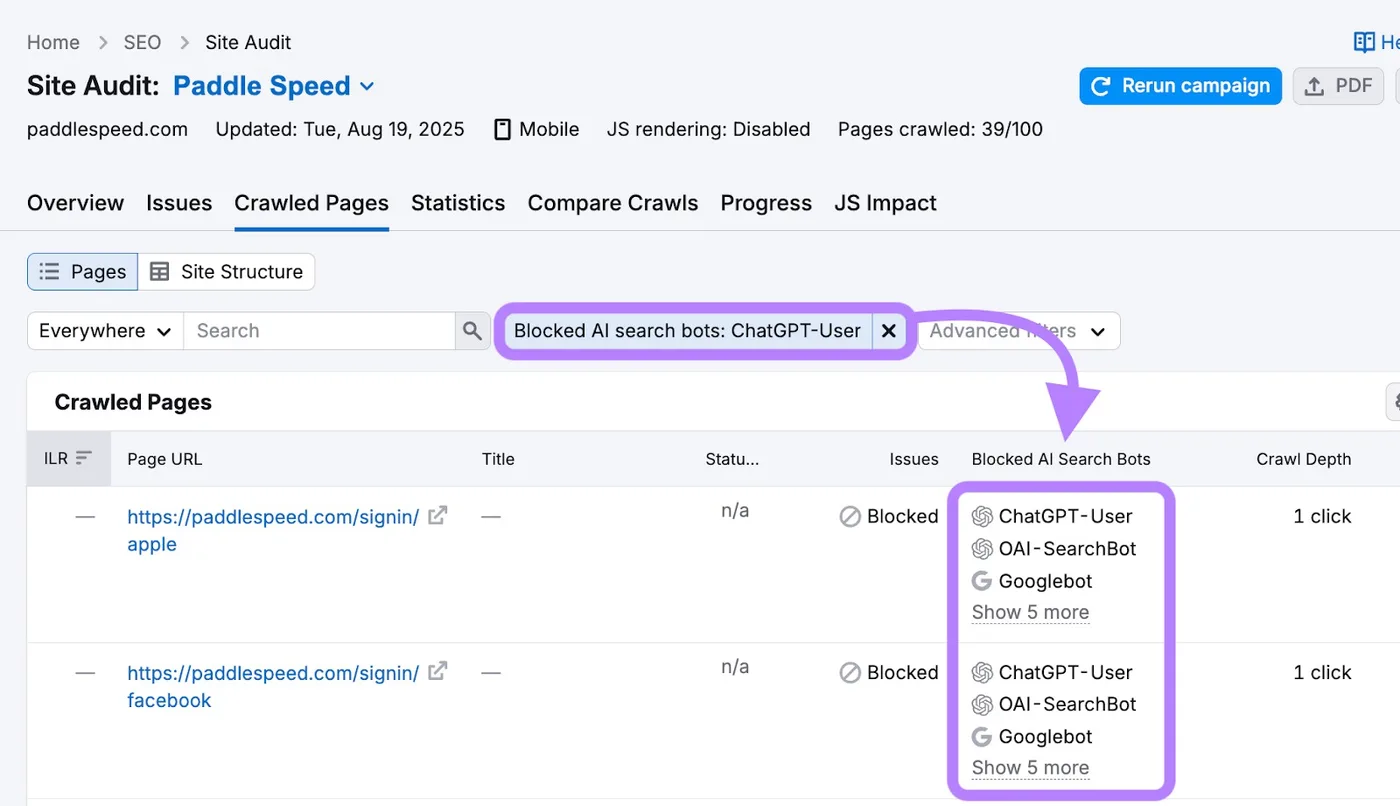
See which AI crawlers a page blocks. The Crawled Pages report can be filtered by blocked AI search bots.
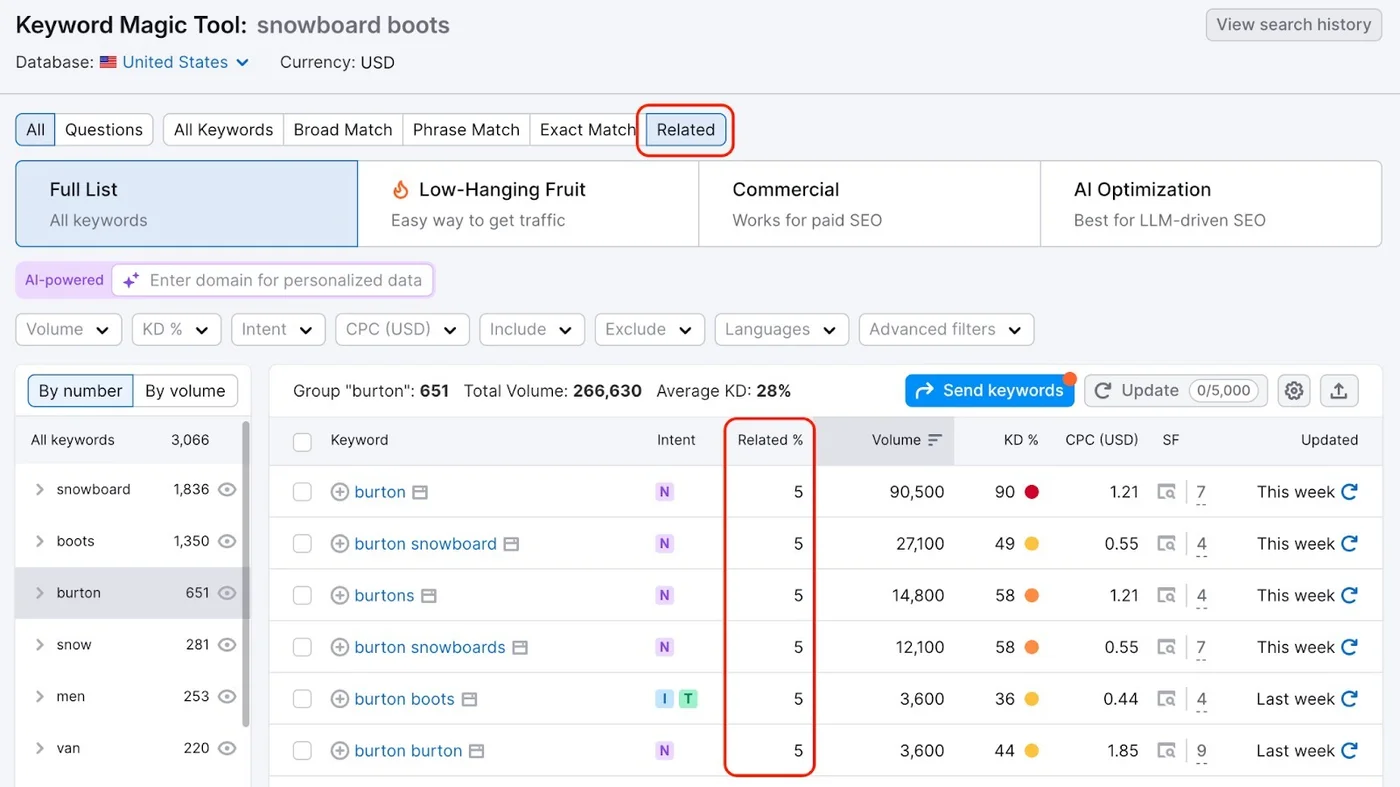
Find the topics worth covering. The Keyword Magic Tool in the SEO Toolkit groups related keywords and shows intent and volume, so the questions a page should answer can be sorted by demand.
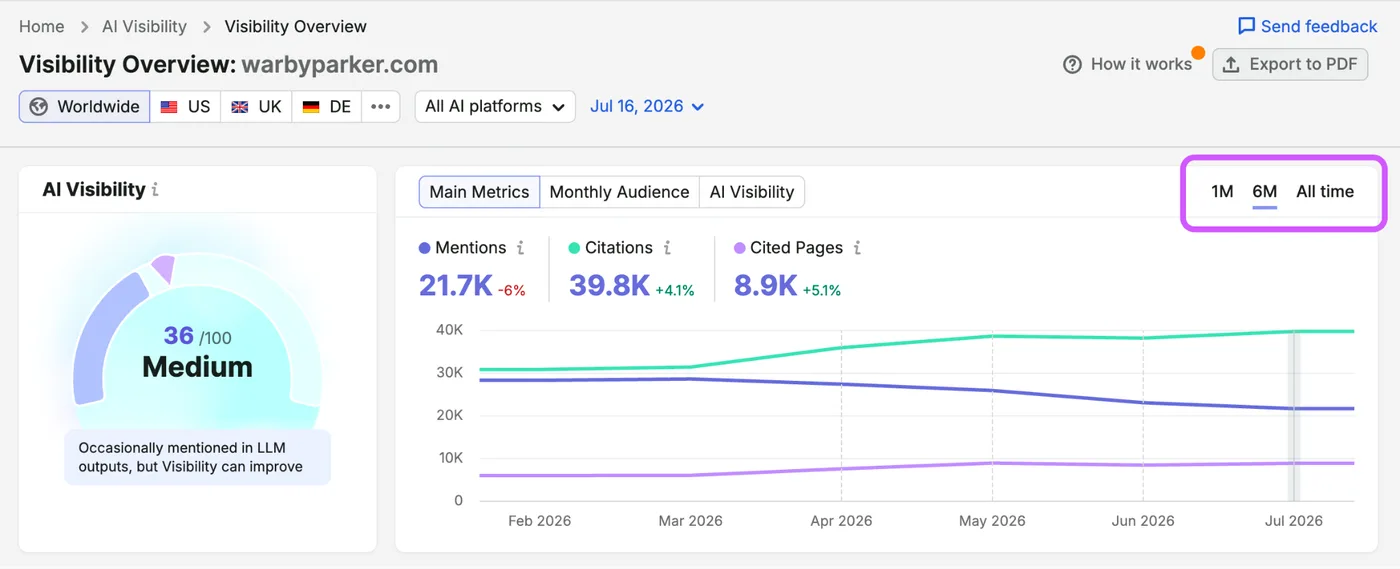
See which of your pages AI platforms cite. Visibility Overview in the AI Visibility Toolkit shows mentions, citations and cited pages over time across AI platforms.
The free trial belongs to Semrush One, not to the AI Visibility Toolkit, which has none of its own; Semrush One includes that toolkit together with the SEO Toolkit. To audit your pages and see your citations without paying first, try Semrush One free for 7 days. Semrush's product page promises "Unlimited access to all Semrush One tools" (we read it on 16 October 2026). That is Semrush's published offer, which we did not test, and none of the data in this article came from a Semrush account.
A one-line rule
Google's rule for its AI features is short, and the biggest sites already meet it. Check that you do too, on every template.
Try Semrush One free for 7 days
Site Audit and the Keyword Magic Tool in the SEO Toolkit, with Visibility Overview in the AI Visibility Toolkit, together in Semrush One. Free for 7 days for new users.
Try Semrush One free for 7 daysHow we counted
- Population: Tranco ranks 1 to 1,000 (downloaded 5 November 2026). One request to each domain's home page on 13 November 2026, falling back to the
wwwaddress when needed. 551 returned an HTML page with a 200 status. - Directives: the content of every meta tag named robots, googlebot or google (the news-only googlebot-news tag was ignored), plus the
X-Robots-Tagheader. "Blocks snippets" meansnosnippetormax-snippet:0. "No limit" meansmax-snippet:-1. "Noindex" meansnoindexornone. - Parts of a page: a page counts for
data-nosnippetif the attribute appears anywhere in its HTML. - Rank bands: ranks 1 to 100 (62 readable pages), 101 to 500 (206) and 501 to 1,000 (283).
- The quote: read from Google's English Search Central guide on 14 November 2026.
- Not shown:
robots.txt, other pages of each site, and whether any page appears in a Google AI feature. - Reproduce it: the crawler and the analysis are in our research folder (
research/r2-d8-snippet-controls/); the raw crawl is not published.
Some links may be affiliate links. We may earn a small commission at no extra cost to you.
Related Articles
Explore more guides and reviews from our experts.
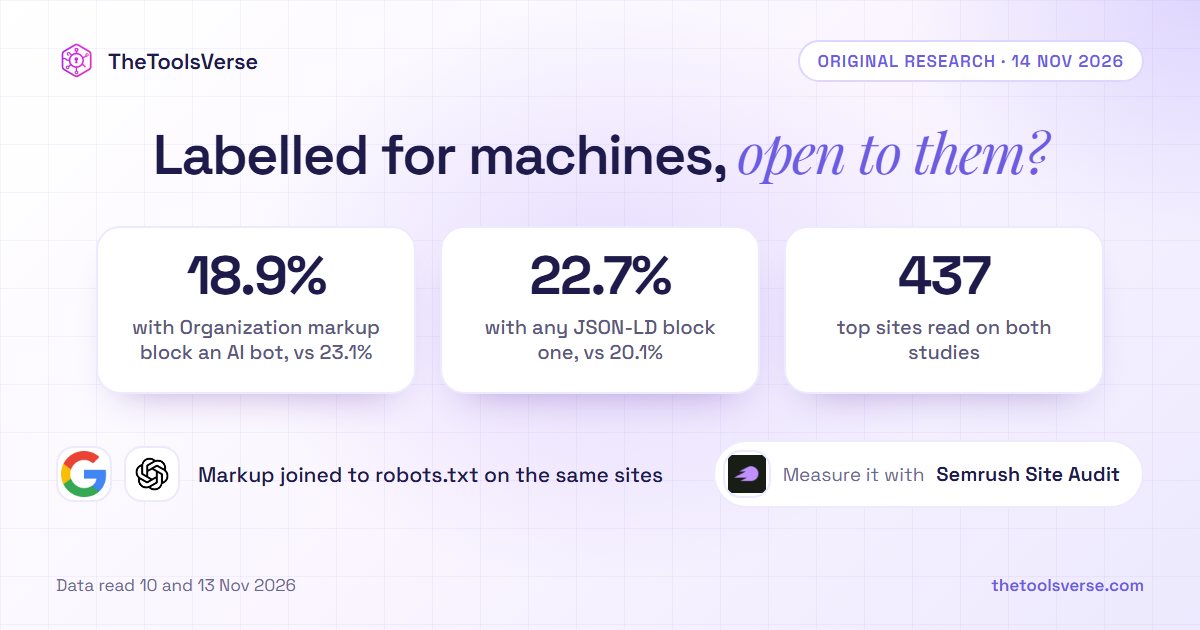
Top Sites With Organization Markup Block AI Crawlers Slightly Less, 18.9% Against 23.1%, but Plain JSON-LD Shows No Such Pattern: Joining Two of Our Studies
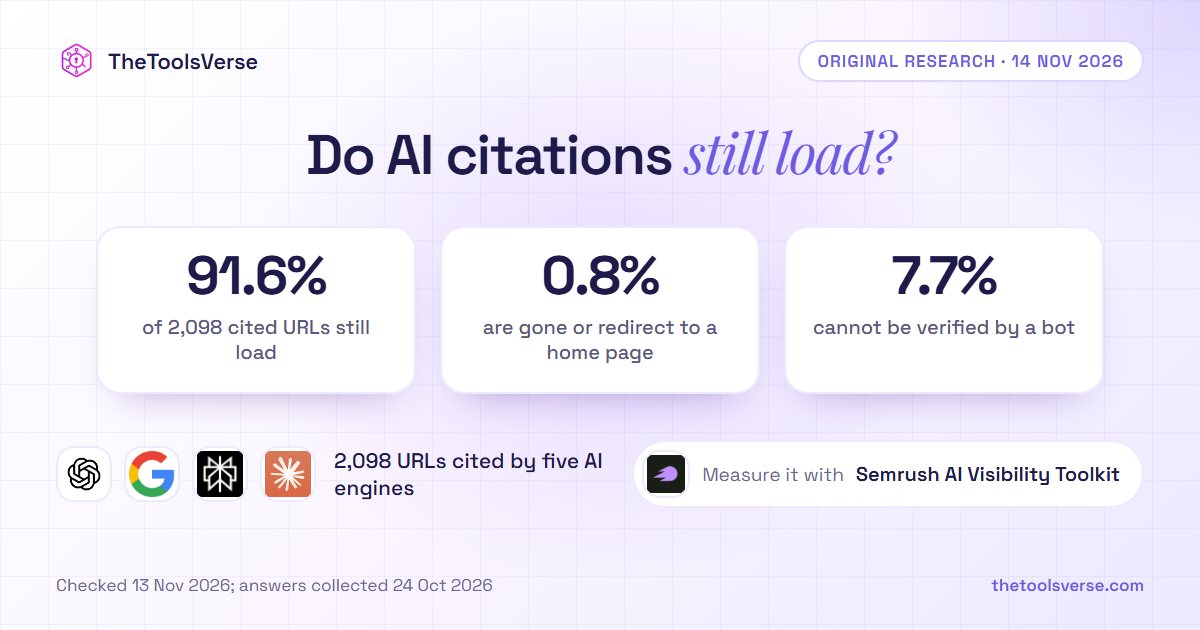
We Re-Checked 2,098 URLs That Five AI Engines Cited: 91.6% Still Load, 0.8% Are Gone, and 7.7% Cannot Be Verified by a Bot