Only One of Our Nine ChatGPT Citations Survived GPT-5.6
Disclosure
This article is promotional content produced as part of the Semrush Creator Accelerator programme. It contains an affiliate link to Semrush — if you buy through it we may earn a commission at no extra cost to you — and we may also receive a reward from Semrush for publishing it. All measurements in this article are our own. Semrush did not supply, review or approve the data, and the conclusions we draw are ours.
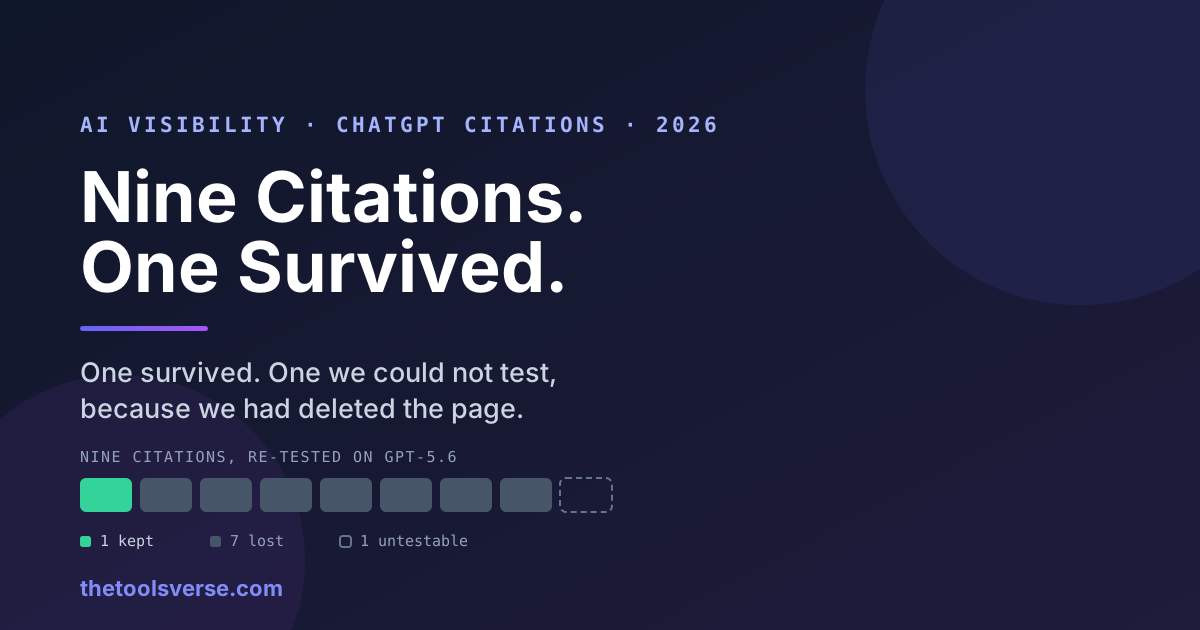
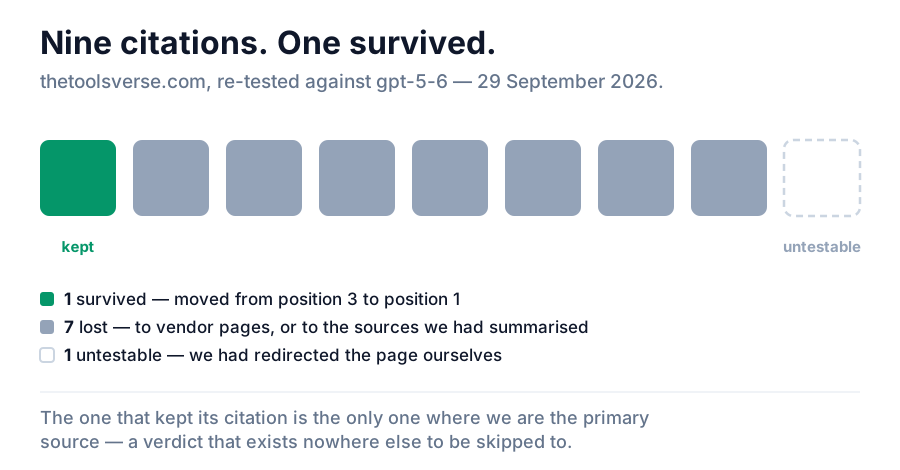
In September 2026 we went looking for every ChatGPT answer that mentioned our domain. We found 56, of which 13 carried a citation — a real link, in the answer, pointing at one of 12 distinct pages.
On 29 September 2026 we took the nine cited entries and asked ChatGPT the same questions again.
One survived.
Seven were gone. And the ninth could not be tested at all, because in the months between the two measurements we had redirected the page ourselves.
This article is the method, the results, and the one rule that turned out to predict which pages keep a citation and which lose it. That rule is not rank, not backlinks, and not how many tools a directory lists.
Why this is worth measuring at all
Semrush's trend brief on the GPT-5.6 citation shift states the problem plainly: since ChatGPT began pre-selecting a shortlist of domains before searching, "Teams can't see which domains ChatGPT shortlists, whether their brand is 'named' for their category, or how their citation share moves week to week."
That is a measurement gap, not a strategy. You cannot act on a shift you cannot observe on your own domain. So we observed it on ours — not to prove the brief right or wrong, which one domain cannot do, but to find out what the shift looks like from inside a site it happened to.
We are a reasonable test case for an uncomfortable reason: we are exactly the kind of site the brief describes as losing. A small, independent directory. Not a help centre, not official documentation, not an established company domain.
The 13 citations we started with
The baseline came from a corpus of ChatGPT answers collected between October 2025 and September 2026, queried for answers whose sources included our domain.
- 56 answers touched
thetoolsverse.com - 13 of those cited us — a footnoted link, not merely a page read during retrieval
- those 13 citations landed on 12 distinct pages
- 43 were retrievals without a citation: ChatGPT read the page and used nothing from it by name
One correction belongs here, because it changes a number we published. Our first count of this was done by hand and came out at 15 citations of 41 answers. A scripted recount of the joined dataset returned 13 of 43. The scripted figure is the one we use throughout, and it happens to match a figure we published separately on 24 September. The hand tally was wrong. We mention it because a citation count produced by eye is exactly the kind of number that gets quoted for a year without anyone re-deriving it.
By model, the 13 citations were spread across six versions: three from gpt-5-6, three from gpt-5-5, three from gpt-5-2, two from gpt-5-1, one from gpt-5-3 and one from gpt-5. Ten of the thirteen came from models older than the one now serving answers. That alone was the signal worth chasing.
How we re-ran them
On 29 September 2026 we re-asked the questions that had produced citations, through a ChatGPT scraper with web search forced on, locale US/English. The model that answered every full-mode response identified itself as gpt-5-6.
For each question we recorded what the corpus had shown, what came back live, and — the part that turned out to matter — which domains were cited instead of us.
This is a small, deliberate design, and its limits are real:
- one domain, one date, one locale, one model. Not a panel, not a time series.
- ChatGPT answers are not deterministic. The same question can return different sources on different runs. A single loss is weak evidence; a pattern across eight is stronger, which is why we report the pattern and not any individual result.
- the corpus and the live run are different instruments. The corpus is a third-party collection; the live run is ours. A difference between them is not automatically a change in the world.
We publish these limits first because the headline number — one of nine — is the kind of figure that travels without them.
What came back
| Question | Before | Live on gpt-5-6 |
|---|---|---|
| which math solver is best for algebra? | cited, position 3 | cited, position 1, 6 inline references |
| how much does a voicemod key cost? | cited | lost — the vendor's own shop page |
| what is google's illuminate? | cited | lost — blog.google, labs.google |
| how to get google ai studio for free? | cited, position 1 | lost — ai.google.dev documentation |
| is it safe to pay to get unbanned on uhmegle? | cited | lost — Trustpilot, the vendor's terms, ScamAdviser |
| is design bundles membership worth it? | cited | lost — the vendor's own site only |
| which free ai is better for writing? | cited | lost — three other independent sites |
| what is the best free math solver online? | cited | lost — two other independent list pages |
| is midjourney better than stable diffusion? | cited | untestable — we had redirected the page |
Eight questions produced a comparable result. One survived.
The rule that explains it
Look at the "lost to" column rather than the losses themselves, and the pattern is not subtle.
Where a single vendor could have answered the question, the vendor answered it. The Voicemod price went to Voicemod's shop. Google's Illuminate went to Google's blog. Google AI Studio went to Google's own developer docs. Design Bundles went to Design Bundles. In a separate check on the same day, a question about whether FaceCheck is free returned 14 of 14 retrieved results from facecheck.id.
Across seven single-product factual questions in our run, not one cited an independent site. Across sixteen questions that compared or ranked several products, twelve cited at least one.
That is the eligibility rule, and it is about the question, not the page. A page cannot win a citation for a question a vendor is better placed to answer. "Is X free", "how much does X cost", "what is X", "how do I get X" — those are now first-party territory, and no amount of optimisation moves them back.
There is a second, sharper version of the same rule in the losses. The Uhmegle answer went to Trustpilot, the vendor's terms of service, and ScamAdviser — which are precisely the sources our page had summarised. We had done the work of gathering the evidence, and the model went to the evidence.
Where we restate someone else's finding, we are a step the model can skip. The one citation that survived is the one where we are the primary source: our own head-to-head verdict on two maths solvers, which exists nowhere else to be skipped to. It did not merely survive — it moved from position 3 to position 1, with six inline references.
Two things that did not predict citation
It is worth naming what we checked and found nothing in, because these are the levers people reach for first.
Bing rank did not predict citation. All eight still-indexable pages that held a citation have zero Bing impressions in our 90-day export. Meanwhile our largest page by Bing impressions — 228,000 in ninety days — was retrieved repeatedly and never cited once. Whatever earns a citation here, it is not search demand, and our own biggest ranking asset is invisible to the thing we are measuring.
Catalogue size did not predict citation either. In the same corpus we hold 13 citations. toolradar.com holds 390. But theresanaiforthat.com — one of the largest AI directories in existence — holds one. A directory ten times our size can hold a tenth of our citations.
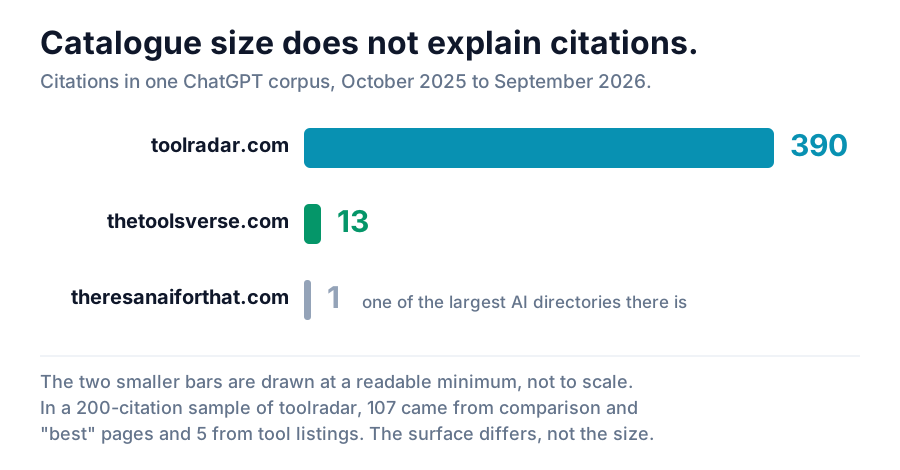
What separates toolradar from us is not size but surface: in a 200-citation sample of theirs, 107 came from editorial comparison and "best" pages and five from tool listings. The citations live in the editorial layer, not the catalogue.
The part that does not flatter us
The ninth entry is the one we would rather not publish.
/compare/midjourney-vs-stable-diffusion held a citation. We could not re-test it, because we had retired the entire /compare/ family and redirected it to a general listing page. The comparison a model had cited no longer exists at that URL, and the redirect target does not contain the answer.
That is not an isolated casualty. Of the 56 URLs ChatGPT used across the whole corpus, 17 are now noindexed, redirected or returning 404 — including 4 of the 12 pages that held citations.
We did that. Not a model update, not a competitor. We pruned the catalogue to satisfy a search-quality problem, and in doing so removed a third of our own citation base without knowing it existed. Nobody runs the check that would have caught it, because the two systems are measured in different places and on different schedules: indexing decisions get made against Google's standards, and the citation surface is only visible if you go and look at ChatGPT.
If you take one operational thing from this article, take that one. Before you noindex, redirect or delete at scale, find out which of those URLs an AI system is currently citing. It is a cheap check and it is not in anybody's pruning checklist, including ours.
What these numbers do not show
- They do not show that GPT-5.6 caused this. We have one domain and two time points with a model change in between. That is consistent with the brief's account; it does not demonstrate it. A clean test needs a control set of pages we did not touch, measured on the same dates.
- They do not measure traffic. Citations are not visits. In the same window, ChatGPT read our pages roughly eighty times a day and sent one session in three days. A citation is a visibility event, not an audience.
- One of nine is a small denominator. It is nine questions. We report them as counts, not as a percentage, because "only 11% of our citations survived" would imply a precision that nine observations cannot carry.
- We did not test recovery. We have not yet rewritten a page and re-measured. Everything above is observation, not intervention.
Measure your own citation base
The method needs no special access and the shape of it is simple enough to run by hand:
- Find every AI answer that mentions your domain — not just the ones that link to you. The retrieved-but-not-cited set is larger and more informative than the cited set.
- Separate retrieval from citation and record them as different events. They move independently.
- Record which domains were cited instead of you. This is the single most useful column and almost nobody keeps it. It tells you whether you lost to a vendor, to a peer, or to your own source.
- Classify each question by shape — single-product factual, multi-product evaluative, or statistical. Eligibility tracks the shape.
- Ask whether you are the primary source for the claim being cited. If you are summarising, you are a step that can be skipped.
- Before any prune, check the list against your cited URLs. We learned this one the expensive way.
- Store the model name and the date with every result. Ours moved across six model versions; a figure without a model attached is not re-checkable.
Five of those seven cost nothing but attention.
Doing this continuously
Everything above was produced with a scraper, a third-party corpus, a spreadsheet and a day of work, on one date. That is a defensible way to answer a question once. It is not a way to notice that a model update moved your citation share, which is the thing that actually happened to us — and we found out weeks late.
That gap is what the Semrush AI Visibility Toolkit is built to close. Its feature page, checked 7 October 2026, lists a Visibility Overview that measures "your AI visibility across platforms, topics, and regions", Competitor Research to "Find where competitors are mentioned over you", Prompt Tracking for "daily AI visibility updates", and — the one that maps directly onto the column we kept by hand — an AI-Cited Media tool for identifying the outlets LLMs cite most. Semrush prices it at "$99/mo per domain billed annually".
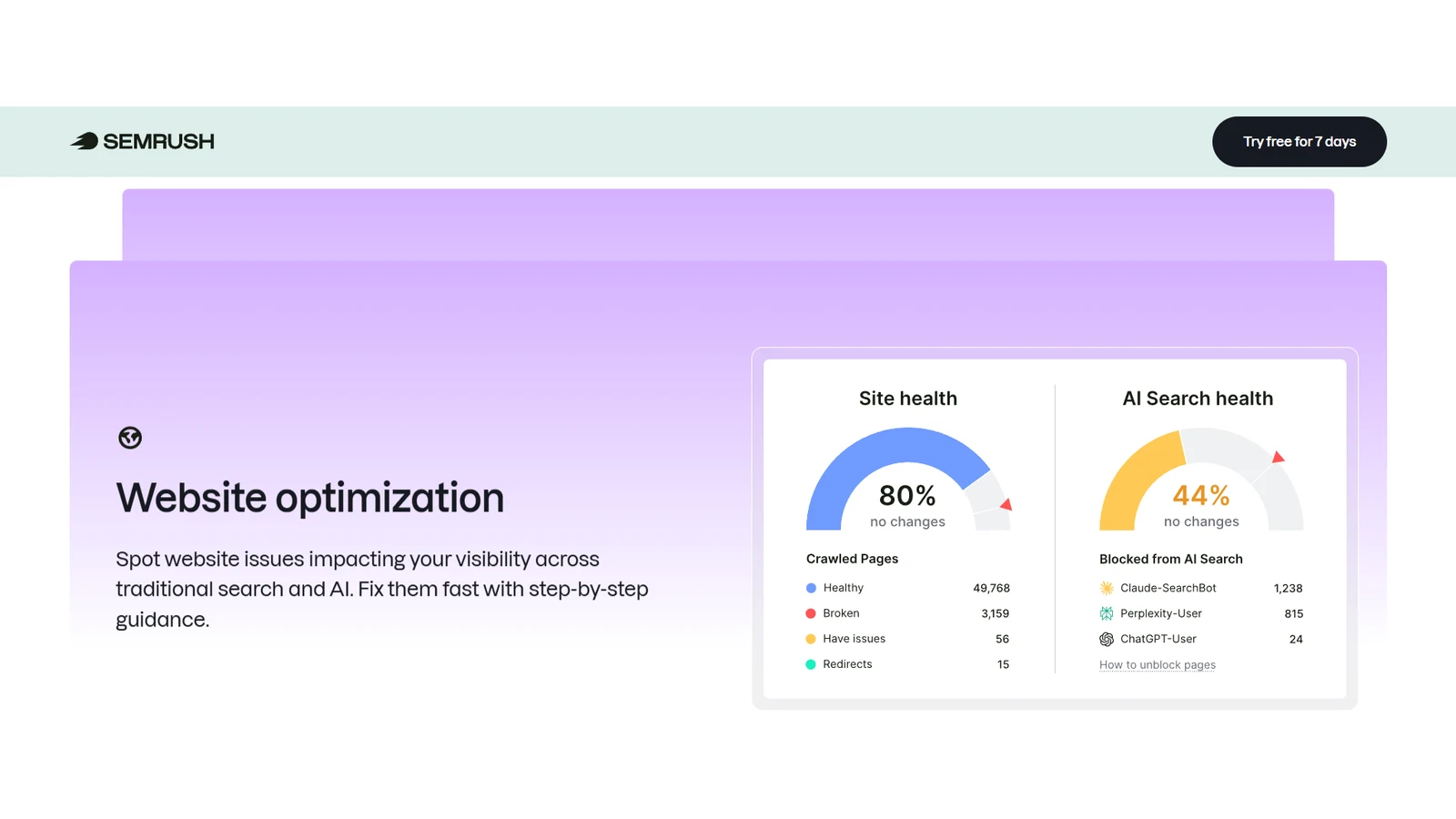
The panel above is a fair picture of the half of this problem we did not even look at: whether the AI crawlers can reach the pages in the first place. Our own measurements started downstream of that question, and a site that blocks ChatGPT-User would have produced the same zeros we did for an entirely different reason.
We have not used the toolkit. We are a Semrush affiliate, not a customer, and the description above is of Semrush's documentation rather than a review. What we can say from our own work is narrower and, we think, more useful: the measurement is worth having continuously, because the thing being measured changed under us between two readings and nothing told us.
Semrush's pricing page states "Try Semrush free for seven days. Cancel anytime", and the AI Visibility feature page carries "Try free for 7 days" — both checked 7 October 2026. The screenshot below is from 26 September, when that offer sat on Semrush's home page under the headline "Win in search, era after era". That headline now reads "Be found everywhere search happens" — a fair reminder that a dated capture is evidence for its date and nothing after it. We have not taken the trial, so read the terms as Semrush's claim rather than our test.
Semrush AI Visibility Toolkit
We found out a model update had moved our citation share by re-running nine questions by hand, weeks after it happened. Continuous measurement is the part we were missing.
See the AI Visibility ToolkitWhat we actually learned
The finding is not that we lost eight citations. Eight is a small number and it will be a different number by the time you read this.
The finding is that two of the three things we would have reached for first do not work here. Not Bing rank — every cited page of ours has zero Bing impressions, and our biggest ranking page has never been cited. Not catalogue size — the largest directory in our sample holds one citation and we hold thirteen. What remains is a question we had never asked about a page: could a vendor, or the source we are summarising, answer this instead of us?
And the part worth sitting with: a third of our citation base was destroyed by our own pruning, in a decision made for sound reasons on a different system's evidence, which nobody thought to check against this one.
Sources and method
| Figure | Source | Date |
|---|---|---|
| 56 answers touching our domain; 13 citations across 12 pages; 43 retrieved-only | DataForSEO LLM Mentions corpus, chat_gpt, subdomains included | corpus Oct 2025 → Sep 2026, pulled 2026-10-02 |
| Citations by model version (gpt-5 → gpt-5-6) | Same corpus, scripted recount | 2026-10-02 |
| 9 cited entries re-tested; 8 comparable; 1 survived | Our own live ChatGPT runs, web search forced, US/en, model gpt-5-6 | 2026-09-29 |
| 0 of 7 single-product questions cited an independent site; 12 of 16 multi-product questions did | Same live runs | 2026-09-29 |
| 17 of 56 URLs now noindexed, 301 or 404; 4 of 12 cited pages | Our own catalogue and redirect records | 2026-10-02 |
| 0 Bing impressions on all 8 still-indexable cited pages; 228k impressions on the never-cited page | Bing Webmaster Tools, our own verified property | 90-day window to 2026-10-02 |
| toolradar.com 390, TheToolsVerse 13, theresanaiforthat.com 1 | Same corpus | 2026-10-02 |
| AI Visibility Toolkit capabilities; "$99/mo per domain billed annually" | Semrush's own AI visibility feature and pricing pages | 2026-10-07 |
| "Try Semrush free for seven days. Cancel anytime"; "Try free for 7 days" | Semrush's pricing page and AI visibility feature page | 2026-10-07 |
| Screenshot wording "Win in search, era after era" (headline since changed) | Semrush's home page, captured by us | 2026-09-26 |
Written by Sohail Akhtar. Every figure here is a measurement on a stated date, against a stated model, and should be read as one.
Some links may be affiliate links. We may earn a small commission at no extra cost to you.
Related Articles
Explore more guides and reviews from our experts.