Is Amplemarket Duo Accounts Worth It? We Tested It on 4 Accounts and Opened Every Source
Disclosure
Paid partnership with Amplemarket. TheToolsVerse is an Amplemarket partner: links to Amplemarket in this article are partner links, and we may earn a commission and a content reward from Amplemarket if you sign up. We are partners, not Amplemarket employees, and we don't speak for the company. Amplemarket gave us a one-month account to create content, not to prospect with, so we contacted nobody. Everything below was run on 21 November 2026 from that account, with no mailbox, LinkedIn or CRM connected. We name none of the four companies we researched, and their names, logos and people are blurred in every screenshot.
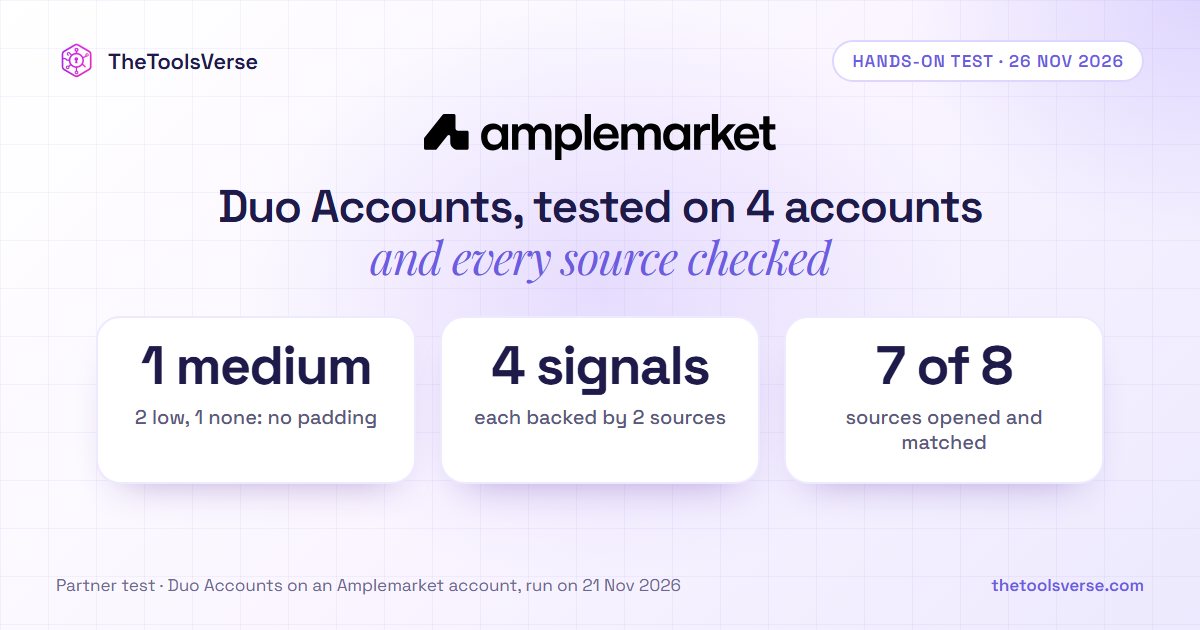
Short answer: Amplemarket's Duo Accounts is a research agent that reads the news, jobs and pages around an account, then gives it a relevancy level (high, medium, low or none) with the reasons and a source for each one. We ran it on four companies that Duo Copilot had found for us. It rated one medium, two low and one none, and for the "none" it said so plainly instead of inventing a reason. It found four signals, each backed by two sources. We opened all eight: seven loaded and matched, dates included, and one was blocked for readers. One headline figure needed context. The hardest part was getting started, because a fresh workspace has no accounts to research.
We've already tested Duo Copilot's lead feed and the Plan outreach button in Claude. Duo Accounts sits between them: it decides which accounts deserve the effort.
What Duo Accounts is meant to do
Amplemarket describes Duo Accounts as an AI account research agent for account-based selling. In its own words, each tracked account gets "a relevancy level: high, medium, low, or none", a run "takes about 2 to 3 minutes", and "tracked accounts are researched again on a regular schedule". It also sends a daily email and Slack digest for up to five tracked accounts, and its research feeds the same Plan outreach button we tested in Claude.
That promise is easy to state and hard to check: does it find real reasons, and does it admit when there aren't any? So we tested exactly that.
Getting started: the step that isn't obvious
Our workspace had never sequenced anyone, so the Accounts page was empty, with the hint "Sequence a lead to add an account". There was no research button on a plain company page either. Amplemarket's own steps are: "Open an account page, or use the extension while you are on a company's website or social page", then "Track the account, or run the agent".
The extension was the way in. With Amplemarket's Chrome extension installed, we opened each company's website. The extension's side panel recognised the company, and its toolbar had a Save as account option:
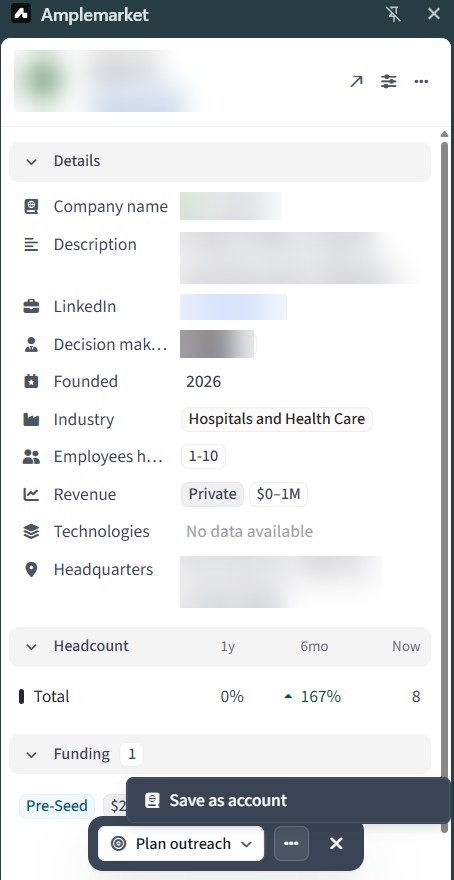
Saving turned the company into an account, and the panel immediately gained an Account research section with a Run agent button: "Find reasons to engage with a deep research agent that continuously monitors signals every 2 weeks."
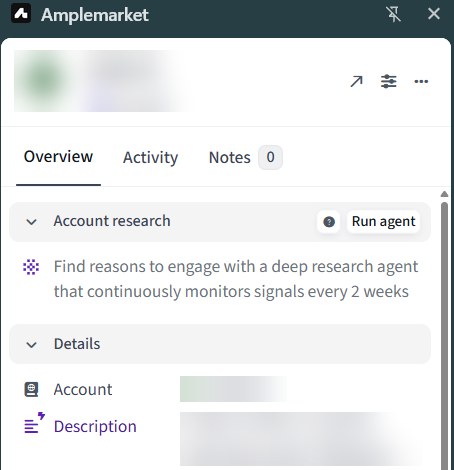
We saved four companies this way and started the research through Amplemarket MCP, the connector we used in our earlier posts, which can start research on saved accounts and read the results back. Each run finished within a few minutes, in line with Amplemarket's estimate. Nothing was sent: saving an account and researching it doesn't contact anyone.
Tip: if you've never sequenced a lead, start with the extension. Without a saved account, there's nothing for Duo Accounts to research.
What it found on four accounts
The four companies came from our Duo Copilot feed, all recently funded AI startups, chosen to be different from each other: a hospital AI services company of about 120 people (Company A), a clinical research software startup (Company B), an AI agent security startup (Company C) and an engineering services firm that uses AI internally (Company D).
Back on the Accounts page, a new Account research column showed each account's top signal, refreshed "Every 2w":

Opening each account showed how much it had read and what it kept:
| Company A | Company B | Company C | Company D | |
|---|---|---|---|---|
| Sources researched | 24 | 19 | 19 | 24 |
| Relevant signals kept | 1 | 2 | 1 | 0 |
| Relevancy level | Medium | Low | Low | None |
| Signal | Series A, expanding AI beyond billing, hiring for marketing | First product workflow launched; pre-seed raised | Out of stealth with a pre-seed | None found |
The relevancy word itself came back through Amplemarket MCP. In Amplemarket, it shows as a small icon next to the summary: three green bars for Company A, one green bar for B and C, and a dash for D.
The best answer was "none"
Company D is the result that convinced us. Duo Accounts read 24 sources and kept none:
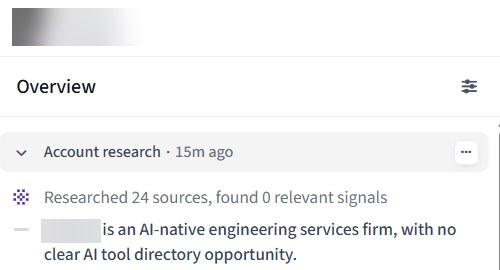
That matches what we know: Company D sells engineering services rather than software, and nothing in its recent news gave us a reason to reach out this month. A research tool that padded every account with a reason would have wasted a rep's afternoon here. This one said so in one line.
"None" isn't a verdict on the company. Amplemarket describes it as nothing worth acting on today, so the account stays tracked, and a new signal can change the rating at the next refresh. That's how we'd treat it: park it, don't delete it.
Notice the phrase "AI tool directory opportunity". The research isn't generic. Every summary was written around what we sell: it judged each company as a possible TheToolsVerse customer, and spoke of visibility and AI-tool buyers. Expect your summaries to be framed around your own offer.
The medium account, in full
Company A was the only medium rating. Clicking through shows the signal, its two sources, and a summary written as a reason to engage:
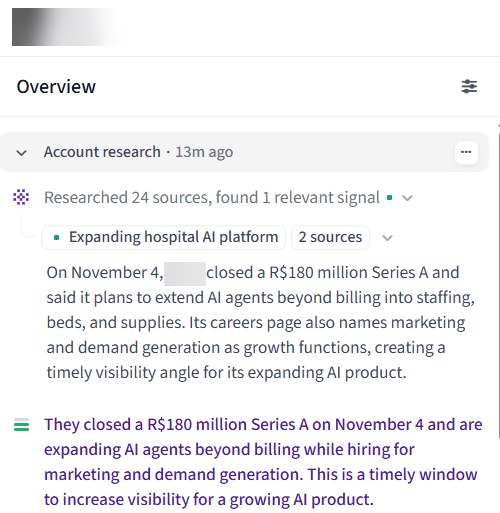
The two low ratings looked similar but thinner. Company B had two signals, a product launch and a pre-seed round; Company C had one, its launch out of stealth:
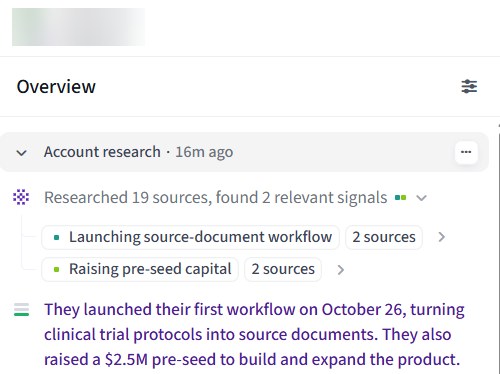
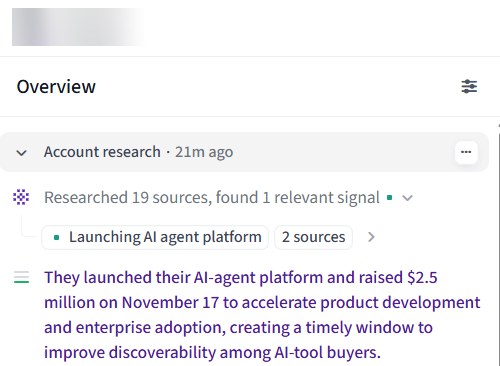
The ranking makes sense. A is bigger, growing, and hiring the people who'd care about visibility. B and C are very early. D has nothing to act on right now.
We opened every source
A research brief is only as good as its sources, so we opened all eight and checked each claim, including the dates:
| Claim (account) | Source type | Result |
|---|---|---|
| Out of stealth with $2.5M on November 17 (C) | Company's own announcement | ✅ Matches, date included |
| $2.5M pre-seed (C) | Co-lead investor's announcement | ✅ Matches |
| First workflow launched October 26 (B) | Co-founder's LinkedIn post | ✅ Matches, posted 26 Oct |
| Workflow turns protocols into source documents (B) | Company's product page | ✅ Matches |
| $2.5M pre-seed, announced October 13 (B) | Co-founder's LinkedIn post | ✅ Matches, posted 13 Oct |
| $2.5M pre-seed for clinical trial operations (B) | Independent news article | ✅ Matches |
| Hiring for marketing and demand generation (A) | Company's careers page | ✅ Matches: "Marketing and demand generation" |
| R$180M Series A on November 4; AI agents into staffing, beds and supplies (A) | Brazilian tech news article | ⚠️ Blocked: the page returned "403 Forbidden", even in a normal browser |
Seven of eight sources loaded and backed their claims, and every date matched. That's a better record than the plans we tested in Claude, where one claim contradicted its own source.
The blocked source needed a second look, so we found other coverage of the same news. A Brazilian business outlet confirmed the round, and added context Duo Accounts left out: the company "concluded an R$80 million extension and concluded its Series A at R$180 million". So R$180 million is the total Series A, and the November news was the R$80 million extension. "Closed a R$180 million Series A" is true. "Congratulations on raising R$180 million this month", which is how a rep might paraphrase it, would not be. That coverage said the money goes to scale and new AI products; none of the sources we could open named staffing, beds and supplies, so we couldn't confirm that detail.
The lesson is the same as with any AI research: open one or two sources before you quote a number to a buyer.
How we'd use it
- Save accounts from the extension if your Accounts page is empty. It's the fastest way in.
- Start with five accounts. The daily digest covers up to five, which is a sensible first batch.
- Trust a "none" for today. On our test, it was the clearest and most useful result. Keep the account tracked: the next refresh can change it.
- Read the medium and high accounts first, then open one source per signal before you write to anyone.
- Check the headline number. Funding totals and extensions are where a short summary loses context.
- Keep your own company details current. The research judged fit against what we sell, as Company D's summary showed.
- Hand the good ones to Plan outreach. The account's research goes along to your AI assistant, which we tested in Claude.
If you'd like to try it on your own target accounts, start a free trial or book a demo with Amplemarket.
What we didn't test
- CRM context. Amplemarket says Duo Accounts also uses CRM activity and notes. We had no CRM connected, so our research used public sources only.
- A "high" rating. None of our four early-stage companies earned one.
- The refresh. Research repeats every two weeks, and our account ends before the first repeat.
- Digests. We didn't wait for the daily email or connect Slack.
- Credits. We didn't measure whether research uses any.
- The Run agent button. We started research through Amplemarket MCP. The panel's own Run agent button should do the same, but we didn't press it.
- Scale. Four accounts is a small sample. Treat the patterns as patterns, not proof.
Our take
Duo Accounts does the job most account research tools get wrong: it tells you when there's nothing worth acting on today. Across four companies, it ranked them in an order we'd agree with, backed every signal with two sources, and got its dates right. The one gap was context on a funding total, and a careful reader would catch it in a minute by opening the source.
Getting started takes one non-obvious step, saving accounts from the extension. After that, it's a few minutes per account, and you get a ranked list with reasons you can check.
FAQ
What is Amplemarket Duo Accounts? An account research agent built into Amplemarket. You track target accounts, and it researches each one, gives it a relevancy level (high, medium, low or none), and lists the reasons to engage with a source for each.
How do I start Duo Accounts research if my Accounts page is empty? Save the company as an account first. The quickest way we found is Amplemarket's Chrome extension: open the company's website, then use Save as account in the side panel. The panel then shows an Account research section with a Run agent button.
How long does a first run take? Amplemarket says about 2 to 3 minutes per account. Ours finished within a few minutes each.
What does a "none" relevancy level mean? That the agent found nothing worth acting on today, not that the account is a bad fit. On our test, one of four accounts got "none", with a one-line explanation.
Can I trust the sources it cites? On our test, 7 of 8 cited sources loaded and matched the claim, dates included. One was blocked for readers. Open at least one source per signal before you quote a figure.
Research your target accounts with Duo Accounts
Save your target accounts, let Duo Accounts rank them, and open the sources before you reach out. Start a free trial or book a demo with Amplemarket.
Get started with AmplemarketSources
| What | Source | Checked |
|---|---|---|
| All screenshots; research results; relevancy levels | Our own runs in an Amplemarket account provided for partner content, with Amplemarket MCP connected | 2026-11-21 |
| How Duo Accounts works (relevancy levels, run time, schedule, digests, setup steps) | Amplemarket: Duo Accounts | 2026-11-21 |
| The eight sources cited by Duo Accounts | A company announcement, a co-lead investor's post, two LinkedIn posts, a product page, a careers page and two news articles; names withheld | 2026-11-21 |
| Company A's Series A structure (R$80 million extension completing a R$180 million round) | Brazilian business press; company name withheld | 2026-11-21 |
Written by Sohail Akhtar. The tips and verdict are our own opinion. Amplemarket's product changes over time, so check its documentation for the current version.
Some links may be affiliate links. We may earn a small commission at no extra cost to you.
Related Articles
Explore more guides and reviews from our experts.