AI Tool Sites With a Wikidata Entry Are 15 Points More Likely to Link Outside Proof, but No More Likely to Be Technically Readable: Identity and Readiness Are Different Jobs
Disclosure
This article is promotional content produced as part of the Semrush Creator Accelerator programme. It contains affiliate links to Semrush — if you buy through them we may earn a commission at no extra cost to you — and we may also receive a reward from Semrush for publishing it. All measurements in this article are our own. Semrush did not supply, review or approve the data, and the conclusions we draw are ours.
"Entity SEO" advice often folds two jobs into one. The first is identity: being a thing that machines can recognise and corroborate, with an entry in a knowledge base, a presence on other platforms and proof from outside sources. The second is readiness: pages that a crawler can read, with text in the HTML, described images and a clear price.
If those were one job, sites that do one would tend to do the other. We checked, on the one set of sites where we had both measured.
See how AI platforms describe your brand
See the narratives, sentiment and topics AI platforms associate with your brand with Brand Performance in the AI Visibility Toolkit. The AI Visibility Toolkit comes in the same subscription as the SEO Toolkit: try Semrush One free for 7 days.
The test
We used the 613 AI tool company websites from our earlier studies. Wikidata was checked on 29 October 2026, and the technical checks (rendering, pages that link outside proof, social links, pricing pages, images and sitemaps) on 28 and 29 October. On 14 November 2026 we joined them and kept the 579 sites that answered every technical check.
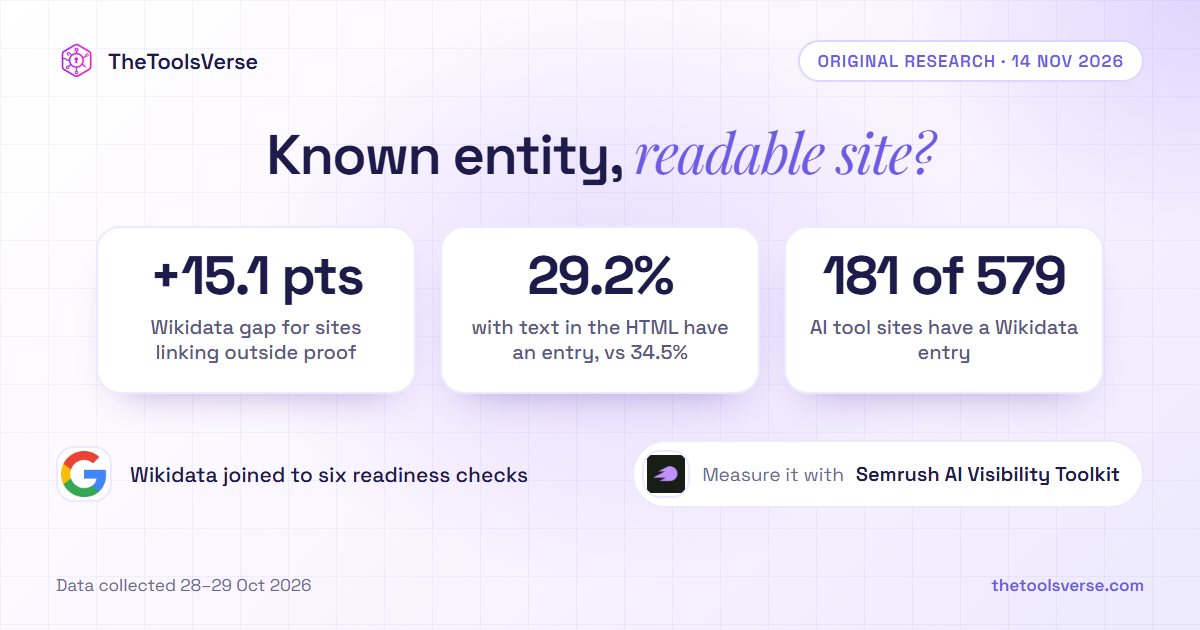
A Wikidata entry counted only if its "official website" property points to the company's own site, as in our earlier Wikidata study. 181 of the 579 sites (31.3%) have one. For each of six technical signals we compared the share with an entry among sites that meet the signal and among sites that do not. The signals are defined at the end.
Identity signals travel with Wikidata
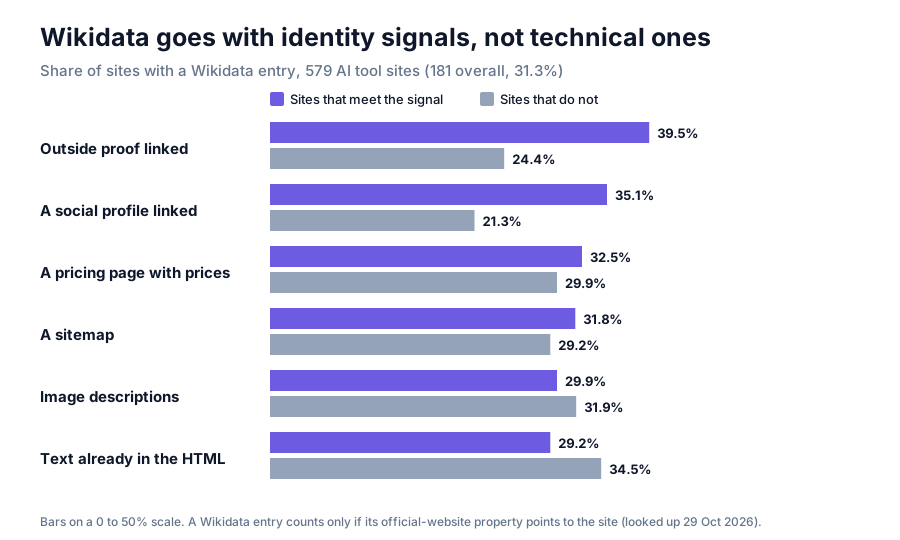
Of the 263 sites that link outside proof (a review site, a press article or a case study), 104 (39.5%) have a Wikidata entry. Of the 316 that do not, 77 (24.4%) do: a gap of 15.1 points. A linked social profile shows the same shape: 147 of 419 (35.1%) against 34 of 160 (21.3%), a gap of 13.8 points.
Those are the signals that say who a company is and what others say about it.
Technical signals do not
The technical signals tell a different story. Among the 356 sites with at least 90% of their text in the HTML, 29.2% have a Wikidata entry. Among the 223 without it, 34.5% do. The difference points the wrong way. For image descriptions it is 29.9% against 31.9%. A priced pricing page (32.5% against 29.9%) and a sitemap (31.8% against 29.2%) show gaps of 2.6 points, which is little.
Counted by how many of the six signals a site meets, the picture is flat above the middle: 22.6% of sites meeting none or one signal have an entry, 28.3% of those meeting two or three, 35.6% of those meeting four and 34.5% of those meeting five or six. The average site with an entry meets 3.66 of the six, against 3.38 for the others.
What this cannot tell you
- That one causes the other. These are shares across a set of sites. A company that spends time on identity may simply be larger or older, which is a likely explanation for the pattern.
- That Wikidata influences AI answers. We did not test any link to citations or visibility.
- That the checks are complete. A site that links outside proof elsewhere than its home page counts as not linking it.
- That small gaps mean nothing. The sample is 579 sites, so gaps of two or three points are within noise. The two large gaps, 15.1 and 13.8 points, are the ones to take seriously.
- That other categories look the same. All sites here are AI tool companies.
What to do with it
- Treat identity and readiness as two projects. Having one does not mean you have the other.
- Check your own entity footprint: an entry in an open knowledge base, a social presence, and outside coverage that you can link.
- Check your own pages separately: text in the HTML, image descriptions, a visible price, a sitemap.
- Do the cheaper one first. Linking a profile or a press article takes minutes. Rewriting how pages render takes a project.
- Do not assume a well-known company is a readable one. Among sites that meet none or only one technical signal, just over a fifth (22.6%) have a Wikidata entry.
See the narrative, check the pages, benchmark rivals
See how AI describes your brand. Brand Performance reports sentiment, narratives and topics for a brand and its competitors across AI platforms.
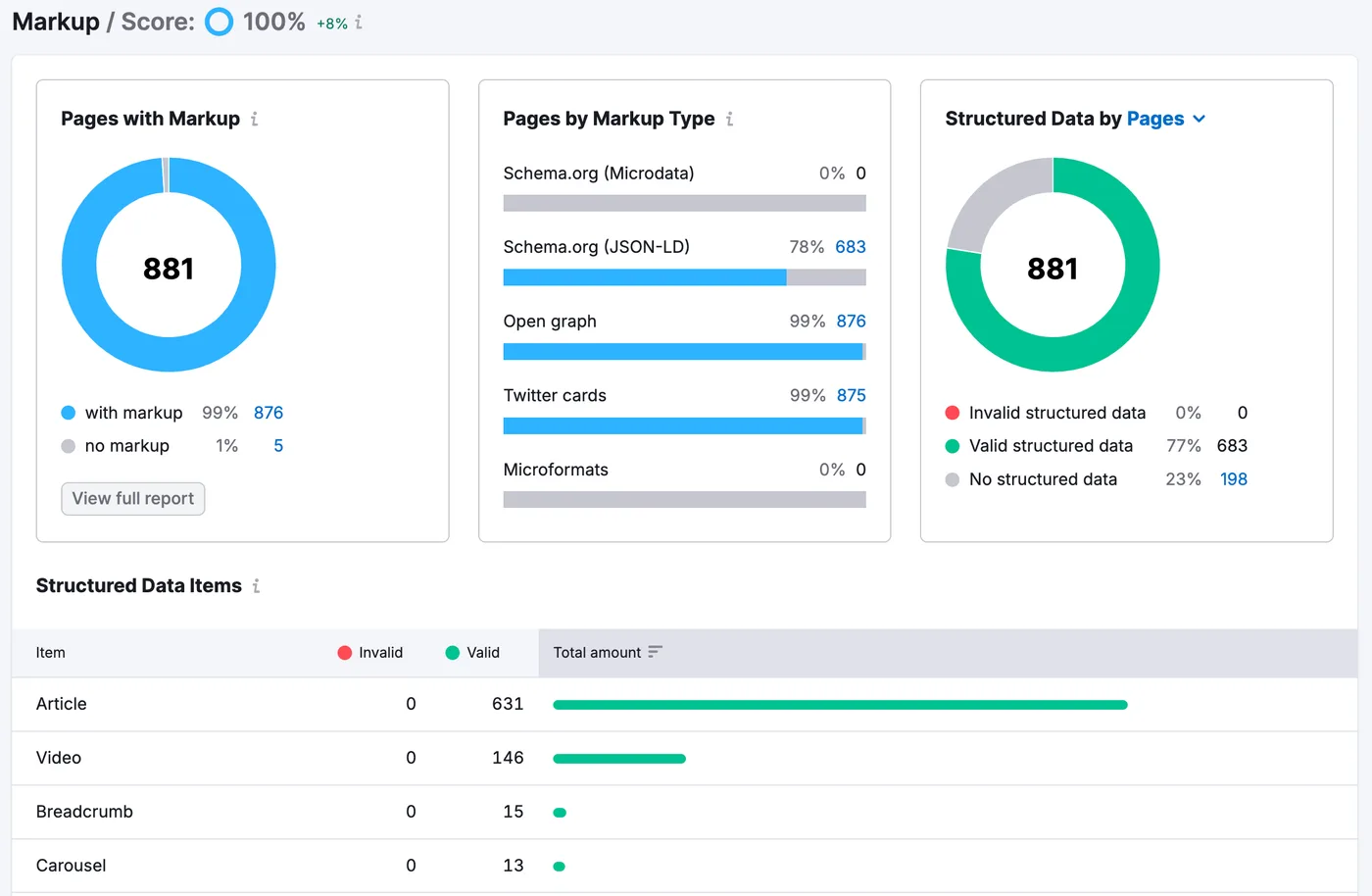
Check structured data and page markup. Site Audit in the SEO Toolkit includes a Markup report showing how many pages carry structured data and whether it is valid.
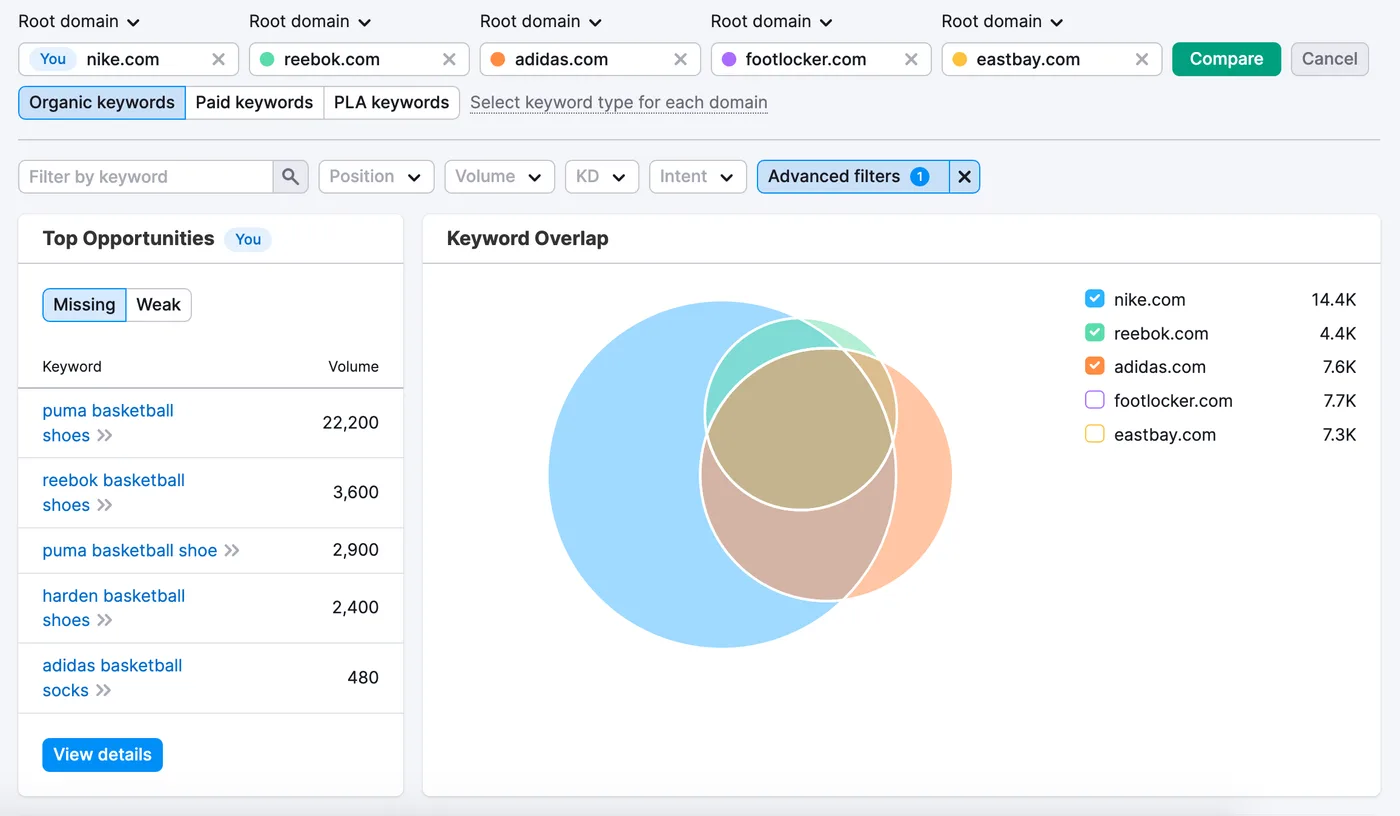
Benchmark topical coverage against rivals. Keyword Gap lists the keywords competitors rank for and you do not.
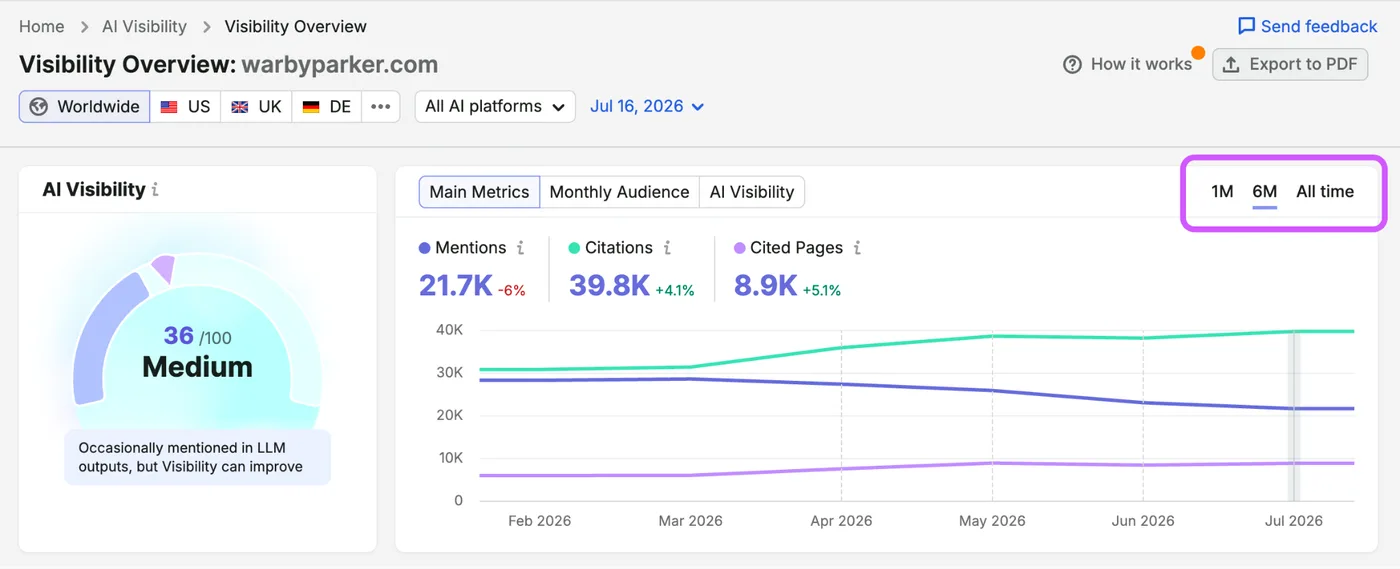
Track whether entity work shows up in citations. Visibility Overview shows mentions, citations and cited pages across AI platforms.
The free trial is Semrush One's. The AI Visibility Toolkit has no trial of its own, and Semrush One includes it together with the SEO Toolkit. To measure how AI describes your brand and audit your markup without paying first, try Semrush One free for 7 days. On its product page Semrush describes "Unlimited access to all Semrush One tools" (we read that on 16 October 2026). We have not tried the offer, and every number above comes from our own crawls, not from a Semrush account.
Two projects, not one
Being recognised and being readable are both worth doing, and in these sites they come apart. Know which one your site is missing before you plan the work.
Try Semrush One free for 7 days
Brand Performance and Visibility Overview in the AI Visibility Toolkit, with Site Audit and Keyword Gap in the SEO Toolkit, together in Semrush One. Free for 7 days for new users.
Try Semrush One free for 7 daysHow we counted
- Data: the Wikidata look-ups of 29 October 2026 and the six technical checks collected 28 and 29 October 2026, joined by site on 14 November 2026. No new requests were made. 579 of 613 sites answered the rendering, credibility, social and image checks.
- Wikidata: an entry counted only if its official-website property points to the site.
- Signals: text in the HTML (at least 90% of rendered words, with at least 50 words); outside proof (a link to a review site, a press article or a case study); a social profile linked; a pricing page with at least one price; image descriptions (at least five images, at least 80% described); a sitemap found.
- Gap: the share with an entry among sites that meet a signal minus the share among those that do not, in percentage points.
- Left out: any test of a link between entries and AI citations, and sites outside this set.
- Reproduce it: the join script and its saved output live in
research/r2-e8-entity-readiness/.
Some links may be affiliate links. We may earn a small commission at no extra cost to you.
Related Articles
Explore more guides and reviews from our experts.
Top Sites With Organization Markup Block AI Crawlers Slightly Less, 18.9% Against 23.1%, but Plain JSON-LD Shows No Such Pattern: Joining Two of Our Studies
We Re-Checked 2,098 URLs That Five AI Engines Cited: 91.6% Still Load, 0.8% Are Gone, and 7.7% Cannot Be Verified by a Bot