Visual Search Reads Images. We Checked 37,354 on AI Tool Home Pages — 45.5% Carry No Description a Machine Can Use
Disclosure
This article is promotional content produced as part of the Semrush Creator Accelerator programme. It contains affiliate links to Semrush — if you buy through them we may earn a commission at no extra cost to you — and we may also receive a reward from Semrush for publishing it. All measurements in this article are our own. Semrush did not supply, review or approve the data, and the conclusions we draw are ours.
For fifteen years search optimization was about words. Visual search changes the input: a photo, a screenshot or a circled object on a phone screen becomes the query, and the answer is assembled from pages whose images a machine could understand. Google has been expanding exactly this — Circle to Search, Lens, and image generation inside its own products.
How a machine understands an image starts with the oldest signal on the web: the text the page attaches to it. The alt attribute says what an image shows; og:image says which image represents the page; an image sitemap tells a crawler where the images are. We checked all three across the AI tool companies we list — companies whose products are, very often, about images.
Find the images search can't read
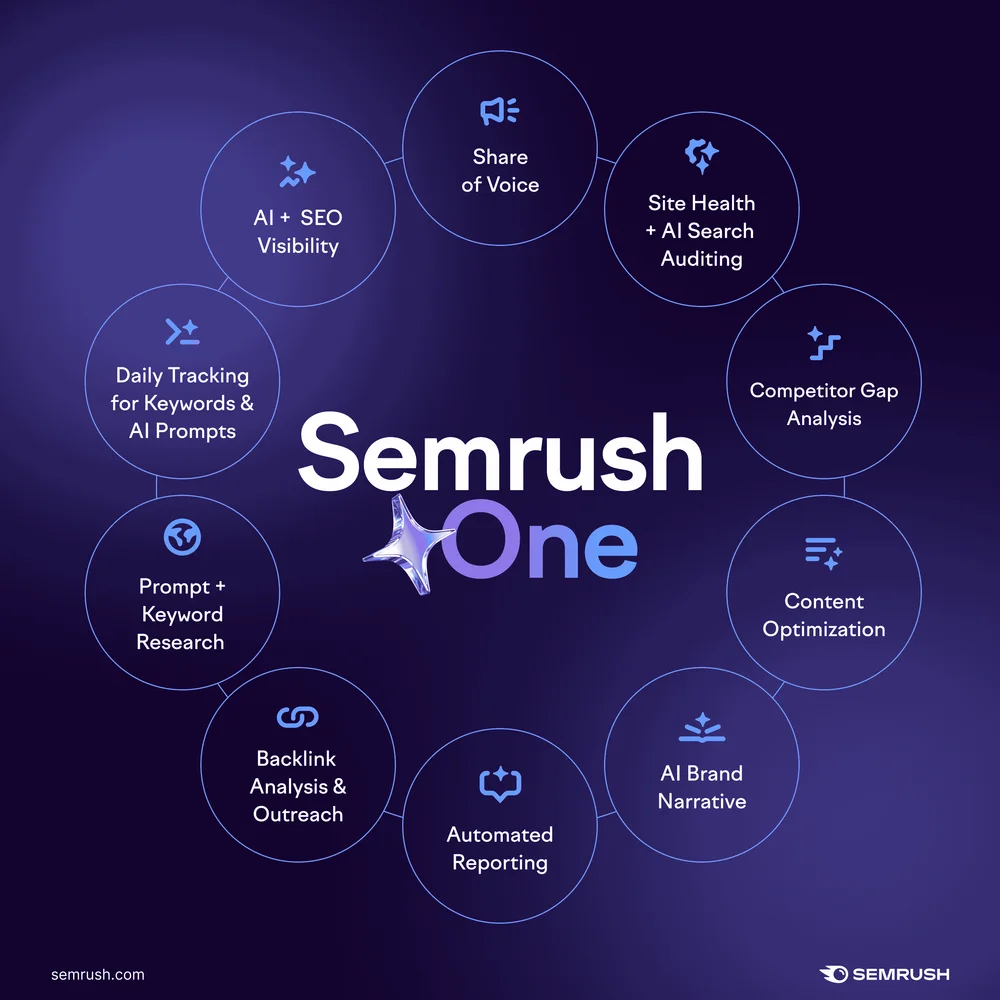
Find every image without an alt attribute across your site with Site Audit, and track your rankings and SERP features as visual results spread with Position Tracking. To get both with AI visibility tracking in one subscription, try Semrush One free for 7 days.
Every image on 528 home pages
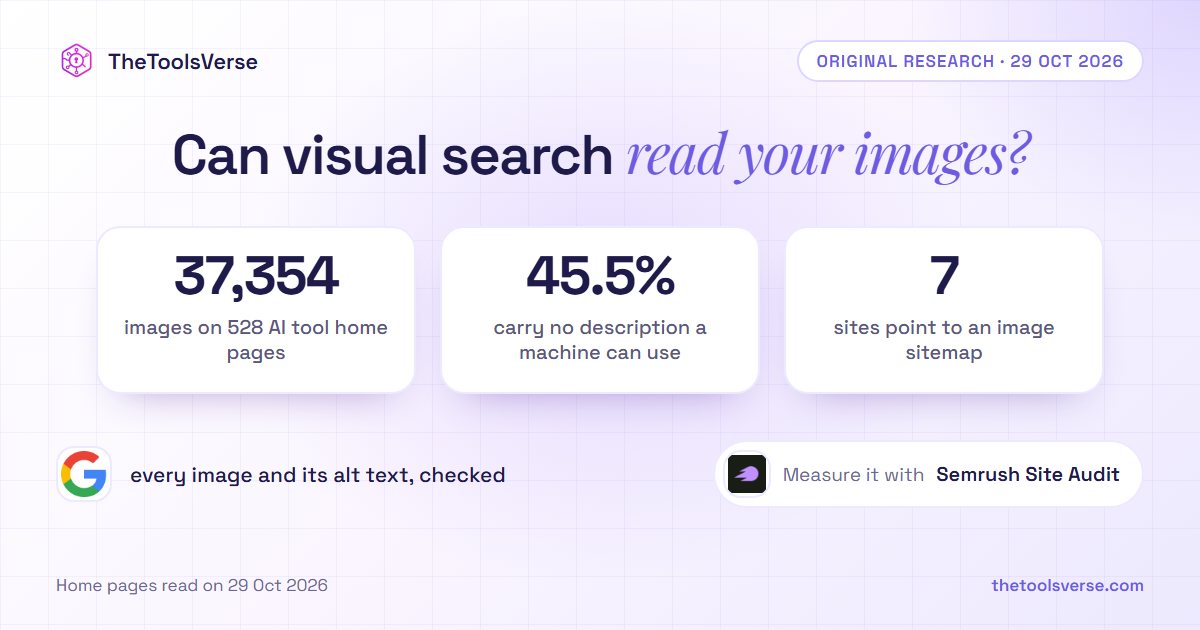
On 29 October 2026 we fetched the home page of each AI tool company in our catalogue that answered and read every <img> element in the HTML: 528 pages carried images, 37,354 of them — a median of 48 per page.
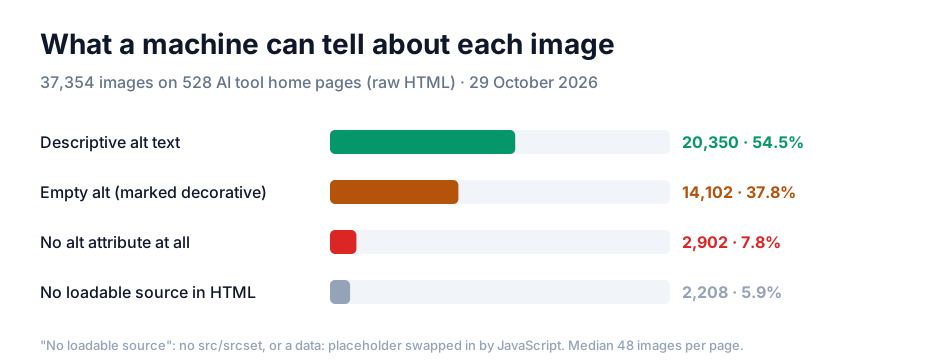
20,350 images (54.5%) carry descriptive alt text. 14,102 (37.8%) have an empty alt, and 2,902 (7.8%) have no alt attribute at all.
An empty alt is not automatically a mistake: it is the correct way to mark an image as decoration, so screen readers skip it. But on these pages it covers far more than ornaments. Customer-logo walls, product screenshots and example outputs — the images that say most about an AI tool — are routinely marked as decoration. To a visual or AI search system, a screenshot of your product with alt="" is an image of nothing in particular.
Another 2,208 images (5.9%) have no loadable source in the HTML at all — a blank placeholder that JavaScript swaps for the real file later. A crawler that does not run scripts sees an empty frame.
Page by page
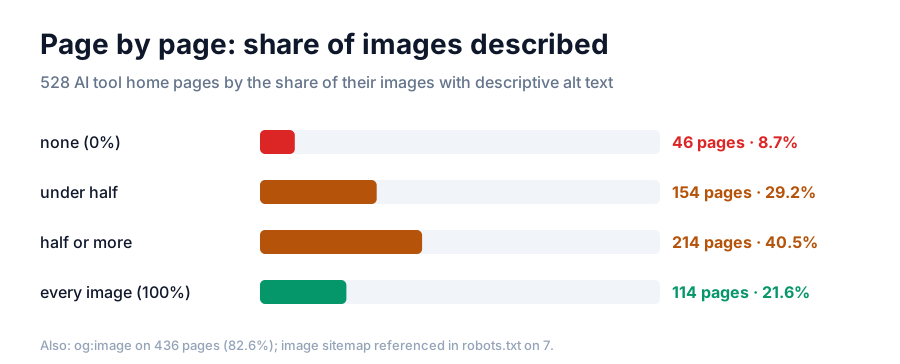
114 pages (21.6%) describe every image. 200 (37.9%) describe fewer than half, and 46 describe none. The median page describes two images in three.
The page-level signals are better looked after: 436 pages (82.6%) set an og:image, the picture shown when the page is shared, and 320 a Twitter image. But the step that tells crawlers where a site's images are almost never happens: only 7 of the 528 sites reference an image sitemap in robots.txt.
What to fix first
- Describe the images that carry meaning. Product screenshots, example outputs, diagrams and customer logos get real alt text — what is shown, in plain words. Keep
alt=""for genuine decoration. - Make sure the real image is in the HTML. Lazy loading is fine; an image whose
srconly appears after JavaScript runs is invisible to crawlers that don't run it. - Name the files like the alt text.
ai-meeting-notes-summary.pngtells a crawler more thanimg_4821.png. - Set one good og:image per page — it is the image AI answers and social cards are most likely to show.
- List important images in a sitemap if your product is visual. Seven sites out of 528 do it; it is an easy way to stand out to crawlers.
Track the visual side of search
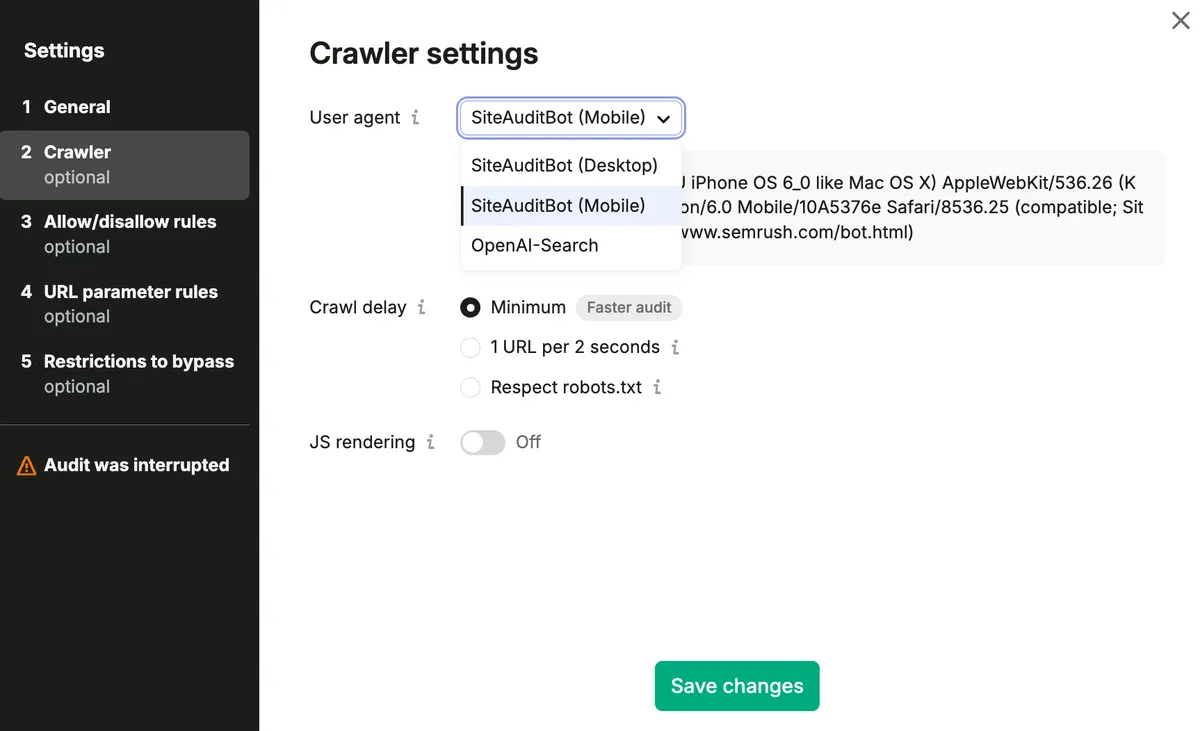
Find the gaps across the whole site. Site Audit reports "Images without alt attributes" as a warning, alongside broken internal and external images, so a home-page check like ours can be run on every page you have. Its crawler can also run as an AI search user agent, to see a page the way an AI crawler does.
Watch which results replace blue links. Position Tracking tracks SERP features for your keywords — including AI Overviews — so you can see when visual and AI results start taking the space your pages used to hold.

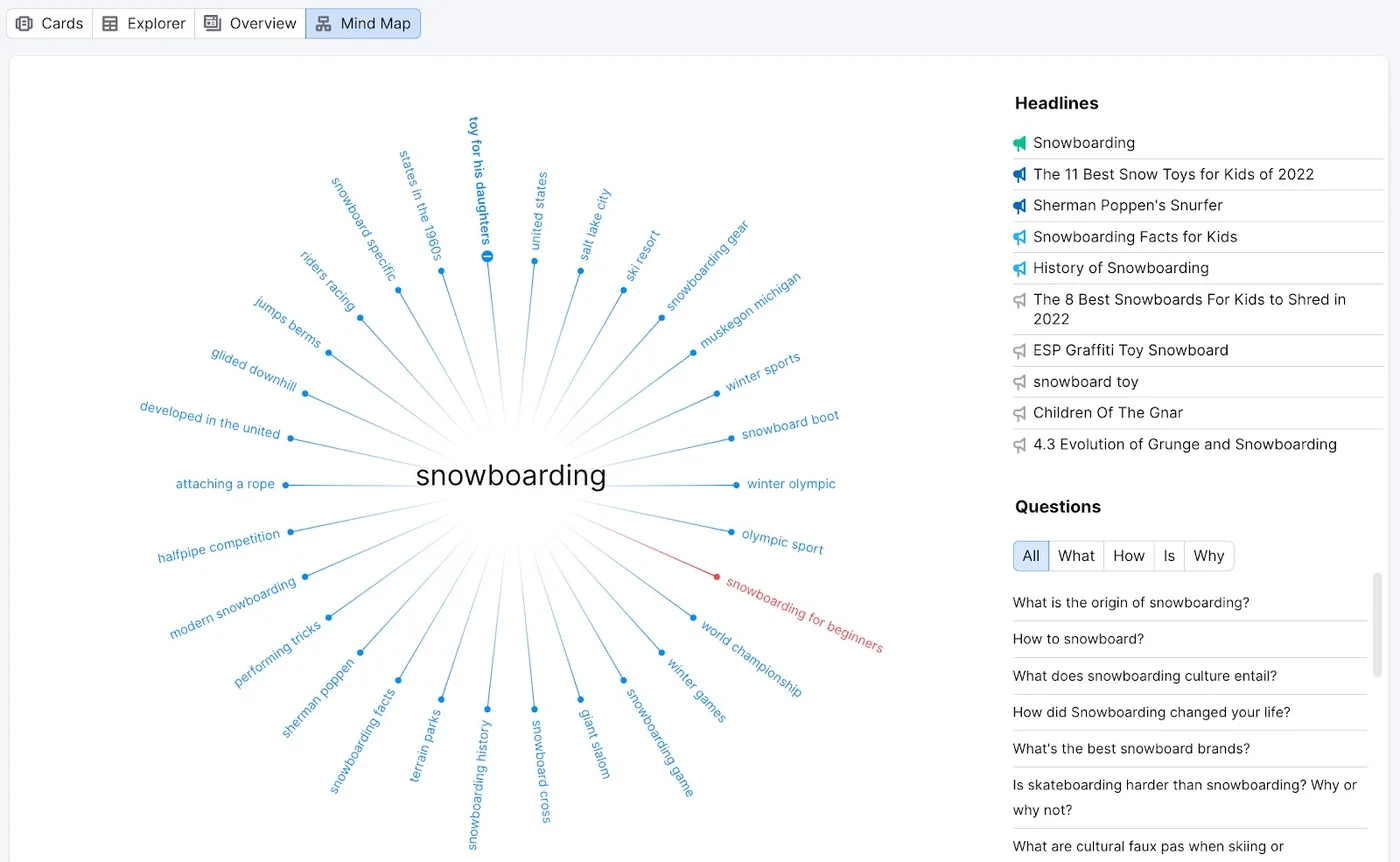
Find what people want to see. Topic Research, part of the Content Toolkit (sold separately from Semrush One), maps a topic into subtopics, headlines and questions — a starting point for deciding which images and screenshots a page actually needs.
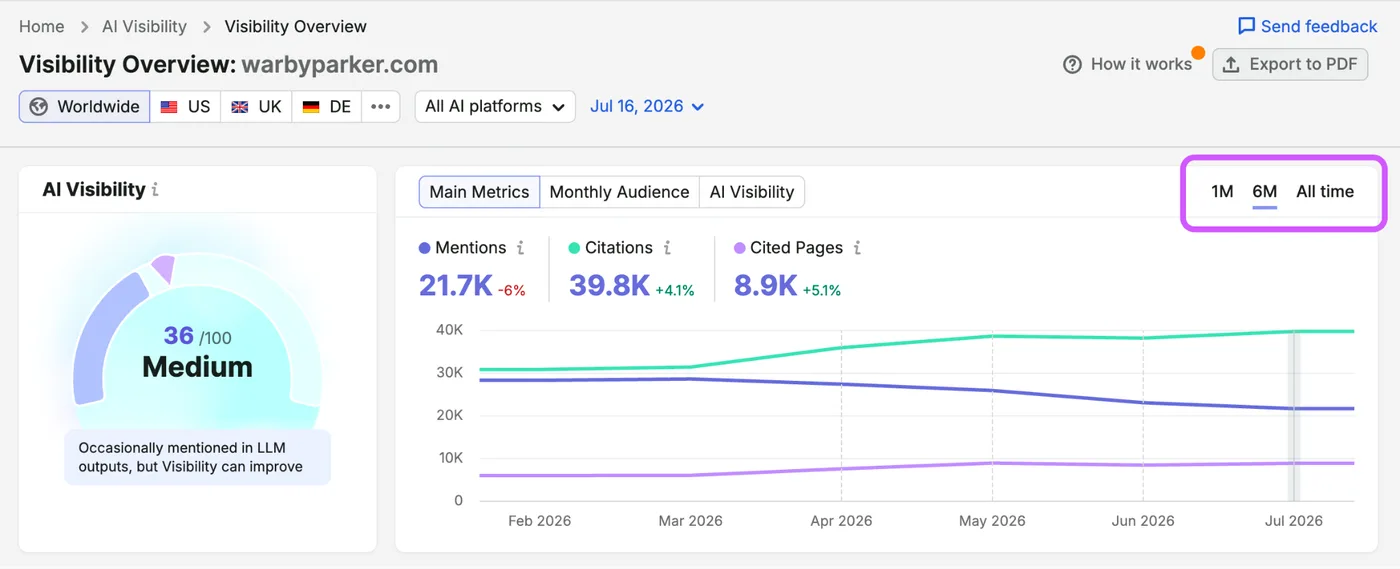
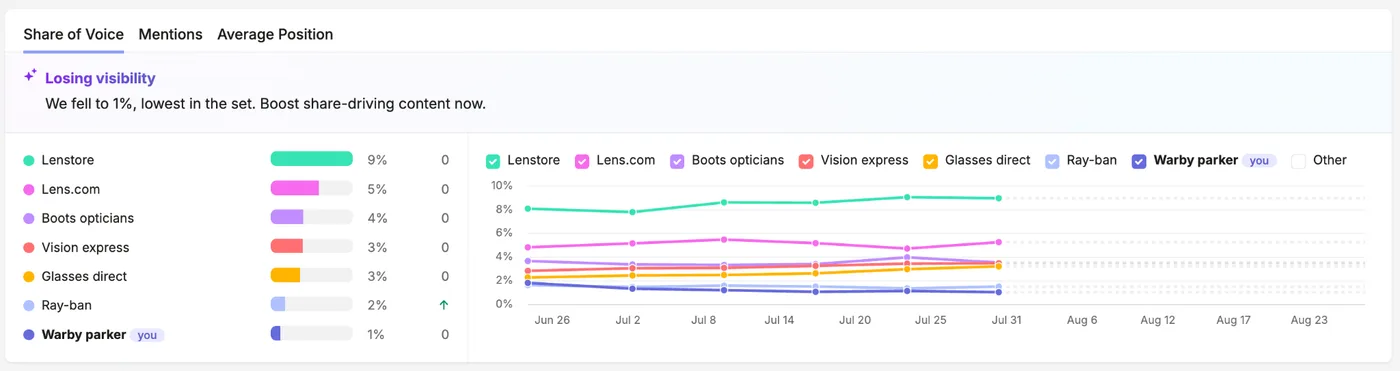
Measure the AI side. The AI Visibility Toolkit tracks your brand's visibility, mentions and cited pages across AI platforms, with a share of voice against competitors — the baseline to watch as AI answers draw on more than text.
Semrush One bundles the SEO Toolkit and the AI Visibility Toolkit, and the 7-day free trial is Semrush One's — the AI Visibility Toolkit has no free trial of its own. To audit your own images before paying, try Semrush One free for 7 days: its page offers "Unlimited access to all Semrush One tools" and notes "Offer available to new users only", checked on 28 October 2026. Those are Semrush's published terms, not something we tested; none of the data above came from a Semrush account.
A picture is only worth the words attached to it
AI tool companies put a lot of images on their home pages — 48 on the median page — and leave nearly half of them without a description a machine can use. Describe the images that matter, keep the real file in the HTML, and point crawlers to them. As search learns to see, those are the words it will read first.
Try Semrush One free for 7 days
Site Audit to find images without alt attributes across your site, Position Tracking for SERP features and AI Overviews, and the AI Visibility Toolkit to measure your presence in AI answers — together in Semrush One. Free for 7 days for new users.
Try Semrush One free for 7 daysHow the images were read
- Pages (613 fetched, 528 with images): the home page of each AI tool company in the TheToolsVerse catalogue that answered on 28 October 2026, fetched once on 29 October 2026 with a desktop browser user agent, without running JavaScript.
- Images: every
<img>element. "Descriptive" = a non-emptyaltvalue; "empty" =alt=""; "no alt" = no attribute. "No loadable source" = nosrcand nosrcset, or adata:placeholder. Inline<svg>icons were counted separately and are not in the totals. - Page signals:
og:imageandtwitter:imagemeta tags;ImageObjectorimagein JSON-LD; a robots.txtSitemap:line whose address mentions images. - Limits of this count: whether an alt text is accurate, or how any visual search system ranks images. Images added only by JavaScript are not counted, and sites may list images in a general sitemap rather than a dedicated one.
| Figure | Source | Date |
|---|---|---|
| 37,354 images and page image signals on 528 home pages | Our fetch of each home page and robots.txt | 2026-10-29 |
| Every count and percentage above | Our analysis of the saved pages | 2026-10-29 |
| Site Audit issue names | Semrush Knowledge Base, "What Issues Can Site Audit Identify?" | read 2026-10-29 |
| Site Audit, Position Tracking, Topic Research and AI Visibility descriptions; screenshots | Semrush Knowledge Base | 2026-10-29 |
| Semrush One graphic and trial terms | Creator Accelerator affiliate resources; Semrush One page | 2026-10-28 |
Written by Sohail Akhtar. The saved pages and analysis script can be re-run.
Some links may be affiliate links. We may earn a small commission at no extra cost to you.
Related Articles
Explore more guides and reviews from our experts.
Most AI Crawlers Don't Run JavaScript. We Rendered 515 AI Tool Home Pages Both Ways: 67 Show a Crawler Less Than Half Their Words
AI Answers Quote Your Price. We Read 427 AI Tool Pricing Pages Like a Crawler: 1 in 4 Shows No Price, and 4 Say When They Were Updated