Is Google Rewarding Brands Over Content Sites? In 120 AI-Tool Searches, It Depends on One Word
Disclosure
This article is promotional content produced as part of the Semrush Creator Accelerator programme. It contains affiliate links to Semrush — if you buy through them we may earn a commission at no extra cost to you — and we may also receive a reward from Semrush for publishing it. All measurements in this article are our own. Semrush did not supply, review or approve the data, and the conclusions we draw are ours.
A popular reading of Google's recent updates goes like this: visibility is moving away from sites that mainly publish content — listicles, comparisons, directories — and toward destination brands, the companies whose products people actually use. If that is right, the search results for software should increasingly show the software itself.
We are a directory of AI tools, so this is not an abstract question for us. We tested it the direct way: by looking at who actually ranks.
See which domains are taking your keywords
Track your rankings daily and catch algorithm-driven shifts as they happen with Position Tracking, and find the keywords competitors win that you don't with Keyword Gap. To get both with AI visibility tracking in one subscription, try Semrush One free for 7 days.
120 searches, 987 results
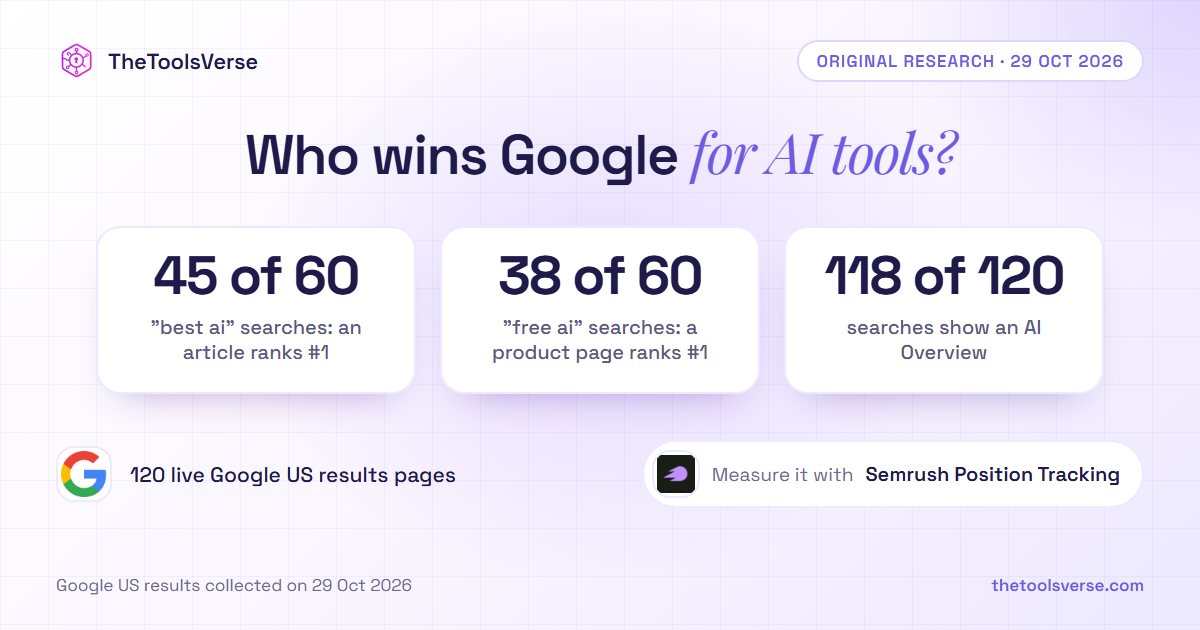
We took 60 kinds of AI tool — video generators, transcription, logo makers, coding assistants, humanizers, headshot generators and so on — and searched Google in the United States for two versions of each: "best ai [tool]" and "free ai [tool]". That is 120 searches on 29 October 2026, and 987 organic results in their top tens. Each result was classified by what kind of page it is:
| Page type | What it means |
|---|---|
| Product's own page | A tool's home, product or feature page — the destination |
| Article / listicle | A "best/top N" article, or a page on a blog, guide or review path |
| Reddit, YouTube, forums | Community and creator platforms |
| Directory / review site | Software directories and review platforms |
| App store | Google Play, the App Store, browser extension stores |
The first result: it depends on one word
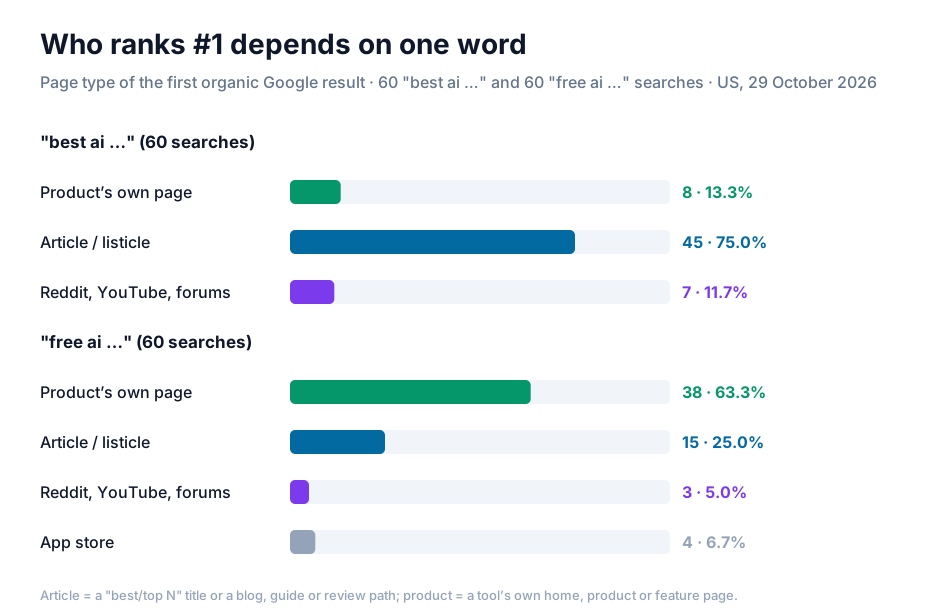
For "free ai …" searches, the destination theory holds: a product's own page ranked first in 38 of 60 (63.3%). Someone looking for a free AI logo maker is usually shown a logo maker.
For "best ai …" searches it does not: an article ranked first in 45 of 60 (75%), and a product page in only 8. Someone asking which tool is best is shown someone else's answer — usually a publisher's comparison, not a vendor's home page.
The difference is intent. "Free" is a request to use something now; "best" is a request to choose. Google appears to be serving those two jobs with different kinds of page, and a site's exposure to the "destination brands" shift depends on which job its pages do.
The whole top ten
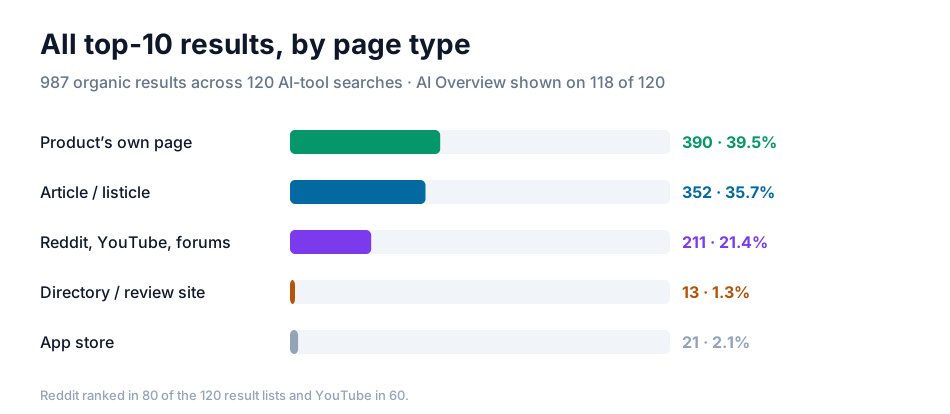
Across all 987 results, product pages (39.5%) and articles (35.7%) are close to even. Three other numbers stand out:
- Community platforms take a fifth of the top ten (21.4%). Reddit ranked in 80 of the 120 result lists and YouTube in 60. For "best" searches the share is higher: 125 of 465 results (26.9%).
- AI Overviews appeared on 118 of the 120 searches. Whatever ranks first now ranks first below an AI answer.
- Directories and review sites — the classic aggregators — held 13 of 987 results (1.3%), and never the first position. On that point the theory is right, and as a directory ourselves we take it seriously.
Who writes the "best" lists
If articles win "best" searches, one more question matters: whose articles? Vendors increasingly publish their own "10 best tools" lists — HeyGen's "10 Best Free AI Video Generators in 2026" ranked second for its search. But across the 247 article results on "best" searches, 27 (10.9%) were published by an AI tool company, and vendor-written articles held only 2 of the 45 first places. The rest came from publishers, review blogs and media. For comparison-intent searches, independent judgement still ranks.
What this means for your site
- Map your pages to the job. Product pages should target "use" searches ("free ai…", "online", "generator"); comparison content should target "choose" searches ("best", "vs", "alternatives").
- Don't expect a home page to win a "best" search. Vendors win "best" searches with genuine comparison content — and even then rarely first.
- Plan for Reddit and YouTube in the results. On two thirds of these searches a Reddit thread sits on page one; being part of those conversations is part of ranking.
- Track by intent, not just by keyword. A ranking drop on "best" keywords and a drop on "free" keywords are different problems.
- Remember the AI Overview above everything. 118 of 120 searches had one; track whether you are cited there too.
Track the shift on your own keywords
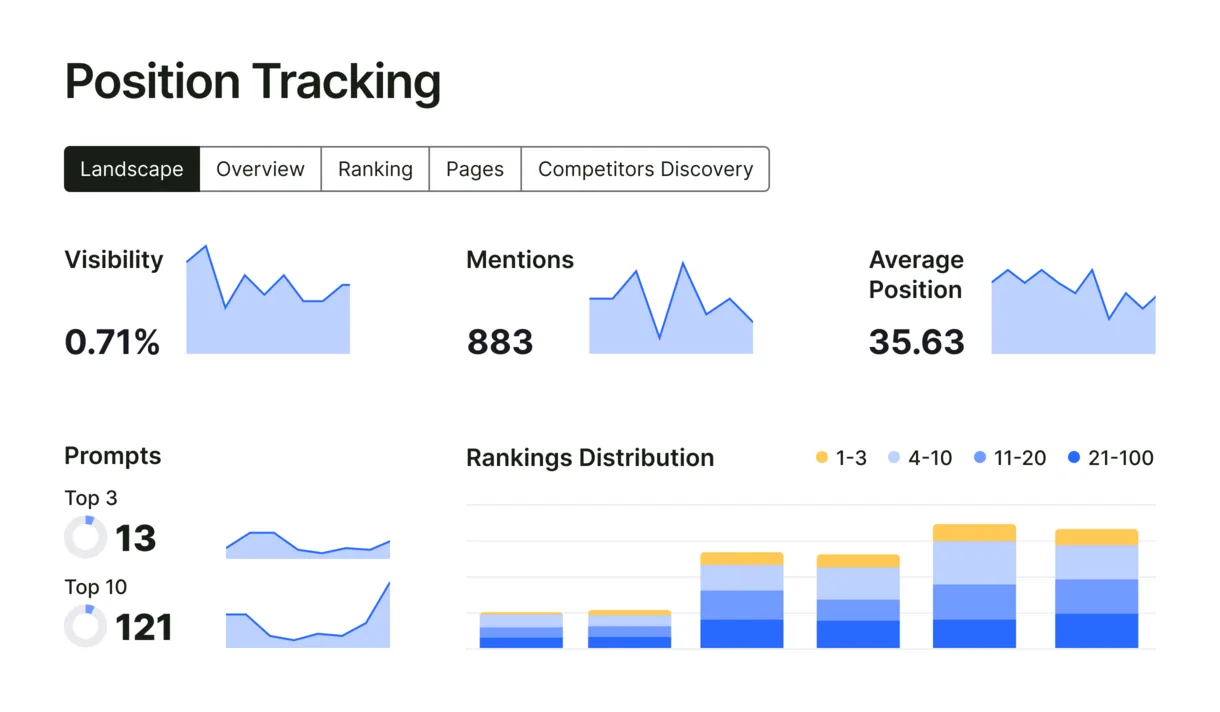
Catch ranking shifts as they happen. Position Tracking follows chosen keywords daily — tag your "best" and "free" keywords separately and its visibility trends show which intent is moving.
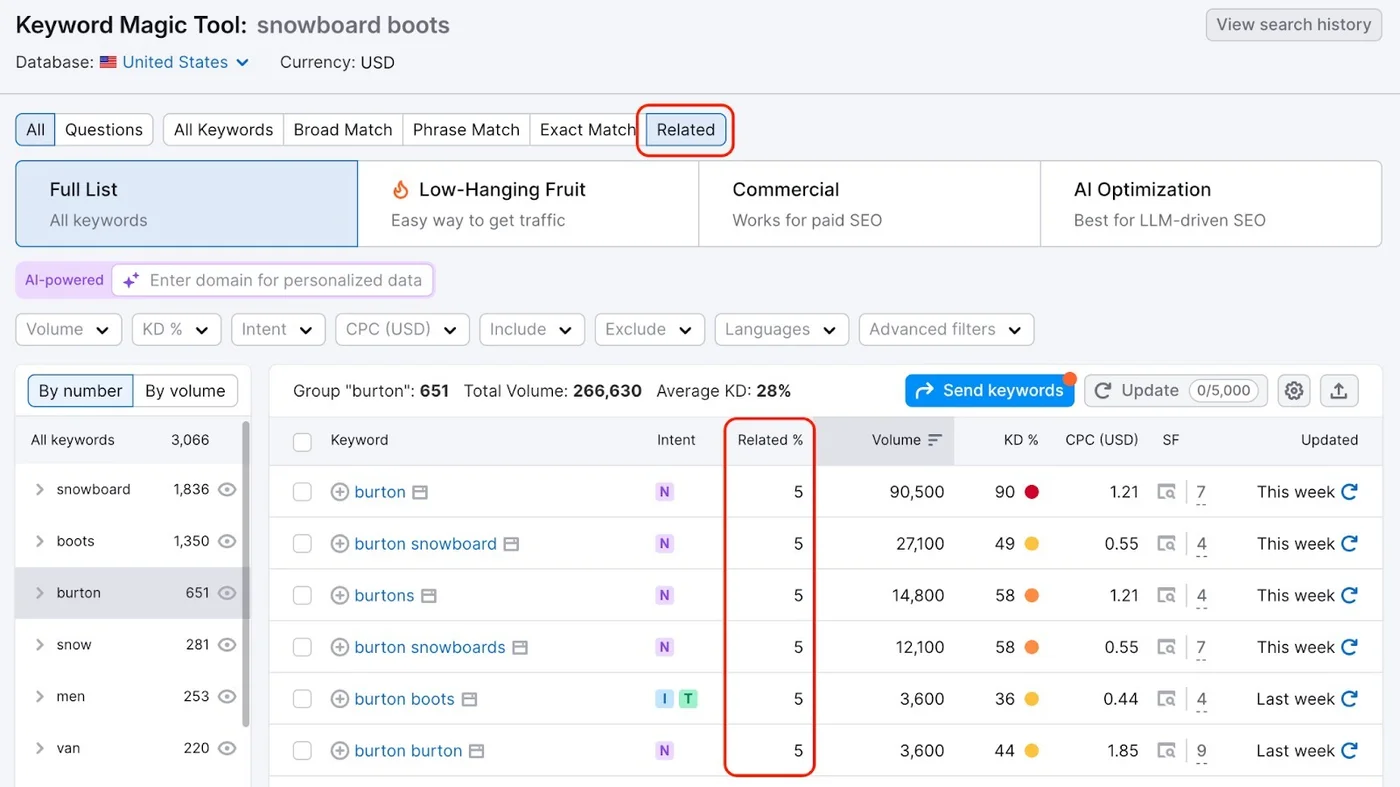
Group keywords by intent. Keyword Magic Tool groups related keywords and shows the intent of each, which is how "use" and "choose" searches can be split before you decide which page should target them.
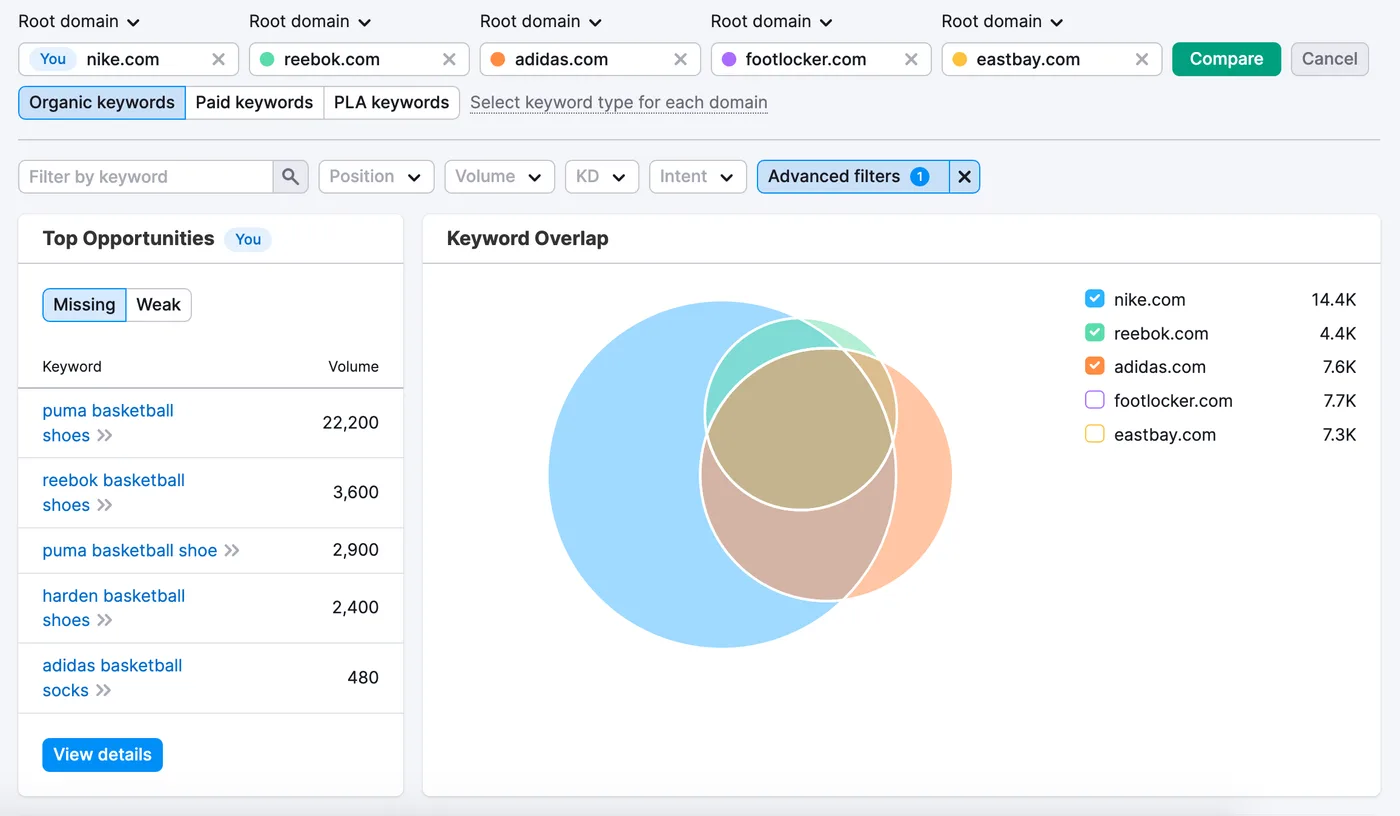
Find what destination brands win that you don't. Keyword Gap compares your keywords with up to four competitors' and lists the ones you are missing.
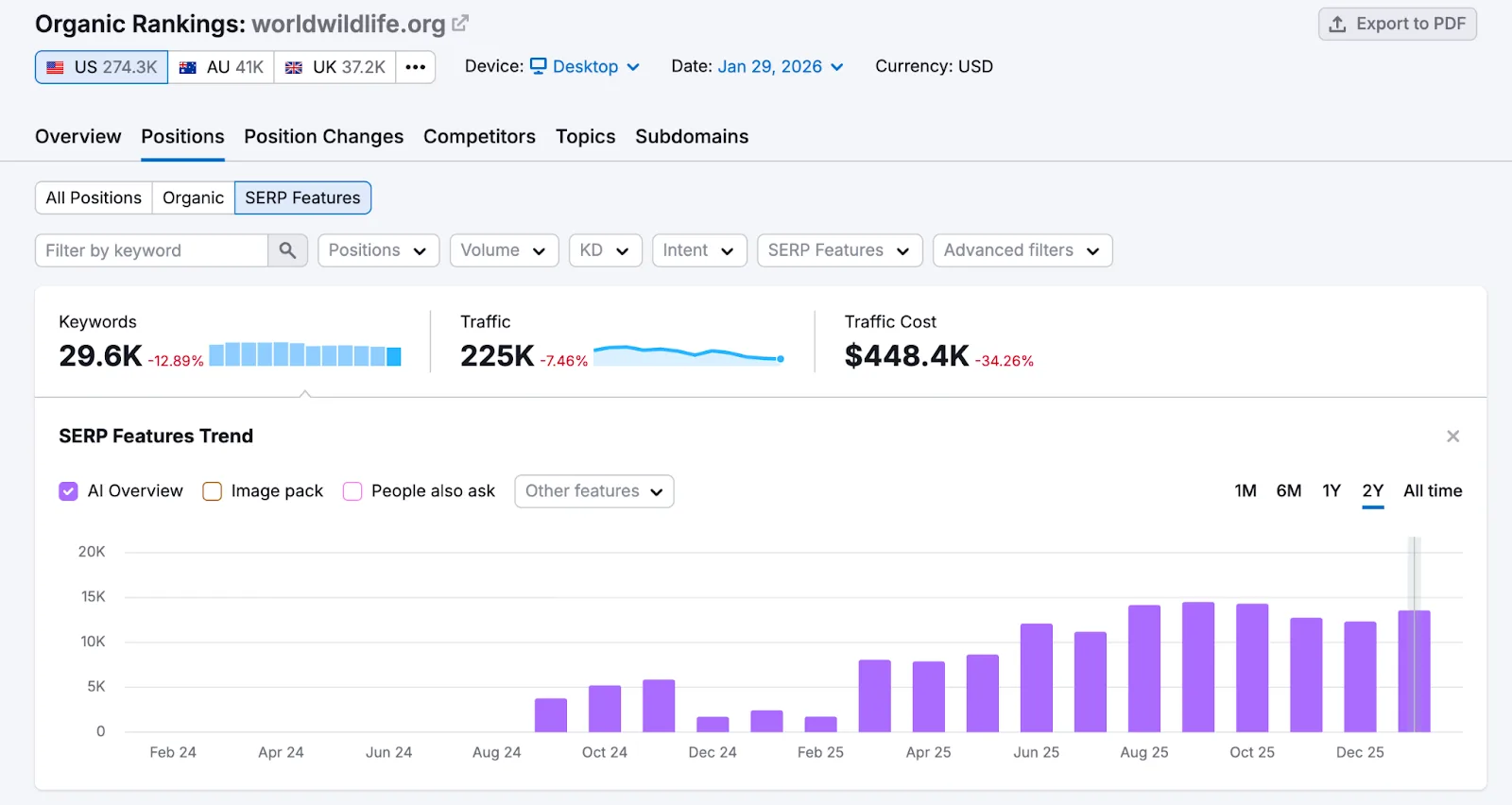
See which pages the winners rank with. Organic Rankings, formerly Organic Research, lists the keywords and pages that bring a domain its organic traffic. Run it on the publisher that holds the #1 "best" result in your category and you can see what kind of page Google rewards there.
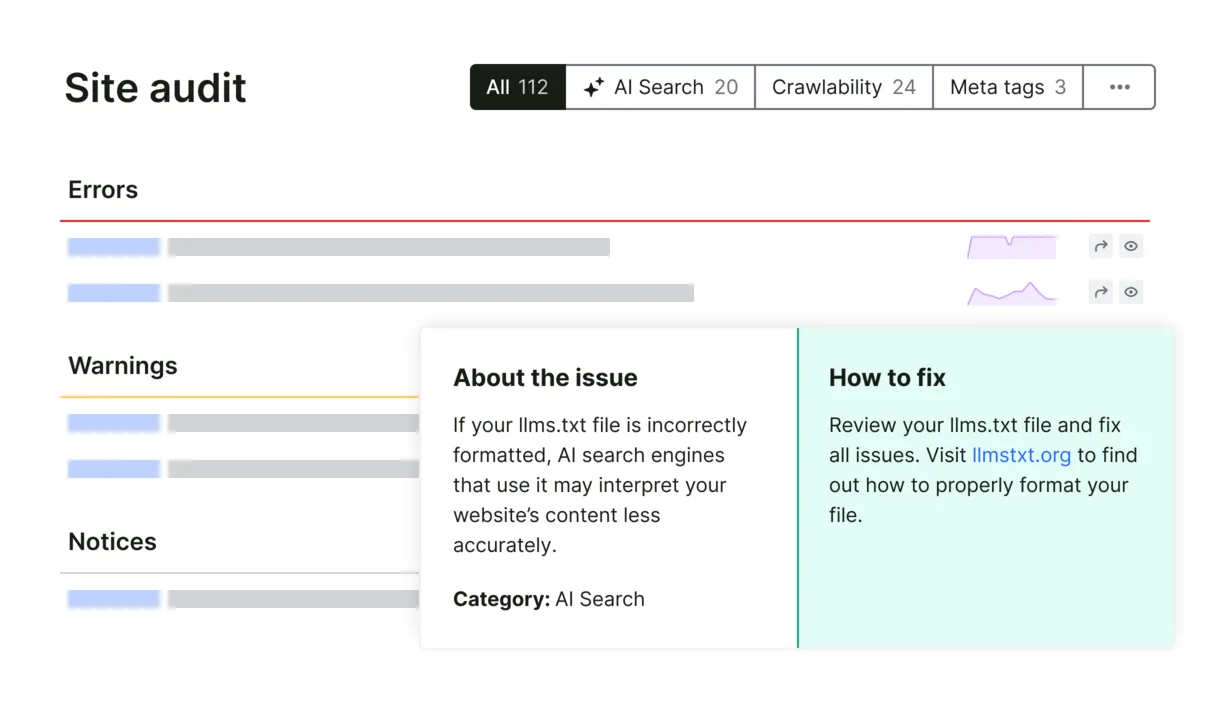
Make sure the destination page is worth landing on. Site Audit checks the pages a "free ai …" search would send people to for crawlability, speed and AI search issues. A product page that ranks #1 still has to load and work.
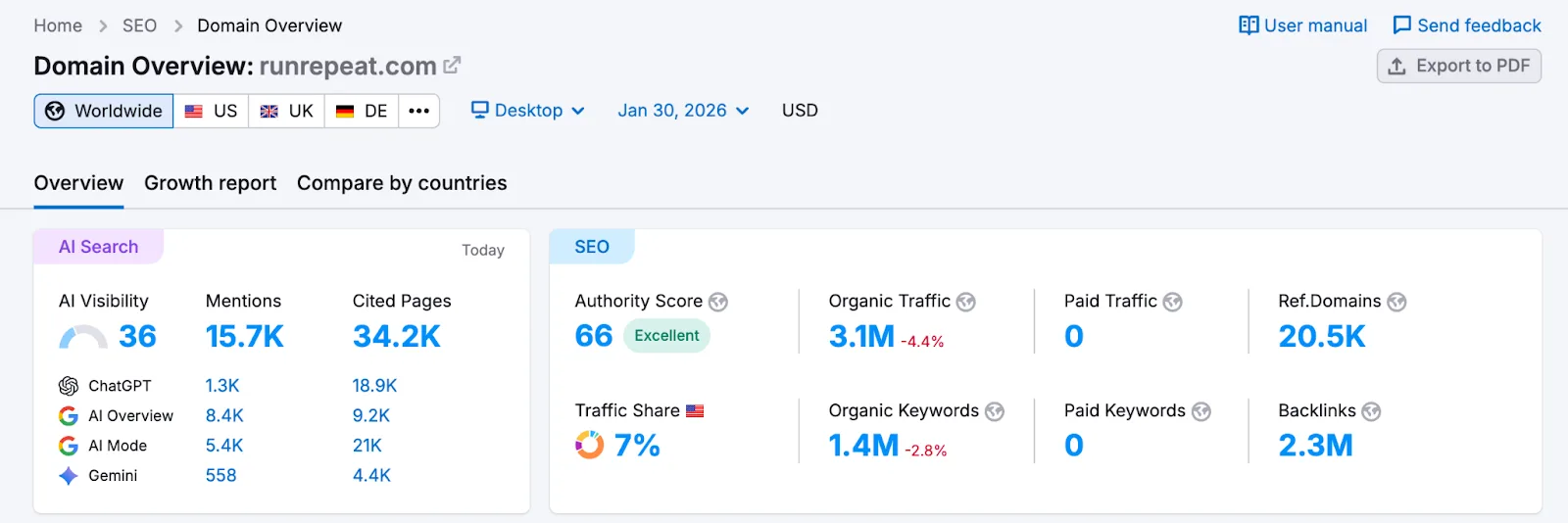
See search and AI visibility together. Domain Overview shows a domain's AI visibility across ChatGPT, AI Overviews, AI Mode and Gemini beside its organic traffic and Authority Score — the view to keep when nearly every search now starts with an AI answer.
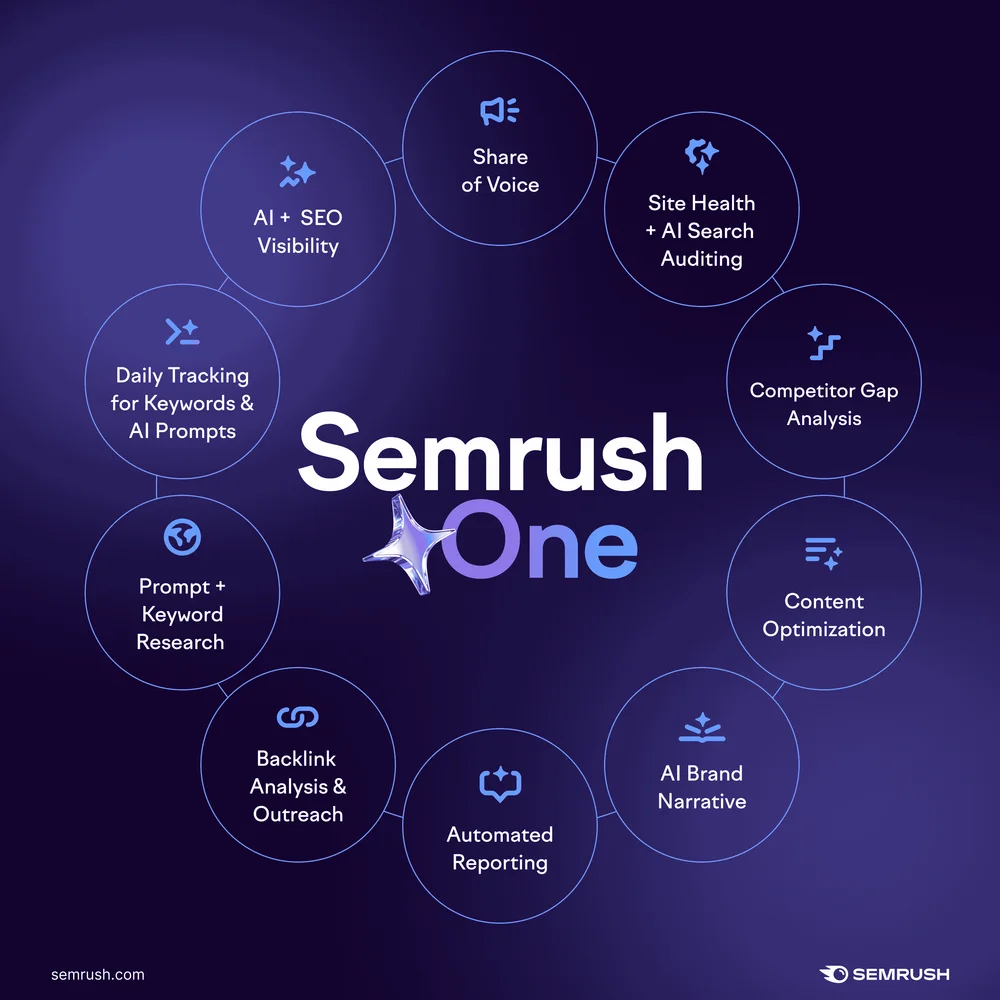
Semrush One bundles the SEO Toolkit and the AI Visibility Toolkit, and the 7-day free trial is Semrush One's — the AI Visibility Toolkit has no free trial of its own. To check your own keywords by intent before paying, try Semrush One free for 7 days: its page offers "Unlimited access to all Semrush One tools" and notes "Offer available to new users only", checked on 28 October 2026. Those are Semrush's published terms, not something we tested; none of the data above came from a Semrush account.
Destination for "use", content for "choose"
Google is not simply rewarding brands over content. In AI-tool searches it shows the product when someone wants to use something and an independent comparison when someone wants to choose — with Reddit beside both and an AI Overview above both. The sites under real pressure are the ones in between: directories and aggregators held 1.3% of the results. Know which job each of your pages does, and track it that way.
Try Semrush One free for 7 days
Position Tracking and Keyword Gap to see which domains are taking your keywords, Keyword Magic Tool to split them by intent, and AI visibility tracking alongside — the SEO Toolkit and the AI Visibility Toolkit together in Semrush One. Free for 7 days for new users.
Try Semrush One free for 7 daysHow the results were classified
- Searches (120): 60 AI tool types, each searched as "best ai [type]" and "free ai [type]", Google United States, English, desktop, through DataForSEO's SERP API (live, advanced), 29 October 2026. One results page per search; 987 organic results in the top tens.
- Classification (applied in order): community — Reddit, YouTube, Quora, Facebook, Medium, Substack, LinkedIn, X, TikTok and community or forum hosts; store — app and extension stores; directory — a list of software directories and review platforms (G2, Capterra, Gartner, Product Hunt, There's An AI For That, Futurepedia, Toolify, AIxploria and others, including our own site); article — a title starting "Best/Top N" or containing a "best … in 2026"-style phrase, or a URL path under blog, guide, review, news or similar; product — everything else. "Vendor-written" articles are those on domains that are AI tool companies in our catalogue or that also ranked with a product page.
- What one day of results can't show: cause, change over time, or the results for any other country or phrasing. One day's results; personalisation and location move rankings. Rule-based classification makes some mistakes in both directions.
| Figure | Source | Date |
|---|---|---|
| 120 Google results pages | DataForSEO SERP API, Google US desktop | 2026-10-29 |
| Every count and percentage above | Our classification of the saved results | 2026-10-29 |
| Position Tracking, Keyword Magic Tool, Keyword Gap, Organic Rankings, Site Audit and Domain Overview descriptions; screenshots | Semrush feature pages and Knowledge Base | 2026-10-29 |
| Semrush One graphic and trial terms | Creator Accelerator affiliate resources; Semrush One page | 2026-10-28 |
Written by Sohail Akhtar. The saved results and classification script can be re-run.
Some links may be affiliate links. We may earn a small commission at no extra cost to you.
Related Articles
Explore more guides and reviews from our experts.
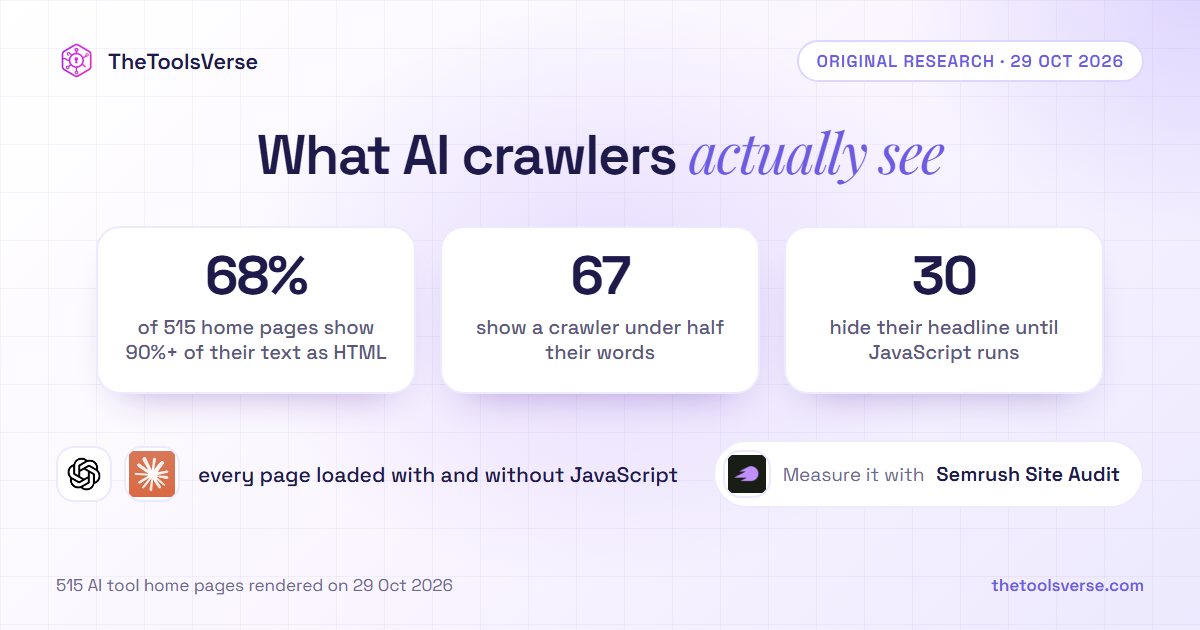
Most AI Crawlers Don't Run JavaScript. We Rendered 515 AI Tool Home Pages Both Ways: 67 Show a Crawler Less Than Half Their Words
AI Answers Quote Your Price. We Read 427 AI Tool Pricing Pages Like a Crawler: 1 in 4 Shows No Price, and 4 Say When They Were Updated