AI Directories No Longer Copy Vendor Text, They Reword It: About 60% of Listing Words Come From the Vendor's Own Page, and Two of Three Directories Add No Price
Disclosure
This article is promotional content produced as part of the Semrush Creator Accelerator programme. It contains affiliate links to Semrush — if you buy through them we may earn a commission at no extra cost to you — and we may also receive a reward from Semrush for publishing it. All measurements in this article are our own. Semrush did not supply, review or approve the data, and the conclusions we draw are ours. TheToolsVerse is itself an AI tools directory and appears in this comparison, so we have an interest in the result; the method and its limits are set out in full below.
A page can pass every plagiarism check and still say nothing its source did not already say. The sentences are new; the information is not.
That gap matters more now. Original research and first-party proof are increasingly treated as what separates a page from the many others on the same subject, and a page that restates what already exists gives a search engine or an AI answer little reason to pick it. So we took a kind of page that exists in the thousands, the AI tool listing, and ran two tests on it: did the directory copy the vendor, and did it add anything the vendor had not said?
Catch copied passages before you publish
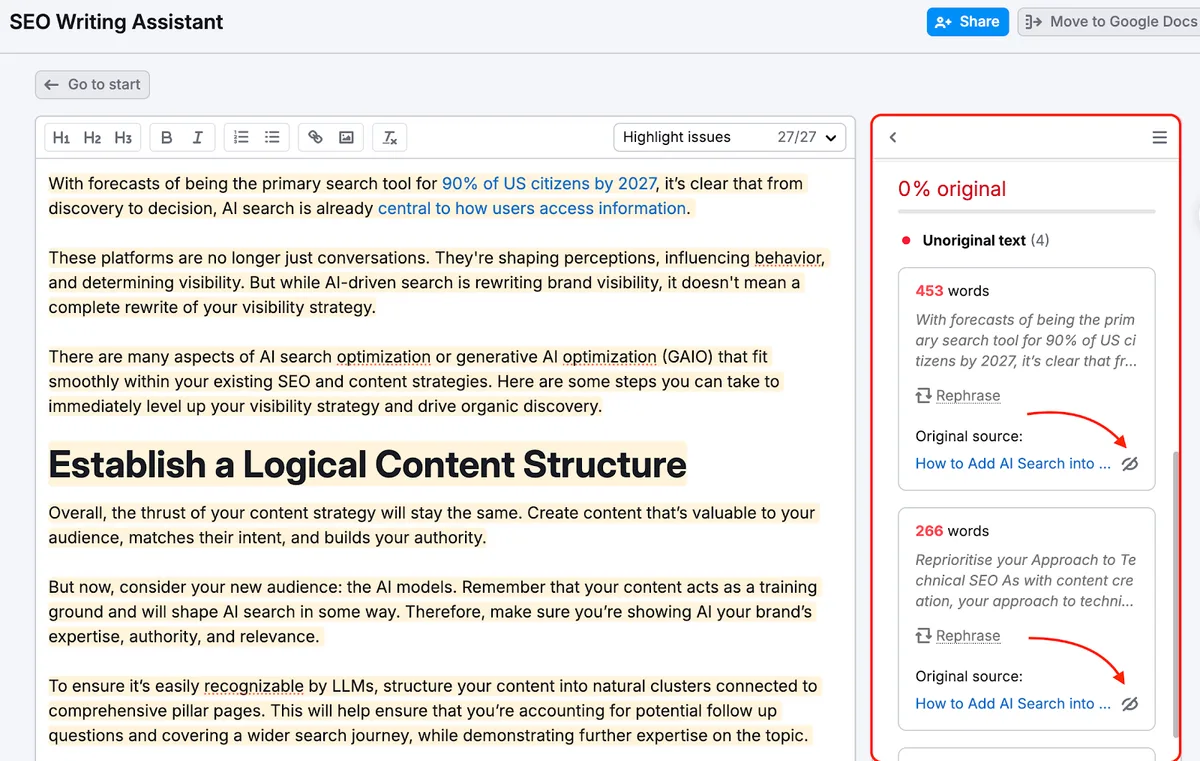
SEO Writing Assistant marks unoriginal passages in a draft and shows the source each one matches. To see whether your pages are cited in AI answers, the AI Visibility Toolkit is part of Semrush One: try Semrush One free for 7 days.
What we compared
We started from 613 AI tool websites we have studied before and, on 15 November 2026, read three things for each: the vendor's own home page, our listing for the tool, and its listing on two other large AI directories whose robots.txt allows crawling. We call them Directory A and Directory B; the point is the pattern, not the brands. A listing only counted if its page named the vendor's own domain, so no tool was matched to the wrong page.
That left 518 vendor home pages with enough text to compare against, and listing descriptions for 154 tools on Directory A, 115 on Directory B and 518 on TheToolsVerse.
Test one: copying is close to zero
We looked for runs of eight words that appear both in the listing and on the vendor's home page, after removing each directory's own template text.
No directory had a single description that was mostly copied. A copied stretch of 20 words or more anywhere on the listing page turned up on 1 of 161 pages on Directory A (0.6%), 1 of 115 on Directory B (0.9%) and 2 of 518 on ours (0.4%).
To be sure the test could find copying at all, we fed each vendor's own meta description back in against its home page. It was found in all 488 cases. The zero is real: these listings are written in their own words.
Test two: the words are new, the vocabulary is not
Rewording is not the same as adding. So we asked how many of a description's meaningful words (three letters or more, common words removed) also appear on the vendor's page.
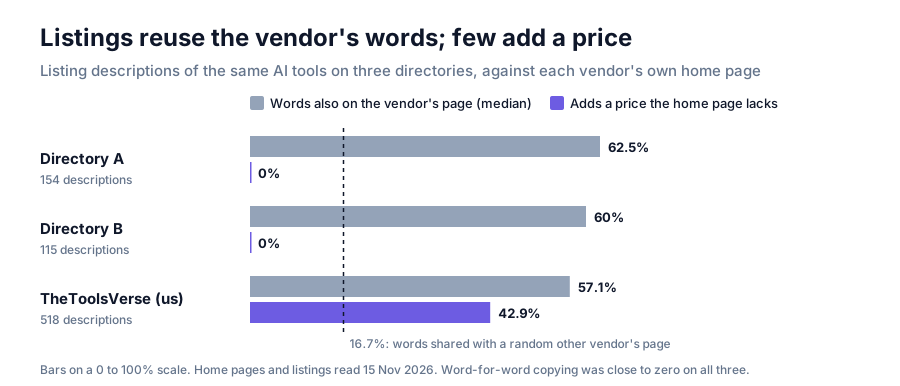
The median description takes 62.5% of its words from the vendor's page on Directory A, 60% on Directory B and 57.1% on ours. Against a different vendor's page, the same descriptions share 16.7%. For a fifth to nearly a third of listings, the overlap is three quarters or more: 29.9% on Directory A, 25.2% on Directory B and 21% on ours.
That is what a paraphrase looks like. The sentences change; the claims, features and phrasing of the vendor's own pitch carry over.
Test three: who adds a fact the vendor did not state?
Information is harder to measure than wording, so we used one narrow, checkable proxy: does the description contain a price that the vendor's home page does not show? Prices are what buyers look for, and many vendors keep them off the home page.
Of the descriptions we measured, 0% on Directory A and 0% on Directory B added such a price. On ours, 42.9% did (222 of 518). On exactly the same tools, the comparison is 51.9% against 0% for the 154 tools Directory A lists, and 38.3% against 0% for the 115 tools Directory B lists.
We also counted any number at all. That raised Directory B to 12.2% and Directory A stayed at 0%, but "any number" includes things like version numbers, so we do not lean on it.
Our listings were written to carry pricing, so this result reflects a choice we made, not proof that our pages are better. A price in a description is not proof the price is right, and we did not check accuracy in this study.
What this cannot tell you
- That listings are low quality. Rewording a vendor's pitch can still help a reader compare tools. We measured only overlap and one kind of added fact.
- That a price is the only useful addition. Testing notes, limits, alternatives and dates can all add information; we did not count them.
- That the prices we found are correct. We did not verify any of them here.
- That search engines or AI answers reward this. We did not measure rankings or citations.
- That the vendor copy came first. We compared against the home page as it stood on 15 November; vendors change their pages.
- That every directory behaves this way. These are three directories; two others disallow crawling, and two more refused our requests, so we left them out.
What to do with it
- Run both tests on your own pages. An originality check answers "did I copy?"; it cannot answer "did I add anything?"
- List what your page says that its source does not. If the list is empty, the page is a paraphrase, however clean the wording.
- Add something checkable. A price, a limit, a date, a result from your own testing: one concrete fact a reader can verify.
- Write where coverage is thin. Original work pays off most on topics that are searched but poorly served.
Find the gap, check the draft, follow the result
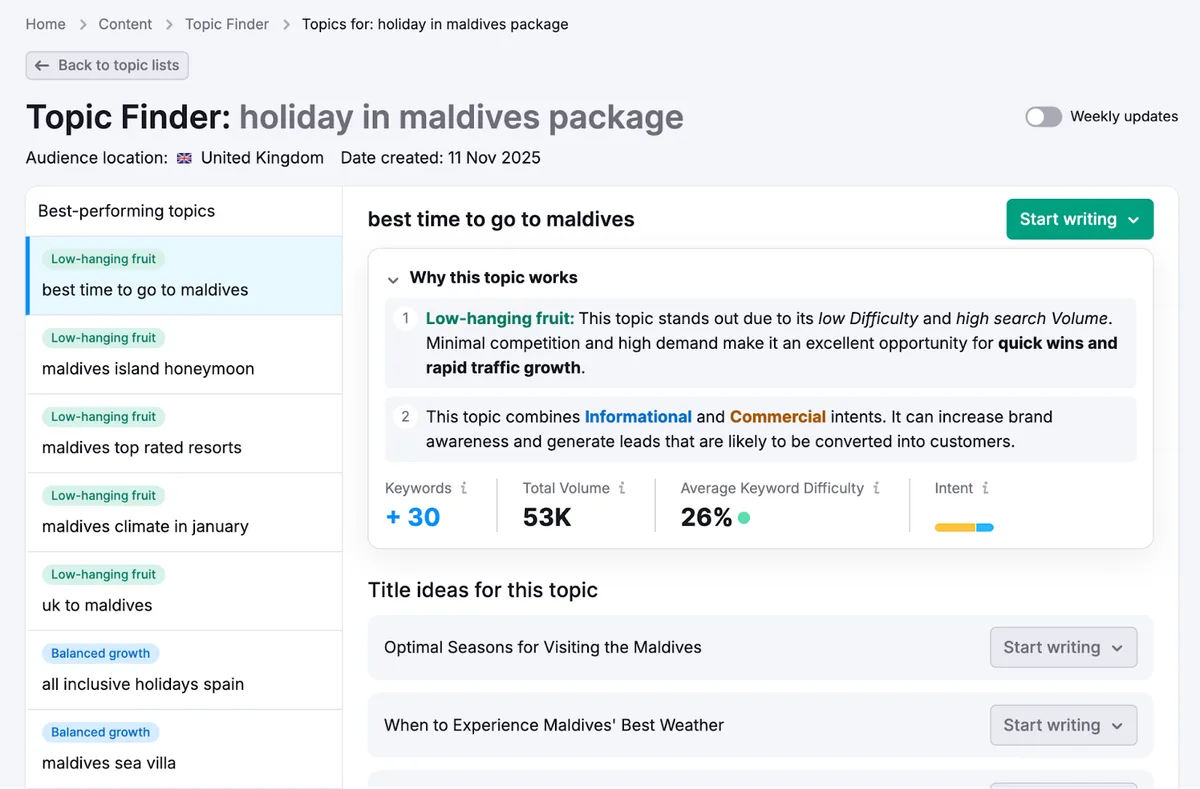
Find a topic worth original work. Topic Finder in the Content Toolkit suggests topics with their keyword count, volume, difficulty and intent, and explains why each is worth covering.
Check the draft for copied passages. SEO Writing Assistant includes an originality check that marks unoriginal passages and names the source each one matches. It answers the first of our two questions; the second is still yours.
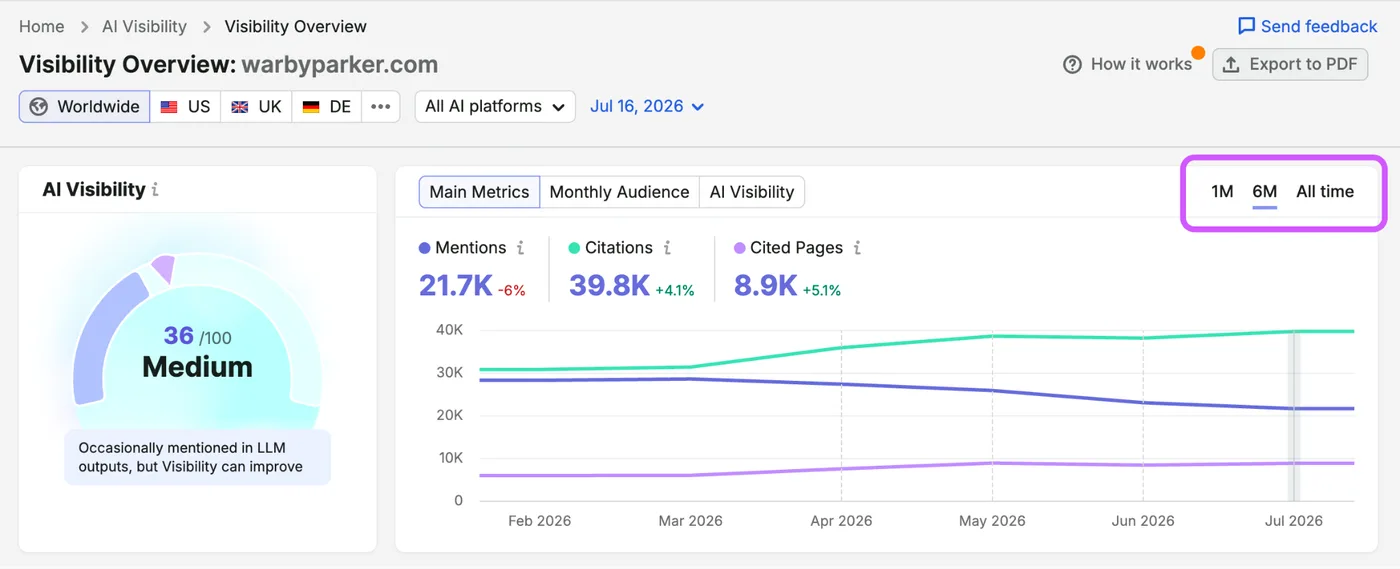
Follow whether original pages get cited. Visibility Overview in the AI Visibility Toolkit shows mentions, citations and cited pages across AI platforms over time.
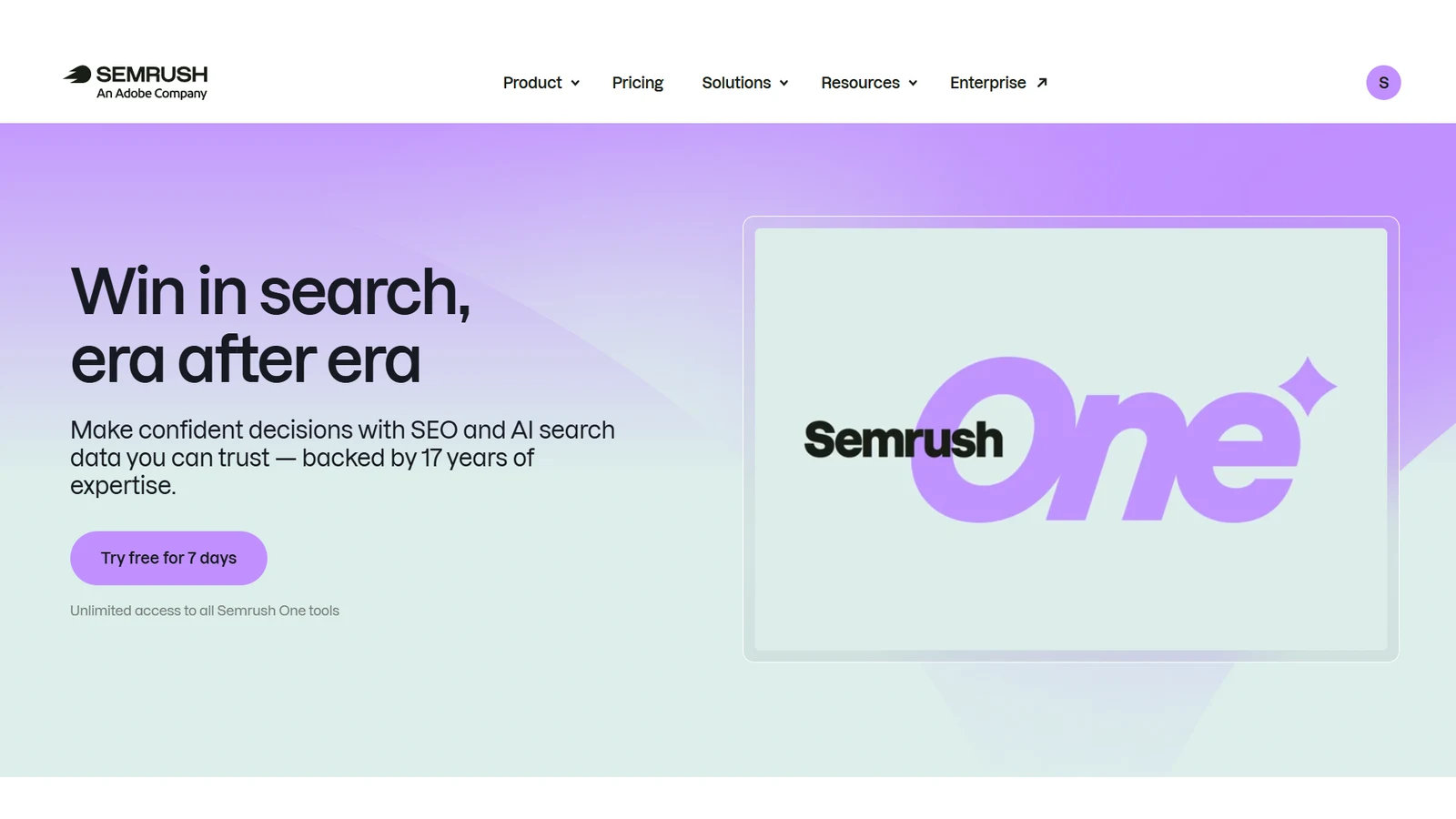
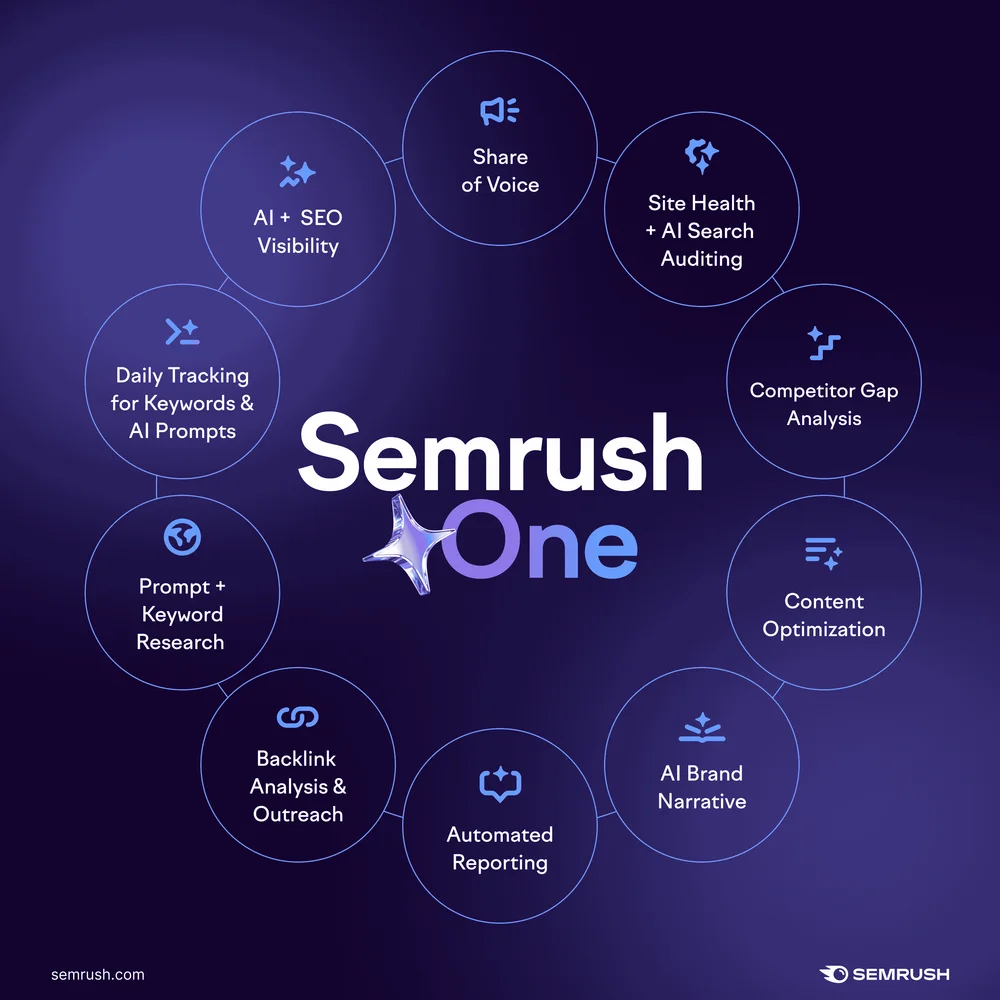
Semrush One includes the SEO Toolkit and the AI Visibility Toolkit, and the 7-day free trial belongs to Semrush One; the Content Toolkit is sold separately. To follow citations of your pages before paying, try Semrush One free for 7 days. Semrush's product page describes the offer as "Unlimited access to all Semrush One tools" (read on 16 October 2026). We have not used the trial; the numbers above come from our own crawl, not from a Semrush account.
New words are not new information
Copying is no longer the problem with these pages; repetition is. Before you publish, ask what the page knows that its source did not, and put that first.
Try Semrush One free for 7 days
Track mentions, citations and cited pages with Visibility Overview in the AI Visibility Toolkit, included in Semrush One. Free for 7 days for new users.
Try Semrush One free for 7 daysHow we counted
- Population: 613 AI tool websites from our earlier studies; 518 vendor home pages had at least 80 words of readable text.
- Read: every page on 15 November 2026. Outside directories were read one request every 2.5 seconds. Two large directories that disallow crawling in robots.txt were not read, and two more were dropped after they refused our requests.
- Match rule: a directory page counted only if its HTML named the vendor's domain. Directory B's sitemap lists its French pages, so we read its English pages instead.
- Copying: runs of eight words found both on the listing and on the vendor's page, after removing text that appears on at least 10% of that directory's pages (its template).
- Vocabulary: the share of a description's words of three letters or more, minus common words, that also occur on the vendor's page; the control uses a different vendor's page.
- Added price: a dollar figure in the description that the vendor's home page does not show.
- Left out: accuracy of any figure, rankings and AI citations, and pages beyond each vendor's home page.
- Reproduce it: the scripts and saved summaries are in
research/r2-f1-directory-copy/.
Some links may be affiliate links. We may earn a small commission at no extra cost to you.
Related Articles
Explore more guides and reviews from our experts.
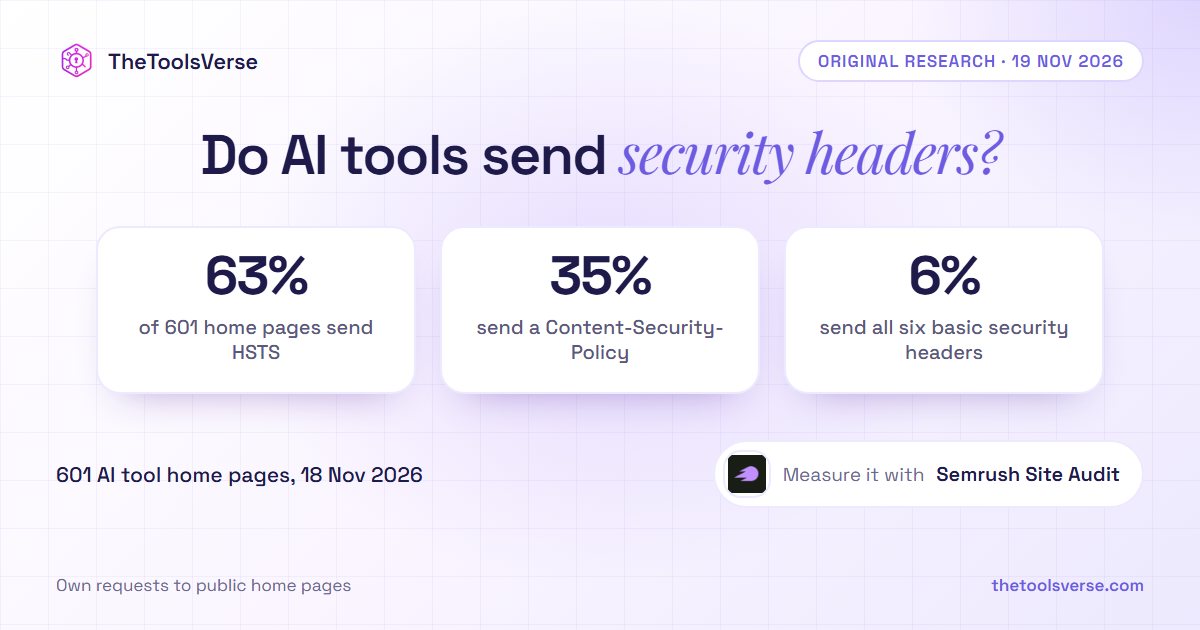
AI Tool Home Pages Redirect to HTTPS 94.5% of the Time, but Only 63% Send HSTS, 35% a Content-Security-Policy and 6% All Six Basic Security Headers: We Checked 601
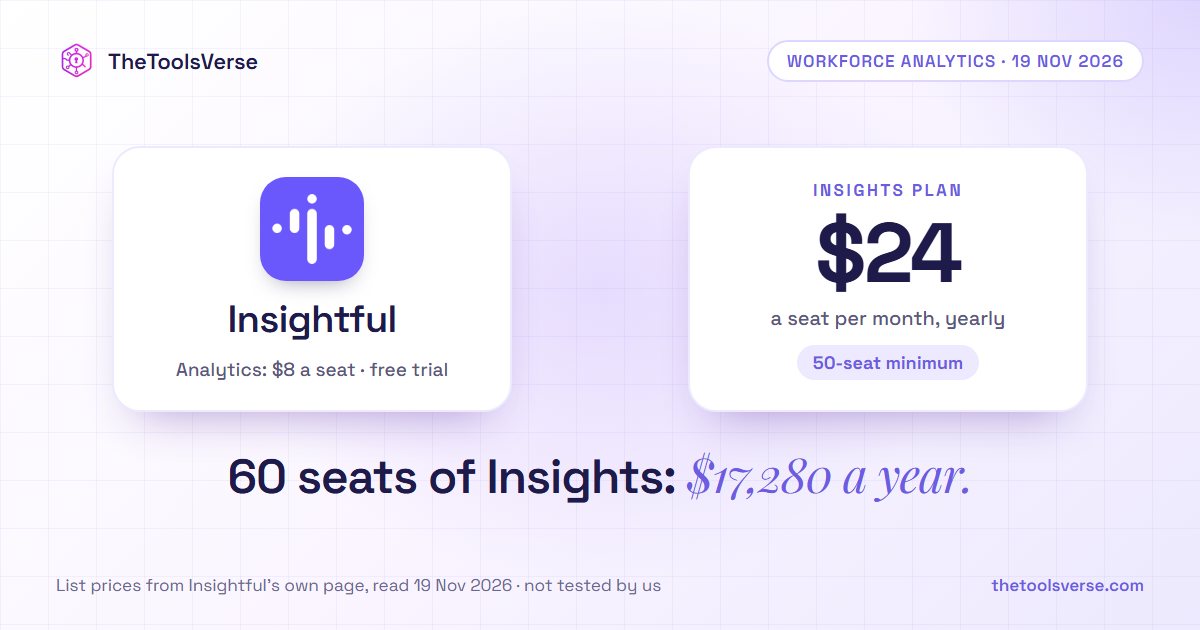
Insightful Pricing (2026): Three Plans, a 50-Seat Minimum and a 14-Day Work Audit