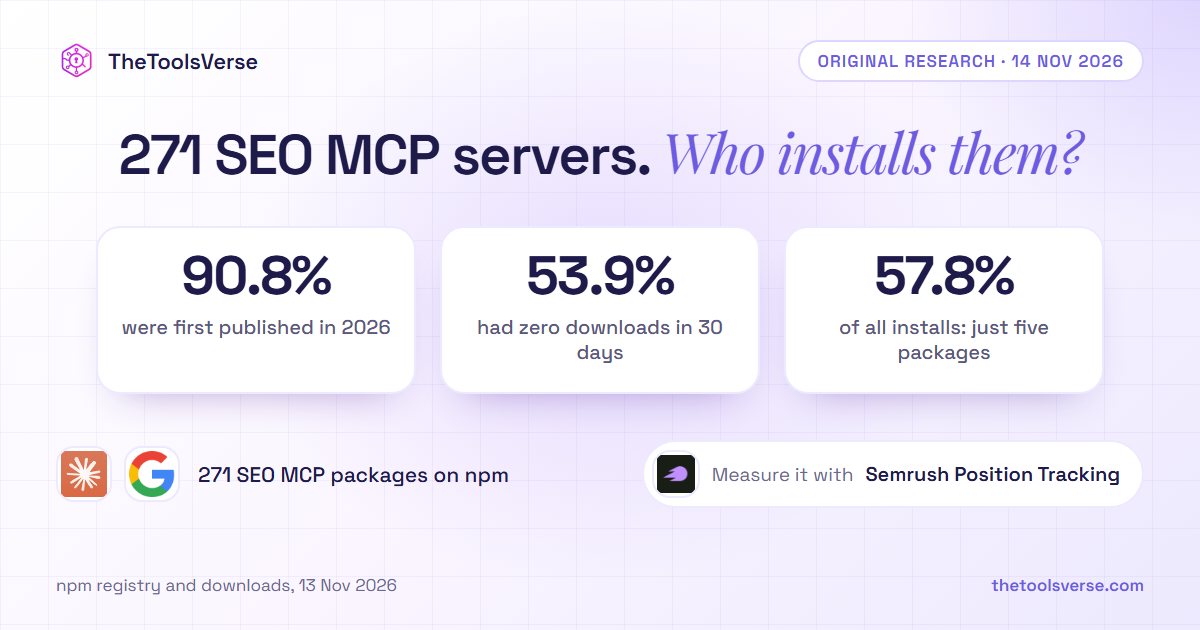
271 SEO MCP Servers Are on npm and 91% Were First Published in 2026. More Than Half Had Zero Downloads in 30 Days, and Five Packages Hold 58% of All Installs
Disclosure
This article is promotional content produced as part of the Semrush Creator Accelerator programme. It contains affiliate links to Semrush — if you buy through them we may earn a commission at no extra cost to you — and we may also receive a reward from Semrush for publishing it. All measurements in this article are our own. Semrush did not supply, review or approve the data, and the conclusions we draw are ours.
A lot of SEO work is now being handed to AI agents that connect to your data through the Model Context Protocol, or MCP. The pitch is that one person with an agent and a few connectors can do in a day what used to take a team a week. Connectors are the part you can count.
In November we counted 1,555 public SEO MCP servers on GitHub and asked whether they could be trusted. This time we asked a different question: which of them are actually installed? For that, npm is the cleanest public signal, because it publishes download counts for every package.
Know how you show up to people and to agents
Track your rankings and your visibility in AI answers, daily, with Position Tracking in the SEO Toolkit and Visibility Overview in the AI Visibility Toolkit. To get both in one subscription, try Semrush One free for 7 days.
The test
On 13 November 2026 we ran 20 searches on the npm registry (terms such as "seo mcp", "google search console mcp", "dataforseo mcp", "ai visibility mcp" and "site audit mcp"), which returned 359 distinct packages. We kept those whose name or description mentions MCP and also names an SEO task, such as SEO, Search Console, SERP, keyword research, backlinks, AI visibility, AEO or GEO. That left 271 packages.
For each one we read its first-publish date from the registry and its downloads for the 30 days from 14 October to 12 November 2026 from npm's download service.
Almost all of it is new
246 of the 271 packages (90.8%) were first published in 2026, and 83 (30.6%) in the last 60 days.
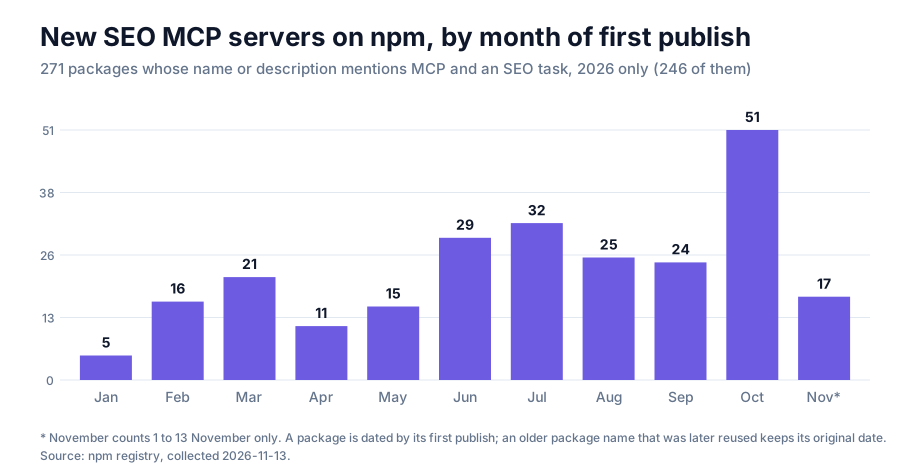
The busiest month so far is October, with 51 new packages, and November had already reached 17 by the 13th. Nothing in the curve suggests the supply is slowing.
Most of them are not installed
Counting is easy. Use is the part to look at.
- 146 of the 271 (53.9%) had no downloads at all in the 30 days.
- 91 (33.6%) had 100 or more. 24 (8.9%) had 1,000 or more, and only 2 had more than 10,000.
- The median package had zero downloads.
Newness does not explain it. Among the 83 packages first published in the last 60 days, 53.0% had zero downloads. Among the 188 older ones the share was 54.3%, and among the 85 that are more than six months old it was 56.5%.
Downloads are also concentrated. The 271 packages together had 164,633 downloads. The top package alone took 35.6%, the top five 57.8% and the top ten 68.6%.
| Package | Downloads in 30 days |
|---|---|
| mcp-gsc | 58,629 |
| seo | 13,519 |
| @danielsogl/lighthouse-mcp | 9,424 |
| mcp-google-multi | 7,338 |
| search-console-mcp | 6,206 |
The package called "seo" has existed since 2014; the name was reused, and it now ships a Search Console server. Packages are dated by their first publish, so that one counts as old.
People install the free data first
We placed each package in the first matching job, by the words in its name and description, and compared the share of packages with the share of downloads.
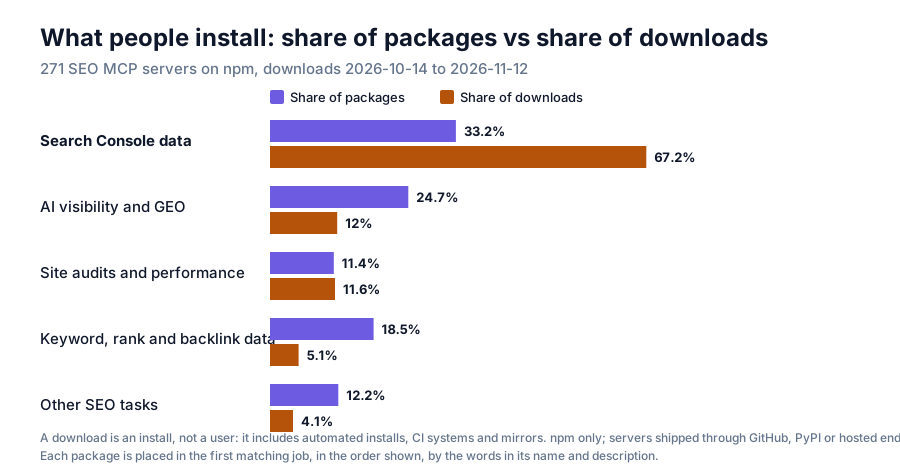
Servers that read Google Search Console are a third of the packages (90) but take two thirds of the downloads (67.2%). Servers built around AI visibility and GEO are a quarter of the packages (67) but 12.0% of the downloads. Those that work with keyword, rank and backlink data are 18.5% of the packages and 5.1% of downloads.
The names are telling. 22 packages mention DataForSEO (15), Semrush (5) or Ahrefs (2), and together they had 2.1% of the downloads. The first thing people connect to an agent appears to be the data they already own and can read for free, their own Search Console. Competitive data from paid sources is a small part of what is installed through npm.
What this cannot tell you
- That a download is a user. npm counts installs, including automated ones from build systems, mirrors and bots. A package with 58,000 downloads may have far fewer people behind it.
- That npm is the whole market. Many servers ship through GitHub, PyPI, Docker or as hosted endpoints that a user adds by URL. Those do not appear here, and some vendors' own servers may be among them.
- That our rule found every SEO server. It depends on the words in the name and description. Some packages are not described well enough to match, and some matches are only partly about SEO.
- Why a package was installed or ignored. We did not test quality, and we did not run any of the code.
- That the pattern is stable. This is one 30-day window, at a time when the field is moving fast.
What to do with it
- Check a connector before you plug it in. Look at its downloads, its age, who maintains it and whether the source is open. Half of the packages here show no sign of use, and our GitHub census found that most repositories lack basic maintenance checks.
- Start with the data you own. Search Console connectors are where the installs are, and the risk is lower when the agent only reads your own property.
- Use read-only access first. Give an agent permission to look before you give it permission to change anything.
- Measure what an agent cannot see for you. Rankings, AI citations and whether AI crawlers can reach your pages need a tracking layer of their own.
- Count again in three months. The field is new enough that the picture will change.
Measure the part the connectors cannot
Track daily rankings, SERP features and AI Overview appearances. Position Tracking in the SEO Toolkit tracks keyword positions daily and can follow AI Overview appearances for a domain.

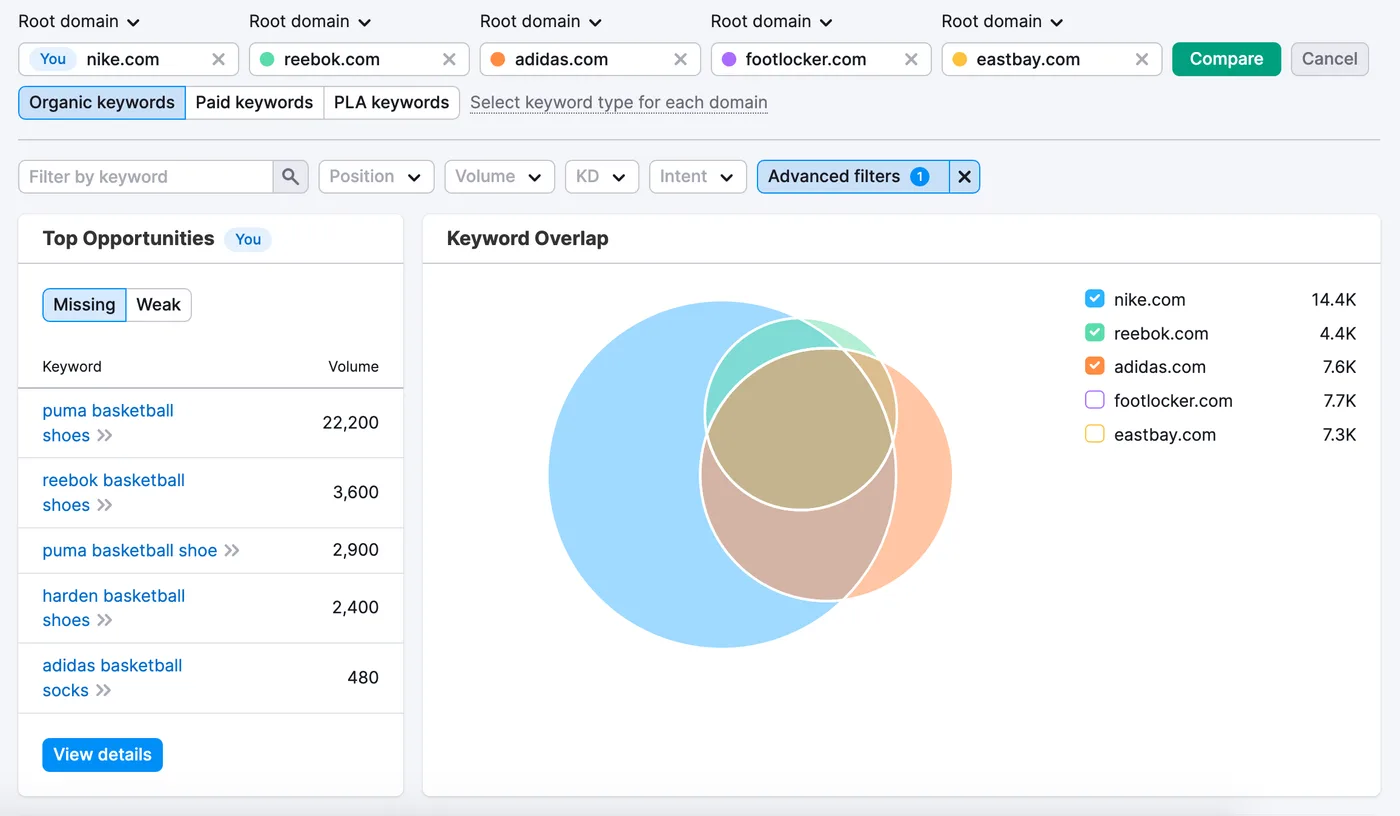
Find the keywords competitors rank for and you do not. Keyword Gap compares domains and lists the keywords you are missing as opportunities.
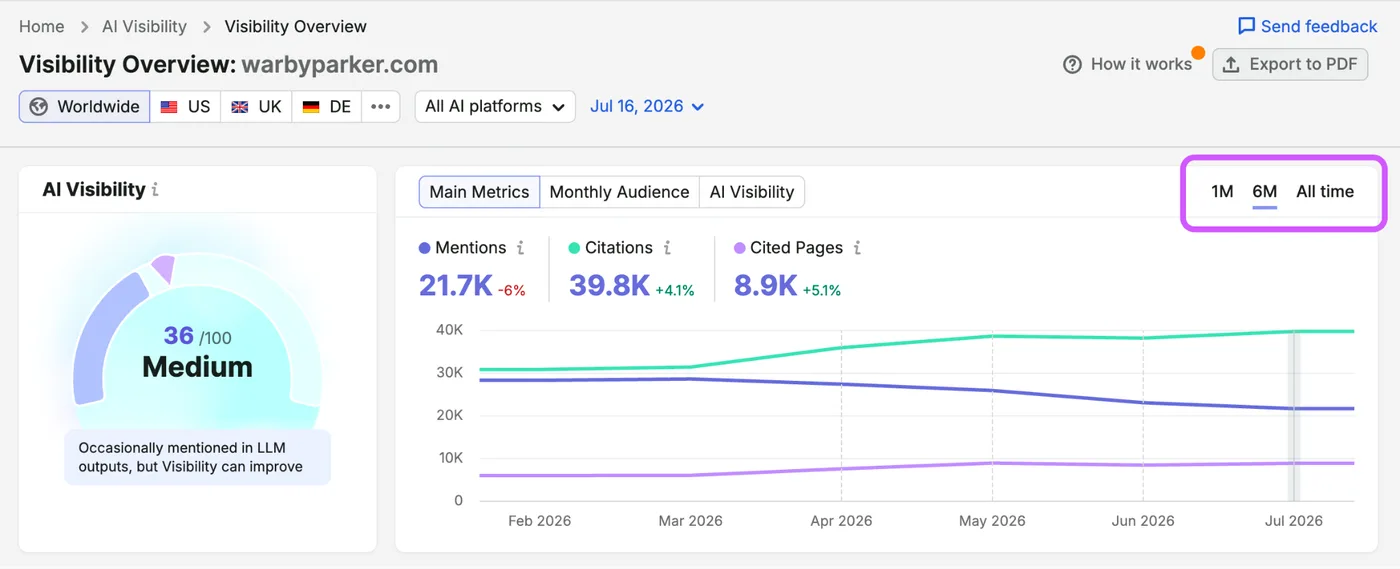
See whether AI platforms mention and cite you. Visibility Overview in the AI Visibility Toolkit tracks mentions, citations and cited pages across AI platforms over time.
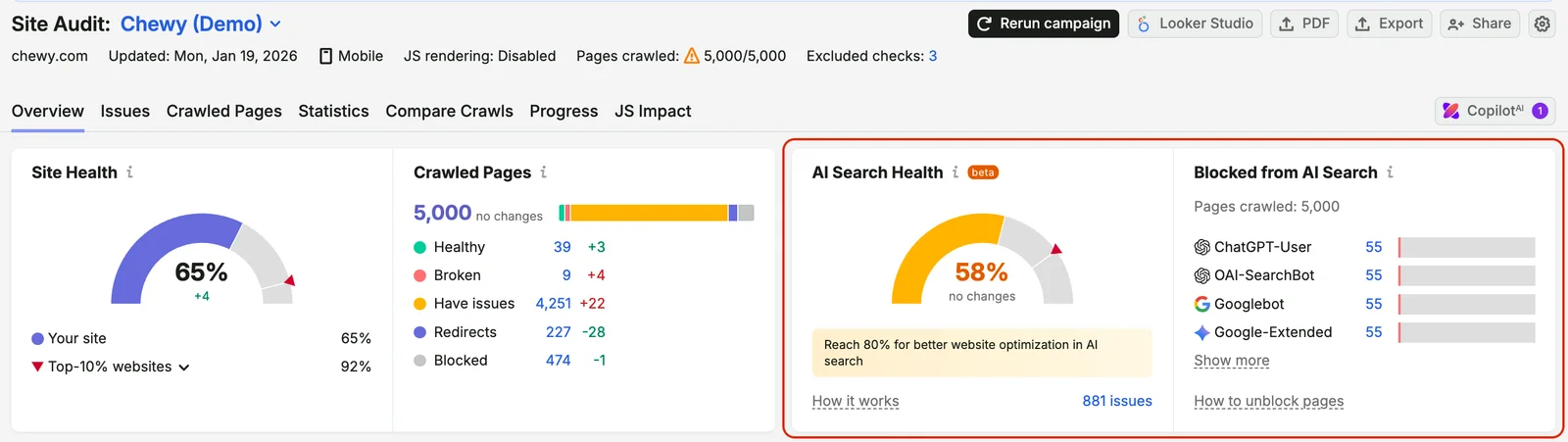
Check the technical foundation for agents and bots. Site Audit in the SEO Toolkit crawls a site as search engines and AI bots do, and reports AI Search Health, including pages blocked from AI search bots.
The AI Visibility Toolkit has no free trial of its own; the 7-day free trial is Semrush One's, which includes it alongside the SEO Toolkit. To measure your rankings and your AI visibility in one place before paying, try Semrush One free for 7 days: its page offers "Unlimited access to all Semrush One tools", checked on 16 October 2026. Those are Semrush's published terms, not something we tested; none of the data above came from a Semrush account.
Connectors are cheap, so look at the ones that are used
At the start of 2026 there were 25 such packages. Now there are 271, and most are unused. Pick from the ones with a record, and keep the agent's access narrow.
Try Semrush One free for 7 days
Position Tracking, Keyword Gap and Site Audit in the SEO Toolkit, with Visibility Overview in the AI Visibility Toolkit, together in Semrush One. Free for 7 days for new users.
Try Semrush One free for 7 daysHow we counted
- Search: 20 queries on the npm registry search service on 13 November 2026, up to 500 results each, returning 359 distinct packages that mention MCP and an SEO term somewhere (name, description or keywords).
- The rule we kept: the package name or description contains "MCP" or "Model Context Protocol" and also an SEO term (SEO, Search Console, GSC, Semrush, Ahrefs, DataForSEO, SERP, backlink, keyword research, AI visibility, AEO, GEO, generative engine). That left 271. Keywords alone did not count.
- Dates: the first-publish time in the registry record of each package. "Last 60 days" means from 14 September 2026.
- Downloads: npm's download service, the 30 days from 14 October to 12 November 2026. A package with no record counts as zero.
- Jobs: each package in the first matching group, in this order, by words in its name and description: Search Console data; AI visibility and GEO; site audits and performance; keyword, rank and backlink data; everything else.
- Not shown: package source code, download sources, and anything about users.
- Reproduce it: the scripts and the saved results are in our research folder (
research/r2-d3-mcp-installs/).
Some links may be affiliate links. We may earn a small commission at no extra cost to you.
Related Articles
Explore more guides and reviews from our experts.
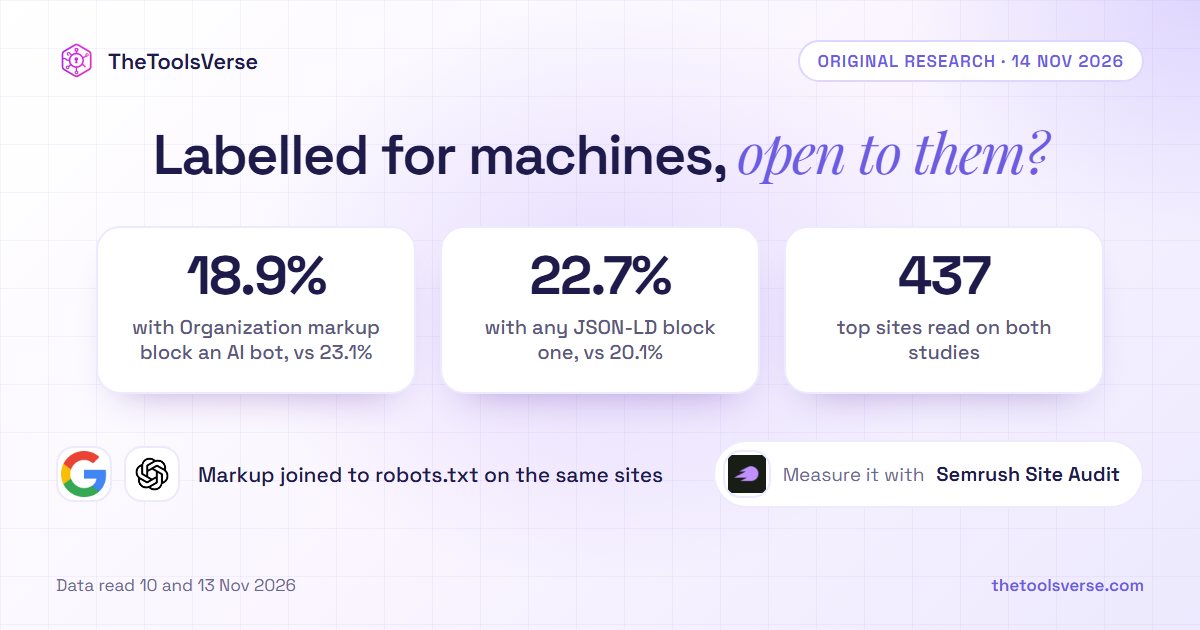
Top Sites With Organization Markup Block AI Crawlers Slightly Less, 18.9% Against 23.1%, but Plain JSON-LD Shows No Such Pattern: Joining Two of Our Studies
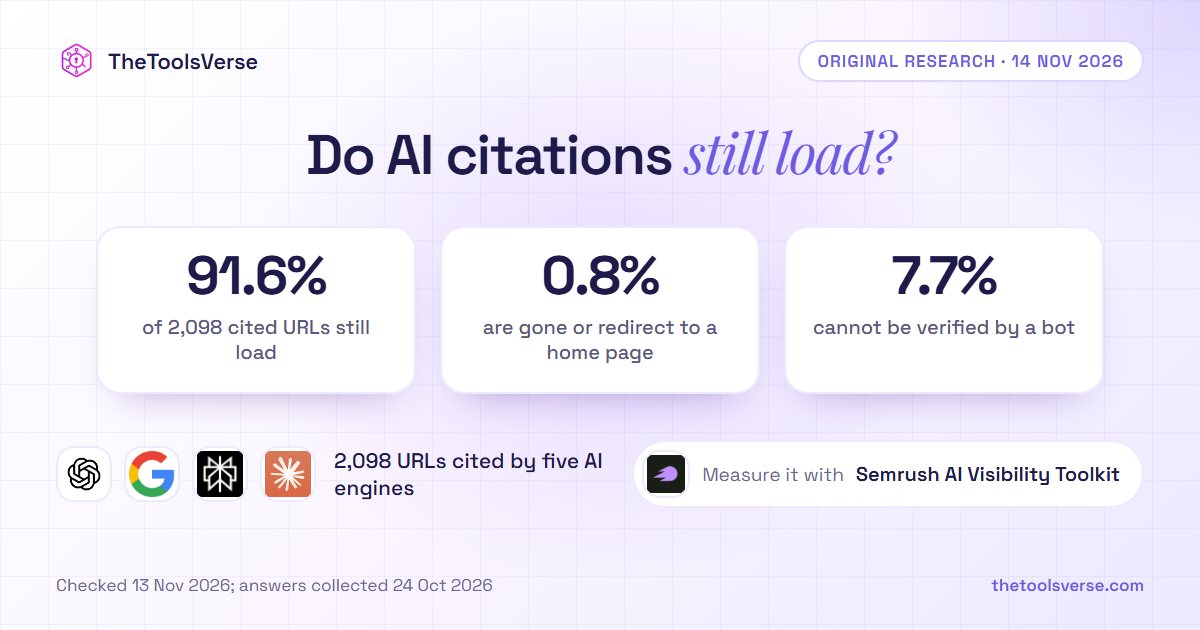
We Re-Checked 2,098 URLs That Five AI Engines Cited: 91.6% Still Load, 0.8% Are Gone, and 7.7% Cannot Be Verified by a Bot