Free AI Image Generators for Commercial Use: What Each Free Plan Really Allows (2026)
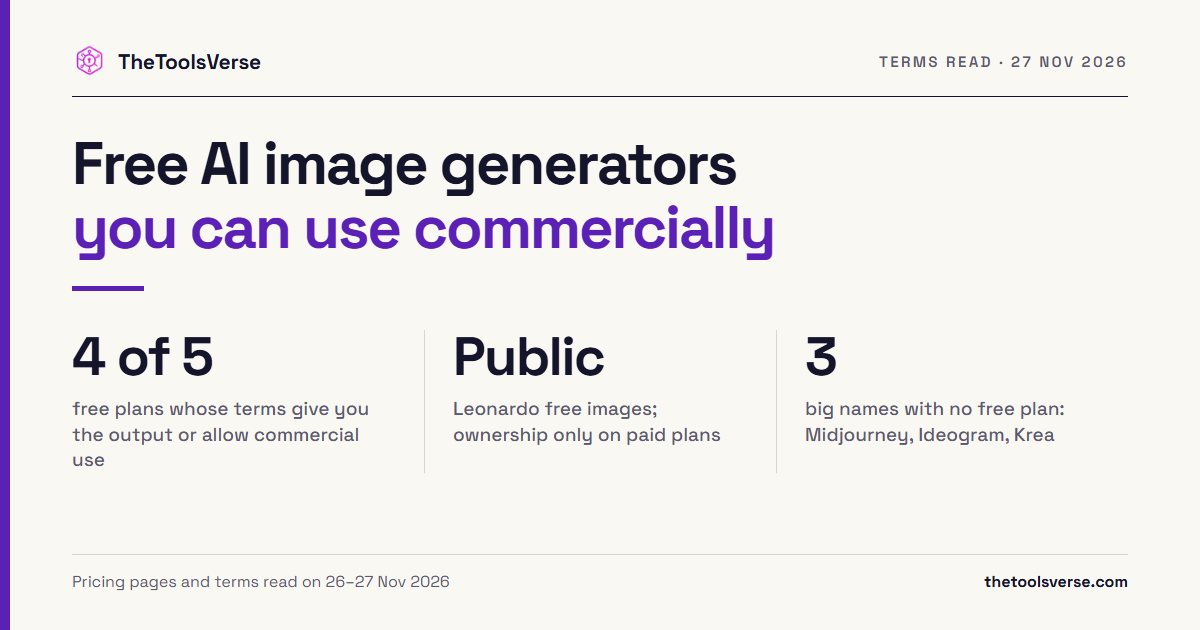
Short answer: the free AI image generators you can use for commercial work are Adobe Firefly (Adobe says outputs from features without a beta label can be used in commercial projects), Canva (you own your output, except Canva library content), ChatGPT (OpenAI assigns the output to you) and Google Gemini (Google won't claim ownership of what you generate). The free plan to be careful with is Leonardo: free images are public, and ownership only passes to you on a paid plan. Midjourney, Ideogram and Krea show no free plan on their pricing pages at all.
We read each vendor's pricing page and terms on 26–27 November 2026. This is what the documents say, not legal advice: if a project depends on it, check the terms again and ask a lawyer.
What we checked
• 8 AI image generators, each read on its own pricing page and its own terms or FAQ. 5 of them have a free plan. • 4 of those 5 free plans have terms that give you the output or allow commercial use: Firefly, Canva, ChatGPT, Gemini. • 1 free plan where ownership is for paying users only and images are public: Leonardo. • 3 well-known generators with no free plan on their pricing page: Midjourney, Ideogram, Krea.
The 8 at a glance
| Tool | Free plan (pricing page) | Commercial use and ownership (vendor's terms) | Verdict for paid work |
|---|---|---|---|
| Adobe Firefly | Limited free daily generations (no number given) | "You can use Firefly-generated outputs in your commercial projects" for features without the beta label | Best free choice |
| Canva | Limited access to Standard and Premium AI | You own your output, except output that modifies or includes Canva library content | Good; keep library elements out of what you need to own |
| ChatGPT | Limited image creation | You own the output; OpenAI assigns its rights in output to you | Good for low volume |
| Google Gemini | Image generation and editing on the free plan | "Google won't claim ownership over that content" | Good |
| Leonardo | 150 fast tokens a day, Auto model only, creations public | Ownership vests in you only on a paid subscription | Not for client work on the free plan |
| Midjourney | No free plan | Commercial use on paid plans; companies over $1M gross revenue a year need Pro or Mega | Paid only |
| Ideogram | No free plan (Plus from $20 a month) | n/a | Paid only |
| Krea | No free plan on the pricing page | "Commercial license" listed on the paid plans | Paid only, per the pricing page |
What makes a free plan usable for commercial work?
Three questions decide it, and they live in different documents:
- Can you use the output commercially? That's in the terms or FAQ, almost never on the pricing page.
- Who owns the output? Some terms assign it to you on every plan, others only on paid plans.
- Is the image public? A free plan that publishes your work in a community feed is a problem for client or product work, even if you own it.
The free quota matters too, but it's the easiest to see. The licence is where people get caught.
The free plans, one by one
Adobe Firefly: the clearest commercial terms
Firefly Free gives limited free daily generations for images and video, with limited access to models from Adobe, Google and OpenAI. Adobe doesn't publish the daily number. On commercial use, Adobe's Firefly FAQ is direct: "For features without the beta label, you can use Firefly-generated outputs in your commercial projects." Beta features are allowed too, "unless explicitly stated otherwise in the product." On copyright, Adobe tells you to ask a lawyer, which is honest: owning an output and being able to register a copyright in it are different questions.
Canva: you own it, except the parts that came from Canva's library
Canva's free plan includes "limited access to Standard and Premium AI". Its AI Product Terms say "you own your Output" and that you may use it "for any lawful purpose", at your own risk. The exception matters for designers: output that modifies or includes Canva library content (a stock photo, for example) stays under Canva's content licence, so you don't own those elements outright.
ChatGPT: you own the output
ChatGPT's free plan includes limited image creation. OpenAI's Terms of Use say you "own the Output" and that OpenAI "hereby assign[s] to you all our right, title, and interest, if any, in and to Output." The constraint on the free plan is volume, not rights.
Google Gemini: Google doesn't claim it
Gemini's free plan includes image generation and editing. Google's Terms of Service say: "Some of our services allow you to generate original content. Google won't claim ownership over that content." Google doesn't publish a free image number; its paid plans are described as 2x and 4x the free usage.
Leonardo: generous quota, but read clause 8
Leonardo's free plan gives 150 fast tokens a day with the Auto model only, and its pricing page lists free creations as public. Its Terms of Service are the strictest here:
- ownership of the content you create vests in you if you're a paid subscriber (clause 8.3);
- only paid subscribers can choose private (8.4);
- for public content, you give Leonardo a perpetual, worldwide licence to use, modify and distribute it (8.6).
So a free Leonardo image is fine for experiments. For a client logo, a product image or anything you'd want to own exclusively, use a paid Leonardo plan or another tool.
How many images can you make for free?
| Tool | Free quota as published | Resets |
|---|---|---|
| Leonardo | 150 fast tokens a day | Daily |
| Adobe Firefly | "Limited free daily generations" | Daily (number not published) |
| ChatGPT | "Limited image creation" | Not stated |
| Canva | "Limited access to Standard and Premium AI" | Not stated on the plans page |
| Google Gemini | Included on the free plan | Not stated; paid plans give 2x and 4x |
Only one of five publishes a number. If you're planning a batch of commercial images, test the quota in the product first.
Do free plans give you high-resolution output?
Of the pricing pages we read, only Leonardo states a quality difference: its free plan lists "Basic" quality settings against "Enhanced" on paid plans. The others don't publish free-plan resolution limits, so check the export size before you plan a print job.
Will your images be public?
Leonardo is the only vendor here whose terms spell it out: free creations are public, and only paid subscribers can make them private. For the other free plans, the terms we read don't describe a public feed, but they also don't promise privacy. If an image is confidential (an unreleased product, a client's brand), keep it off any free plan until you've checked the tool's privacy settings.
Where to find more verified free tools
Every listing in our verified free AI tools directory shows the free limit, checked by hand against the vendor's own page. For the bigger picture, see which popular AI tools are actually free and AI tools with hidden free plan limits.
Frequently Asked Questions
Can I sell artwork made with a free AI image generator?
Which free AI image generator is best for commercial use?
Does Leonardo AI's free plan allow commercial use?
Do Midjourney, Ideogram or Krea have a free plan?
Are there truly unlimited free AI image generators?
Find free AI tools with the limits written down
Every listing shows the exact free-plan limit and the catch, checked by hand against the vendor's own pricing page.
Browse verified free AI toolsResearch by Sohail Akhtar, founder of TheToolsVerse. Pricing pages and terms read on 26–27 November 2026. Quotes are from each vendor's own pricing page, Terms of Service or FAQ. This article is not legal advice. Method: how we review.
Some links may be affiliate links. We may earn a small commission at no extra cost to you.
Related Articles
Explore more guides and reviews from our experts.