Only 7% of 579 AI Tool Sites Pass All Six Machine-Readability Checks Together, and the Most Common Gap Is Image Descriptions: Joining Six of Our Studies
Disclosure
This article is promotional content produced as part of the Semrush Creator Accelerator programme. It contains affiliate links to Semrush — if you buy through them we may earn a commission at no extra cost to you — and we may also receive a reward from Semrush for publishing it. All measurements in this article are our own. Semrush did not supply, review or approve the data, and the conclusions we draw are ours.
Technical advice for AI search comes as a list: make sure your text is in the HTML, publish a sitemap, describe your images, show your prices, link some proof. Each item has a study behind it somewhere, and each study reports one number.
What nobody reports is the overlap. A site can do three of those things well and fail the other three, or do all six. We had six studies of the same set of sites on our shelf, so we joined them.
Audit the whole stack in one crawl
Check crawlability, rendering and structure across a whole site with Site Audit in the SEO Toolkit. The AI Visibility Toolkit is part of the same subscription: try Semrush One free for 7 days.
The test
The population is 613 AI tool company websites, the same sites in our earlier studies of JavaScript rendering, credibility claims, social presence, pricing pages, images and sitemaps. All were collected on 29 October 2026. On 14 November 2026 we joined the six data sets by site and kept the 579 sites (94.5%) that returned a page on every check. For each site we asked whether it met each of six signals:
- A sitemap: one was found.
- A social profile: the home page links at least one.
- Text in the HTML: at least 90% of the words a browser shows are already in the page source, so a crawler that does not run JavaScript sees them.
- A pricing page with prices: a pricing page was found and it shows at least one price.
- Outside proof: the home page links a review site, a press article or a case study.
- Image descriptions: at least 80% of the page's images (on pages with at least five) carry a description.
Almost nobody passes everything
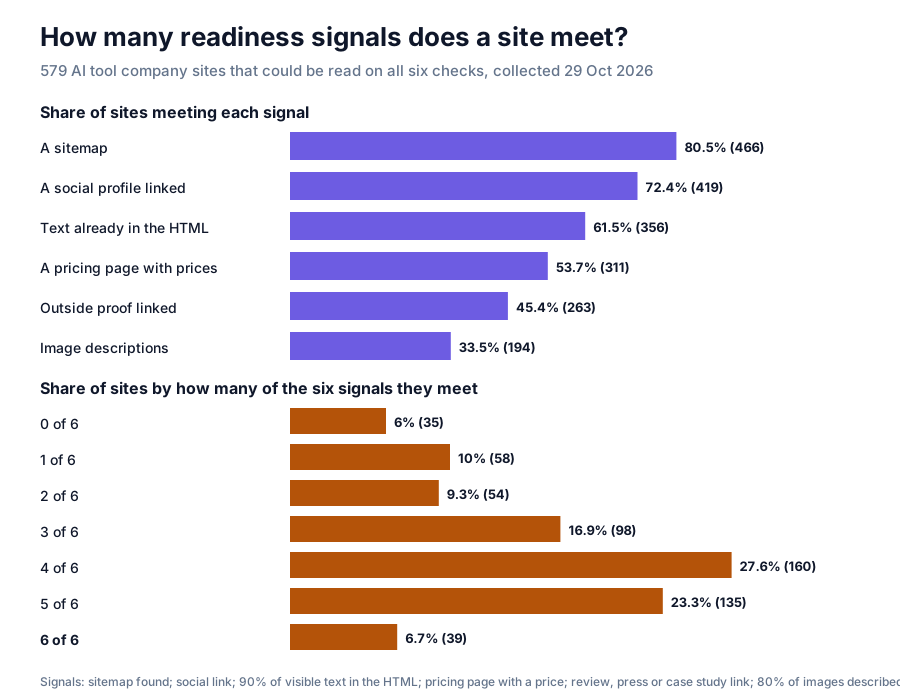
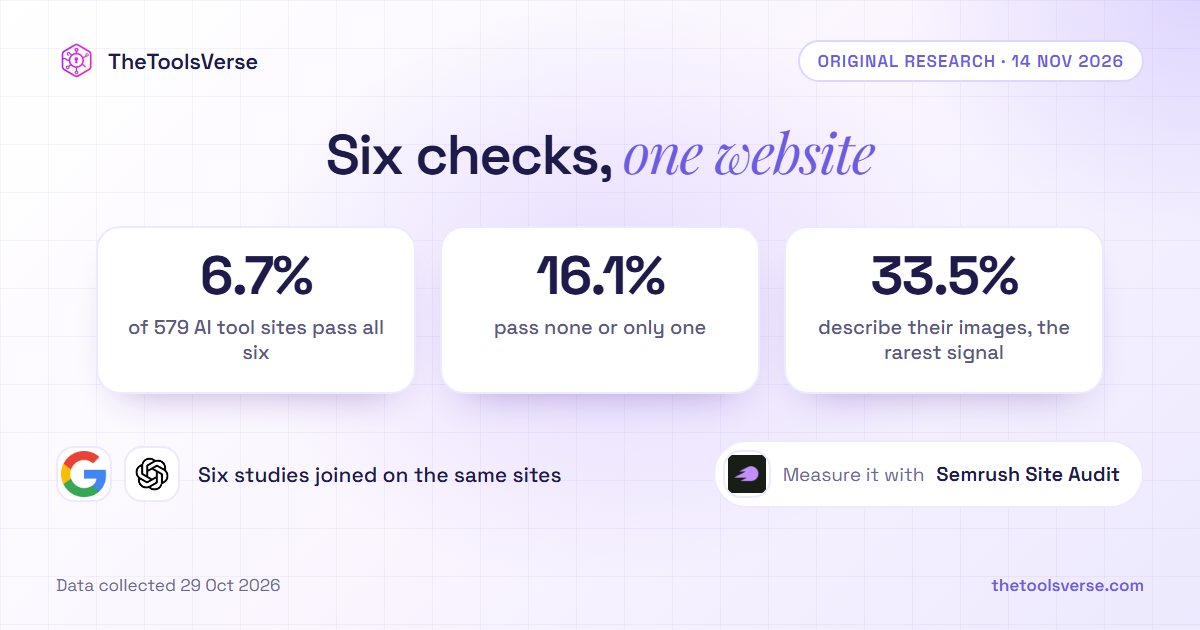
39 of the 579 sites (6.7%) meet all six signals. 174 (30.1%) meet five or more, and 93 (16.1%) meet none or only one. The average site meets 3.47 of the six.
The signals are not equally common. A sitemap (80.5%) and a social link (72.4%) are easy. Outside proof (45.4%) and especially image descriptions (33.5%) are rare.
The gap is usually one thing, and it is images
Of the 135 sites that meet exactly five signals, 75 are missing image descriptions, 27 are missing outside proof, 16 are missing a priced pricing page, 13 are missing text in the HTML and 4 are missing a sitemap. None of them lacks a social link. For a site that is almost there, the cheapest fix is most often to describe its images.
Signals travel together
The signals are not independent. Among the 356 sites with text in the HTML, 63.2% also have a pricing page with prices. Among the 223 sites without it, 38.6% do. A site whose pages are built to be read is also more likely to put a price where a reader can find it. It is a correlation, not proof that one causes the other: both may come from a team that maintains the site carefully.
What this cannot tell you
- That meeting a signal earns a citation. We measured readiness, not results. No signal here was tested against AI citations.
- That the thresholds are the right ones. 90% of text in the HTML and 80% of images described are our cut-offs. Other cut-offs would give other counts.
- That one day describes the sites. The data are from 29 October 2026, and sites change.
- That the 579 describe the web. These are AI tool companies, which are likely to be more technical than most.
- That six signals are all that matter. They are the six we had measured.
What to do with it
- Audit the stack, not one signal. A site that passes five checks and fails one has a specific, cheap job to do.
- Describe your images. It is the most common missing piece, and it can be done page by page.
- Put the facts in the HTML. That includes your price.
- Link proof you did not write, such as a review, a press mention or a case study.
- Re-run the checks after every redesign. One release can undo several of them at once.
Crawl it, track it, see what AI cites
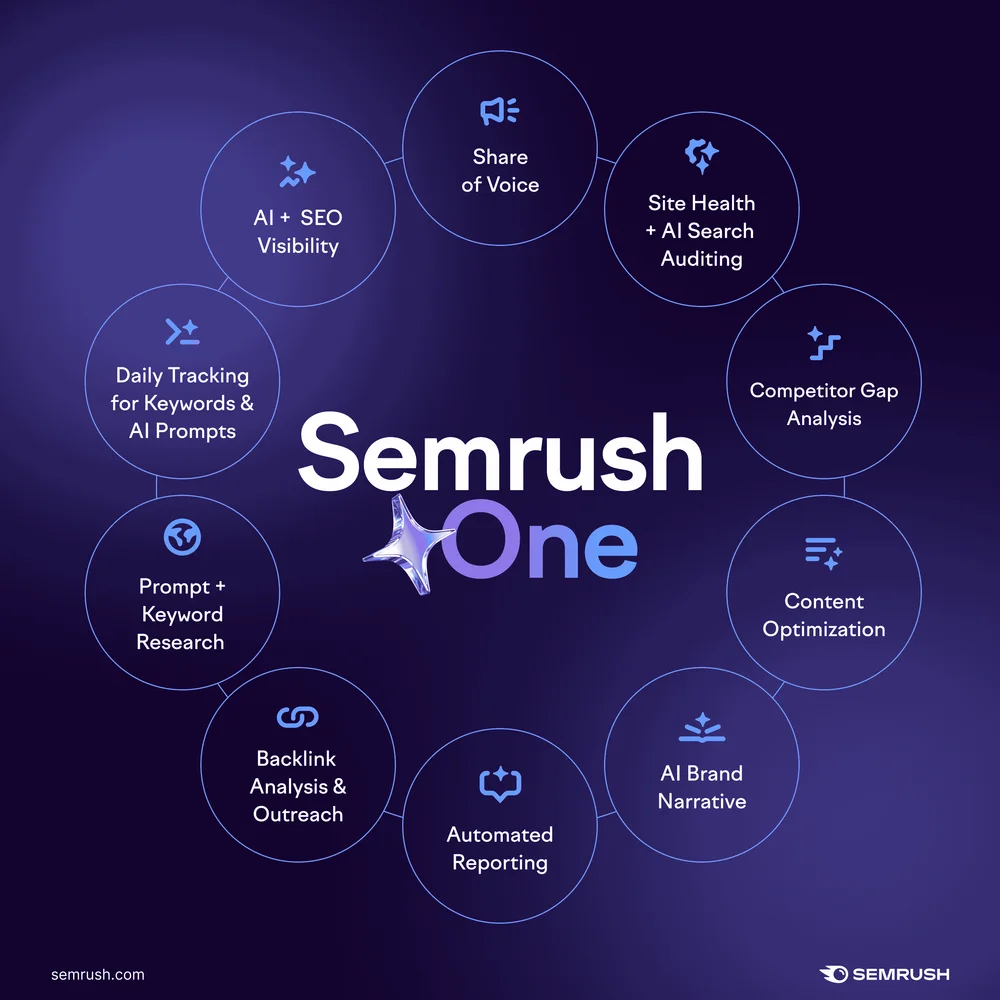
Crawl the whole stack. Site Audit sorts what it finds into categories such as crawlability, each issue paired with advice on fixing it.
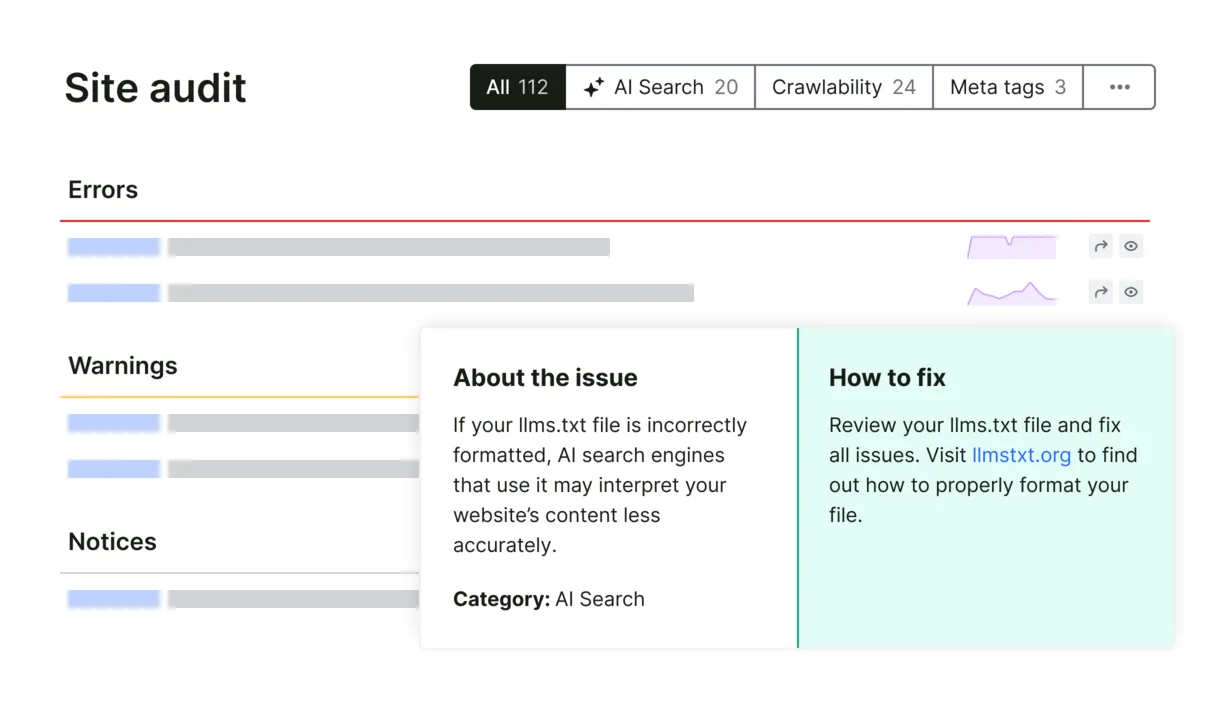
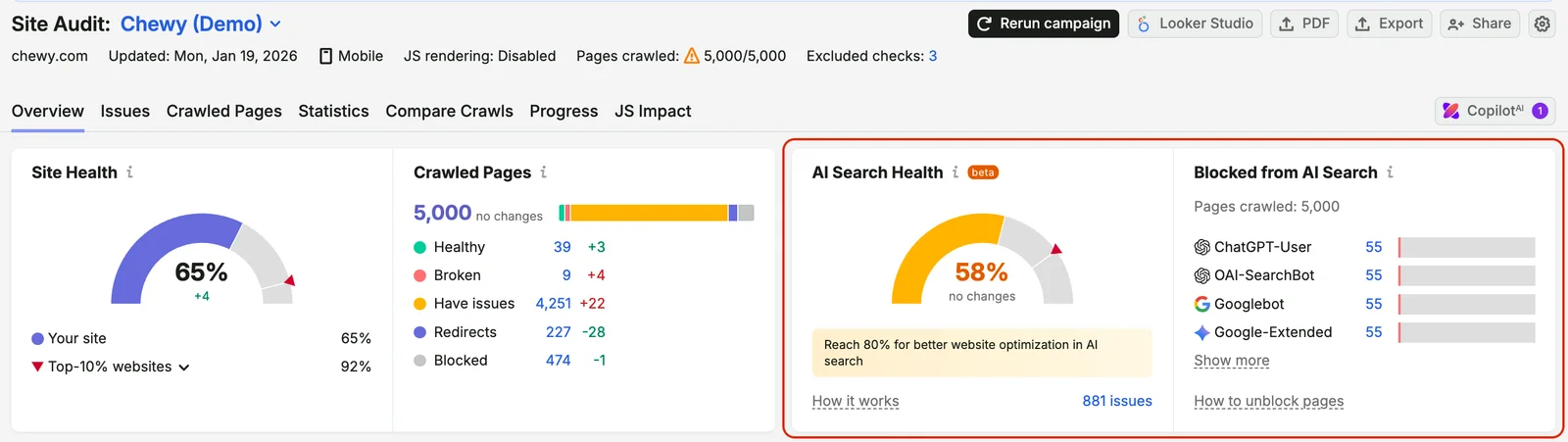
Check what AI bots can reach. AI Search Health in Site Audit lists pages blocked from AI search bots.
Track rankings alongside AI appearances. Position Tracking follows daily positions and SERP features such as AI Overview.

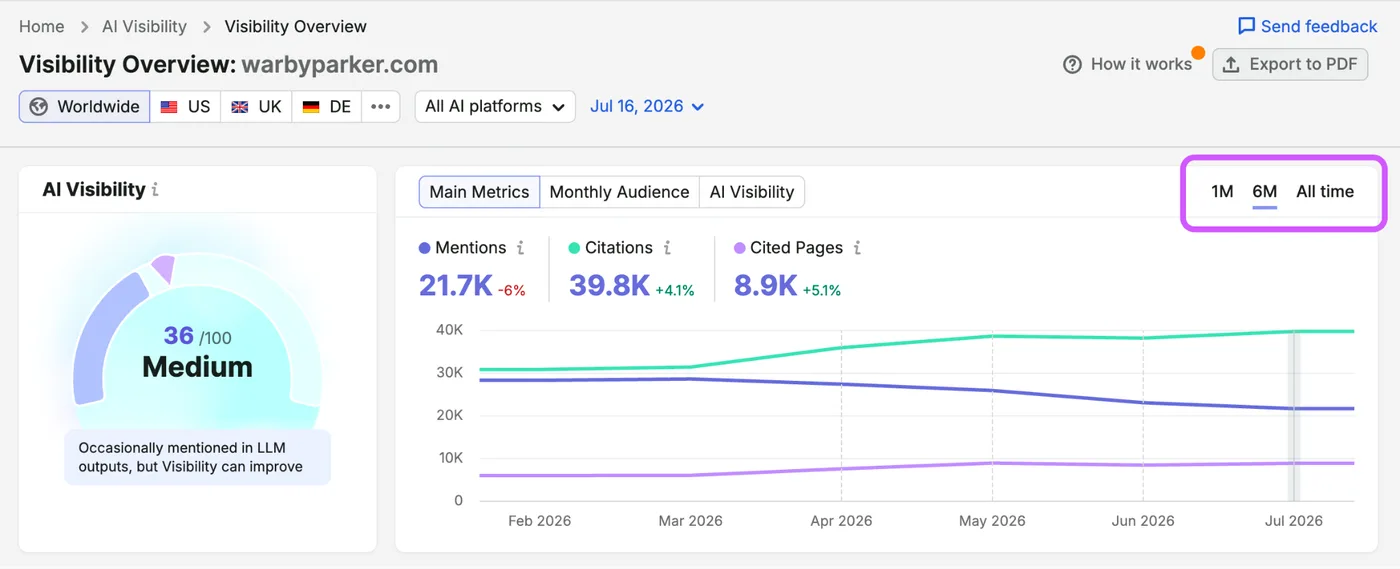
See whether readiness turns into citations. Visibility Overview in the AI Visibility Toolkit reports mentions, citations and the pages cited, per AI platform and over time.
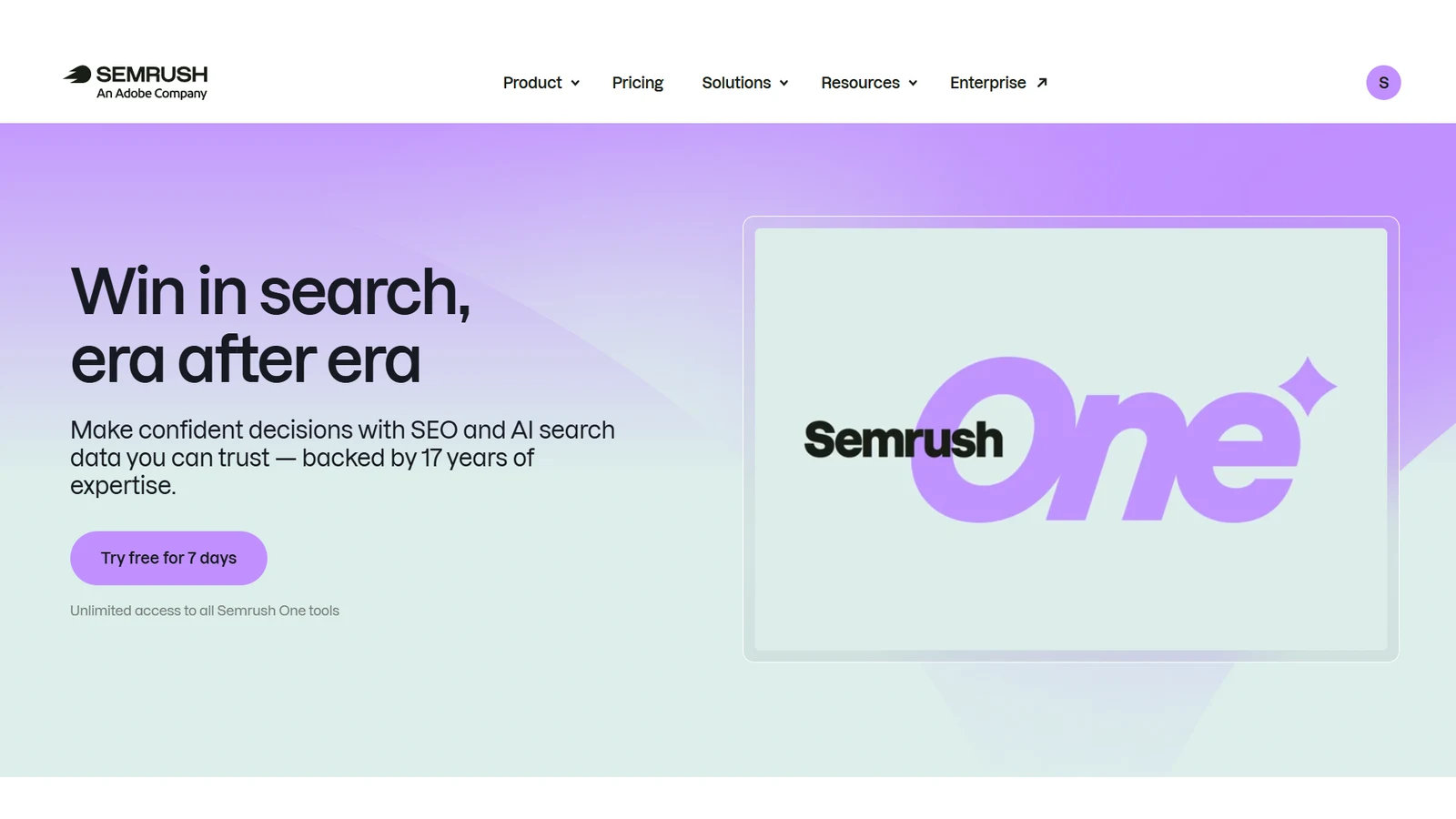
The 7-day trial is Semrush One's. The AI Visibility Toolkit has none of its own, and Semrush One includes it with the SEO Toolkit. To crawl your site and see your citations without paying first, try Semrush One free for 7 days. On its product page Semrush describes "Unlimited access to all Semrush One tools" (we read that on 16 October 2026). We have not tried the offer, and every number above comes from our own crawls, not from a Semrush account.
Readiness is a stack
Most sites do some of these things well. Very few do all of them. Count how many your own site meets, and start with the one that is closest to done.
Try Semrush One free for 7 days
Site Audit and Position Tracking in the SEO Toolkit, with Visibility Overview in the AI Visibility Toolkit, together in Semrush One. Free for 7 days for new users.
Try Semrush One free for 7 daysHow we counted
- Data: six saved data sets on the same 613 sites, all collected 29 October 2026 (rendering, credibility, social platforms, pricing pages, images, sitemaps). They were joined by site on 14 November 2026. No new requests were made.
- Kept: the 579 sites that returned a successful response on the rendering, credibility, social and image checks.
- Text in the HTML: words in the page source divided by words in the rendered page, at least 0.9, with at least 50 rendered words.
- Outside proof: at least one link to a review site or press article, or a case study link, found by our credibility check.
- Pricing: a pricing page was found and at least one price was read on it.
- Image descriptions: at least five images on the page and at least 80% with a non-empty description.
- Left out: any link between these signals and AI citations, traffic or rankings.
- Reproduce it: the join script and its saved output live in
research/r2-e7-readiness-stack/.
Some links may be affiliate links. We may earn a small commission at no extra cost to you.
Related Articles
Explore more guides and reviews from our experts.
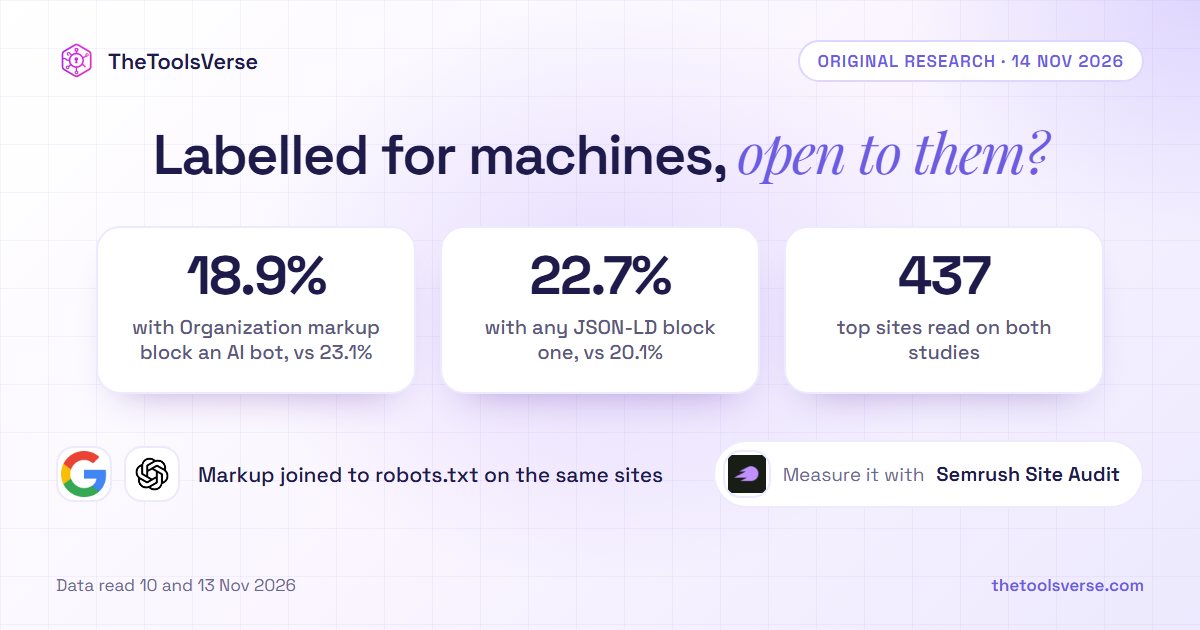
Top Sites With Organization Markup Block AI Crawlers Slightly Less, 18.9% Against 23.1%, but Plain JSON-LD Shows No Such Pattern: Joining Two of Our Studies
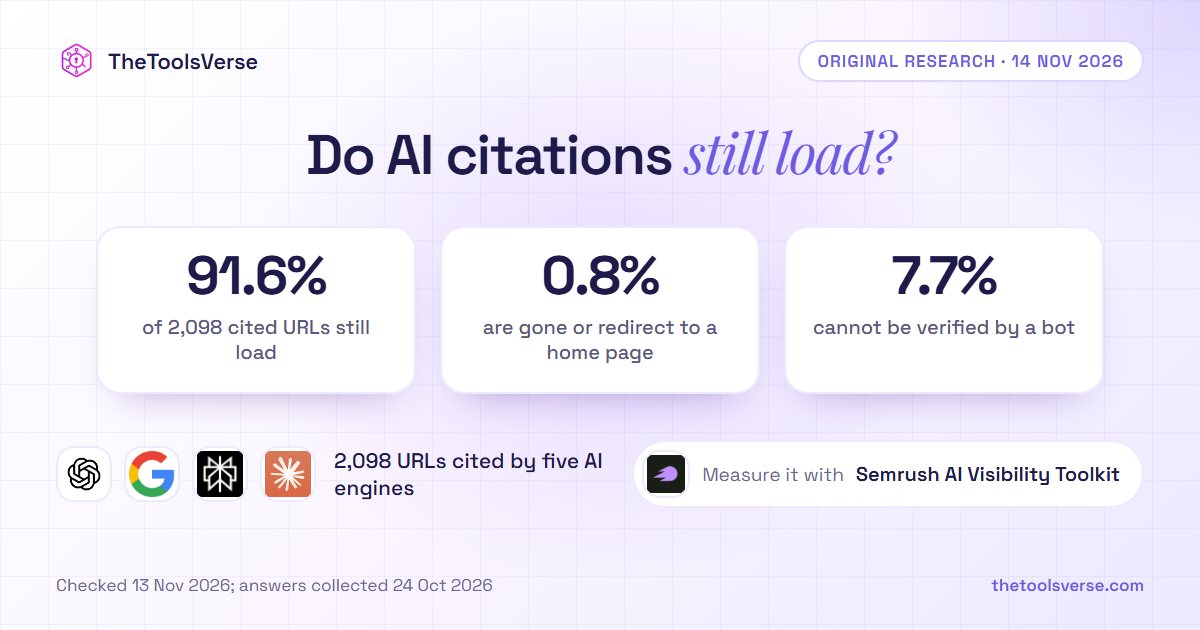
We Re-Checked 2,098 URLs That Five AI Engines Cited: 91.6% Still Load, 0.8% Are Gone, and 7.7% Cannot Be Verified by a Bot