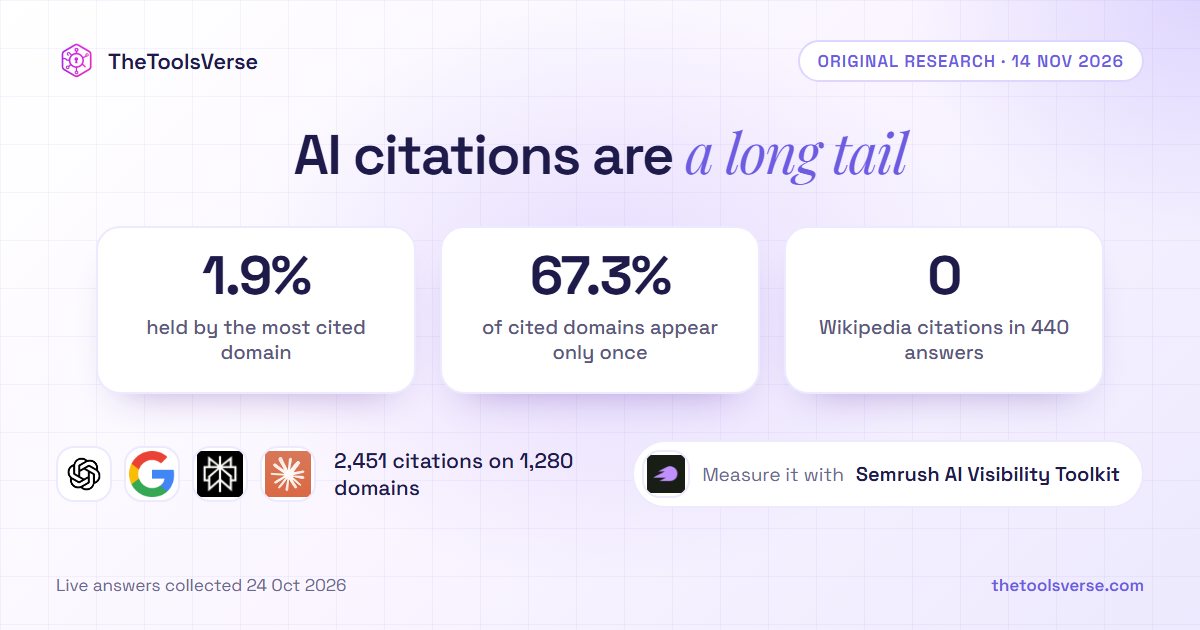
Which Pages Does AI Cite? Lists and Comparisons Are 70% of Sources for "Best" Questions, ChatGPT Cites Home Pages 43% of the Time, and Half of All Cited Titles Say "2026"
Disclosure
This article is promotional content produced as part of the Semrush Creator Accelerator programme. It contains affiliate links to Semrush — if you buy through them we may earn a commission at no extra cost to you — and we may also receive a reward from Semrush for publishing it. All measurements in this article are our own. Semrush did not supply, review or approve the data, and the conclusions we draw are ours.
Generative engine optimisation advice says to restructure your content so AI can retrieve and cite it: clearer headings, direct answers, lists, comparisons. That is easy to say and hard to prioritise. Which format should you build first?
The answer should depend on what people ask, so we looked at it that way: we took the pages that AI engines cited for 88 real buyer questions and sorted them by format and by the type of question that produced them.
Find the formats that win citations in your category
See which pages AI platforms cite for the prompts you track, grouped by source, with Prompt Tracking in the AI Visibility Toolkit. To get it with the SEO Toolkit in one subscription, try Semrush One free for 7 days.
The test
The raw material is a capture we made on 24 October 2026: 88 buyer questions about AI tools and software, put to five engines (ChatGPT, Perplexity, Claude, Gemini and Google AI Mode). The 440 answers carried 2,684 citations. We sorted the questions into five types and every cited page into a format:
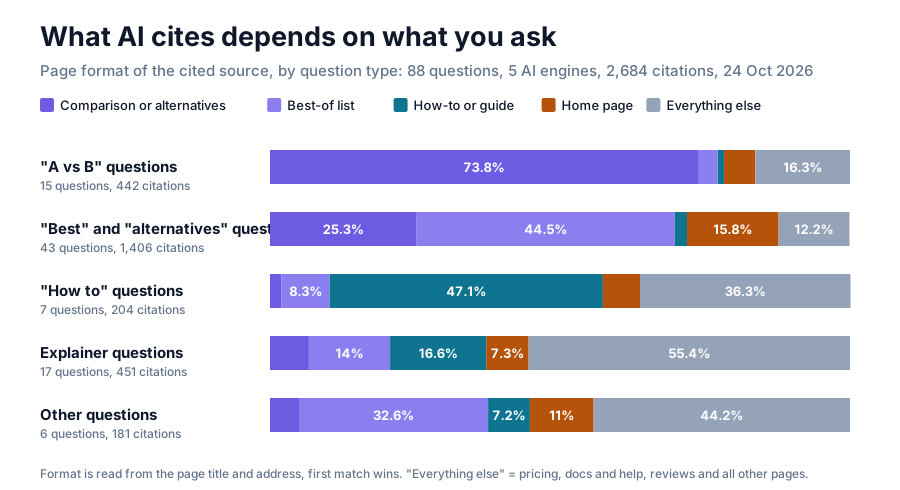
- Question types: "versus" (15 questions, 442 citations), "best" or "alternatives" (43 questions, 1,406 citations), "how to" (7 questions, 204 citations), explainers that start with "does", "is", "why", "what" or "which" (17 questions, 451 citations), and other (6 questions, 181 citations).
- Page formats, from the page title and address: comparison or alternatives, best-of list, how-to or guide, home page, and everything else (pricing pages, documentation and help, reviews, and all other pages).
The format follows the question
| Question type | Citations | Comparison or alternatives | Best-of list | How-to or guide | Home page | Everything else |
|---|---|---|---|---|---|---|
| "A vs B" | 442 | 73.8% | 3.4% | 1.1% | 5.4% | 16.3% |
| "Best" or "alternatives" | 1,406 | 25.3% | 44.5% | 2.1% | 15.8% | 12.2% |
| "How to" | 204 | 2.0% | 8.3% | 47.1% | 6.4% | 36.3% |
| Explainer | 451 | 6.7% | 14.0% | 16.6% | 7.3% | 55.4% |
For "best" and "alternatives" questions, 69.8% of citations were best-of lists (44.5%) or comparison and alternatives pages (25.3%). For "A vs B" questions, comparison pages took 73.8%, and pricing pages another 10.0%. For "how to" questions, guides took 47.1%.
Explainer questions behave differently. Nearly half of the citations (48.1%) went to ordinary articles and other pages that do not announce a format, and only 4.0% went to documentation or help pages. If you want to be cited for explainers, the format to build is a clear article, not a landing page.
ChatGPT cites home pages. The others cite lists.
Within the "best" and "alternatives" questions, the engines did not behave alike.
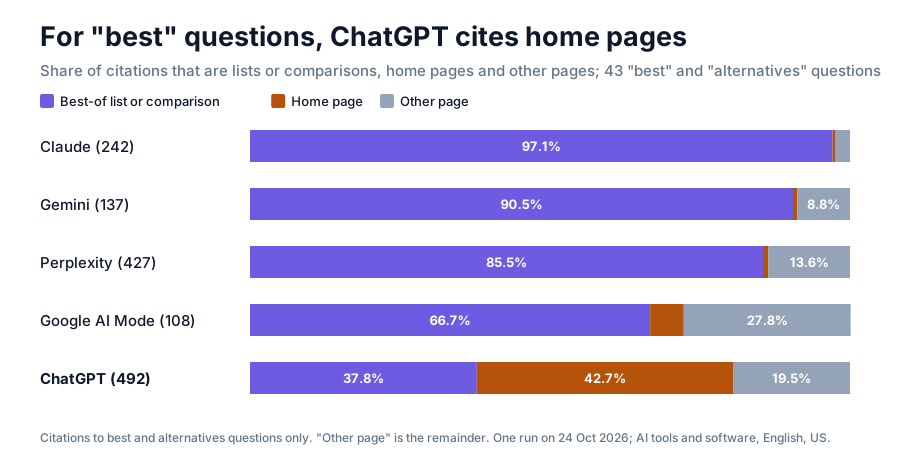
Claude, Gemini and Perplexity cited lists or comparisons for 97.1%, 90.5% and 85.5% of their citations, and almost never a home page (0.4% to 0.9%). ChatGPT cited a list or comparison for 37.8% and a home page for 42.7%. Google AI Mode sat in between, at 66.7% and 5.6%.
ChatGPT appears to name tools and link to their own sites. For a tool, that makes the home page itself a citation target on ChatGPT, while on the other engines it is the third-party list that gets cited. They are two different jobs: be on the lists, and have a home page that says plainly what you are and who you are for.
Half of the cited titles say 2026
We also checked how many cited page titles contain the year. 1,348 of the 2,684 citations (50.2%) had "2026" in the title. The share depends a lot on the engine:
| Engine | Citations with "2026" in the title |
|---|---|
| Claude | 73.1% (361 of 494) |
| Gemini | 62.9% (180 of 286) |
| Perplexity | 54.3% (474 of 873) |
| Google AI Mode | 47.0% (110 of 234) |
| ChatGPT | 28.0% (223 of 797) |
It was not only because the question named a year. Only 11 of the 88 questions did, and for those 70.8% of the cited titles carried the year. For the 77 questions that did not mention a year, 46.9% of the cited titles still did. This shows what gets cited, not what caused it, but a list or comparison whose title is a year behind is competing against titles that are not.
What this cannot tell you
- That a format caused the citation. We sorted what was cited. We did not test whether changing a page's format would earn a citation.
- That the formats are exact. They come from words in the title and address, and the first matching format wins. A page with "guide" in its title counts as a guide even if it is mostly a list.
- That the pattern carries over to other fields. The run covered one day, AI tools and software, English, US. Other topics will favour other formats.
- That a home page citation means a recommendation. We know it was cited, not what the answer said about it.
- That people see the same thing. The answers were captured through a data provider, not typed into each app by hand.
What to do with it
- List your category's question types and build the format each one draws. Lists for "best", comparisons for "vs", guides for "how to", clear articles for explainers.
- Get onto the lists, not just onto your own site. For "best" questions the lists took 69.8% of citations, and most of them are third-party pages.
- Fix your home page for ChatGPT. It should say in the first lines what the product is and who it is for, because ChatGPT cites it directly.
- Date your lists and comparisons honestly. If the title says 2026, the content should be checked against 2026.
- Re-run the exercise on your own questions every month. Which format wins is a property of the question and of the engine, and both move.
Find the sources, check the structure
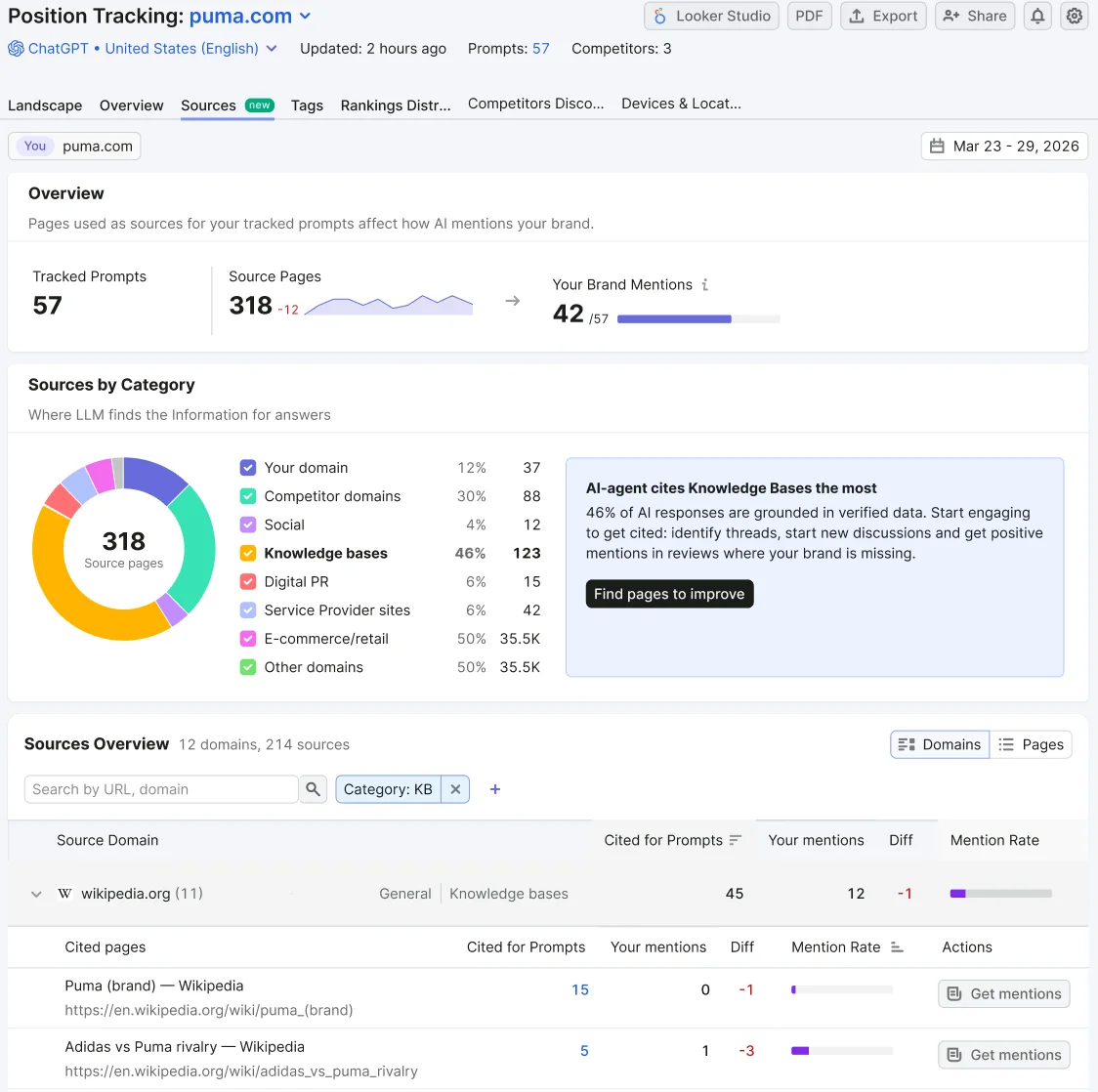
See which sources and pages AI cites for your prompts. Prompt Tracking in the AI Visibility Toolkit groups the sources cited for the prompts you track, with the domains cited and how often.
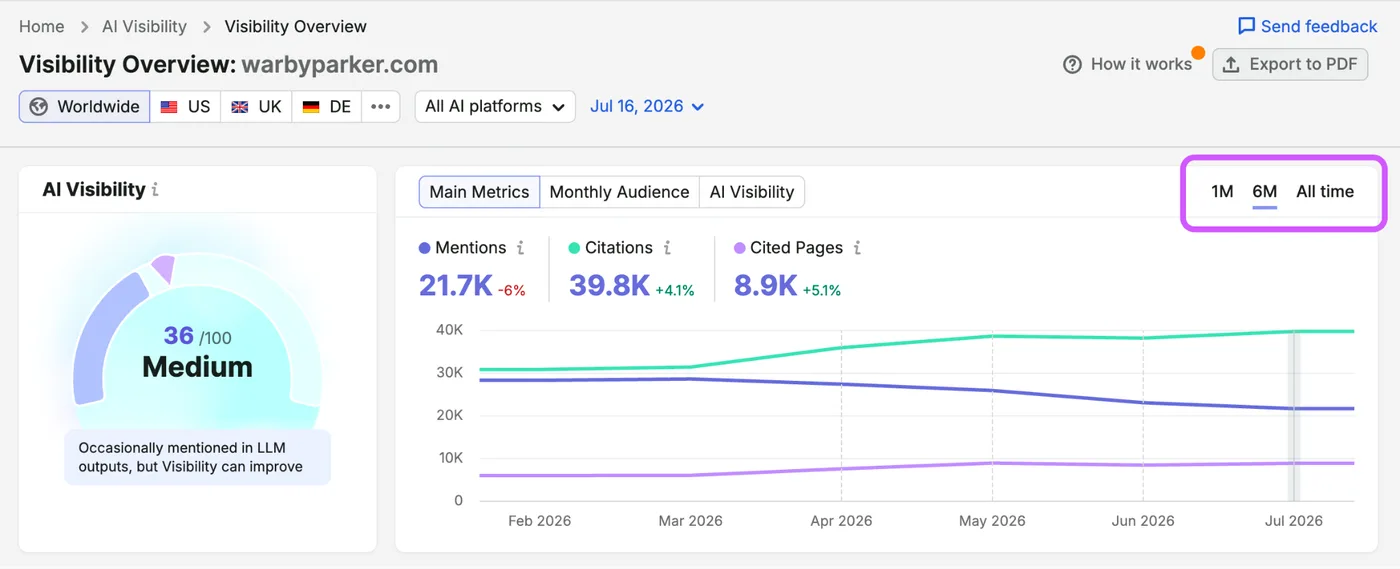
Track how your brand and your pages show up across AI platforms. Visibility Overview shows mentions, citations and cited pages over time.
Compare traditional rankings with AI appearances. Position Tracking in the SEO Toolkit tracks keyword positions daily, with SERP features such as AI Overview.

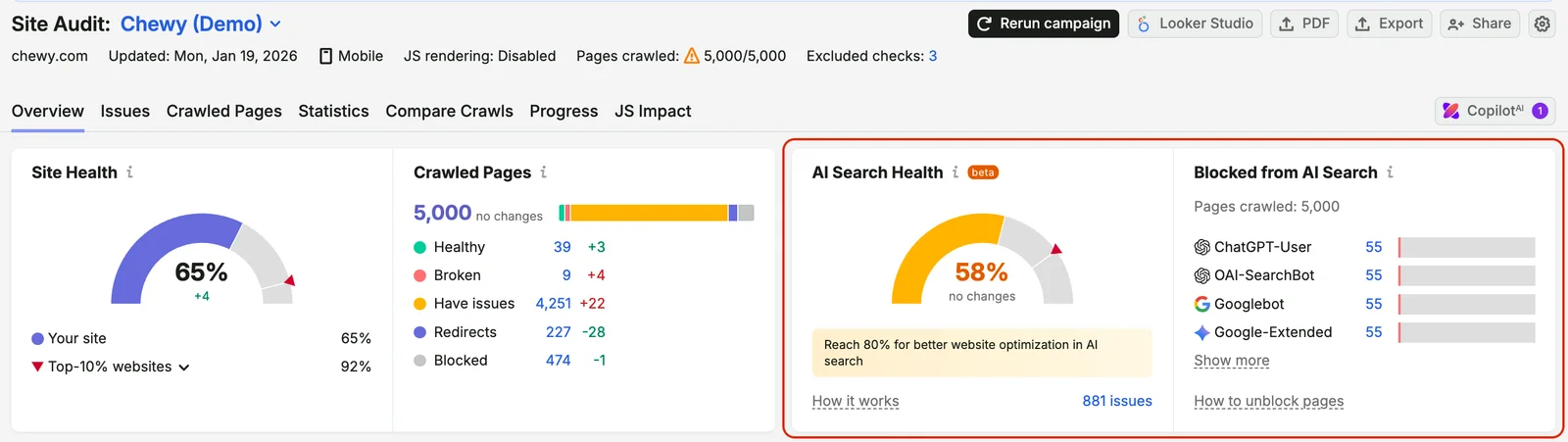
Check the structure that AI crawlers read. Site Audit is the SEO Toolkit's crawler. It audits headings, markup and crawlability, and its AI Search Health view lists pages that AI search bots cannot reach.
The free trial belongs to Semrush One, not to the AI Visibility Toolkit, which has none of its own; Semrush One includes that toolkit together with the SEO Toolkit. If you want to see which pages AI cites for your prompts without paying first, try Semrush One free for 7 days. Semrush's product page promises "Unlimited access to all Semrush One tools" (we read it on 16 October 2026). That is Semrush's published offer, which we did not test, and no number in this article came from a Semrush account.
Start from the question
The format AI cites is not a property of your site. It is a property of the question being asked. Find the questions, then build the page that answers them in the format the engines pick.
Try Semrush One free for 7 days
Prompt Tracking and Visibility Overview to see which pages AI cites, with Position Tracking and Site Audit in the SEO Toolkit, together in Semrush One. Free for 7 days for new users.
Try Semrush One free for 7 daysHow we counted
- Capture: one answer to each of 88 buyer questions from every engine, collected through DataForSEO for a US searcher on 24 October 2026. That is 440 answers with 2,684 cited addresses: ChatGPT 797, Perplexity 873, Claude 494, Gemini 286 and AI Mode 234.
- Question types, first match wins: versus ("vs" or "versus" in the question); best or alternatives ("best", "alternatives" or "worth paying"); how to ("how to", "how do I", "how can", "how much"); explainer (starts with does, do, is, are, why, what, which, can or how many); other.
- Page formats, first match wins, on title and address: a bare home page; comparison or alternatives ("vs", "versus", "compar" or "alternativ"); best-of list ("best", "top" and a number, "ranked" or "leading"); how-to or guide ("how to", "guide", "tutorial", "step by step", "what is", "explained" or "FAQ"); pricing page; documentation or help; review; everything else.
- Year: whether the title of the cited page contains "2026". The 11 questions that name a year contain a number of the form 20xx.
- Left out: the answer texts themselves, the content of the cited pages, and any judgement of what an answer said about a page.
- Reproduce it: the analysis script and its saved summary sit in
research/r2-d4-format-fit/.
Some links may be affiliate links. We may earn a small commission at no extra cost to you.
Related Articles
Explore more guides and reviews from our experts.
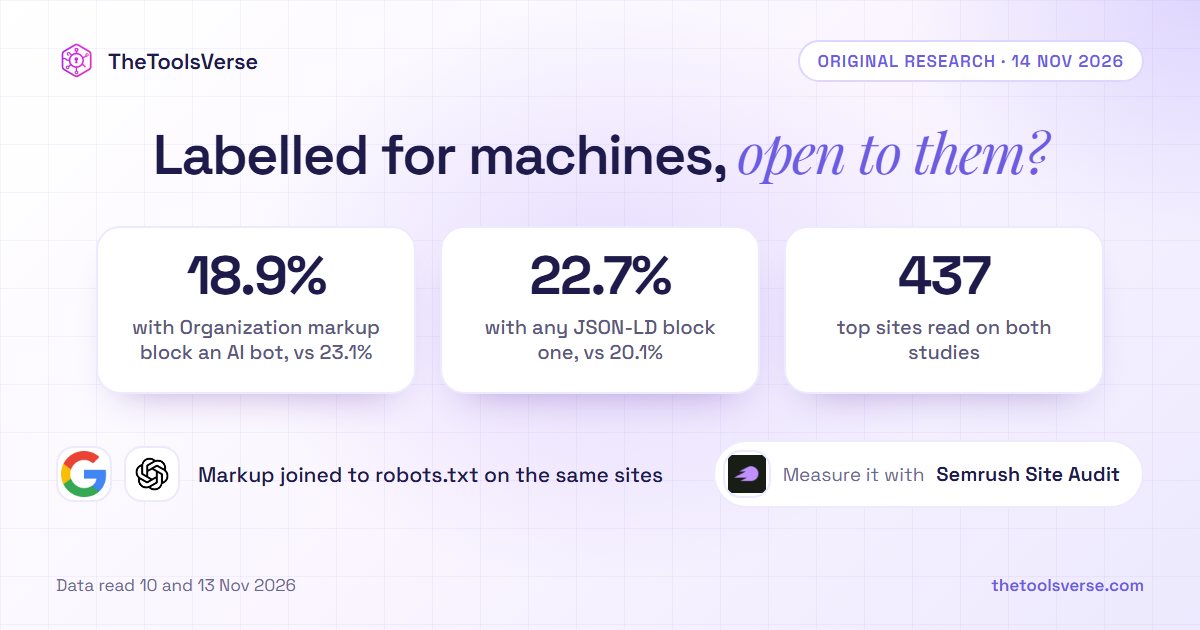
Top Sites With Organization Markup Block AI Crawlers Slightly Less, 18.9% Against 23.1%, but Plain JSON-LD Shows No Such Pattern: Joining Two of Our Studies
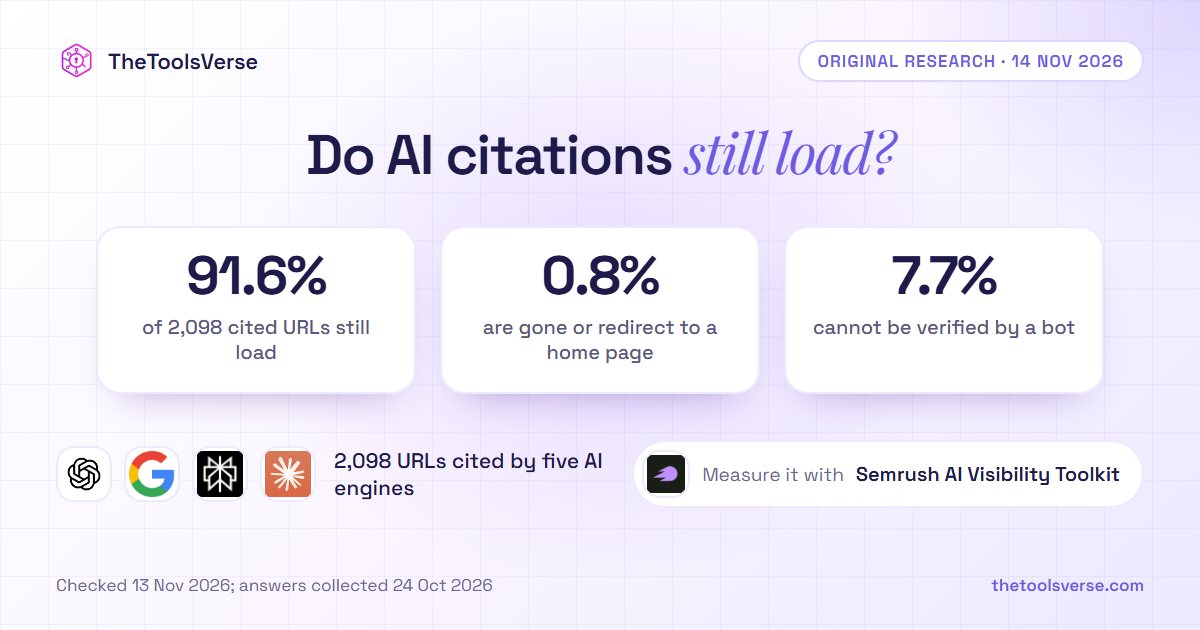
We Re-Checked 2,098 URLs That Five AI Engines Cited: 91.6% Still Load, 0.8% Are Gone, and 7.7% Cannot Be Verified by a Bot